
What you’ll learn in this article…
- Oregon's most affordable M.Ed. programs start with net prices well under $20,000 at public universities.
- Accelerated programs at several Oregon schools allow completion in 12 to 18 months.
- The MAT targets career changers seeking initial licensure, while the M.Ed. advances already licensed teachers.
- Oregon educators can combine TEACH Grants with state awards up to $12,000 to offset tuition costs.
Oregon's Teacher Standards and Practices Commission requires a master's degree for a Professional Teaching License, which means most educators in the state will pursue graduate study at some point in their careers. Across 11 ranked institutions, the options span M.Ed., MAT, and M.S. in Education pathways, with total program costs ranging from under $10,000 at Corban University to nearly $40,000 at Pacific University.
Formats vary just as widely. Fully online programs serve educators in rural parts of the state, while hybrid and campus-based cohorts anchor students in local school partnerships. Specializations include curriculum and instruction, educational leadership, special education, and early childhood education. For working teachers, the key tension is straightforward: balancing cost and speed against depth of training and licensure alignment.
Best Master's in Education Programs in Oregon for 2026
Oregon offers a wide range of master's in education degree programs, from licensure-focused MAT pathways to advanced M.Ed. and M.S. options in curriculum, leadership, and special education. Whether you want to teach in Portland's urban schools, serve rural communities in eastern Oregon, or advance into administration, the programs below represent the strongest options in the state for 2026. Net prices and graduation rates cited are institution-level figures from federal data and may not reflect individual program costs.
- Graduate tuition and net price
- Institution-level graduation rates
- Program breadth and specializations
- Licensure pathway alignment
- Delivery format flexibility
- Independent program research
- Internal program database
- College Scorecard graduate earnings — collegescorecard.ed.gov
- NCES-IPEDS federal institutional data — nces.ed.gov
| Rank | School | Location | Net price | Best for | |
|---|---|---|---|---|---|
| #1 | University of Oregon | Eugene, OR | ~$22,000/yr (est.) | Licensure-track teachers wanting district partnerships | |
The University of Oregon's College of Education is one of the state's most regionally embedded teacher preparation hubs, with deep partnerships across Oregon school districts. Its UOTeach pathway lets aspiring secondary teachers earn a curriculum and teaching M.Ed. with licensure in as little as one year, while its special education programs span early intervention through advanced non-licensure study. UO also offers distinctive initiatives such as the Sapsik'wala Teacher Education Program for American Indian and Alaska Native candidates. With in-state graduate tuition around $19,474 and an institution-level graduation rate of 71.7%, UO balances research-university resources with accessible pricing for Oregon residents.
| |||||
| #2 | Oregon State University | Corvallis, OR | $15,000 – $20,000/yr | Working educators needing statewide online access | |
Oregon State University's College of Education leverages the university's strong Ecampus infrastructure to deliver graduate education programs statewide, making it one of the most accessible options for working Oregon educators who cannot relocate. The MAT program spans multiple subject areas, from elementary education to language arts, with a clinically based approach that requires at least 15 credits of practicum and internship hours. OSU also offers an online M.Ed. in Adult and Higher Education for professionals aiming beyond K-12. In-state graduate tuition is approximately $16,206 (out-of-state around $33,351), with a net price of $19,604 and an institution-level graduation rate of 70.1%.
| |||||
| #3 | University of Portland | Portland, OR | $28,000/yr (net price) | Career changers seeking fast Oregon certification | |
University of Portland's School of Education prepares educators through a tightly structured, cohort-based model with a strong professional network across the Portland metro region. Its 10-month MAT program offers elementary and secondary concentrations with a paid student teaching partnership through the Beaverton School District, making it especially practical for career changers. The M.Ed. in Special Education and M.Ed. in Educational Leadership round out the graduate portfolio. Graduate tuition is $27,000 regardless of residency, with a net price of $28,210 and an institution-wide graduation rate of 79.8%, the highest among ranked schools.
| |||||
| #4 | Portland State University | Portland, OR | ~$10,000/yr (est.) | ||
Portland State University is deeply connected to Oregon's largest urban school district region, making it an ideal fit for educators drawn to equity-centered, culturally sustaining practice. Its MA/MS in Curriculum and Instruction is delivered online with synchronous and asynchronous options, and its Graduate Teacher Education Program offers both one-year and two-year completion timelines with field experiences in Portland metro schools. PSU also provides specialized pathways in special education and early intervention. The net price of $9,552 is the lowest among ranked Oregon schools, and in-state graduate tuition runs about $17,745 (out-of-state $23,334). The institution-level graduation rate is 52.7%.
| |||||
| #5 | Lewis & Clark College | Portland, OR | $35,000 – $40,000/yr | ||
Lewis and Clark College's Graduate School of Education is well regarded in Oregon for small-cohort, practitioner-centered training grounded in a social justice mission. The 13-month MAT program reports a 100% job placement rate and includes 1,000 clinical hours across partnerships with 20 school districts. Its M.Ed. with Principal License pathway prepares current educators for Oregon administrative licensure through flexible evening, weekend, and hybrid scheduling, including regional cohorts in Central Oregon. Graduate tuition is $19,800 with a net price of $36,013 and an institution-level graduation rate of 75.4%.
| |||||
| #6 | George Fox University | Newberg, OR | $30,000 – $35,000/yr | ||
George Fox University serves working educators across Oregon through hybrid and online graduate programs offered from its Newberg campus and satellite locations in Portland and Redmond. The MAT can be completed in as few as 10.5 months, with licensure eligibility after three semesters and optional endorsements in ESOL, reading, or special education. The M.Ed. in Special Education is entirely online and leads to a generalist endorsement covering preschool through age 21. Graduate tuition is $15,920 regardless of residency, with a net price of $31,679 and an institution-level graduation rate of 72%.
| |||||
| #7 | Western Oregon University | Monmouth, OR | ~$17,000/yr (est.) | ||
Western Oregon University has a long history as one of Oregon's core teacher preparation institutions, with particular strength in serving rural and regional districts. Its one-year secondary MAT and two-year elementary MAT both use cohort models tied to practicum placements in local professional development schools. WOU also offers an online M.S. in Education with a Learning Design and Technology concentration that embeds an instructional design certificate. In-state graduate tuition is approximately $19,452, the net price is $17,237, and the institution-level graduation rate is 47.1%.
| |||||
| #8 | Pacific University | Forest Grove, OR | $35,000/yr | ||
Pacific University offers a hybrid MAT in General Education from its Forest Grove campus, combining online coursework with in-person instruction. Students can choose an accelerated one-year summer-start track or a more flexible two-year fall-start track, both leading to Oregon teaching licensure. Pacific's 10:1 student-to-faculty ratio supports individualized mentoring, and its regional network spans private, charter, and public school placements across western Oregon. Graduate tuition is $39,938, the net price is $35,273, and the institution-level graduation rate is 67%.
| |||||
| #9 | Eastern Oregon University | La Grande, OR | $15,000 – $20,000/yr | ||
Eastern Oregon University provides graduate teacher preparation specifically designed for candidates planning to serve eastern and rural Oregon communities. Its 10-month MAT blends hybrid coursework with a full year of student teaching at school sites throughout Oregon, preceded by a one-week on-campus summer intensive in La Grande. EOU also offers an online M.S. in Education with a Special Education concentration at 36 credit hours. Graduate tuition is $19,332 regardless of residency, with a net price of $17,148 and an institution-level graduation rate of 43%.
| |||||
| #10 | Corban University | Salem, OR | $28,000/yr | ||
Corban University in Salem offers one of Oregon's most affordable private graduate education options, with a 30-credit online M.S. in Education that can be completed in five semesters. The Curriculum and Instruction concentration is designed for current teachers who want to strengthen instructional practice while integrating a biblical worldview. Coursework is available in both synchronous and asynchronous formats, and military benefits are accepted. Graduate tuition is $9,640 (approximately $750 per credit), the net price is $28,035, and the institution-level graduation rate is 60.6%.
| |||||
| #11 | Southern Oregon University | Ashland, OR | ~$17,000/yr (est.) | ||
Southern Oregon University offers some of the most budget-friendly graduate education programs in the state, with online M.S. in Education concentrations completable in as few as 12 months at a total tuition of $16,605. Concentrations span curriculum and instruction, leadership in early childhood education, and leadership in higher education, all delivered through seven-week course terms with multiple start dates. SOU also provides a two-year MAT with distance options for students outside the Rogue Valley. In-state graduate tuition is about $17,874 (out-of-state $20,601), the net price is $16,732, and the institution-level graduation rate is 42.5%.
| |||||


M.Ed. vs. MAT vs. M.S. in Education: Which Oregon Degree Is Right for You?
Choosing the right master's degree in education starts with understanding where you are in your career and where you want to go. Oregon institutions offer three primary graduate pathways, each designed for a different type of educator. Here is how they compare across purpose, audience, licensure outcomes, and career trajectory.
Master of Arts in Teaching (MAT)
The MAT is built for career changers and recent graduates who hold a bachelor's degree in a field other than education and want to become licensed classroom teachers.1 Programs typically include intensive student-teaching placements and coursework aligned with Oregon TSPC (Teacher Standards and Practices Commission) standards, culminating in a Preliminary Teaching License. Because the MAT is a licensure pathway, prior teaching experience is generally not required for admission. You will, however, need a bachelor's degree and usually must pass basic skills and subject-area assessments before or during the program. The University of Oregon's UOTeach program is one well-known example of this model.2
Master of Education (M.Ed.)
The M.Ed. serves a broader audience. Some M.Ed. programs in Oregon do lead to initial TSPC licensure, making them a viable route for candidates who want both a graduate degree and a teaching credential. Other M.Ed. tracks are designed for educators who already hold a license and want to deepen expertise in areas like curriculum and instruction, educational leadership, or special ed masters degree. Because of this range, admission prerequisites vary. Licensure-track M.Ed. programs resemble the MAT in their practicum requirements, while advancement-focused tracks often expect applicants to document prior classroom experience. If you are already teaching and want to move into administration, instructional coaching, or a specialist role, an advancement-oriented M.Ed. is typically the most direct path.
Master of Science in Education (M.S.)
The M.S. in Education leans more heavily on research methodology and academic inquiry. While some Oregon M.S. programs can also lead to a Preliminary Teaching License, the degree is particularly well suited for educators considering doctoral study, policy analysis, or research-focused positions.3 Expect coursework in quantitative and qualitative methods, educational theory, and a thesis or capstone with a research component. Admission requirements may include a statement of research interest alongside standard transcripts and recommendations.
Quick Comparison
- MAT: Best for non-education bachelor's holders seeking initial Oregon TSPC licensure. Teaching experience typically not required.
- M.Ed.: Versatile degree that can lead to licensure or career advancement. Prerequisites vary by track; advancement programs often expect prior teaching experience.
- M.S. in Education: Research-oriented degree suited for future doctoral candidates or policy roles. May also lead to licensure depending on the program.
Before you apply, confirm directly with each program whether it is TSPC-approved for the specific license endorsement you need. Oregon State University's College of Education and other institutions maintain current licensure details on their program pages.3 Choosing the right degree type from the start saves time, money, and unnecessary coursework down the road.
Questions to Ask Yourself
Most Affordable M.Ed. Programs in Oregon
Cost is one of the most important factors when choosing a graduate education program, and Oregon's public universities offer several budget-friendly options. The three programs below are sorted by net price, which reflects the average cost after grants and scholarships. Notably, median graduate debt at completion across all three schools falls in the $20,300 to $20,500 range, meaning monthly loan payments over a standard 10-year repayment plan remain relatively manageable for educators earning Oregon-level salaries.
| School | Program | In-State Graduate Tuition | Out-of-State Graduate Tuition | Net Price | Median Graduate Debt | Format |
|---|---|---|---|---|---|---|
| Portland State University | MA/MS in Curriculum and Instruction | $17,745 | $23,334 | $9,552 | $20,500 | Online (synchronous and asynchronous options) |
| Southern Oregon University | M.S. in Education, Leadership in Early Childhood Education | $17,874 | $20,601 | $16,732 | $20,332 | Online |
| Eastern Oregon University | Master of Arts in Teaching | $19,332 | $19,332 | $17,148 | $20,500 | Hybrid |
Fastest M.Ed. Programs in Oregon
If you want to earn your master's degree and get back into the classroom quickly, Oregon offers several accelerated programs that can be completed in 12 to 18 months. These compressed timelines suit working teachers who prefer to minimize time away from their careers and students who want to enter the profession as soon as possible. For a broader look at how these options compare nationally, see our guide to one-year M.Ed. programs.
Programs You Can Finish in a Year or Less
The fastest option in the state is the University of Portland's on-campus MAT, which runs approximately 10 months and requires 36 to 45 credits depending on the licensure endorsement area.1 For an online route, Eastern Oregon University offers a 12-month M.S. in Education (36 credits) with a special education track available on the same timeline.23
Bushnell University's hybrid M.Ed. also wraps up in about 12 months with 30 to 38 credits, launching each July in a cohort format.4 Western Oregon University's accelerated M.S.Ed. is another 12-month hybrid option, though its 45-credit load is notably heavier per term. The University of Oregon's Sapsik'wala M.Ed. with licensure is an intensive on-campus program that also targets a 12-month completion.6
George Fox University provides a fully online M.Ed. that takes roughly 16 months and requires 30 to 36 credits, offering a middle ground between speed and weekly workload.
How Cohort Models and Year-Round Scheduling Help
Most of these accelerated programs use a cohort structure, meaning you progress through a fixed sequence of courses with the same group of peers. Combined with year-round scheduling that includes summer terms, this approach eliminates gaps between semesters and keeps momentum steady. Cohort models also simplify planning because your entire course schedule is mapped out from day one.
What to Consider Before Choosing an Accelerated Track
Faster timelines come with trade-offs worth weighing:
- Heavier course loads: Completing 36 or more credits in 12 months may mean taking three or four courses at once during some terms.
- Less scheduling flexibility: Cohort programs typically lock you into specific start dates and course sequences, so stepping out mid-program can delay graduation significantly.
- Format matters: Online and hybrid programs tend to offer the quickest paths because they eliminate commute time and often run asynchronous coursework that working teachers can fit around their school day.
If your priority is finishing quickly without relocating, online programs from Eastern Oregon University, George Fox University, and Moreland University (which also offers a 12-month online M.Ed. of 30 to 36 credits) deserve a close look.7 Teachers who prefer face-to-face learning and can commit to a full-time schedule will find the University of Portland and University of Oregon programs among the most streamlined in-person options in the state.
Online Master's in Education Programs in Oregon
Oregon educators who need the flexibility to study from home, or who live far from a university campus, have a growing number of online and hybrid options. Understanding how each program delivers coursework, handles fieldwork, and interacts with state licensure requirements can save you time and money.
Fully Online, Hybrid, and Campus-Only Options
Among the ranked programs on this list, delivery formats vary considerably:
- Fully online: Eastern Oregon University's M.S. in Education, Southern Oregon University's M.S. in Education, Warner Pacific University's M.Ed., Oregon State University's M.Ed. in Adult and Higher Education, George Fox University's M.Ed. in Special Education, and Corban University's M.S. in Education can all be completed without relocating to campus.
- Hybrid: Oregon State University's MAT, Western Oregon University's MAT, and Portland State University's M.Ed. programs blend online coursework with some in-person components.4 Portland State, for example, offers a mix of synchronous sessions, asynchronous modules, and occasional on-campus meetings depending on the program track.5
- Campus-based: University of Portland's M.Ed. in Educational Leadership, Lewis & Clark College's M.Ed. with Principal License, Pacific University's MAT, and the University of Oregon's M.Ed. in Special Education are primarily delivered on site, though some individual courses may be available online.
The University of Oregon offers fully online options with flexible pacing for certain graduate education programs, but its initial teacher licensure pathways are campus-based or hybrid.6
Synchronous vs. Asynchronous Delivery
If your teaching schedule makes it hard to log in at set times, look for asynchronous programs. Eastern Oregon University's M.S. in Education and Corban University's M.S. in Education are designed for full remote completion with no on-campus requirements, making them strong choices for working teachers in rural areas.2 George Fox and Portland State offer both synchronous and asynchronous sessions, so you may need to attend some live virtual classes.
Practicum and Field Experience Logistics
Even fully online programs require supervised field hours. Eastern Oregon University arranges practicums local to each student, and Warner Pacific University expects student teaching or practicum placements in school settings near where you live.3 If you are pursuing a degree that leads to an endorsement or initial license, expect to coordinate field placements with your program advisor regardless of format.
Tuition Considerations for Online Learners
Public universities in Oregon typically charge different tuition rates for in-state and out-of-state students, and this distinction applies to online programs as well. Oregon State University's MAT, for instance, lists roughly $16,200 for in-state students compared to about $33,350 for out-of-state students.4 Southern Oregon University is a notable exception: its online M.S. in Education charges the same per-credit rate regardless of residency, making it competitive for out-of-state learners.7 Private institutions like Warner Pacific, George Fox, and Corban charge a single tuition rate for all students.
TSPC Licensure and Online Programs
Oregon's Teacher Standards and Practices Commission (TSPC) approves educator preparation programs based on curriculum and outcomes, not delivery format. An online M.Ed. or MAT from a TSPC-approved Oregon institution carries the same licensure eligibility as its campus-based counterpart. However, if you enroll in an out-of-state online program, that program may not hold TSPC approval. You would then need to pursue licensure through reciprocity, which can involve additional steps and paperwork. Oregon State's fully online masters in adult education track is one example of a TSPC-approved program delivered entirely at a distance. Before committing to any program, confirm its TSPC approval status directly with the institution and verify which endorsements or licenses the program prepares you to earn. If you are weighing programs across state lines, our M.Ed. programs by state guide can help you compare options and reciprocity requirements.
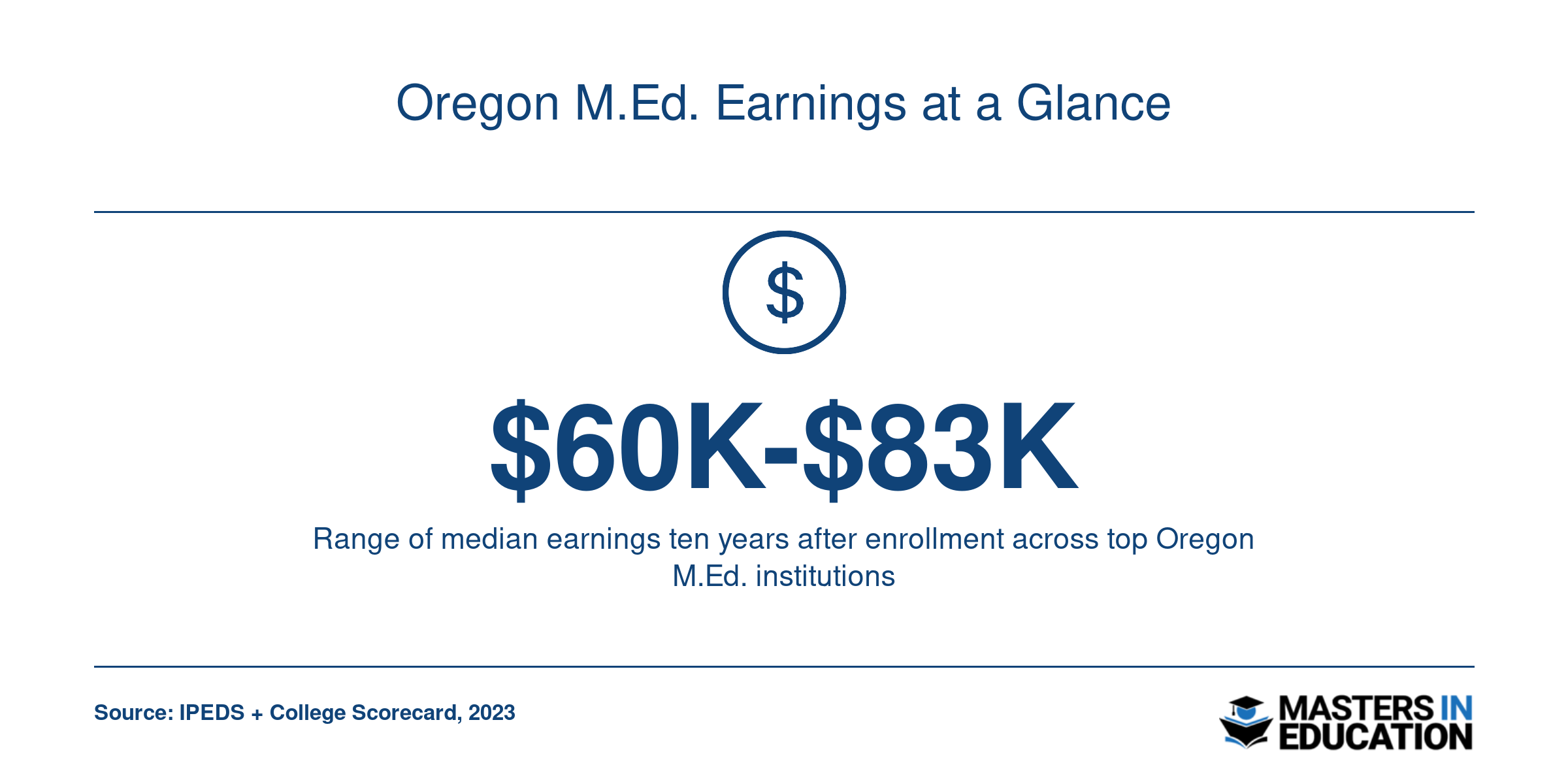
Oregon M.Ed. Earnings at a Glance
Program-level median earnings shortly after completion are not yet available for these Oregon M.Ed. programs. However, institution-level data offers a useful long-term benchmark. Among the top Oregon schools offering master's in education degrees, median earnings ten years after enrollment range from roughly $60,000 to over $82,000. These figures reflect all graduates of each institution, not just education program completers, and are drawn from federal data rather than Oregon district salary schedules.
Oregon M.Ed. Specializations and Concentrations
Choosing the right specialization shapes not only your coursework but your long-term career trajectory. Oregon's graduate education programs offer a range of concentrations, and understanding which ones are widely available versus niche can help you target the degree that fits your goals.
Curriculum and Instruction
Curriculum and instruction is one of the most common M.Ed. specializations in Oregon, offered at schools like Portland State University and Corban University. This concentration is designed for practicing K-12 educators who want to deepen their expertise in instructional design, assessment, and equity-centered pedagogy. Graduates often advance into roles as instructional coordinators, curriculum specialists, or district-level coaches. Portland State's program, for example, emphasizes culturally sustaining practices and allows students to stack endorsements or graduate certificates alongside the degree.
Educational Leadership
If your goal is moving into school administration, educational leadership programs at the University of Portland and Lewis & Clark College prepare graduates for Oregon principal licensure. These cohort-based programs typically blend coursework in organizational management, school law, and community engagement with built-in practicum experiences. Lewis & Clark's program is notable for its flexibility, offering evening, weekend, and summer classes designed for working educators.
Special Education
The University of Oregon and George Fox University both offer M.Ed. programs in special education, though their approaches differ. UO's campus-based program requires existing teaching licensure and emphasizes assessment, policy, and advocacy, while George Fox delivers its program fully online with authorizations spanning preschool through transition-age students. Graduates in this field fill high-demand roles as special education teachers, behavior specialists, and inclusion coordinators.
ESOL and Bilingual Education
Oregon State University's MAT program integrates ESOL instruction directly into its teacher preparation coursework, making it a strong choice for candidates who want to serve multilingual learners from day one. Stand-alone ESOL or bilingual education concentrations are less common at the master's level in Oregon, so candidates interested in this path should look closely at programs that embed these competencies.
Early Childhood Education and Other Niche Concentrations
Some specializations are unique to a single institution. Southern Oregon University offers a fully online M.S. in Education with a concentration in leadership in early childhood education, a distinct option not widely replicated elsewhere in the state. STEM education and reading/literacy concentrations are similarly limited in availability at the master's level across Oregon, so candidates pursuing those areas may need to explore programs with flexible elective structures or out-of-state online options.
Matching Your Specialization to a Career Pathway
The connection between concentration and career outcome is direct, and understanding masters in education salary data can help you weigh the return on each path:
- Curriculum and instruction: Instructional coordinator, curriculum developer, literacy coach
- Educational leadership: Assistant principal, principal, district administrator
- Special education: Special education teacher, behavior analyst, inclusion specialist
- ESOL/bilingual education: ESL program coordinator, bilingual resource teacher
- Early childhood education: Preschool program director, early learning policy advocate
Before committing, verify that your chosen specialization aligns with any Oregon licensure or endorsement requirements you plan to pursue. Programs structured around licensure, such as the principal-track degrees at Lewis & Clark and University of Portland, build those requirements directly into the curriculum, saving you time and additional coursework later.
Admissions Requirements and How to Apply
Admissions standards for Oregon master's in education programs share common elements, but the details vary enough from school to school that verifying requirements directly is essential. Here is a practical roadmap for putting together a strong application.
Gather Your Academic Credentials
Most M.Ed. and MAT programs at institutions such as the University of Oregon, Portland State University, Oregon State University, Western Oregon University, George Fox University, and Lewis & Clark College expect a minimum undergraduate GPA, often in the 2.75 to 3.0 range for general admission. Some programs set a higher bar for competitive applicants. GRE policies have shifted significantly in recent years, and many Oregon programs now operate under test-optional or test-free admissions. Visit the official program pages, particularly the "Admissions" or "How to Apply" sections, to confirm the current policy for any school on your list.
Understand Prerequisite Experience
MAT programs designed for initial licensure typically require documented classroom observation hours or volunteer experience in educational settings, even if you do not yet hold a teaching license. M.Ed. programs geared toward practicing educators may expect one or more years of professional experience. Prerequisites can also include specific undergraduate coursework in education foundations, child development, or content-area methods. If you are unsure whether your background qualifies, reach out to the program's admissions office by email or phone. Staff can clarify whether you need to complete prerequisite courses before applying.
Prepare Your Supporting Materials
Nearly every Oregon program asks for the following:
- Letters of recommendation: Two or three letters, usually from academic or professional references who can speak to your readiness for graduate study.
- Personal statement or essay: A narrative explaining your goals in education, relevant experience, and reasons for choosing that specific program.
- Resume or CV: Highlighting teaching, tutoring, mentoring, or related work.
- Official transcripts: From all colleges and universities attended.
Some programs request additional items such as a writing sample, a diversity statement, or a brief interview.
Check State Licensure Alignment
If you plan to earn or upgrade an Oregon teaching license, review the Oregon Teacher Standards and Practices Commission (TSPC) website alongside the program requirements. TSPC sets the licensure prerequisites that many MAT and M.Ed. programs are built around, including background checks, basic skills testing, and content-area competency. Confirming alignment early prevents surprises later in the process.
Stay Current
Requirements can shift from one application cycle to the next. Deadlines, fee structures, and prerequisite lists may all change. Contact each program's admissions office directly for the most accurate information before you submit. A quick email or phone call can save you from assembling materials based on outdated details.
Career Outcomes and Earnings for Oregon M.Ed. Graduates
An Oregon master's in education opens doors to higher salaries, leadership roles, and stronger job security in a state that continues to face educator shortages. Here is what the data tells us about career trajectories and earning potential.
Salary Expectations for Oregon Educators
Nationally, the Bureau of Labor Statistics reports median annual wages of roughly $63,680 for elementary school teachers and $65,220 for secondary school teachers as of 2023.12 Oregon salaries tend to track near or slightly above those national medians, particularly in the Portland metro area and other urban districts where the cost of living is higher.
Program-level earnings data at the one-year, two-year, and four-year marks after completion are not yet available for most Oregon master's in education programs. That means prospective students should look to district salary schedules and BLS wage estimates for the most reliable salary benchmarks. As more graduates move through the workforce pipeline, expect federal reporting to fill in those gaps in the coming years.
The Master's Degree Salary Bump
Oregon school districts typically use a step-and-column salary schedule, and holding a master's degree moves you into a higher column. In districts like Portland Public Schools and Salem-Keizer, this column jump can translate to an increase of roughly $3,000 to $6,000 per year over a bachelor's-level salary at the same experience step. Over a 20- or 30-year career, that differential compounds significantly, especially as annual step increases stack on top of the higher base.
Employment Outcomes
While program-specific employment share figures (the percentage of graduates working rather than enrolled within a year of completion) are not yet reported for Oregon's M.Ed. programs, broader labor market conditions paint an encouraging picture. Oregon has designated teacher shortage areas in special education, bilingual education, STEM fields, and several rural regions. Graduates with credentials in those areas are in especially high demand.
Top Career Paths
A master's in education prepares you for far more than a classroom teaching role, though classroom teachers with an advanced degree remain the largest group of graduates. For a broader look at roles and pay scales, see our guide to masters in education jobs. Common career paths include:
- Classroom teacher with salary advancement: Move to a higher pay column on your district's schedule and qualify for mentor or lead teacher roles.
- Instructional coordinator: Design curricula and training programs at the district or regional level. National median pay for this role exceeds $66,000, with experienced coordinators earning substantially more.
- Curriculum specialist: Work within a school or district to align instruction with state standards, evaluate textbooks, and coach teachers on pedagogy.
- Assistant principal or principal: Educational leadership concentrations, like those offered at Lewis & Clark College and the University of Portland, prepare graduates for administrative licensure in Oregon.
Oregon-Specific Context
Oregon's largest districts, including Portland Public Schools, Salem-Keizer, Beaverton, Eugene 4J, and Hillsboro, routinely post openings for educators holding or pursuing a master's degree. The state's ongoing teacher shortage, particularly in special education and English for speakers of other languages, means that candidates with an M.Ed. or MAT have a competitive edge. Those interested in special education roles can explore the path to becoming a special education teacher with master's salary expectations in mind. Rural districts in eastern and southern Oregon also face acute hiring needs; programs at Eastern Oregon University and Southern Oregon University are well positioned to feed graduates into those communities.
In short, earning a master's in education in Oregon is both a financial and professional investment that pays dividends through higher salaries, broader career options, and stronger positioning in a tight labor market.
Frequently Asked Questions About Oregon M.Ed. Programs
Choosing the right graduate education program in Oregon means understanding the details that affect your timeline, budget, and career path. Below are answers to the most common questions prospective students ask about master's in education programs across the state.