

What you’ll learn in this article…
- Four in ten teacher-preparation programs graduate cohorts that are less diverse than their state's current teacher workforce.
- Having just one Black teacher in grades K through 3 reduces Black male students' dropout risk by 39 percent.
- The post-Brown v. Board firing of tens of thousands of Black educators deliberately dismantled a diverse teaching force.
- The combined cost of licensure exams, unpaid student teaching, and tuition can exceed $36,000, disproportionately excluding candidates of color.
American public schools now enroll a majority of students of color, yet the teaching workforce remains overwhelmingly white, a persistent gap that shortchanges millions of children. In many states, teacher preparation programs are graduating cohorts even less diverse than the current teacher workforce, a pattern detailed in a 2026 Education Week opinion piece by Sharif El-Mekki.1
The mismatch is not a pipeline problem alone. It traces back to the post-Brown purge of Black educators and continues through contemporary economic barriers like unpaid student teaching and costly licensure exams that disproportionately block candidates of color. Understanding these diversity and inclusion coordinator pathways makes clear that structural reform, not surface-level recruitment, is what the profession requires. Without confronting these systemic barriers, the gap between who teaches and who learns will keep widening.
The State of Teacher Diversity in U.S. Schools
Teacher diversity in the United States is not just a gap , it is a glaring mismatch that shortchanges students every day. Across the country, the faces at the front of the classroom rarely mirror the faces in the seats, and that disparity starts long before a teacher steps into a school.
The Numbers Tell a Stark Story
Nationally, roughly 49% of K, 12 students are children of color, yet only about 21% of the teaching workforce identifies as people of color.1 That 28-percentage-point gap has remained stubbornly wide. Even when compared to the working-age adult population with degrees, where 35% identify as people of color, the teacher workforce lags significantly, revealing an untapped talent pool that preparation programs have not yet reached.
These national averages mask state-level disparities that are even more concerning. According to the National Council on Teacher Quality's (NCTQ) Teacher Diversity Dashboard, 4 in 10 teacher preparation programs graduate classes that are less diverse than their state's existing teacher workforce, a clear sign that many programs are falling behind rather than leading.1 In Pennsylvania, for example, the share of working teachers from historically disadvantaged backgrounds trails the share of working-age adults with degrees from similar backgrounds by 7.7 percentage points.
A Pipeline Problem, Not a Choice Problem
In a pointed Education Week opinion piece, Sharif El-Mekki, founder of the Center for Black Educator Development, reframes the issue as a systemic pipeline failure rather than a matter of individual career preference. The data supports him: when preparation programs produce less diverse cohorts than the communities they serve, the problem is embedded in access, affordability, and institutional culture, not just in recruitment brochures. A parallel dynamic plays out in other underrepresented groups as well, including male early childhood educators, where structural and cultural barriers similarly thin the pipeline long before candidates reach the classroom.
From Problem to Solution: The Role of Preparation Programs
If graduate-level education programs are part of the current mismatch, they can also become powerful engines for change. The rest of this article explores how M.Ed. programs can address systemic barriers, expand economic support, and build culturally responsive pathways that don't just diversify the profession temporarily, but sustain a workforce that reflects the nation's students for the long haul.
What the Research Says: How Teacher Diversity Benefits All Students
Some see teacher diversity as a symbolic gesture; research proves it's a measurable engine for student success. While representation matters in its own right, a growing body of studies connects same-race teachers to concrete improvements in academic, behavioral, and long-term outcomes for students of color and for their white peers. The evidence isn't uniform, and no single study is a silver bullet, but the pattern is consistent enough to demand attention from every educator preparation program.
The Role Model Effect and Long-Term Outcomes
When Black students have at least one Black teacher in elementary school, their chances of graduating high school jump by 9 percentage points, and college enrollment rises by 6 percentage points, according to a 2018 study by Gershenson and colleagues.1 An alternate specification in the same research puts the graduation bump at 5 percentage points and college-going at 4 percentage points, confirming the robustness of the finding.2 The effect is strongest for low-income Black boys, exactly the students who face the steepest climb. These aren't short-term blips. The impact compounds across years, reshaping life trajectories.
Academic Gains in the Classroom
Student-teacher demographic matching also shows up in test scores. Dee (2004) found that when students were assigned to a same-race teacher, their performance rose by 2 to 5 percentile points, with an effect size of 0.06 to 0.15 standard deviations.3 That's roughly equivalent to a well-implemented small-group tutoring intervention. A large-scale Florida study (Egalite et al., 2015) found smaller overall effects (0.01 SD in reading, 0.02 SD in math) but the gains were concentrated among lower-performing students: struggling readers and math learners saw boosts of 0.02 to 0.08 SD from having a same-race teacher.3 These aren't magic numbers, but they consistently point in the same direction.
Social-Emotional and Behavioral Benefits
Beyond grades, teacher diversity reshapes school climate. A 2021 analysis showed that same-race teachers reduced chronic absenteeism among Black students by 26% in relative terms, or 3.1 percentage points in absolute terms.4 Discipline data tell a similar story: non-white students taught by diverse faculty saw a 19% reduction in suspensions overall, and Black students' probability of being suspended in 8th grade dropped by 10.5 to 14 percentage points in a 2025 study.3 Students of color report stronger feelings of belonging and safety when they see themselves reflected in the front of the classroom.
Benefits for All Learners
White students gain, too. Exposure to diverse teachers reduces implicit bias and builds cross-cultural competency, skills that predict civic engagement in adulthood. Research suggests that when white students learn from educators of color, they exhibit more complex thinking about race and society. Teacher diversity isn't a trade-off; it's a resource that strengthens the entire student body. Programs focused on diverse learning master's degree options are already building frameworks that reflect this reality.
Putting the Evidence in Context
Correlation isn't causation, and these studies use careful controls, comparing students in the same school, same grade, with similar prior achievement. The effects are specific, not universal: matching benefits are largest for Black students and less pronounced for other groups. No one claims that teacher diversity alone erases opportunity gaps. But the replication across settings and outcomes makes a compelling case that who teaches matters as much as what is taught.
Did you know? A study from the IZA Institute of Labor Economics found that having just one Black teacher in grades K through 3 reduced the likelihood of Black male students dropping out of high school by 39 percent.
Historical and Systemic Barriers to a Diverse Teaching Force
The shortage of Black and Brown educators in U.S. classrooms is not an accident of the labor market. It is the direct result of deliberate policy choices and entrenched structures that, over decades, dismantled a once-thriving pipeline of teachers of color and replaced it with barriers that continue to lock out aspiring educators today.
The Post-Brown Purge: A Deliberate Dismantling
Leslie Fenwick's 2022 book, *Jim Crow's Pink Slip*, details a devastating chapter in education history. After the Brown v. Board of Education decision in 1954, Southern school districts responded not with integration but with the illegal firing, demotion, or forced resignation of tens of thousands of highly credentialed Black teachers and principals.1 These educators were replaced by less-qualified white hires, intentionally erasing a generation of Black professional leadership. The loss extended beyond individual careers: it shattered community institutions, mentorship networks, and the visible presence of Black educators that had taken generations to build.
This post-Brown purge created a demographic fracture from which the Black teaching workforce has never recovered. Before Brown, Black teachers comprised a significant share of the profession in many states. Today, despite making up about 15% of public school students, Black teachers represent only about 7% of the teacher workforce. The gap is not merely a historical relic; ongoing structural inequities have compounded it. In Pennsylvania, for example, the share of working teachers from historically disadvantaged backgrounds now lags behind the share of working-age adults with degrees from similar backgrounds by 7.7 percentage points.1 The pipeline that was deliberately severed has not been rebuilt.
Economic Hurdles That Block Candidates of Color
Contemporary barriers add a financial dimension to the historical legacy. Sharif El-Mekki, founder of the Center for Black Educator Development, points to economic obstacles that disproportionately affect Black and first-generation college students.1 These include:
- Unpaid student teaching: Candidates often must forgo income for several months while completing full-time clinical placements, creating a financial strain that wealthier students can absorb more easily.
- Costly licensure exams: State-required teacher certification exams carry steep per-attempt fees, and retakes add up quickly for candidates from under-resourced academic backgrounds.
- High tuition: Even at public institutions, graduate program costs can exceed $30,000, a burden that falls hardest on those without family financial cushions.
These barriers function as a gatekeeping mechanism, filtering out aspiring educators who cannot afford to pause earning or take on debt. The result is a teaching force that skews toward those with greater economic privilege.
Political and Legal Risks for Equity-Minded Districts
The current political climate has added another layer of obstruction. The Trump administration has threatened to penalize school districts that attempt to diversify their workforce, framing equity-minded hiring as a violation of federal law.1 This creates a chilling effect: districts that might invest in targeted recruitment or pipeline programs now face legal and financial risk. For aspiring teachers of color, the message is clear: even when doors seem to open, external forces may close them.
Interlocking Systems, Not Isolated Obstacles
These forces do not operate in isolation. The post-Brown purge slashed the supply of Black educators, economic barriers suppressed demand from candidates, and political threats now intimidate districts that try to intervene. Any meaningful solution must address the full stack: repairing the historical damage requires intentional recruitment, financial support, and policy protection. Without confronting all three dimensions, efforts to advance education advocacy careers through M.Ed. programs or direct hiring initiatives will remain superficial and short-lived.
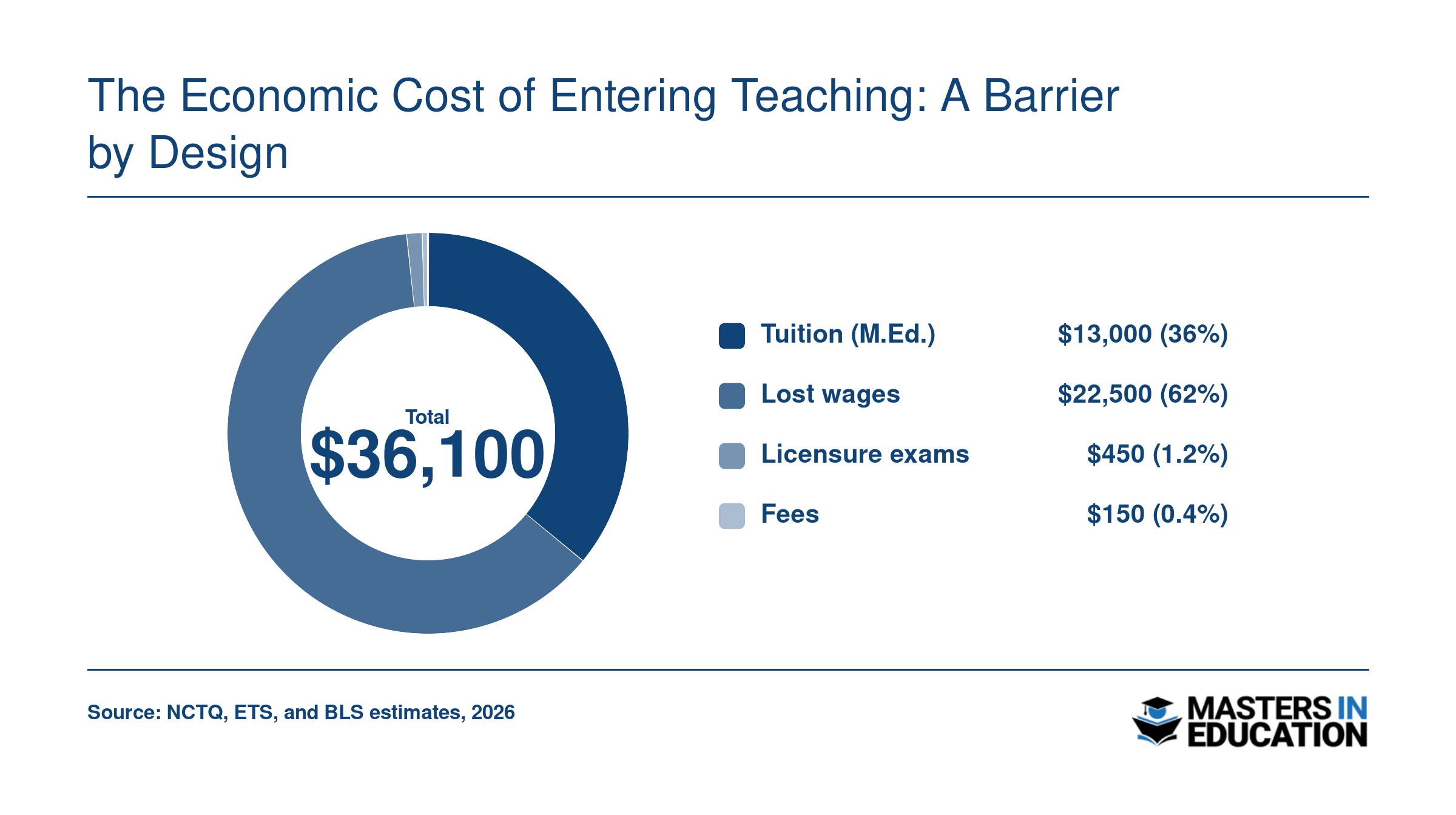
The Economic Cost of Entering Teaching: A Barrier by Design
For many aspiring teachers, the financial barriers begin long before the first day in the classroom. The combined cost of tuition, unpaid student teaching, licensure exams, and fees can exceed $36,000, a sum that disproportionately impacts candidates of color.
How M.Ed. Programs Can Drive Diversity and Equity
Graduate education programs do more than prepare teachers , they actively shape who enters the classroom and how long they stay. Admissions criteria, financial aid structures, curriculum design, and advising cultures either reinforce longstanding inequities or disrupt them. If four in ten teacher-preparation programs are graduating classes less diverse than their own state's existing teacher workforce,1 the issue is not simply an applicant pipeline problem. It is a program design challenge that graduate schools of education can address head-on.
Rethinking admissions and financial barriers
Unpaid student teaching, costly licensure exams, and high tuition disproportionately exclude Black and other candidates of color. M.Ed. programs can restructure these touchpoints: replacing unpaid field experiences with funded residencies, waiving application fees, and allocating scholarships specifically for candidates committed to working in underserved schools. When programs audit their own admissions data and adjust cut scores that needlessly screen out promising candidates, they begin to dismantle gatekeeping by design.
Curriculum that reflects and sustains
Candidates who see their identities, histories, and cultural knowledge reflected in coursework are more likely to persist. Embedding anti-racist and culturally responsive teaching across all pedagogy courses , rather than consigning it to a single elective , signals that equity is central to the degree. Montclair State University's 30-credit M.Ed. in Teaching for Equity and Justice, for example, threads these principles throughout its curriculum.2 Similarly, the University of Michigan offers an M.A. in Higher Education with a Diversity and Social Justice track, preparing graduates to lead equity initiatives.3 Such programs send a powerful recruitment message while equipping educators to create inclusive classrooms.
- Culturally responsive coursework functions as both a recruitment signal and a retention mechanism; when candidates see their lived experiences as assets rather than deficits, they are more likely to complete the program and remain in the profession.
Building supportive cohorts and mentorship
Isolation pushes teachers of color out of the profession. Cohort-based models, where candidates progress through coursework together, create peer networks that reduce that isolation. Intentional mentorship pairing with faculty and alumni of color provides navigation support and professional socialization. Programs can also develop grow-your-own pipelines: partnerships with historically Black colleges and universities (HBCUs) or district-based pathways that help paraprofessionals earn advanced credentials while working. Graduates who pursue roles such as diversity and inclusion coordinator positions are well placed to sustain these pipelines from inside institutions.
- Mentorship structures that connect candidates to educators of color increase persistence and model long-term career viability.
Programs leading by example
Several programs are designing themselves around equity. York College of Pennsylvania offers a fully online M.Ed. in Diversity and Student Resilience, expanding access for working professionals who might otherwise be excluded by geography or schedule.4 The U.S. Department of Education's 2022-2026 strategic plan emphasizes educator diversity as a priority,5 and state-level reporting, like Maryland's institutional cultural diversity data, helps hold programs accountable.6 These models demonstrate that diversity outcomes are not left to chance; they are built into program architecture.
From passive pipeline to active lever
M.Ed. programs that accept the status quo perpetuate a system that, as Leslie Fenwick's research on the post-Brown teacher purges shows, dismantles Black educator communities and replaces them with less qualified white teachers. Programs that critically examine their own practices, from recruitment materials to clinical placements, can become active levers for equity. When a candidate of color encounters a program that values their background, funds their training, surrounds them with mentors, and challenges them to dismantle bias, the entire profession benefits.
Related Articles
Scholarships, Loan Forgiveness, and Paid Residencies for Diverse Educator Candidates
A highly qualified secondary math or special education teacher who completes five consecutive years at a low-income school can receive up to $17,500 in Teacher Loan Forgiveness.1 This concrete figure underscores the tangible support available for educators committed to high-need communities, but financial assistance extends well beyond a single program.
Federal Grants and Loan Forgiveness Programs
The federal TEACH Grant offers up to $4,000 per year for students who agree to teach in a high-need field at a low-income school.1 Undergraduates can receive a lifetime maximum of $16,000, while graduate students are capped at $8,000.1 To qualify, you must complete the FAFSA, enroll at least half-time, and maintain a cumulative GPA of 3.25.1 The service obligation requires four years of teaching within an eight-year window after graduation.1 A critical detail: if you fail to fulfill the service requirement, the grant converts to a Direct Unsubsidized Loan with interest accrued from the original disbursement date.1
Public Service Loan Forgiveness (PSLF) is another pathway. Teachers employed full-time by a public school or a qualifying nonprofit can have their remaining federal Direct Loan balance forgiven after 120 qualifying monthly payments under an income-driven repayment plan. While PSLF is not diversity-specific, its impact is significant for educators of color, who hold disproportionate student debt.
The Teacher Loan Forgiveness program provides an enhanced benefit for those in designated high-need subjects. Teachers who are highly qualified and work full-time for five consecutive years at a low-income elementary or secondary school can receive $5,000 in forgiveness, but secondary math, science, or special education masters degree candidates who teach in that field can qualify for the full $17,500.1
Scholarships Targeting Educators of Color
Beyond federal aid, philanthropic and affinity organizations have created targeted support. The Center for Black Educator Development offers fellowship programs that combine financial stipends with mentorship and professional development, directly addressing pipeline gaps. Teach For America provides stipends and transitional funding for corps members, many of whom identify as people of color. The United Negro College Fund (UNCF) administers multiple education-related scholarships, including those for aspiring teachers. On the state level, programs like Pennsylvania's Aspire to Educate initiative provide grants to underrepresented candidates pursuing teacher certification, helping offset tuition and testing fees.
Paid Residencies: Earning While Learning
The financial burden of unpaid student teaching is a well-documented barrier, particularly for Black and Latino candidates who cannot afford to forgo income for a semester or more. Paid teacher residency models flip this script. Programs like the Boston Teacher Residency offer a living stipend and tuition support while candidates co-teach in a classroom for a full year. Similar models exist in cities such as Chicago, Denver, and Oakland. These residencies often partner with fully funded master's in education programs, allowing candidates to earn their degree and certification simultaneously without the financial strain of a traditional clinical placement. By paying residents a stipend that covers basic expenses, these programs remove a major obstacle and draw a broader, more diverse pool of talent into the profession.
Proven Strategies for Schools and Districts: Recruitment, Retention, and Culture
Grow-Your-Own Programs: Recruiting from Within
The strongest retention strategy is also a recruitment one: grow-your-own (GYO) programs that prepare individuals already rooted in the community to become teachers. When candidates come from the neighborhoods they will serve, they bring cultural knowledge, established relationships, and a long-term commitment that external hires often lack. Chicago's GYO Teacher program, for example, has demonstrated higher retention rates by focusing on paraprofessionals, community members, and high school students interested in education careers. These programs often eliminate common barriers like unpaid student teaching by offering paid residencies and tuition support. Districts that invest in GYO models create a pipeline of diverse, homegrown educators who are more likely to stay and thrive.
Building Supportive Communities for Teachers of Color
Research consistently shows that Black and Latino teachers leave the profession at higher rates than their white colleagues, often citing isolation, lack of mentorship, and insufficient administrative support. To counter this, school districts are increasingly establishing affinity groups and professional learning communities specifically for teachers of color. These spaces provide peer networks, mentorship opportunities, and a forum to discuss shared experiences in a supportive environment. When educators feel valued and connected, they are less likely to leave. Culturally affirming school climates, including inclusive curricula, anti-racist professional development, and leadership that reflects the student body, further reinforce retention. Without these deliberate efforts, even successful recruitment becomes a revolving door.
Community Partnerships to Strengthen the Pipeline
Districts that build formal partnerships with local Historically Black Colleges and Universities (HBCUs), community colleges, and paraprofessional pools see more diverse and sustained candidate pipelines. By actively recruiting from teacher's aides, instructional assistants, and other non-certified staff already working in schools, districts tap into a motivated, experienced talent pool. Partnerships can include tuition reimbursement, on-site cohort programs, and streamlined pathways to certification. These collaborations not only diversify the workforce but also create career ladders for individuals who have deep ties to the school community and a proven dedication to students.
Retention: Closing the Leaky Bucket
Recruitment without retention is a leaky bucket. Competitive compensation, meaningful mentorship, and career advancement opportunities are non-negotiable if districts want to keep diverse educators. Teachers of color often report being pigeonholed into disciplinary roles or overlooked for leadership positions. Structured induction programs, ongoing professional development, and transparent promotion processes help address these frustrations. Educators who aspire to move into district administration roles benefit when districts pair those pathways with clear sponsorship and equity-focused leadership pipelines. School culture must also shift: zero-tolerance policies and disproportionate discipline practices can alienate both students and staff of color. A truly inclusive environment requires intentional work on climate, not just hiring numbers.
Navigating the Legal Landscape
Given the current federal policy climate, districts must proceed with caution when launching formal diversity-in-hiring initiatives. The Trump administration has signaled it will challenge race-conscious employment practices.1 Before implementing any targeted recruitment program, school leaders should consult legal counsel to ensure compliance with evolving interpretations of antidiscrimination laws. This does not mean abandoning diversity goals; it means framing them around documented educational benefits, employee retention, and community representation rather than quotas. Proactive, legally informed strategies can still advance equity while minimizing risk.
Questions to Ask Yourself
Teacher Salaries Across the U.S.: How Compensation Intersects with Diversity
Teacher pay is not just a matter of personal finances; it is a structural barrier that intersects with race. The table below, using 2024 BLS data for selected states, illustrates the wide range in salaries. In many states, the 25th percentile wage for early-career teachers falls below a sustainable living wage - especially in high-cost areas - making it difficult for first-generation and minority candidates to enter the field without substantial debt. Districts that have invested in raising starting salaries are seeing measurable gains in the diversity of their applicant pools.
| State | Occupation | 25th Percentile Salary | Median Salary | Employment |
|---|---|---|---|---|
| WA | Elementary School Teachers | 78150 | 99110 | 30790 |
| WA | Secondary School Teachers | 79750 | 99640 | 14730 |
| CA | Elementary School Teachers | 74940 | 98190 | 141650 |
| CA | Secondary School Teachers | 76870 | 98710 | 96050 |
| NY | Elementary School Teachers | 63550 | 82480 | 103920 |
| NY | Secondary School Teachers | 76290 | 98370 | 76730 |
| DC | Elementary School Teachers | 75110 | 94730 | 3540 |
| DC | Secondary School Teachers | 63000 | 78770 | 2960 |
| OH | Elementary School Teachers | 50060 | 65380 | 50110 |
| OH | Secondary School Teachers | 59840 | 76740 | 51470 |
| PA | Elementary School Teachers | 59680 | 74160 | 47220 |
| PA | Secondary School Teachers | 60700 | 77990 | 52650 |
Moving Forward: What Aspiring and Current Educators Can Do
Moving forward on teacher diversity means translating awareness into action. It is the concrete work educators, candidates, and leaders do every day to reshape a profession that has historically excluded Black and brown talent. Change does not live solely in policy papers or national reports; it lives in the choices made at the application desk, in the faculty meeting, and in the way a school hires its next third-grade teacher.
For M.Ed. Candidates: Choosing Programs Intentionally
Selecting a graduate program is a strategic career move, not just a personal milestone. Before committing, ask the program director or admissions representative specific questions. How racially and ethnically diverse is the current cohort? How many faculty members of color teach core courses? Does the curriculum include coursework on anti-racist pedagogy, culturally responsive teaching, and the history of educational inequity? Perhaps most critically: is student teaching a paid, stipended, or scholarship-supported experience? Unpaid clinical placements are a well-documented barrier that disproportionately squeezes candidates from historically disadvantaged backgrounds. A program that cannot answer these questions directly may not be prepared to support your success or the mission of diversifying the field.
For Teachers of Color: Building Professional Networks
Visibility in the profession is both a career asset and a systemic lever. Organizations like the Center for Black Educator Development, the National Alliance of Black School Educators (NABSE), and local teacher affinity groups provide mentorship, professional development, and advocacy. Connecting with these networks can counteract the isolation that many educators of color experience and create pathways into leadership. When teachers of color are seen in classrooms, at conferences, and in principal pipelines, it signals to colleagues and students that the profession belongs to everyone. These networks also serve as accountability structures, pushing districts and policymakers to follow through on diversity commitments. Educators who want to formalize that advocacy work may find that an education advocacy career with an M.Ed. offers a direct route from the classroom into policy and systems change.
For School and District Leaders: Auditing and Partnering
Leaders hold the keys to the hiring pipeline. Start with a rigorous audit of your recruitment funnel: at which stage do candidates of color disproportionately drop out? Is it the application, the interview, or the first two years on the job? Use that data to address specific leaks rather than launching another generic recruitment campaign. Partner with a local university's M.Ed. program to build a grow-your-own cohort, offering tuition support, paid residencies, and a guaranteed job upon licensure. Just as critical is the post-hire phase: establish formal mentorship and affinity group infrastructure so that newly hired educators of color are not left to navigate institutional culture alone. Districts serious about systemic change often benefit from hiring a diversity and inclusion coordinator who can anchor these efforts institutionally.
This work echoes Sharif El-Mekki's central argument: diversifying teaching demands sustained, systemic commitment, not a seasonal recruitment push, not a single scholarship, and not superficial representation without structural change. Teacher diversity is not merely a social justice imperative; it is an evidence-backed academic intervention. When students see themselves reflected in their educators, the data show improved attendance, higher expectations, and stronger achievement, measurable benefits that touch every learner in the classroom. Moving forward begins with each of us asking what our institution, our program, or our own professional path is doing to make that evidence a daily reality.
Frequently Asked Questions About Teacher Diversity
Understanding teacher diversity is critical for educators and policymakers alike. Below are answers to common questions about why diversity matters, the systemic barriers that persist, and how graduate programs can help. Use these insights to inform your own career and advocacy.