

What you’ll learn in this article…
- Wisconsin's Fast Forward grants cover two years of teacher training costs for 84 candidates in high-need schools.
- The TEACH Grant offers up to $4,000 per year but becomes a loan if teaching service isn't certified.
- In 2021, 63% of TEACH Grants converted to loans, mostly due to missed paperwork deadlines.
- Search state workforce agency websites and university financial aid pages for additional teacher training grants.
What if a state grant covered two years of your teacher training costs? In June 2026, Wisconsin's Department of Workforce Development awarded $1 million in grants, $250,000 each to Mount Mary University, Carroll University, Concordia University, and Innovators in Learning and Achievement, to recruit, train, and license 84 teachers for urban and low-income schools.1 That dollar amount signals more than a one-time news item. Teacher shortages in special education, ESL, math, and science are driving states to underwrite graduate-level preparation directly, moving beyond recruitment slogans to funded pathways. For M.Ed. candidates exploring master's in education programs in Wisconsin and beyond, the tuition barrier that kept many out of the classroom is becoming less absolute, as states begin treating teacher training grants the way they treat workforce development in other critical industries.
Wisconsin's Fast Forward Grant Program: A Funded Model for M.ed. Candidates
The biggest obstacle for many aspiring teachers isn't the coursework, it's the tuition bill. Wisconsin's Fast Forward Teacher Training and Recruitment Grant Program offers a direct counter to that barrier, covering two full years of costs to recruit, train, and license educators for low-income and urban districts. On June 11, 2026, the Wisconsin Department of Workforce Development (DWD) awarded $1 million in grants to four organizations, each receiving $250,000.1
Breaking Down the Four Grantee Programs
Each grant targets specific shortage areas and degree pathways:
- Mount Mary University: Recruits, trains, mentors, and places 10 licensed teachers in Milwaukee area schools. Focus areas include special education, ESL, math, science, social studies, and elementary education.
- Carroll University: Offers 20 teacher candidates a Master of Arts in Teaching program, addressing shortages in elementary/middle school, special education, and math.
- Concordia University: Supports 15 post-baccalaureate candidates earning cross-categorical special education licensure through a Master of Science in Education.
- Innovators in Learning and Achievement Inc.: Partners with CESA 1 to recruit, prepare, and license 39 teachers in southeastern Wisconsin, providing 50% tuition scholarships.
Full-Cost Coverage Over Two Years
Unlike piecemeal tuition discounts, these grants cover the complete pipeline: recruiting, training, and licensing. For the 84 educators ultimately served, that means zero out-of-pocket costs for tuition and fees over two academic years, provided they commit to teaching in designated high-need schools. This structure removes the financial guesswork that often derails mid-career switchers or recent graduates weighing a fully funded master's in education.
A Blueprint That's Spreading
DWD Secretary Amy Pechacek captured the ethos behind the investment: "Teachers are essential to the success of our kids and our state... investing in the workforce of the future."1 Wisconsin's approach isn't an isolated experiment. Other states are watching and adapting similar recruitment grant programs, often targeting special education master's degrees, bilingual education, and STEM fields. Understanding the Wisconsin model helps M.Ed. candidates spot analogous opportunities in their own states, funded pathways that turn a tuition bill into a signed commitment to serve.
Federal Grants for Teacher Training: How the TEACH Grant Works for M.ed. Students
The TEACH Grant provides up to $4,000 per year in federal grant funding, not a loan, for students who commit to teaching in a high-need field at a low-income school. Unlike loans, TEACH Grant funds do not require repayment as long as recipients fulfill a service commitment. The grant is available to undergraduate, post-baccalaureate, and graduate students, including those pursuing a Master of Education (M.Ed.) with initial teacher licensure. Each year you receive the grant, you must sign a service agreement, and the total grant amount cannot exceed $16,000 for graduate study.
Eligibility for Graduate Students
M.Ed. candidates must be enrolled in a TEACH-eligible program at a participating institution. Eligibility requires maintaining a cumulative GPA of at least 3.25 or scoring in the top 25th percentile on a college admissions test. Students must also sign an Agreement to Serve (ATS) each year, promising to meet the teaching obligation. Your school's financial aid office will confirm whether your specific M.Ed. program is TEACH-eligible. Many graduate-level programs qualify, including those that lead to initial certification in high-need areas, so if you plan to transition into teaching through a master's degree, you may be eligible.
Serving in a High-Need School
The service obligation is four academic years of full-time teaching within eight years of completing the program. You must teach in a school designated as low-income (Title I) and in a high-need subject area. The U.S. Department of Education updates the list of high-need fields annually, so confirm your subject area before committing. High-need fields include:
- Special education: Roles such as cross-categorical or early childhood special education.
- Mathematics: Middle school and high school math teaching positions.
- Science: Including biology, chemistry, physics, and earth science.
- English as a Second Language (ESL): Bilingual and dual-language instruction.
- Reading specialist: Literacy intervention roles.
- Foreign language: Less commonly taught languages may qualify depending on state shortages.
Note that part-time teaching can be combined to meet the full-time equivalent, but the total must equal four years of full-time service. Educators targeting masters in special education or STEM fields will find no shortage of qualifying placements under this program.
Understanding the Conversion Risk
If you do not complete the service obligation, the TEACH Grant converts to a Direct Unsubsidized Loan, with interest charged from the date the grant was disbursed. This can create a significant debt surprise, but careful planning and tracking can prevent it. Staying informed about your progress and the teaching licensure requirements is key. Later in this article, we cover strategies to manage and avoid loan conversion. For now, know that the risk exists but is entirely avoidable if you stay on top of your requirements.
State-By-State Teacher Training Grant Programs M.ed. Candidates Should Know
Teacher training grants are not one-size-fits-all across states, and the most valuable opportunities for M.Ed. candidates are often tucked inside state-specific workforce initiatives. Rather than relying on a static, pre-compiled list that quickly becomes outdated, a proactive search strategy helps you uncover funded pathways that match your specialization and location.
Focus your initial search on state education agency websites
Every state maintains a Department of Education or equivalent agency that posts current grant-funded teacher preparation programs. Look for pages labeled "Grow Your Own," "teacher residency," "educator recruitment grants," or "teacher pipeline initiatives." These official sites typically include eligibility criteria, award amounts, application deadlines, and contact information for program coordinators. Because funding cycles and program names shift from year to year, checking directly with the state agency is the surest way to find active opportunities for M.Ed. candidates.
- Grow Your Own programs often support paraprofessionals and career changers who commit to teaching in high-need schools.
- Teacher residency grants may cover tuition and provide a stipend while you complete a master's degree and clinical training in a partner district.
- State recruitment grants sometimes target specific shortage areas like special education master's degree programs, ESL, math, or science, and may require a multi-year service commitment.
Tap into professional networks and educator associations
National organizations like the American Association of Colleges for Teacher Education (AACTE) and the National Education Association (NEA) regularly compile and update directories of state-level funding opportunities. Many state-level teacher associations also maintain lists of scholarships and grants on their websites and send out alerts through member newsletters. These networks can be especially useful for discovering new programs or changes in eligibility requirements before they appear in general web searches.
- AACTE publishes research briefs and policy updates that often include summaries of state grant initiatives.
- NEA and its state affiliates may highlight funding sources for members pursuing advanced degrees, including master's in education programs.
- Ed prep program faculty are another underutilized resource: your M.Ed. admissions office or faculty advisor may know of upcoming grants that aren't yet widely advertised.
Contact the administering agency for the most accurate details
Grant rules, award amounts, and service obligations can change with each legislative session. The most reliable information comes from the agency listed on the official program page, such as the Texas Education Agency, the California Commission on Teacher Credentialing, or Illinois State Board of Education. A quick phone call or email to the program coordinator can clarify:
- Whether the grant covers full tuition or a set dollar amount.
- If the award is renewable for multiple years of a master's program.
- How the service commitment must be fulfilled (specific districts, subject areas, or length of service).
- Whether the grant can be combined with federal TEACH Grants or other financial aid.
Use targeted keyword searches for hidden gems
If your target state doesn't appear to have a high-profile grant program, adjust your search terms. Try combinations like "[state] teacher loan forgiveness," "[state] teacher scholarship," or "[state] paid student teaching." Some programs are designed to stack with federal TEACH Grants, effectively reducing M.Ed. program service obligations to near zero in cost when combined. Others may offer renewable scholarships for candidates who maintain satisfactory academic progress. Always check the fine print: many state grants require you to teach in a critical shortage school for a set number of years after graduation, so align your M.Ed. specialization with those needs to maximize eligibility.
Related Articles
Grants for Online M.ed. Programs: What Qualifies and What Doesn't
Online Master of Education programs have grown rapidly, and many prospective teachers wonder whether they can tap into state and federal grants to fund their degrees. The short answer: yes, but eligibility hinges on a few critical details that are easy to overlook.
TEACH Grant Eligibility for Online M.Ed. Programs
You can use a federal TEACH Grant for an online M.Ed., but the program must be offered by a Title IV-participating institution and specifically designated as TEACH-eligible.1 Not every online master's concentration qualifies; the grant targets high-need fields such as special education, mathematics, science, and English as a Second Language.2 Before enrolling, contact the financial aid office to confirm the program's eligibility code is active. Additionally, you must sign an Agreement to Serve2, complete annual counseling3, and maintain a cumulative GPA of at least 3.25 or score above the 75th percentile on a college admissions test.1
State Grant Flexibility for Online Learners
Many state teacher training grants prioritize service in high-need schools within that state rather than requiring candidates to attend a local brick-and-mortar campus. This creates real opportunity for online learners. For instance, a student living in Illinois could enroll in a M.Ed. programs by state search, find a fully online program based in another state, and still qualify for an Illinois grant, provided the program leads to Illinois licensure and the candidate commits to teaching in an Illinois shortage area. The key is geographic commitment, not physical attendance.
The Wisconsin Hybrid Model: A Blueprint
A recent Wisconsin grant illustrates how funding can reach candidates in non-traditional settings. Innovators in Learning and Achievement Inc., in partnership with CESA 1, received $250,000 to recruit, prepare, and license 39 teachers in southeastern Wisconsin.4 The program offers 50% tuition scholarships and uses a hybrid delivery model that blends online coursework with in-person clinical experiences. While not a fully online program, it demonstrates how state dollars can support flexible, accessible pathways for career changers and working adults who cannot relocate or attend full-time.
Pitfalls to Avoid: Out-of-State Online Candidates
Some state "Grow Your Own" programs explicitly require enrollment at an approved in-state institution. If you apply to such a grant while enrolled in an online program from an out-of-state university, you may be deemed ineligible, even if you intend to teach in that state after graduation. Always read the fine print for language like "must be enrolled at an eligible institution within the state" or "priority given to in-state resident candidates." When in doubt, contact the grant administrator directly before submitting your application. Candidates pursuing ESL teaching degrees should pay particular attention, as licensure reciprocity rules vary significantly by state.
Action Steps Before Enrolling
- Verify federal eligibility: Ask the financial aid office for the TEACH Grant program code. If the school participates, it can tell you which online programs qualify.1
- Check state grant lists: Search your target state's department of education website for a list of approved teacher preparation providers. Some publish the list publicly; others require a direct inquiry.
- Align licensure and grant requirements: Make sure your online program meets the licensure standards for the state where you plan to teach. A grant may be void if you cannot obtain the required credential.
- Document everything: Keep records of grant applications, service commitment agreements, and communications. You are responsible for tracking your service obligation and avoiding grant-to-loan conversion.2
Step-By-Step Timeline for Securing Teacher Training Grants
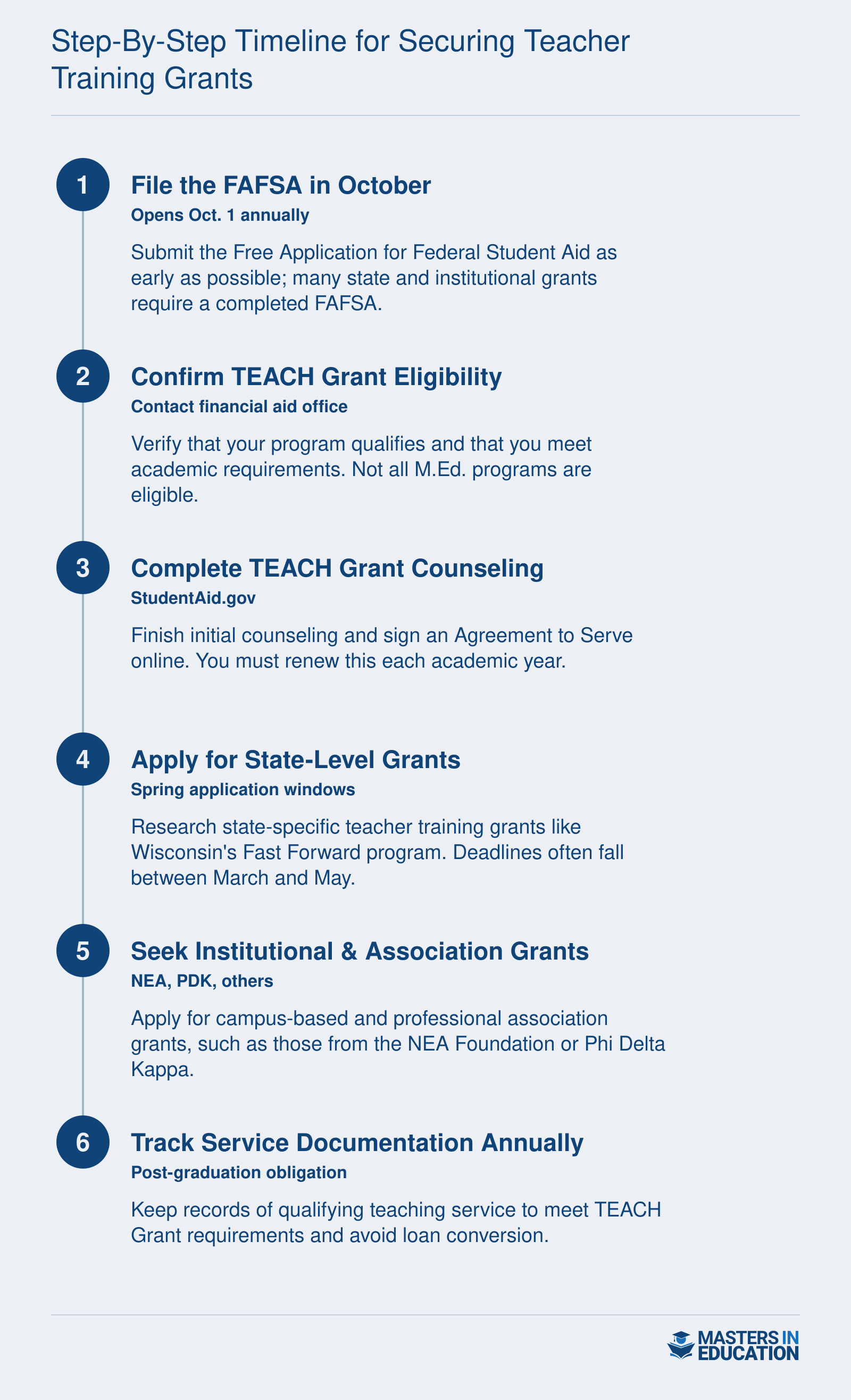
Filing the FAFSA and qualifying for the TEACH Grant are not automatic, candidates must actively apply and complete mandatory counseling each academic year. Missing a step or deadline can delay funding or trigger loan conversion.
How to Apply for Teacher Training Grants: Deadlines, FAFSA, and Institutional Windows
Securing grant funding for an M.Ed. or teacher certification program requires more than filling out one form. It demands a coordinated search across multiple sources, each with its own deadlines and criteria. While a single award can cover significant costs, most candidates piece together support from federal programs, institutional awards, and private foundations. A proactive, organized approach is the difference between leaving money on the table and entering the classroom debt-free.
Start with Professional Associations
Professional education associations are often the most reliable starting point for grant listings. Organizations like Phi Delta Kappa (PDK) and the American Federation of Teachers (AFT) regularly update their websites with funding opportunities for aspiring and practicing teachers. These sites typically categorize grants by purpose, such as initial licensure, M.Ed. research, or classroom innovation, and provide clear eligibility guidelines. Bookmark these pages and check them quarterly, as many professional association grants have rolling or limited submission windows that are not advertised elsewhere.
Tap Institutional Resources
Your target college or university remains one of the most underutilized sources of grant aid. Beyond general financial aid offices, education departments often administer fellowships, assistantships, and tuition remission programs specifically for M.Ed. and certification students. Visit department websites directly and speak with a program coordinator or financial aid counselor. Some institutions offer need-based grants negotiated during the admissions process, while others automatically consider applicants for merit scholarships. Deadlines for these internal awards frequently precede federal aid priority dates, so early inquiry is essential.
Explore Private Foundations and Local Opportunities
Private foundations and community organizations often fund teacher training with less competition than national programs. The Bill & Melinda Gates Foundation supports education initiatives nationwide, and the American Association of University Women (AAUW) provides grants for women pursuing advanced degrees. Local community foundations, rotary clubs, and regional education support networks also sponsor candidates who commit to teaching in underserved areas. Use free grant search tools like Foundation Directory Online or Candid's database to filter by location and field. Tailoring applications to a foundation's stated mission, whether equity, STEM education, or rural access, significantly boosts your chances.
Monitor Federal and State Portals
Government websites aggregate funding streams that many applicants overlook. workforce development coordinator roles and state employment agencies often post teacher recruitment grants alongside broader workforce pipeline programs. State department of education pages frequently list recruitment grants, loan forgiveness programs, and grow-your-own teacher pipeline initiatives. Set alerts for keywords like "teacher training grant" or "M.Ed. scholarship" on state employment and education portals. Because these opportunities often align with legislative cycles, applying early in the fiscal year can capture newly released funds before they are exhausted.
Avoiding TEACH Grant Loan Conversion: Risks and Strategies
What actually triggers a TEACH Grant to turn into a loan? If you fail to meet the service requirements, the entire grant amount converts to an unsubsidized Direct Loan with interest backdated to the day the money was first paid out. As highlighted in the callout above, approximately half of all TEACH Grants eventually convert to loans.
How TEACH Grant Conversion Works
To keep your TEACH Grant from converting, you must teach full-time for four years in a high-need field at a Title I school within eight years of finishing your program. High-need fields include accredited special education master's programs, math, science, bilingual education, and reading specialist roles. Title I schools serve low-income students and are designated annually. If you leave teaching early, switch to a non-qualifying school, or your school loses Title I status, the grant flips to a loan.
- Retroactive interest: Interest accrues from the original disbursement date, not from the date of conversion. For a four-year-old grant, that can add thousands of dollars.
- Common causes: Career changes, schools losing Title I status mid-year, or failing to file paperwork are top triggers.
The Annual Certification Trap
The most overlooked requirement is annual certification. Every year you must submit a form to your loan servicer proving you are on track. Missing this deadline, even by a day, can cause automatic conversion, even if you are actively teaching in a qualifying job. Administrative errors, like a school's name not matching the federal database, also cause problems.
- Deadline discipline: Certification must be received by your servicer within 120 days of the end of each qualifying year. Servicers send reminders, but many recipients miss them.
- Verification: Always double-check that your school remains on the Title I list each year. A change in funding can drop a school off the list without warning.
Three Concrete Strategies to Stay Safe
Before you accept a TEACH Grant, put these protections in place.
- Verify your job site first: Confirm your school is a Title I school and your subject is a high-need field using the Department of Education's online databases. Do this before signing the Agreement to Serve.
- Set a recurring calendar reminder: Pick a date 30 days before your annual certification deadline each year. Treat it like a tax deadline.
- Explore alternatives before conversion: If you face a job loss or health issue, contact your loan servicer immediately. You may qualify for a forbearance or deferment that pauses the service timeline and prevents conversion.
What If Your Grant Has Already Converted?
Lesser known is the reinstatement option. If you later complete the four-year service requirement, you can request that your converted loan be reinstated as a grant. Candidates who initially pursued how to choose a masters in education specialization with TEACH funding in mind are sometimes the best positioned to meet the original terms after a gap. The Department of Education does not advertise this widely, but reinstatement has been approved in some cases. Ask your servicer about the TEACH Grant Reconsideration process. While not guaranteed, it is worth pursuing if circumstances change and you eventually meet the original terms.
Questions to Ask Yourself
What M.ed. Graduates Earn as Teachers: National and State Salary Data
Elementary and secondary school teachers' salaries vary widely by state. The top five states offer median wages above $83,000 for elementary teachers, while the bottom five hover around $61,000 to $63,000. For grant-funded M.Ed. graduates, even starting at the 25th percentile in a lower-paying state can be manageable: a teacher who receives $16,000 in TEACH Grants (over four years) plus state grant tuition coverage faces a significantly lower debt-to-income ratio. Keep in mind that salaries in high-cost metropolitan areas often exceed state medians, giving urban teachers additional earning potential.
| State | Elem. 25th %ile | Elem. Median | Elem. 75th %ile | Sec. 25th %ile | Sec. Median | Sec. 75th %ile |
|---|---|---|---|---|---|---|
| Washington | $78,150 | $99,110 | $108,470 | $79,750 | $99,640 | $115,130 |
| California | $74,940 | $98,190 | $107,020 | $76,870 | $98,710 | $122,350 |
| District of Columbia | $75,110 | $94,730 | $117,080 | $63,000 | $78,770 | $98,480 |
| Rhode Island | $62,080 | $86,900 | $94,200 | $61,810 | $89,040 | $96,150 |
| Massachusetts | $64,000 | $83,260 | $99,100 | $76,650 | $88,990 | $99,590 |
| Utah | $52,490 | $61,710 | $77,790 | $58,470 | $74,280 | $79,630 |
| Virginia | $52,230 | $62,270 | $79,260 | $57,960 | $63,760 | $80,440 |
| Michigan | $49,810 | $62,350 | $78,030 | $50,270 | $64,000 | $79,290 |
| Minnesota | $49,970 | $63,120 | $79,820 | $55,130 | $63,950 | $79,690 |
| Georgia | $59,170 | $63,490 | $77,340 | $60,320 | $73,340 | $77,210 |
Common Questions About Teacher Training Grants and M.ed. Funding
State and federal grants are opening new doors for aspiring teachers to fund their master's degrees. Below, we answer the most common questions M.Ed. candidates have about finding and securing these financial awards.
Funded pathways into teaching are no longer hypothetical. The federal TEACH Grant, state programs like Wisconsin's Fast Forward grants, and institutional awards can collectively cover a large share of M.Ed. costs for candidates who commit to high-need schools. Start with the FAFSA in October, verify TEACH Grant eligibility with your program, and research your state's teacher recruitment grant windows before spring. Teacher shortages remain urgent, and states are investing real money. Candidates who compare master's in education worth it against the available grant landscape may find the return on investment is stronger than expected, especially when tuition is offset by state and federal awards.