
What you’ll learn in this article…
- School districts now hire AI Curriculum Specialists and Robotics Coaches.
- Specializing in AI and robotics can add $7,510 to a teacher's salary.
- New federal grants in 2026 fund classroom robotics via CS mandates.
What M.Ed. specialization actually leads to a role as an AI curriculum specialist or robotics coach, and how do you choose a master's in education specialization that aligns with these emerging fields? K-12 schools are adopting AI and robotics tools at a pace that outstrips the supply of qualified instructors, creating a persistent teacher preparation gap. Districts now post positions that blend instructional design with technical know-how, and the educators who fill them often come from a nontraditional mix of credentials.
An M.Ed. with a STEM concentration provides the theoretical grounding, but hiring committees increasingly scan for post-master’s certifications in computational thinking, machine learning basics, or robotics integration. These additional credentials are becoming the key to higher salary bands and expanded career options, as schools stretch their pay scales to secure the expertise they need.
The result is a window of opportunity for M.Ed. graduates willing to specialize: the chance to lead curriculum development and earn above-par compensation in a field that is still defining itself.
The New Frontier: Why AI and Robotics Are Reshaping STEM Education Now
The push for AI and robotics in K-12 STEM classrooms is accelerating faster than the teacher pipeline can keep up. While schools race to adopt new technologies and meet state mandates, a critical shortage of qualified educators leaves many programs stalled before they start. For M.Ed. graduates, this gap is not a warning sign: it is a wide-open opportunity to step into leadership roles that barely existed five years ago.
A Perfect Storm of Investment and Mandate
The convergence of federal policy, industry funding, and state-level graduation requirements has created an almost overnight demand for AI-literate teachers. A 2025 White House executive order on advancing AI education for American youth came alongside major corporate pledges: NVIDIA committed $25 million over five years, Microsoft offered free AI Copilot to all U.S. K-12 students for the 2025-2026 academic year, and Anthropic set aside $1 million over three years. By early 2026, more than 30 states had published formal AI guidance documents1, and nearly 100 AI education bills had been filed2. Some states went further: Iowa now requires a semester of computer science and AI coursework for the class of 2031, Illinois mandates a full year by 2028-29, and Ohio requires one unit of computer science including AI starting in 2029. Hawaii even launched a six-week AI literacy course requirement for 2027-28.3 These are no longer pilot programs; they are graduation prerequisites.
The Teacher Training Gap
Despite all this momentum, most credentialed STEM teachers have never received formal AI or robotics training. A 2025 national survey found that 68% of teachers lacked preparation in AI, even as 71% of districts planned to expand AI use. The AI in K-12 education market actually cites the teacher shortage itself as a primary growth driver4, meaning demand is outpacing supply at a structural level. As reported in a recent analysis of emerging STEM trends, AI and robotics are actively reshaping teacher preparation and alternative teacher certification pathways, but the existing workforce is not keeping pace.5
Where the M.Ed. Fits In
An M.Ed. already signals leadership capacity: it is a credential built for instructional design, curriculum leadership, and systemic change. When graduates add AI and robotics skills, they become first movers in a field that schools are desperate to staff. The rest of this article maps out exactly what that looks like: the job roles emerging now, the certifications that complement an M.Ed., and the concrete steps to integrate AI and robotics into your classroom or school. The gap is real, the opportunity is now, and the pathways are ready.
Emerging Teacher Roles in AI and Robotics: What the Job Market Actually Looks Like
School systems are actively staffing positions that did not exist five years ago. Job boards now carry titles like AI Curriculum Specialist, Robotics Coach, and STEM Integration Coordinator, reflecting a structural shift in how districts approach technology instruction. These roles sit at the intersection of classroom teaching, curriculum design (similar to a stem curriculum developer), and technical support, and they are increasingly filled by educators who hold a master’s degree with coursework in STEM, instructional technology, or educational leadership.
New Job Titles Emerging Across Districts
The job market divides roughly into three lanes. First, school-based roles such as the Robotics Coach or AI Lab Facilitator manage day-to-day instruction, coach peer teachers (a form of teacher leadership degree), and maintain equipment. Second, district-level coordinators write curriculum, train staff across multiple schools, and align programs with state standards. Third, external partners like museums, nonprofits, and education technology companies hire specialists to deliver programs directly or design learning modules that schools adopt. Many of these positions report directly to directors of curriculum or innovation offices.
Typical Qualifications and Credentials
A master’s degree in education, instructional technology, or a STEM field is the floor for most of these roles. Job descriptions often list a valid teaching license as required or strongly preferred. Additional credentials from organizations like ISTE or the Computer Science Teachers Association can differentiate candidates. Beyond formal degrees, hiring panels look for demonstrated experience integrating coding platforms, physical computing kits, or generative AI tools into classroom settings. Some districts now write “AI integration” or “robotics coaching” into the job title itself, signaling that the role is distinct from a general technology teacher.
Where to Find These Positions
Active postings for jobs for masters in education appear on school district career pages, regional education service center websites, and nationwide platforms like LinkedIn and Indeed. Filtering by keywords such as “robotics,” “STEM coach,” or “computer science specialist” surfaces a mix of full-time teaching jobs and hybrid roles that spend part of the day in the classroom and part on curriculum or professional development. Nonprofit organizations and STEM enrichment providers also hire for outreach and program management positions that require a background in education.
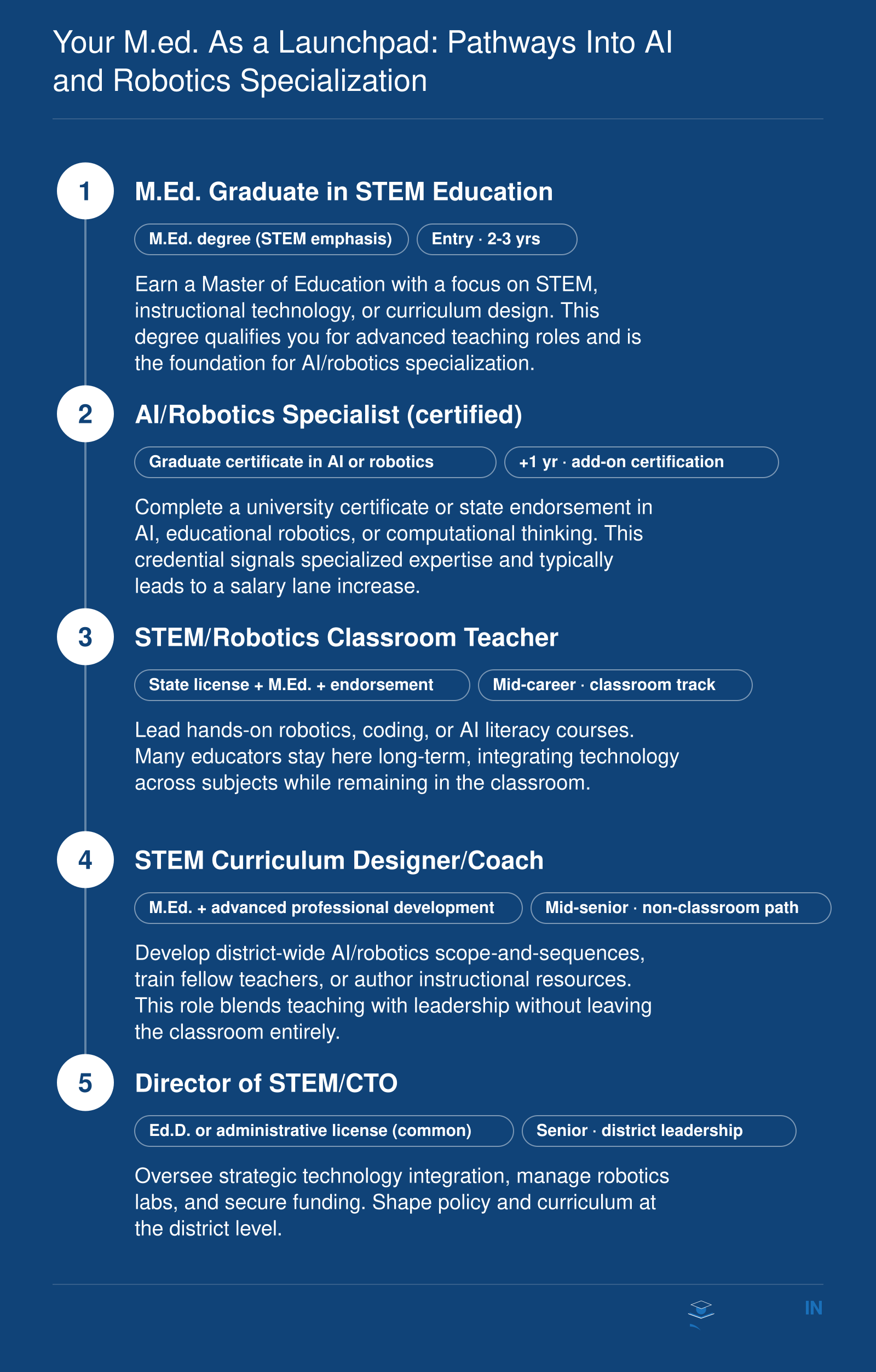
Your M.ed. As a Launchpad: Pathways Into AI and Robotics Specialization
An M.Ed. with a STEM focus opens the door to specialized AI and robotics teaching roles. Use this ladder to see how credentials stack toward leadership.
Upskilling Programs and Certifications: What to Look for After Your M.ed.
The most effective way to transition into AI and robotics teaching is through targeted, post-master’s credentials that signal specialized competence to school districts. A standard M.Ed. provides foundational pedagogical knowledge, but the rapid evolution of educational technology means that additional, focused training is often what separates a generalist from a candidate schools actively recruit to lead STEM innovation and open doors to rewarding jobs with a masters in education.
University Graduate Certificates
Many universities now offer graduate certificates specifically in AI for education or educational robotics. These programs typically require three to five courses and can be completed in under a year, often fully online or through hybrid formats that accommodate working teachers. Costs vary widely, from a few hundred dollars per course at public institutions to several thousand at private universities, but many states offer tuition reimbursement for in-service educators pursuing STEM endorsements. Look for programs that include hands-on project work, such as designing a classroom robotics curriculum or building an AI tutoring prototype, because portfolio outcomes can directly support job applications.
Professional Association Credentials
Leading education and technology associations provide standards-aligned certifications that carry weight with administrators. The International Society for Technology in Education (ISTE) offers an AI in Education certification that focuses on ethical integration, data literacy, and student-centered AI use. For robotics, organizations like FIRST Robotics and the IEEE Robotics and Automation Society publish educator resources, host workshops, and sometimes credential participants in specific pedagogical approaches. These certifications often combine online modules with in-person training at national conferences, and they frequently come with access to practitioner communities where teachers share lesson plans and troubleshooting advice.
Micro-credentials and Stackable Pathways
Micro-credential platforms such as Digital Promise and Coursera for Campus have emerged as flexible, cost-effective alternatives to full certificates. Courses like “AI for Educators” or “Teaching Robotics with Python” can be stacked into a specialization that districts recognize as continuing education units. Many of these platforms partner with universities to offer graduate credit options, allowing teachers to apply completed micro-credentials toward a second master’s or an Ed.D. later. The modular nature means educators can customize their upskilling: one semester might focus on robotics hardware, the next on AI-driven assessment tools, all while maintaining a full teaching load.
Leveraging Employer and State Support
Before enrolling, educators should check their state department of education’s list of approved professional development providers, as many grant automatic credit for listed programs. As broader education job growth comparison confirms, STEM teaching specializations are expanding, and some states have earmarked grants that effectively offer tuition-free teacher education for educators who upskill in high-need areas like computer science and robotics. School districts often negotiate group rates with course providers, so asking a curriculum director about cohort-based learning can reduce individual costs. In addition, local teacher unions may maintain databases of tuition reimbursement opportunities that go underutilized. Aligning your chosen upskilling pathway with state endorsement requirements ensures the time and money directly advance your certification status.
Questions to Ask Yourself
Integrating AI and Robotics Into Your STEM Classroom by Grade Band
Integrating AI and robotics across grade levels requires meeting students where they are developmentally. Rather than a one-size-fits-all approach, effective STEM instruction, often deepened through a master's in STEM education, adapts tool complexity and inquiry depth to each band. Below, we pair activities with the standards that validate them.
Grades K-5: Playful Foundations
Start with unplugged AI activities: sort objects to understand training data and simulate machine learning through movement games.4 These align with NGSS practice "Developing and Using Models" and ISTE Standard 1.3 (Knowledge Constructor). For physical robotics, Bee-Bot (K-2) teaches sequencing, while the Fisher-Price Code-A-Pillar reinforces cause and effect.1 In upper elementary, Google's Teachable Machine lets students train an image or sound model without writing code.3
- Free platform: Code.org's AI for Oceans (grades 3-6) introduces training data and bias through puzzles aligned to AI4K12 concepts.2
Grades 6-8: Collaborative Problem Solving
Move to block coding with LEGO SPIKE Prime or VEX IQ, where students build and program robots for challenges like line following.1 This develops NGSS "Computational Thinking" and ISTE 1.5 (Computational Thinker) as they automate solutions. Extend learning with ISTE's secondary guide project "AI Chatbots," using visual tools to create conversational agents.2
- Cost-conscious option: VEXcode VR offers a free online simulation environment to practice block coding and sensor logic.
Grades 9-12: Authentic Engineering and Data Science
Introduce Python-based machine learning via Google Colab or Jupyter notebooks, training models on real datasets to practice NGSS "Analyzing and Interpreting Data." ISTE's computer science guide project "Programming with Machine Learning" provides a ready-to-adapt framework.2 For autonomous robotics, have students design sensor-driven systems to navigate mazes or sort objects using Arduino or Raspberry Pi, strengthening ISTE 1.4 (Innovative Designer).
- Free platform: Teachable Machine exports to TensorFlow for advanced prototyping.3
Facilitating Without Being a Coding Expert
You do not need to write every line of code. Many AI and robotics tools use visual, block-based environments. Your role is to guide inquiry, ask probing questions, and normalize debugging. Start with an unplugged activity to build your own comfort, then let students teach one another. As ISTE emphasizes, fostering a safe space for trial and error matters far more than technical mastery of every tool.
Related Articles
Career Outcomes: What AI and Robotics Specialization Does for Your Salary and Trajectory
National median salaries for classroom teachers establish a floor, but specialization in AI and robotics can lift compensation well above those baselines. The data below pairs BLS figures for traditional teaching roles with job-market ranges for emerging specialist positions, showing how an M.Ed. focused on AI integration can increase earning potential.
| Occupation | Median Annual Wage | Typical Salary Range | Notes |
|---|---|---|---|
| Elementary School Teachers | $62,340 | $50,680 – $79,410 | BLS national median and 25th-75th percentile |
| Middle School Teachers | $62,970 | $53,540 – $79,380 | BLS national median and 25th-75th percentile |
| Secondary School Teachers | $64,530 | $57,950 – $82,340 | BLS national median and 25th-75th percentile |
| Postsecondary Education Teachers | $72,090 | $50,630 – $96,260 | BLS national median and 25th-75th percentile |
| AI Literacy and Instruction Specialist | N/A | $80,000 – $97,500 | Based on job listings, e.g., DSST Public Schools |
| Curriculum & Learning Specialist (AI Education) | N/A | $90,000 – $110,000 | Based on job listings; often includes OTE + equity |
| AI Curriculum Developer (National) | N/A | $113,000 – $169,000 | Based on ZipRecruiter national estimates |
| AI Programs Consultant / K-12 Specialist | N/A | $55,000 – $75,000 | Based on job listings |
| Curriculum Developer (AI, Coding, Robotics) | N/A | $68,000 – $78,000 | Based on job listings |
Funding, Equipment, and Policy: How to Actually Start an AI or Robotics Program
A quiet shift in federal and state policy is making it easier than ever to fund classroom robotics programs, if you know where to look. With new computer science education mandates and dedicated grant streams, the 2026 landscape provides multiple entry points for M.Ed. graduates leading AI and robotics initiatives.
Tap Federal Title IV-A Student Support and Academic Enrichment Grants
The U.S. Department of Education's Title IV-A SSAE program remains the largest flexible federal funding source for well-rounded education, including computer science and robotics. States receive block grants and sub-allocate to districts based on local needs. Begin by visiting the Department's Title IV-A page to confirm current funding levels and eligible uses. Then check your state education agency's website for application timelines and specific priority areas. Many states now explicitly list STEM and computer science as allowable expenditures, making a direct pitch for robotics equipment, software, and professional development, which can cover the cost of AI tools for schools, relatively straightforward.
Pursue National Science Foundation Computer Science for All Grants
The National Science Foundation's CS for All initiative supports research and implementation of inclusive computer science education. The Computer and Information Science and Engineering (CISE) directorate regularly issues calls for proposals that can fund curriculum development, teacher training, and equipment for AI and robotics programs. Visit nsf.gov, browse CISE education programs, and sign up for grant alert emails to catch new solicitations. Additionally, keep an eye on the White House Office of Science and Technology Policy; it periodically announces new federal AI education initiatives that may translate into future grant opportunities or agency partnerships.
Follow State-Level Mandates and Grant Programs
A growing number of states have enacted computer science education mandates: some now require a high school CS credit for graduation or integrate AI concepts into existing STEM standards. These policy tailwinds often come with state-specific grant programs or partnerships to help schools comply. Search your state department of education's website for enacted bills or board regulations, and note any dedicated funding streams. Even in states without mandates, you may find competitive grants aimed at expanding equitable access to advanced technology coursework.
Leverage Private Foundation Partnerships
Private organizations offer ready-made pathways to launch robotics programs without starting from scratch. Verizon Innovative Learning, in partnership with Digital Promise, provides schools with technology, curriculum, and professional development at no cost, targeting underserved middle schools. Amazon Future Engineer offers free computer science curriculum and robotics grants, including access to virtual field trips and teacher training. For competitive robotics, FIRST (For Inspiration and Recognition of Science and Technology) provides grant-finding tools and regional support networks to help start and sustain teams. Contact these organizations directly to explore partnership eligibility and application cycles.
Frequently Asked Questions About AI and Robotics Pathways for M.ed. Graduates
As AI and robotics continue to reshape classrooms, M.Ed. graduates have new opportunities to specialize. Below are answers to common questions about carving out a career path at the intersection of education and emerging technology.
How does an M.Ed. graduate pivot into a high-demand AI or robotics teaching role? The foundation you already have opens the door; specialization creates the leap. Schools are hiring for roles like Robotics Coach and AI Curriculum Specialist that command salaries above the standard teacher median. The concrete next step: identify one certification or micro-credential from the upskilling comparison earlier in this guide and submit your application before the next enrollment deadline. The educators building AI literacy in today’s classrooms are directly shaping the workforce pipeline for the next decade.