
What you’ll learn in this article…
- UNESCO's 2024 digital global citizenship guidelines offer free lesson plans and modules for M.Ed. programs.
- Over 31.5 million Facebook hate speech posts were removed in a single quarter, underscoring GCED's urgency.
- Instructional coordinators with GCED training earned a median $74,720 in 2024.
- Several M.Ed. programs now offer dedicated global citizenship concentrations or integrated coursework.
Global citizenship education (GCED) prepares students to analyze and respond to interconnected global issues, including digital hate speech, climate disinformation, and cross-cultural conflict, that routinely surface in classrooms. In a single quarter, Facebook removed over 31.5 million pieces of hate-speech content, placing teachers on the frontlines of helping students navigate a digital environment saturated with harmful material.
GCED is not an abstract ideal. It addresses the practical demand for educators who can foster critical thinking about digital content, model ethical dialogue across difference, and design lessons that connect local curriculum to global realities. Choosing a master's in education specialization that embeds GCED competencies can directly shape both classroom readiness and long-term career outcomes. As UNESCO's 2024 digital-age guidelines make clear, teacher preparation programs that ignore this competency gap are sending graduates into classrooms unequipped for the complexities students already live.
What Is Global Citizenship Education and Why It Matters for M.ed. Students
Traditional civics education teaches students how government works within national borders. Global citizenship education (GCED) pushes that boundary outward, equipping learners to engage with issues that transcend borders: climate change, digital misinformation, social justice, and intercultural conflict. For M.Ed. candidates, understanding this distinction is not an academic exercise; it is a career-defining shift in what schools expect teachers to know and teach.
What Global Citizenship Education Actually Means
UNESCO defines GCED as a framework for preparing learners to think critically, act ethically, and participate responsibly in both physical and digital environments. It is not a single subject but a lens applied across disciplines. At its core, GCED builds three domains: cognitive (knowledge and critical thinking about global and local issues), socio-emotional (values of empathy, solidarity, and respect for diversity), and behavioral (acting effectively and responsibly at local, national, and global levels). For teachers, this means moving beyond content delivery to cultivating skills that help students navigate a connected, often polarized world.
How GCED Differs from Traditional Civics
Where traditional civic education typically centers on national institutions, voting, and constitutional rights, GCED broadens the scope. It includes:
- Intercultural competence: Understanding and valuing multiple cultural perspectives.
- Sustainability and climate literacy: Linking local actions to global ecological systems.
- Digital citizenship: Acting ethically online, identifying misinformation, and countering hate speech.
- Social justice: Examining power, privilege, and equity across communities.
These competencies are not add-ons; they reflect the reality that today's classrooms are globally connected and that students will inherit collective challenges that no single nation can solve alone.
Why GCED Belongs in Every Teacher Preparation Program
Teachers are the frontline defense against misinformation, bias, and digital harm. When students encounter hate speech on social media or struggle to distinguish credible sources, educators need more than subject expertise; they need pedagogical strategies to foster ethical decision-making and media literacy. GCED provides that toolkit. For M.Ed. students, coursework that embeds GCED means graduating ready to lead difficult conversations, design cross-curricular projects with global themes, and model digital responsibility. Choosing a master's in education specialization that includes GCED components can directly shape both classroom readiness and long-term career outcomes. Without it, a graduate degree in education risks being incomplete for the realities of modern classrooms.
GCED and SDG 4: A Policy Mandate, Not an Optional Layer
Target 4.7 of Sustainable Development Goal 4 calls on nations to ensure that all learners acquire knowledge and skills needed to promote sustainable development, human rights, gender equality, and a culture of peace and global citizenship. This is not a suggestion; it is a commitment embedded in international education policy. As states and districts align standards with this vision, M.Ed. programs that ignore GCED leave their graduates underprepared for current hiring expectations and curriculum requirements. GCED is no longer a niche elective; it is becoming a baseline competency for licensure and career advancement.
UNESCO's Digital-Age Teacher Guidelines: What Educators Need to Know
The digital landscape presents an unprecedented challenge for educators, and UNESCO's 2024 guidelines offer the first comprehensive roadmap to meet it.
The Urgent Need for Digital Global Citizenship
The statistics are staggering. In just three months of 2021, YouTube removed 85,247 videos for hate speech violations, while Facebook took down more than 31.5 million pieces of content for the same reason.1 These numbers reveal a digital environment where harmful rhetoric spreads faster than many teachers realize, and young learners are often caught in the crossfire. For educators, the lesson is clear: digital literacy must go beyond technical skills to include ethical reasoning and intercultural understanding. This is precisely the gap that "Global Citizenship Education in a Digital Age: Teacher Guidelines," published by UNESCO on February 23, 2024, seeks to address.
What the Guidelines Provide
Designed for both new and experienced teachers, as well as non-formal education professionals, the guidelines focus on upper-primary and secondary learners.2 At their core is the goal of building teacher capacity to prepare students to act ethically and responsibly in both physical and digital spaces. To make this actionable, the publication includes concrete classroom resources:
- Lesson plans that integrate critical thinking and ethical decision-making into digital citizenship topics1
- Ready-to-use teaching modules that align with existing curricula
- Evidence-based pedagogical strategies for fostering respectful dialogue and analyzing online content
These tools are not abstract theory. They help learners evaluate online information, recognize hate speech, and understand their role in a connected world. The guidelines emphasize developing knowledge, values, skills, and attitudes that support a sustainable, inclusive, just, and peaceful society, directly tied to Sustainable Development Goal 4 on quality education.1
A Framework Grounded in Global Consensus
The guidelines did not emerge in isolation. They build on the 2023 UNESCO Recommendation on Education for Peace and Human Rights, adopted by all 194 Member States in November 2023.3 This normative instrument gives the guidelines a strong mandate, signaling that countries worldwide recognize the need to embed global citizenship and peace education into teacher preparation and school curricula.
Early Adoption and Institutional Responses
Since publication, institutional adoption of the specific guidelines remains limited, as of mid-2026. However, the groundwork is already visible. George Washington University's Graduate School of Education and Human Development contributed faculty, students, and alumni to the revision process, reflecting growing interest from higher education.4 UNESCO has also launched the UNESCO Prize for Global Citizenship Education to incentivize innovation in the field.3 While no official addenda or follow-up publications have been released through mid-2026, the guidelines are now integrated into UNESCO's broader Global Citizenship Education and peace education programs, ensuring their principles continue to reach teacher training networks worldwide.
For M.Ed. students and practicing teachers, these guidelines represent more than a resource: they mark a shift in what the profession expects. Critical thinking, ethical digital navigation, and the ability to foster inclusive dialogue are no longer optional. They are becoming core competencies, and programs that ignore this reality risk leaving their graduates unprepared for the classrooms of today and tomorrow.
How GCED Fits Into Existing M.ed. Coursework and Specializations
During a single quarter in early 2021, over 31.5 million pieces of content violated Facebook's hate speech policy1, a scale of digital harm that teacher preparation can no longer ignore. This fact alone underpins why global citizenship education (GCED) is not a fringe elective but an increasingly embedded thread within master's programs across the country.
Threading GCED Through Core Specializations
Most M.Ed. candidates will not find a standalone "global citizenship" degree. Instead, GCED competencies are woven into existing tracks like Curriculum & Instruction, Educational Leadership, and Literacy. In a curriculum and instruction degree, a course on instructional design might ask candidates to evaluate UNESCO lesson plans that teach students to deconstruct online hate speech. An Educational Leadership course, meanwhile, could use GCED frameworks to design school-wide equity audits or restorative justice protocols that encourage ethical digital engagement. Literacy specialists might analyze how global narratives can be integrated into reading selections to build intercultural awareness.
Concrete Integration Examples
Faculty are incorporating GCED through practical assignments, not abstract theory. In one example drawn from newly developed syllabi, a C&I course asks master's students to adapt one of the UNESCO guide's digital ethics modules for a middle-school social studies unit. The assignment requires mapping local standards to the lesson's critical thinking outcomes and adding a formative assessment that gauges students' ability to distinguish fact from manipulation online. In an EdLeadership course, candidates may draft a professional development plan that uses GCED principles to train a school's staff on handling incidents of cyberbullying through a lens of global empathy and responsible citizenship.
Pre-Service vs. In-Service Needs
For pre-service teachers, GCED operates as foundational pedagogy, the "how" of teaching students to function in interconnected physical and digital communities. Coursework must equip novices with both the rationale (why a digital-ethics conversation is urgent) and the ready-to-use tools (the UNESCO modules, for instance). In-service teachers, by contrast, typically encounter GCED as a professional development lens that elevates current practice. An in-service M.Ed. program might have a veteran teacher analyze her existing unit plans through a GCED rubric, then redesign one unit to explicitly foster skills like ethical decision-making or cross-cultural collaboration.
Certificate and Concentration Pathways
Educators who want structured GCED training without committing to a full program can find middle-ground options. A handful of universities offer post-master's certificates in global education or embed a GCED concentration within a broader M.Ed. These pathways typically bundle three to five courses covering topics like digital citizenship pedagogy, education for sustainable development, and culturally responsive leadership. They serve both pre-service candidates seeking a credential differentiator and in-service teachers needing a coherent framework for their district's global learning initiatives.
Accessible Through Online and Hybrid Formats
Because many M.Ed. students are working teachers, programs increasingly embed GCED modules into online and hybrid formats. Balancing full-time teaching and an M.Ed. program is a real challenge, and asynchronous discussions centered on case studies of digital hate speech, combined with synchronous virtual sessions that include simulations of cross-border classroom collaborations, help candidates manage that tension. This design allows candidates to immediately test GCED strategies in their own classrooms, then return to the course for peer feedback, a loop that makes the training practical and immediately relevant.
Questions to Ask Yourself
M.ed. Programs Leading the Way in Global Citizenship Education
Global citizenship education is no longer an add-on for M.Ed. programs. It is becoming a structural priority for institutions that recognize the classroom is now both physical and digital. A growing number of U.S. and international master's programs now offer dedicated concentrations, explicit tracks, or deeply embedded GCED coursework that align with frameworks like UNESCO's 2024 teacher guidelines. These programs signal a shift toward preparing educators who can foster ethical, digitally literate global citizens. Choosing the right concentration matters, and choosing an M.Ed. specialization carefully can determine how well your training maps onto GCED competencies.
U.S.-Based Programs with Global Citizenship Focus
- Harvard Graduate School of Education: Ed.M. in International Education Policy and Management (on-campus or online, 32-36 credits, total cost approx. $53,760; on-campus track completes in 12 months, online in 24 months).1 The pathway emphasizes policy analysis and leadership through a global lens. Students can tailor practicum projects to GCED initiatives and digital ethics, and many graduates move into roles shaping global citizenship curricula in schools and NGOs.
- Stanford Graduate School of Education: Global and Comparative Education / International Education Policy Analysis (on-campus, about 45 quarter units; application deadline September 15, 2025).2 Courses probe transnational education challenges, with electives in digital learning and human rights that parallel UNESCO competencies. The program's comparative policy focus prepares teachers to adapt GCED across diverse contexts.
- University of San Francisco: M.A. in International and Multicultural Education, Global Education concentration (on-campus, 30 credits, approx. $1,300 per credit). Explicitly designed around human rights and global citizenship, the concentration often places students in UNESCO-affiliated schools for practical experience, making it a direct pipeline for GCED teaching.
- American College of Education: M.Ed. in Curriculum and Instruction (100% online, 30-36 credits).3 While not a named GCED program, the flexible elective structure allows candidates to build a global citizenship focus by selecting courses in culturally responsive pedagogy, digital citizenship, and inclusive curricula. This self-designed approach suits working teachers who need to apply GCED immediately in their classrooms.
International Programs Aligned with UNESCO Frameworks
- University College London (UK): MA Global Citizenship Education (on-campus, 1 year full-time, international tuition approx. £28,000). The curriculum is built around UNESCO's GCED model and directly references the 2024 digital-age teacher guidelines. Students learn to design ethical, tech-integrated lesson plans while examining how digital platforms can democratize global learning.
- University of Toronto (Canada): MEd in Global Education and International Development (on-campus, 10 half-courses, domestic tuition approx. CAD 10,000, international CAD 35,000). With close ties to UNESCO networks, the program focuses on applying GCED to issues like digital equity and refugee education, often through community-engaged research and international field placements.
- Monash University (Australia): Master of Education, Global Connections specialisation (on-campus or online, 2 years, international tuition approx. AUD 40,000). Core units mirror UNESCO's Sustainable Development Goals, including GCED Target 4.7, and integrate the 2024 guidelines into digital citizenship modules. The online option makes it accessible to teachers worldwide.
What to Look For in a GCED-Ready M.Ed.
When evaluating programs, search beyond the name. Check that the curriculum maps clearly to UNESCO's core competencies: critical thinking, ethical decision-making, and responsible digital engagement. Look for built-in partnerships with international schools or NGOs that provide practicum placements. The strongest programs will give you room to create original GCED lesson plans (not just study them) and explicitly reference frameworks like UNESCO's to ensure your training aligns with current global standards.
Related Articles
Career Paths and Outcomes for Gced-Trained Educators
Instructional coordinators, a role frequently pursued by M.Ed. graduates with global citizenship training, earned a median annual wage of $74,720 in 2024, according to the Bureau of Labor Statistics.1 For educators who embed global citizenship education (GCED) into their practice, the career landscape extends well beyond the classroom, offering paths that leverage this specialization in curriculum development, policy, and international settings.
The Career Landscape for GCED-Trained Educators
A GCED emphasis within an M.Ed. opens doors to several distinct roles. K, 12 classroom teachers in public schools often find that GCED strengthens their candidacy for leadership committees, equity initiatives, or magnet programs, even if the credential is not a baseline requirement. In contrast, for international school educators, curriculum coordinators, and NGO program officers, GCED serves as a clear differentiator that can tip hiring decisions.
- International school educator: IB World Schools and other global institutions actively seek teachers who can integrate intercultural understanding and digital citizenship. Salaries vary by country, but experienced teachers in top-tier international schools often earn between $45,000 and $80,000, with benefits such as housing and relocation.
- Curriculum coordinator / instructional designer: District-level curriculum roles increasingly call for experience in inclusive, globally minded content. Mean annual wages for instructional coordinators in K, 12 schools reached $79,660 in 2023,2 and the salary range for 2026 spans $43,000 to $104,000, with a national mean of $81,321.3 Projected growth is modest at 1% through 2034, yet over 21,900 openings are expected annually due to retirements and transitions.1
- NGO program officer / education policy analyst: Organizations like UNICEF, Save the Children, and World Bank education divisions regularly recruit educators with GCED expertise to design and evaluate programs. While specific salary bands are less standardized, training and development specialists, a related occupational category, posted a median of $65,850 in 2024, with faster 11% growth and about 43,900 annual openings.4
- University faculty in teacher education: Postsecondary roles preparing the next generation of teachers demand advanced GCED knowledge. Instructional coordinators in colleges and universities averaged $74,480 in 2023.2
Where GCED Is a Differentiator Versus a Strengthener
In public K, 12 districts, GCED deepens an educator's ability to meet state standards or lead equity work, but it rarely defines the job description. In contrast, international schools, NGOs, and policy organizations view global citizenship competencies as central. Job postings from large urban districts with equity initiatives, IB schools, and development agencies now regularly list GCED-related qualifications. Educators interested in how to become an education policy analyst will find that GCED training maps directly onto the competencies those roles demand.
The Hybrid Career Path
An increasing number of educators use GCED training to pivot from classroom teaching into curriculum design, ed-tech product development, or international education consulting. The blend of pedagogical skill and global perspective positions them to create multilingual resources, advise schools on digital citizenship frameworks, or train teachers abroad. For those weighing a broader shift, alternative careers for teachers with M.Ed. explores how transferable skills translate into roles outside traditional school settings. These hybrid roles often command project-based or consultant fees that can exceed salaries in traditional school settings, though they come with less stability.
Ultimately, a GCED focus in an M.Ed. serves as both a career amplifier in existing education roles and a gateway into specialized, high-demand niches where global competence is no longer optional.
Practical Steps: Integrating GCED Into Your Teaching Today
Global citizenship education doesn't demand a curriculum overhaul. The UNESCO 2024 digital-age guidelines provide free, classroom-ready lesson plans and modules that let any teacher begin immediately.
For the Pre-Service Teacher: Proposing GCED in Student Teaching
Even if your mentor teacher hasn't heard of GCED, you can frame unit plans around skills every classroom values. Start by selecting one SDG (Sustainable Development Goal) as a thematic anchor. Propose a structured Socratic seminar on digital ethics using UNESCO's discussion protocols. Show how the activity builds critical thinking and media literacy, which align with state standards. Document student responses and reflection to demonstrate the approach's impact.
For the In-Service Teacher: Auditing an Existing Unit
Instead of building from scratch, audit one current unit for GCED integration points. Look for natural connections: a history unit on industrialization links to SDG 9 (industry, innovation), while a novel study can prompt perspective-taking activities with global partners via free platforms like PenPal Schools. Identify where students already encounter digital media and insert a 20-minute media literacy analysis using real-world news events. These competencies also translate directly to interview preparation, and teacher interview tips for M.Ed. graduates increasingly include questions about global and digital literacy.
Classroom Strategies That Work Now
- Socratic seminars on digital ethics: Use UNESCO's case studies of online hate speech or misinformation. Guide students in evidence-based discussion and ethical reasoning.
- Cross-cultural collaborative projects: Pair with a classroom abroad through iEARN or ePals. Co-create a presentation comparing local sustainability challenges.
- Media literacy analysis: Take a breaking news story and trace its coverage across three international outlets. Discuss bias, sourcing, and perspective.
- Community partner speakers: Invite a speaker from a local refugee resettlement organization or cultural center. A 30-minute Q&A brings authentic global voices into the room at zero cost.
Leveraging Community Partnerships
Community resources are often overlooked but powerful. Local NGOs, diaspora organizations, and international businesses can provide speakers, project mentorship, or site visits. Teachers interested in formalizing these cross-cultural efforts may also find a role as a diversity and inclusion coordinator a natural career step. Connect with your city's sister city program or a nearby university's international student office. These partnerships demand no budget, just an email. They transform abstract GCED concepts into lived experiences your students remember.
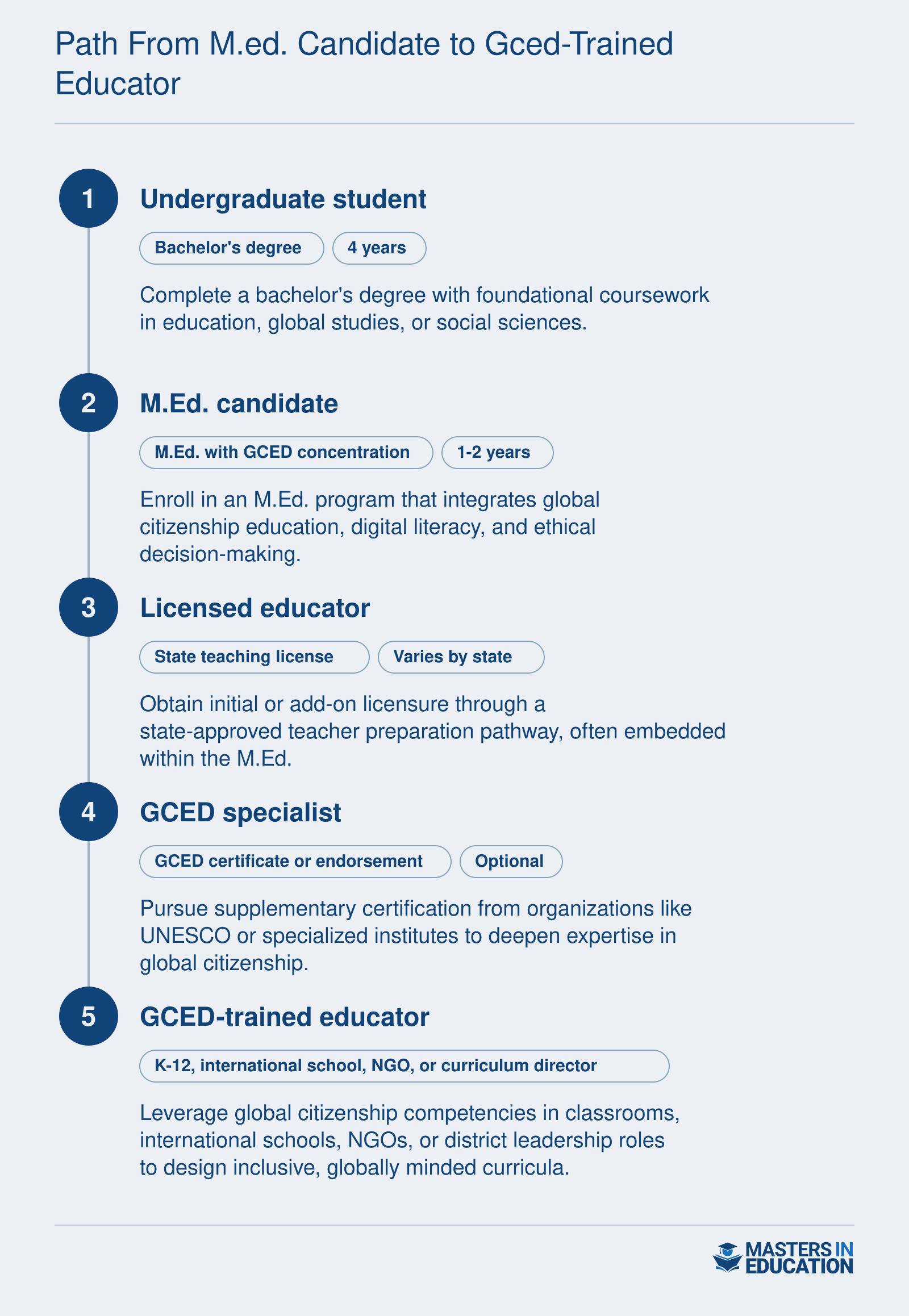
Path From M.ed. Candidate to Gced-Trained Educator
Choosing a Gced-Focused M.ed. Program: Key Questions to Ask
Finding the right M.Ed. program that emphasizes global citizenship education can feel overwhelming. These FAQs address the most pressing questions educators ask when evaluating graduate options in this growing field.
Some M.Ed. programs sideline global citizenship as a single multiculturalism seminar; others now embed it into every methods course, digital literacy module, and clinical experience. The explosion of digital hate speech, with 31.5 million posts removed by Facebook in one quarter, makes this no longer optional. Review the UNESCO 2024 guidelines, identify one GCED-aligned course in your target program, or ask a coordinator how the curriculum addresses digital ethics. For educators weighing the return on a graduate degree, comparing education job growth can clarify how GCED competencies translate into hiring advantage. As international schools and equity-focused districts seek educators who can navigate both physical and digital global challenges, the M.Ed. candidate who builds these competencies now is investing in career resilience, not just a better lesson plan.