

What you’ll learn in this article…
- Delaware has three M.Ed. providers: University of Delaware, Delaware State University, and Wilmington University.
- Annual tuition ranges from about $9,100 at Delaware State to over $20,000 at the University of Delaware.
- Delaware's three-tier licensure system rewards a master's degree with automatic advancement and higher salary placement.
- Specializations span school leadership, educational technology, literacy, special education, and STEM-focused concentrations.
Delaware has just three institutions offering CAEP-accredited master's in education programs, yet that small roster covers a surprisingly wide range of specializations: educational technology, school leadership, special education, curriculum and instruction, and more. Graduate tuition spans from about $9,100 per year at Delaware State University to over $20,000 at the University of Delaware, a gap that makes cost comparison essential.
For working teachers, the practical tension is real. Choosing between online M.Ed. programs, hybrid, and on-campus formats at so few schools means each program's structure, licensure alignment, and price tag carries outsized weight. Delaware's three-tier licensure system ties salary advancement directly to graduate credentials, so the financial stakes of picking the right M.Ed. are concrete and measurable.
Best Master's in Education Programs in Delaware: Ranked
Delaware's three graduate education providers each occupy a distinct niche: a flagship research university with broad online and hybrid options, the state's only HBCU with a social-justice lens on leadership, and a practice-oriented private university built for working teachers. Because program-level earnings data are not yet available for these M.Ed. offerings, we frame return on investment through institution-wide median graduate debt, school-level median earnings, and tuition figures. All three schools hold CAEP accreditation for at least some of their education programs.
- Graduate debt and tuition costs
- Institutional graduation and retention rates
- Program breadth and specialization options
- Delivery format flexibility
- Accreditation and licensure alignment
- NCES-IPEDS federal institutional data — nces.ed.gov
- College Scorecard graduate earnings — collegescorecard.ed.gov
- Internal program database
- Independent program research
| Rank | School | Location | Net price | Best for | |
|---|---|---|---|---|---|
| #1 | University of Delaware | Newark, DE | $15,000 – $20,000/yr | Tech-focused educators seeking online flexibility | |
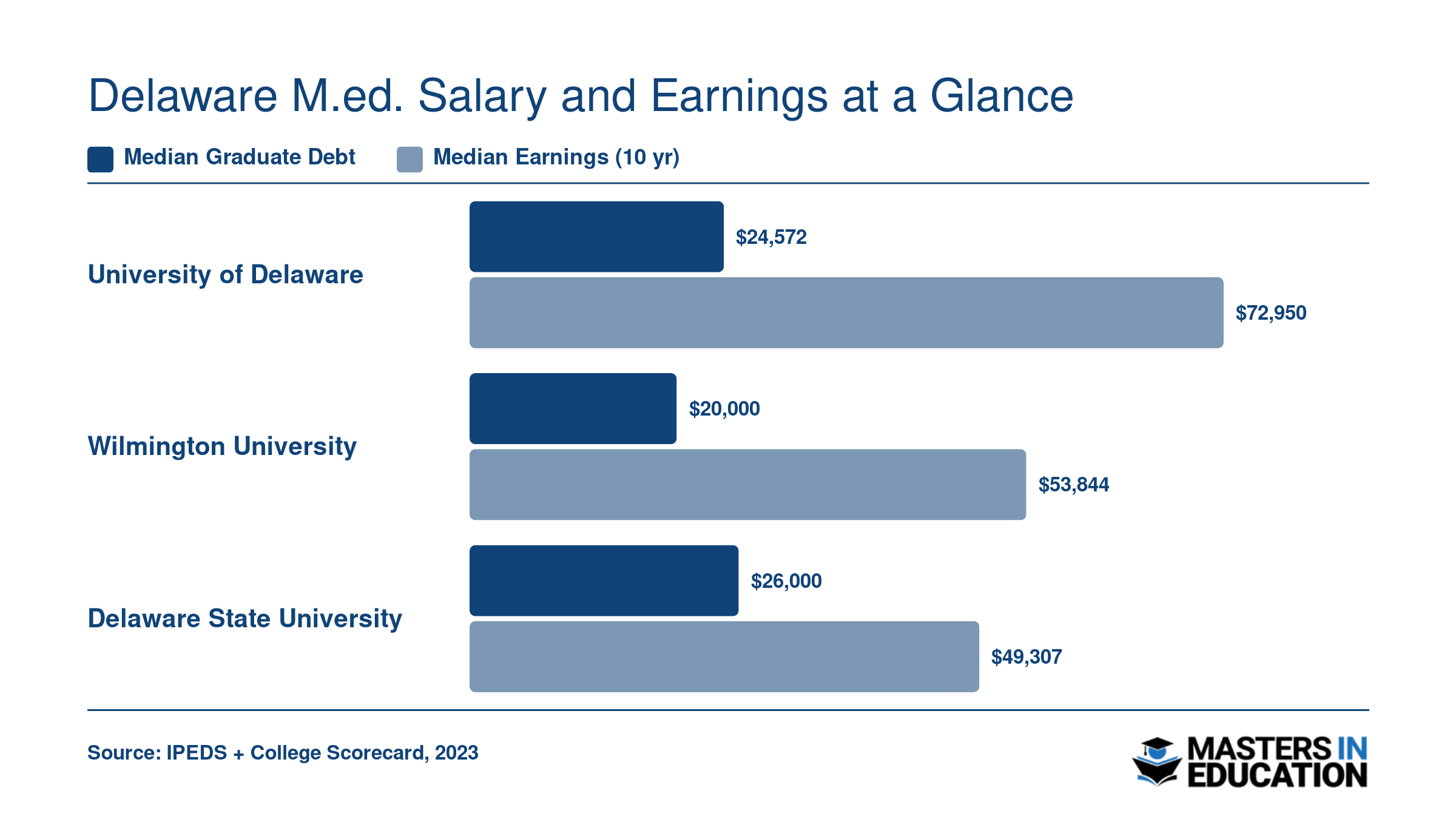
The University of Delaware's College of Education and Human Development offers multiple M.Ed. pathways, from a fully online Educational Technology degree to hybrid Special Education concentrations covering elementary, secondary, and autism/severe disabilities tracks. The school is consistently ranked among the nation's top education colleges, and its 80.6% institution-wide graduation rate is the highest in the state. With a median graduate debt of $24,572 and institution-wide median earnings of $72,950 ten years after enrollment, UD provides a strong long-term value proposition for Delaware educators.
| |||||
| #2 | Delaware State University | Dover, DE | $10,000 – $15,000/yr | Aspiring school leaders at an HBCU | |
Delaware State University, the state's only HBCU, grounds its education master's programs in equity, social justice, and community-centered leadership. The M.Ed. in Educational Leadership (K-12) and the M.Ed. in Adult & Higher Education both run in accelerated eight-week sessions, while the Master of Arts in Teaching offers a full-year classroom residency that leads to Delaware certification. In-state tuition starts at $9,114, making DSU the most affordable public option in the state, and median graduate debt sits at $26,000.
| |||||
| #3 | Wilmington University | New Castle, DE | ~$16,000/yr (est.) | Certified teachers seeking affordable advancement | |
Wilmington University is a private, open-access institution that emphasizes field-based preparation and practitioner readiness. Its M.Ed. in School Leadership can be completed in as little as one year and is approved for Delaware principal certification, while the Applied Technology in Education program is fully online and aligned with ISTE standards. With tuition at $9,726 regardless of residency and a median graduate debt of $20,000, the lowest among Delaware's M.Ed. providers, Wilmington is a cost-effective choice for certified teachers adding credentials.
| |||||


How Much Does a Master's in Education Cost in Delaware?
Tuition for a master's in education in Delaware ranges from roughly $9,100 to over $20,000 per year, depending on the institution and residency status. The cost spread is significant: Delaware State University offers the lowest in-state rate, while the University of Delaware sits at the higher end. Keep in mind that the average net price figures shown below are institution-wide averages and not guaranteed quotes for M.Ed. students specifically. Financial aid, graduate assistantships, and employer tuition reimbursement (a benefit many working teachers can access through their school districts) can significantly reduce what you actually pay out of pocket.
| School | In-State Tuition | Out-of-State Tuition | Avg. Net Price (Institution-Wide) | Median Graduate Debt |
|---|---|---|---|---|
| Delaware State University | $9,114 | $17,484 | $13,910 | $26,000 |
| Wilmington University | $9,726 | $9,726 | $15,644 | $20,000 |
| University of Delaware | $20,304 | $20,304 | $17,799 | $24,572 |
Online vs. On-Campus M.Ed. Programs in Delaware
Delaware's small geographic footprint means most educators are never far from a campus, yet the state's limited number of M.Ed. providers makes modality choice especially consequential. The University of Delaware offers a fully online M.Ed. in Educational Technology, while Delaware State University and Wilmington University both deliver hybrid formats that blend online coursework with in-person components. Understanding the tradeoffs helps you pick the format that fits your career and lifestyle.
- Online programs let full-time teachers complete coursework on their own schedule without adding a commute, even in a compact state with few campuses.
- Fully online options, such as UD's Educational Technology M.Ed., can carry a lower effective cost by eliminating commuting, parking, and relocation expenses.
- Hybrid models at Delaware State and Wilmington University combine online flexibility with structured face-to-face sessions for clinical placements and cohort interaction.
- On-campus and hybrid formats provide direct access to faculty mentorship, collaborative projects, and peer networking that deepen professional relationships.
- In-person or hybrid programs offer built-in clinical placement coordination, which is especially valuable for leadership tracks requiring supervised internship hours.
- A set class schedule in on-campus or hybrid programs creates accountability and routine, which many educators find easier to manage than self-paced formats.
- Fully online learners may feel isolated from peers and faculty, requiring strong self-discipline to stay engaged without regular in-person interaction.
- On-campus or hybrid schedules can conflict with full-time teaching responsibilities, particularly when courses meet during school hours or require midweek attendance.
- With only three primary M.Ed. providers in Delaware, campus-based students have fewer program and specialization choices than those willing to study online out of state.
- Online programs that rely on asynchronous delivery may offer limited real-time collaboration, making group projects and discussions harder to coordinate.
Related Articles
Delaware M.Ed. Specializations and Concentrations
Delaware's graduate education landscape may be compact, but the state's institutions offer a meaningful range of M.Ed. specializations that align with distinct career goals. Understanding which concentration fits your professional trajectory can save you time and tuition dollars.
School Leadership and Educational Leadership
If you aim to move from the classroom into administration, educational leadership is the clear path. Both Delaware State University and Wilmington University offer CAEP-accredited M.Ed. programs in this area. Delaware State's 36-credit Educational Leadership in K-12 program centers on equity and social justice while preparing candidates for principal and assistant principal roles. Wilmington University's Master of Education in School Leadership can be completed in one year or less and includes preparation for the School Leaders Licensure Assessment (SLLA), a requirement for Delaware principal certification. Both programs incorporate substantial clinical hours and field-based components. Graduates of these programs can explore a wide range of careers for masters in education beyond the principalship.
Educational Technology
The University of Delaware offers a 33-credit Master of Education in Educational Technology that is open to educators and non-educators alike. Coursework spans virtual reality, artificial intelligence, eLearning development, and mobile web design. This specialization suits instructional designers, technology coaches, and teachers who want to lead digital learning initiatives in their districts. The program is available fully online with synchronous and asynchronous options.
Curriculum and Instruction, Special Education, and Literacy
Curriculum and instruction concentrations are designed for classroom practitioners who want to deepen their pedagogical expertise without leaving teaching. Special education tracks are ideal for teachers pursuing a SPED endorsement or seeking the skills to serve students with diverse learning needs; those considering this path may also want to review accredited special education master's programs nationwide. Literacy and reading specializations prepare educators for roles as reading specialists or literacy coaches. These concentrations are available across Delaware institutions, though program names and credit requirements vary.
Accelerated and 4+1 Pathways
One option that competitors often overlook is the accelerated 4+1 pathway. The University of Delaware offers a 4+1 M.A. in Teaching English as a Second Language, which allows UD English majors to double-count credits between their undergraduate and graduate programs, reducing total time and cost.1 Eligible students must apply by March 1 of their junior year.2 This type of accelerated track is worth exploring early in your undergraduate career if you already know graduate school is part of your plan. Check with Wilmington University and Delaware State University for any similar accelerated options that may emerge, as institutions in this size range frequently expand these offerings to stay competitive.
Delaware Teacher Licensure and M.Ed. Pathways
Understanding how a master's degree fits into Delaware's licensure framework can help you plan your career trajectory and determine whether an M.Ed. is a strategic investment or a professional requirement.
Delaware's Three-Tier Licensure System
Delaware operates a three-tier licensure structure for educators.1 The Initial License is valid for four years and requires a bachelor's degree, passing scores on relevant Praxis content tests, and completion of clinical experience through student teaching or approved alternatives such as one year of long-term teaching (at least 91 days) or three years of substitute teaching (at least 91 days per year).2 New teachers also complete a Comprehensive Induction Program during this phase.
The Continuing License follows after four years of teaching experience and is valid for five years. The Advanced License, valid for ten years, is reserved for educators who earn National Board Certification.4
A master's degree is not required to move through these three license tiers. However, certain specialist certificates do mandate one, and holding an M.Ed. typically positions educators for higher salary steps on district pay scales. For a broader look at how graduate credentials interact with teaching licensure with master's in education, our resource guide covers the national landscape.
Specializations That Require or Lead to Specific Certificates
Several M.Ed. concentrations map directly to Delaware Standard Certificates or endorsements:5
- Reading Specialist: Requires a master's degree and leads to the Reading Specialist Standard Certificate.
- School Counselor: Also requires a master's degree, leading to the School Counselor Standard Certificate.
- Educational Leadership: Prepares candidates for Principal Certification.
- Special Education: Aligns with the Special Education Standard Certificate.
- Elementary Education: Maps to the Elementary Teacher (K-6) certificate.
- Secondary Education: Leads to a subject-area Secondary Standard Certificate.
- TESOL: Results in an ESL Endorsement.
If your goal is a role as a reading specialist, school counselor, or building administrator, a master's degree is not optional. It is a prerequisite for the credential itself.
Interstate Reciprocity for Tri-State Educators
Many Delaware educators live across state lines in Maryland, Pennsylvania, or New Jersey. Delaware participates in the NASDTEC interstate agreement, which streamlines the process of transferring a valid out-of-state license. Educators coming from MD, PA, or NJ can generally receive an Initial or Continuing License in Delaware based on their years of experience and current credentials. The process still requires verification of qualifications, so contacting the Delaware Department of Education early in the transfer process is advisable.
For educators who hold licenses in neighboring states and are considering an M.Ed. program in Delaware, this reciprocity means completing a Delaware-based program will not limit your ability to teach across the region. It also means that a master's degree earned to meet Delaware specialist certificate requirements can carry professional weight in adjacent states as well.
Delaware M.Ed. Salary and Earnings at a Glance
Program-level median earnings shortly after completion are not yet published for Delaware's M.Ed. programs. The figures below use each institution's median graduate debt alongside median earnings reported ten years after enrollment, giving you a single snapshot of debt versus long-term earning power across all three Delaware schools offering master's-level education degrees.
Career Outcomes and Salary Expectations for Delaware M.Ed. Graduates
Earning a master's degree in Delaware translates directly into higher pay, but understanding the full financial picture requires looking at district salary schedules, regional factors, and long-term return on investment.
The Master's Degree Pay Differential
Delaware's teacher compensation follows a structure built on a state base (set by Title 14 §1305) plus district supplements.1 Salary schedules across the largest districts use horizontal lanes (BA, BA+15, MA, MA+30, and so on) and vertical steps tied to years of experience. Moving from the bachelor's lane to the master's lane, often called a "lane change," produces an immediate and permanent salary increase.
In the Brandywine School District, for example, a first-step teacher with a bachelor's degree earns $49,761, while a teacher at the same step with a master's degree earns $55,997, a difference of $6,236 per year.2 At the second step, that gap widens slightly to $6,275.2 Across Delaware's largest districts, including Christina, Red Clay, Brandywine, and Capital, the master's pay differential generally falls within these ranges:
- Entry level (Step 0): $5,000 to $7,000 more per year
- Mid-career (Step 5): $5,000 to $8,000 more per year
- Experienced (Step 10): $6,000 to $9,000 more per year
These differentials compound over time because each subsequent step increase builds on the higher base in the master's lane. For a broader look at how these numbers compare nationally, see our masters in education salary guide.
Program-Level Earnings Data
Program-level earnings data for Delaware M.Ed. programs are not yet available at the one-year, two-year, or four-year post-graduation marks. However, institutional-level outcomes offer useful context. University of Delaware graduates across all programs report median earnings of $72,950 at ten years out, while Wilmington University graduates report $53,844. These figures span all degree levels and fields, so individual M.Ed. outcomes will vary depending on your specialization and career path.
Quantifying the ROI
Tuition for Delaware M.Ed. programs ranges from roughly $9,100 to $20,300 depending on residency status and institution. Taking Wilmington University's tuition of approximately $9,726 as an example, a conservative annual salary bump of $6,000 means the degree pays for itself within two years. Over a 10-year career, that same differential adds $60,000 to $90,000 in cumulative earnings, representing a strong return even when factoring in median graduate debt levels, which range from $20,000 to $26,000 at Delaware's main institutions. Educators considering a faster path to that ROI may want to explore one year m.ed programs that minimize time away from full-time teaching.
Regional Cost of Living and Earning Power
Delaware's northern districts sit within commuting distance of Philadelphia and the broader Wilmington metro area, where teacher salaries and cost of living both tend to run higher. Educators in New Castle County districts like Brandywine and Red Clay benefit from relatively competitive pay scales while enjoying a lower cost of living than their counterparts across the Pennsylvania or New Jersey state lines.3 Southern Delaware districts centered around Dover offer even more affordable living, though base salaries may be somewhat lower. This geographic flexibility gives Delaware M.Ed. graduates real leverage: you can teach in a well-compensated northern district while stretching your salary further than educators in neighboring states, or pursue roles in the Philadelphia metro market where your Delaware credentials and advanced degree carry weight.
Admissions Requirements for Delaware M.Ed. Programs
Getting into a master's in education program in Delaware starts with understanding what each institution expects. Requirements vary across the state's main providers, and knowing the details can help you build a stronger application and avoid last-minute surprises.
GPA and Testing Requirements
The University of Delaware sets a minimum undergraduate GPA of 3.0 for most M.Ed. applicants and has adopted a GRE-optional policy, meaning you can apply without submitting standardized test scores.1 While Wilmington University and Delaware State University also offer graduate education programs, prospective students should verify current GPA thresholds and testing policies directly with each institution, as these can shift from year to year.
At the University of Delaware, applicants are expected to submit three letters of recommendation.1 International applicants must demonstrate English proficiency with a minimum TOEFL iBT score of 79 or an IELTS score of 6.5.
Teaching Experience and Prerequisite Coursework
Teaching experience requirements depend on the specific program and concentration you choose. Some M.Ed. tracks at the University of Delaware require prior classroom experience, while others do not. If you hold a bachelor's degree in a field outside of education, the University of Delaware does accept non-education majors into certain programs, including initial licensure pathways.1 This is a significant advantage for career changers looking to enter the teaching profession through a graduate-level route. You can compare how other states structure their programs by exploring M.Ed. programs by state.
Application Deadlines and Start Dates
Deadlines for Fall 2026 entry at the University of Delaware vary by program and department, so checking with the School of Education early in the cycle is essential.1 Some programs admit students in cohorts with fixed start dates, while others offer rolling admissions. Starting your application well ahead of posted deadlines gives you the best chance of securing a spot, especially for competitive specializations.
Tips for a Strong Application
- Confirm program-specific requirements early: Even within the same university, different M.Ed. concentrations may have distinct prerequisites.
- Reach out to admissions advisors: A brief conversation can clarify whether your background qualifies you for a particular track.
- Prepare recommendation requests in advance: Give your recommenders at least four to six weeks to write thoughtful letters.
- Highlight relevant experience: Classroom teaching, tutoring, mentoring, and curriculum development all strengthen your candidacy, even if formal teaching experience is not required.
How to Choose the Right M.Ed. Program in Delaware
Selecting the right master's in education program is a decision that touches every part of your professional life, from your daily schedule to your long-term earning potential. Delaware's small but focused roster of M.Ed. programs means you can compare your options thoroughly before committing. Use the decision factors covered throughout this article to narrow your choices with confidence.
Align Your Career Goal with a Program Type
Start by identifying the outcome you want most. If you are pursuing a salary bump on your district's pay scale, a general M.Ed. or curriculum and instruction degree may be the most efficient route. If you plan to move into administration, look for programs that embed principal or school-leader certification coursework. Those seeking a specialization endorsement, such as a master's in reading and literacy or masters in special education, should confirm the program offers the exact concentration that maps to that credential. Matching your goal to the right program type prevents wasted credits and keeps your timeline on track.
Weigh Cost, Format, and Return on Investment
Tuition varies meaningfully across Delaware's graduate education programs, so compare net costs after factoring in employer tuition assistance, state-funded incentives, and financial aid. Decide whether an online, hybrid, or on-campus format fits your life. Online programs offer scheduling flexibility for working teachers, while on-campus cohorts can provide richer practicum experiences and peer networking. Balance affordability against the career ROI you expect: a lower-cost program that meets licensure requirements may deliver a stronger return than a premium option with features you will not use.
Verify Delaware DOE Approval
Before you enroll, confirm that the program is approved by the Delaware Department of Education for the specific licensure pathway you need. Not every M.Ed. program leads to a new certificate or endorsement, and requirements can change from year to year. Check the Delaware DOE's educator licensure page or contact the program's certification officer directly. This single step can save you from completing a degree that does not unlock the credential you planned on.
Take a Concrete Next Step
Once you have a short list, act on it. Request detailed program information from each school, attend a virtual information session, or reach out to an admissions counselor with specific questions about clinical placements and completion timelines. Use the cost and salary data presented earlier in this article to compare programs side by side. The sooner you gather firsthand details, the sooner you can make a confident, well-informed choice and move your teaching career forward.
Common Questions About M.Ed. Programs in Delaware
Below are answers to some of the most frequently asked questions about pursuing a master's in education in Delaware. For deeper detail on costs, specializations, licensure pathways, and salary data, refer to the corresponding sections earlier in this article.