
What you’ll learn in this article…
- California ranks among the bottom 12 states in preparing teachers to teach reading, per NCTQ 2026 report.
- SB 488 mandates a new literacy performance assessment for teachers, backed by a $1 billion state literacy investment.
- Online M.Ed. programs with science-of-reading emphasis can help California educators meet new certification and salary goals.
California ranks among the bottom 12 states for preparing future educators to teach reading, according to the National Council on Teacher Quality's 2026 literacy report. For M.Ed. applicants, that means a teaching credential alone no longer signals strong preparation. The state's own SB 488 mandates now require performance-based proof of evidence-based reading instruction, yet many in-state programs still fall short.
No California-based M.Ed. program currently leads the national online rankings, but top-rated online programs from outside California actively enroll and support California residents. These programs align their coursework with the science of reading research that California's new literacy assessments are designed to measure.
Reading specialist credential pathways, salary data, and program evaluation criteria all hinge on one truth: where you earn your M.Ed. degree determines whether you enter the classroom ready to teach reading or playing catch-up.
Best Online M.ed. In Reading & Literacy Programs for California Students
For California educators seeking to strengthen literacy instruction skills, these online M.Ed. programs offer evidence-based preparation aligned with today's science of reading standards. Each listed program accepts California residents and can be completed entirely online, providing flexibility for working teachers aiming for reading specialist roles.
- Graduate earnings data
- Institutional graduation rates
- Online delivery accessibility
- Program curriculum strength
- Internal program database
- NCES-IPEDS federal institutional data — nces.ed.gov
- College Scorecard graduate earnings — collegescorecard.ed.gov
- Independent program research
| Rank | School | Location | Net price | Best for | |
|---|---|---|---|---|---|
| #1 | University of Florida | Gainesville, FL | ~$7,000/yr (est.) | Time-crunched professionals needing fully online reading degree | |
The University of Florida's online M.Ed. in Reading Education equips practicing teachers with evidence-based literacy strategies. The 36-credit curriculum covers reading foundations, assessment, and ESOL methods, and graduates may pursue Florida K-12 Reading Certification independently.
| |||||
| #2 | University of Maryland-College Park | College Park, MD | $16,000/yr (net price) | Hands-on literacy learners seeking summer reading clinic | |
The University of Maryland's hybrid M.Ed. in Curriculum and Instruction with a Reading Specialist specialization blends online courses with on-campus clinics. Emphasizing equity and culturally responsive teaching, it includes a summer reading clinic and prepares graduates for Maryland reading specialist certification.
| |||||
| #3 | North Carolina State University at Raleigh | Raleigh, NC | $9,000 – $33,000/yr | Science-of-reading advocates seeking K-12 licensure | |
North Carolina State University's online M.Ed. in Curriculum and Instruction with K-12 Reading concentration is cohort-based and emphasizes the science of reading. Designed for working teachers, it offers evening classes and prepares graduates to add a K-12 Reading Specialist license by passing the Praxis exam.
| |||||
| #4 | Texas A & M University-College Station | College Station, TX | $13,000 – $40,000/yr | ||
Texas A&M University's online M.Ed. in Curriculum and Instruction with a Reading and Literacy emphasis offers both asynchronous and synchronous options. Students gain expertise in reading assessment, intervention, and leadership, with an optional Reading Specialist Certification track. An Early Start pathway allows undergraduates to begin graduate work during their senior year.
| |||||
| #5 | Grove City College | Grove City, PA | $22,000/yr | ||
Grove City College's online M.S. in Education in Reading Specialist emphasizes the science of reading and prepares certified teachers for Pennsylvania Reading Specialist Certification. The 30-credit asynchronous program focuses on literacy assessment, intervention, and coaching, and features rolling enrollment.
| |||||
| #6 | University of Central Florida | Orlando, FL | $10,000/yr | ||
The University of Central Florida's online M.Ed. in Reading Education is a 30-credit program aligned with ILA Standards for Literacy Professionals. It prepares students for the Florida Reading K-12 certification exam and includes coursework in developmental reading, assessment, and literacy leadership.
| |||||
| #7 | Auburn University | Auburn, AL | $13,000 – $35,000/yr | ||
Auburn University's online M.Ed. in Reading Education is developed by faculty who helped create the Alabama Reading Initiative, focusing on evidence-based instruction. The program does not lead to initial certification but prepares graduates for literacy coach or specialist roles. Note that it is not currently accepting applications.
| |||||
| #8 | CUNY Hunter College | New York, NY | $3,000/yr | ||
CUNY Hunter College's hybrid MSEd in Literacy Education (All Grades) prepares certified New York teachers for literacy specialist certification. The program focuses on equity-based, culturally affirming instruction and includes fieldwork in NYC public schools, addressing language and literacy diversity.
| |||||
| #9 | University of Delaware | Newark, DE | $15,000 – $20,000/yr | ||
The University of Delaware's fully online M.Ed. in Literacy is a 30-credit, part-time program delivered in 7-week terms. It covers writing instruction, digital literacies, and reading clinics, preparing students for Reading Specialist certification through the Praxis II exam.
| |||||
| #10 | James Madison University | Harrisonburg, VA | $23,000/yr | ||
James Madison University's online M.Ed. in Education with a Literacy Education concentration prepares experienced teachers for reading specialist and intervention roles. The 33-credit program includes practicums in literacy assessment and coaching, and qualifies graduates to sit for the Virginia Reading Specialist Praxis.
| |||||


California's NCTQ Literacy Report Card: What the 2026 Findings Mean for M.ed. Applicants
California ranks among the bottom 12 states nationwide for preparing future educators to teach reading, according to the National Council on Teacher Quality's 2026 report 'Decoding Progress in Reading Preparation.'1 For M.Ed. applicants, this signals that not all graduate-level teaching programs deliver the literacy training needed to succeed in California classrooms. The report evaluated coursework from 52 elementary teacher preparation programs that chose to participate; 37 others declined to submit materials for review.
Grade Distribution Reveals Wide Variation
Among the 52 programs that opened their curricula to scrutiny, fewer than a quarter (less than 25%) earned an A. The full breakdown: 13% received a B, 23% a C, 6% a D, and a striking 35% received an F.1 This uneven performance underscores that even within a single state, program quality can differ dramatically. An applicant cannot assume that any California-based M.Ed. will provide strong literacy preparation; the program's specific approach matters enormously.
Rapid Improvement Possible, Prestige Not Guaranteed
The trajectory of individual institutions reveals that change is possible. The Stanford Graduate School of Education improved from an F in the 2023 NCTQ review to an A+ in 2026, demonstrating that programs can rapidly align their coursework with evidence-based reading instruction.1 At the same time, the UCLA Teacher Education Program received an F, proving that a prestigious university name does not guarantee effective literacy training. For M.Ed. applicants, program grade, not school brand, should guide the decision.
California vs. the Nation
Nationally, 53% of teacher preparation programs earned an A or A+ in 2026, more than double the 2023 rate of 26%.1 California, by contrast, lags far behind this national trend. The state's programs are not yet matching the rapid improvement seen elsewhere, leaving many future educators without adequate grounding in the science of reading.
What This Means for Your Program Search
This finding has a direct implication: an online M.Ed. from a high-performing state may offer stronger literacy foundations than a prestigious but low-scoring California institution. Look beyond location and name recognition. Reading specialist certification requirements and program content should both be on your checklist; research whether a program explicitly teaches phonemic awareness, phonics, fluency, vocabulary, and comprehension , the five pillars of evidence-based reading instruction , and whether it avoids practices not supported by research.2 For a detailed look at the California results, see EdSource's analysis of the 2026 NCTQ report.
How California Is Raising the Bar: SB 488 and the $1 Billion Literacy Investment
State mandate versus independent audit: California's approach to literacy training quality now runs on two tracks. The first is SB 488, a law that requires every new multiple-subject and education specialist candidate to demonstrate evidence-based reading instruction skills before earning a credential.1 The second is the NCTQ report card, which grades programs on whether they actually teach those practices. For M.Ed. applicants, both forces shape which programs will prepare them to meet the state's bar, and whether that preparation will hold up under independent scrutiny.
From RICA to Performance-Based Literacy Assessments
As of July 2025, the long-standing Reading Instruction Competence Assessment (RICA) was retired and replaced by a set of CTC-adopted literacy performance assessments.2 For candidates in the 2026-2027 cycle, the requirement is clear: you must pass one of these assessments, either the CalTPA Literacy Performance Assessment, the edTPA Multiple Subject Literacy with Mathematics or Education Specialist Literacy version, or the FAST literacy assessment, or qualify for the Foundations of Reading exam if you meet specific eligibility rules.2 These assessments are embedded in teacher preparation programs, meaning your coursework and clinical practice must build the skills to analyze student reading data, deliver explicit phonics instruction, and support English learners and struggling readers.
How SB 488 Redefines Program Approval
SB 488 didn't just change what candidates do; it required programs to earn state certification under updated literacy standards.3 Starting in the 2024-2025 academic year, all Preliminary Multiple Subject and Education Specialist programs, including those for mild/moderate support needs, extensive support needs, early childhood special education, and deaf/hard of hearing, had to prove their curriculum aligns with California's new Teaching Performance Expectations (TPEs) for literacy.3 The California Commission on Teacher Credentialing (CTC) reviewed program coursework against EC §44259(b)(4)(A) and (B) and provided technical assistance from fall 2023 through fall 2025 to help programs comply.3 This means that by 2026, any M.Ed. or certification pathway leading to those credentials must embed the science of reading throughout its sequence, not treat it as a single course bolted onto the end.
The $1 Billion Backdrop: Coaches, Training, and Accountability
While SB 488 tightened requirements at the credentialing level, California simultaneously poured roughly $1 billion into literacy since 2020: $500 million for literacy coaches placed in schools, $200 million for teacher training, and hundreds of millions more for early screening and intervention.1 This investment creates a pipeline that expects newly licensed educators to arrive with strong literacy foundations. M.Ed. applicants should understand that the state isn't just setting a bar; it's building the infrastructure to support that bar, and schools are hiring reading specialists and literacy coaches who can work inside that framework.
What the NCTQ Scores Miss , and What They Get Right
Some educators argue that SB 488's performance assessments are more rigorous than NCTQ's methodology because they require candidates to demonstrate teaching competency in real or simulated contexts, not just pass coursework reviews. Yet the NCTQ grades still offer a valuable signal: programs that earned an A or A+ in 2026, like Stanford, are overwhelmingly aligned with evidence-based instruction, while those with F grades often devote minimal time to English learners and struggling readers. The state certification process checks for structural compliance; the NCTQ report checks for instructional depth. Both matter, and forward-looking M.Ed. candidates will use both filters.
Ask Every Program This Question
When you explore an M.Ed. in reading or literacy, ask specifically: "How does your curriculum map to California's SB 488 literacy TPEs, and which performance assessment does your program administer?" The answer tells you whether the program treats the teacher certification exam as an afterthought or as an integrated outcome. Because by the time you complete your credential in the 2026-2027 cycle, you will need to pass one of these assessments. A program that can't articulate its alignment, or that earned a low NCTQ grade despite state certification, should prompt a second hard look.
The Science of Reading Vs. Balanced Literacy Debate: Why It Should Drive Your Program Search
What is the science of reading, and why does it matter when you compare M.Ed. programs?
For educators, the science of reading is not a single program or product. It is a decades-deep body of cognitive research that explains how the brain learns to read. At its core, this research points to a set of necessary skills: phonemic awareness (hearing and manipulating individual sounds in words), systematic phonics (linking sounds to letters and blending them), fluency, vocabulary, and comprehension. Effective reading instruction teaches these components explicitly and sequentially, leaving little to chance. Balanced literacy, by contrast, often de-emphasizes explicit phonics in favor of a more incidental approach, where students are encouraged to use multiple cues, such as pictures and context, to guess at words. The evidence is clear that this guessing approach can hold back many children, especially those who struggle.
How the NCTQ grades line up with instructional philosophy
The 2026 NCTQ report card for California teacher prep programs shows a pattern that M.Ed. applicants should know: programs earning A or B grades consistently embed structured literacy in their coursework, while those receiving D or F grades often continue to rely on balanced literacy frameworks. Specifically, programs that dedicate real instructional time to phonological awareness, decoding strategies, and systematic phonics scored higher. For candidates, this is a reliable signal. A program that claims to support all learners but still centers balanced literacy may leave you underprepared for today's classrooms.
California's glaring gaps for English learners and struggling readers
Two figures from the NCTQ report stand out: 60% of California programs devoted fewer than two hours of instruction to supporting English learners, and 37% spent fewer than two hours on how to teach struggling readers.1 These are red flags in any program a candidate evaluates. California serves one of the largest populations of multilingual students in the country, so a program that skims over these topics is not giving you the tools you need for the actual job market. Look for programs that integrate English learner strategies and reading intervention methods throughout their curriculum, not just as a single guest lecture.
What to look for in an M.Ed. program's literacy training
As you compare programs, use a practical filter. If you are considering a master's in reading and literacy, confirm that required courses explicitly cover phonological awareness, decoding, and multisensory instruction.
- Language matters: If a program uses the term "structured literacy" and names specific methods like Orton-Gillingham or LETRS, that is a positive indicator.
- Coursework check: Ensure required courses explicitly cover phonological awareness, decoding, and multisensory instruction.
- Practicum placements: A strong program provides supervised, hands-on experience with diverse learner populations, including English learners and students with dyslexia.
- Recent revisions: Ask whether the program updated its literacy curriculum after 2023, when California's SB 488 kicked in.
California is gaining ground but still playing catch-up
Nationwide, the 2026 NCTQ data reflects a sea change: more than double the number of teacher prep programs earned A or A+ grades compared to 2023.1 States that adopted science-of-reading mandates early, such as Mississippi and Colorado, are leading the pack. California, with its recent $1 billion literacy investment and SB 488, is moving in the right direction, but it ranks among the bottom 12 states for reading preparation. For M.Ed. applicants, this means program choice matters enormously. You can align yourself with the growing majority of programs that follow the research, or risk entering the classroom with outdated methods. Understanding reading specialist requirements and certification can help you identify which programs truly prepare you for this work. The programs highlighted on mastersineducation.org are chosen specifically because they anchor their literacy training in evidence-based practice, giving you a head start in a state that is rapidly raising its standards.
Questions to Ask Yourself
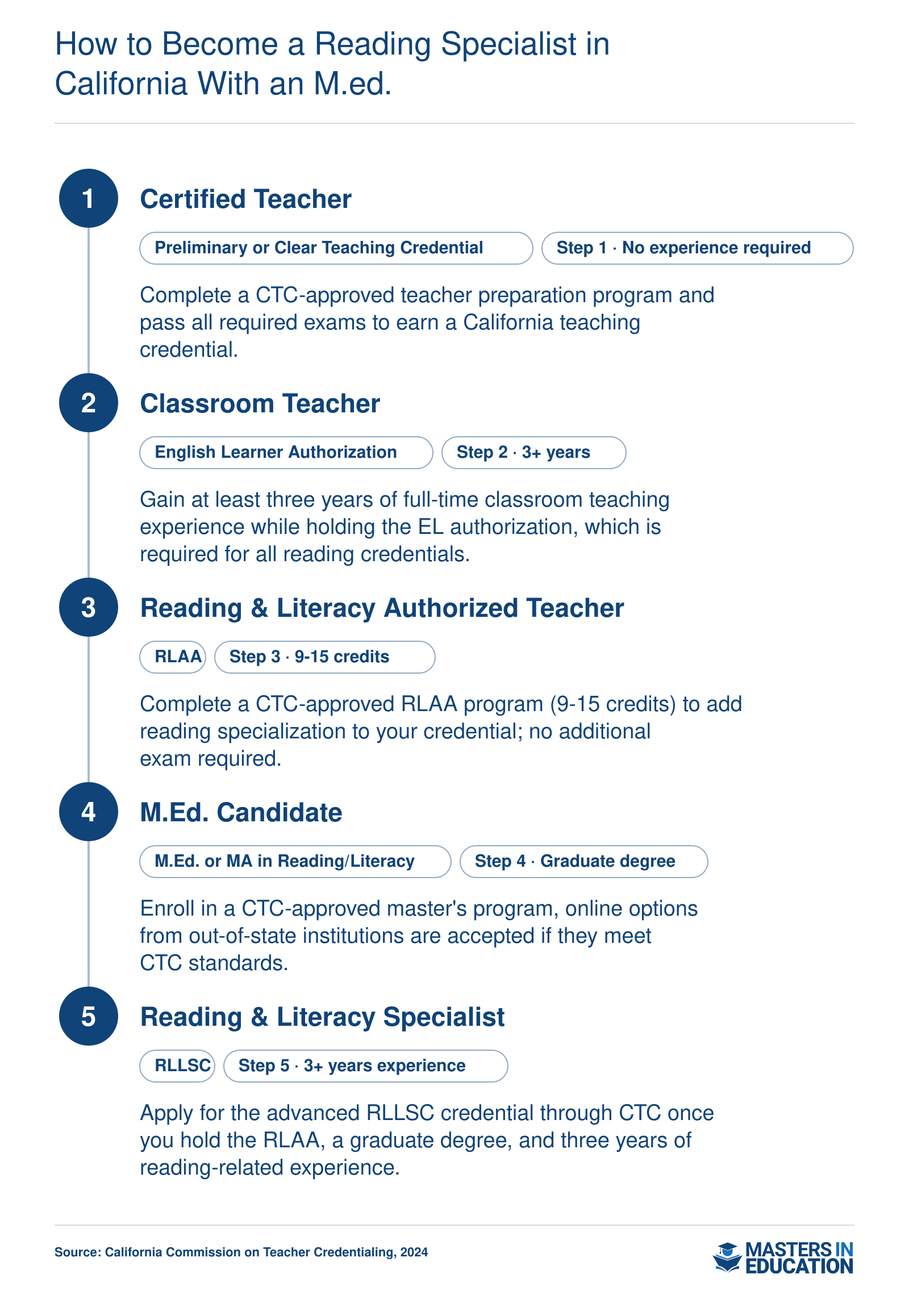
How to Become a Reading Specialist in California With an M.ed.
California offers two levels of reading credentialing: the Reading and Literacy Added Authorization (RLAA) for classroom teachers and the advanced Reading and Literacy Leadership Specialist Credential (RLLSC) for instructional coaches and literacy leaders. Both paths begin with a clear teaching credential and require verified classroom experience.
RLAA Vs. RLLSC: Which California Reading Credential Does Your M.ed. Unlock?
California offers two distinct teaching credentials for educators wanting to specialize in reading instruction. The Reading and Literacy Added Authorization (RLAA) is a shorter, targeted add-on to an existing teaching credential, while the Reading and Literacy Leadership Specialist Credential (RLLSC) is an advanced standalone credential that positions you for coaching and program leadership roles.1 Understanding their differences helps you choose the M.Ed. program that aligns with your career goals.
RLAA: The Added Authorization
The RLAA allows you to provide specialized reading instruction within your current teaching scope. Key details: - Eligibility: You must hold a valid California teaching credential and have completed at least three years of full-time teaching experience.1 - No exam required: The RLAA does not require a separate state exam, though programs include their own performance assessments. - Time to complete: Programs typically take one to two semesters, making this the faster on-ramp for adding reading expertise. - Authorized roles: With this authorization, you can work as a reading interventionist, Title I reading teacher, or provide targeted literacy support, but you are not authorized to independently lead schoolwide literacy programs.
RLLSC: The Leadership Specialist Credential
The RLLSC is designed for educators aiming to become literacy coaches, coordinators, or curriculum specialists. Note: - Eligibility: Program entry requirements vary; many require a teaching credential and some post-teaching experience, but specific years are set by each program rather than state mandate.1 - No exam required: Like the RLAA, no state exam is mandated. Programs evaluate competency through coursework and fieldwork. - Time to complete: Often embedded within a full master's degree, this credential may take two or more years, depending on whether you pursue it alongside an M.Ed. - Authorized roles: The RLLSC qualifies you to design and lead literacy programs, coach colleagues, and serve as a school or district literacy specialist. It is the state-recognized leadership credential in reading.
How Your M.Ed. Fits In
Most online M.Ed. programs with a reading or literacy focus are intentionally designed around RLLSC standards. While a master's degree is not legally required for either credential, completing an M.Ed. simultaneously with the RLLSC program streamlines your path to both the credential and the graduate degree. If your goal is the simpler RLAA, some programs offer a shorter, non-degree sequence. For a broader look at reading specialist requirements and certification, the roles each credential unlocks, and how salaries differ, confirm with your program's credential advisor that coursework aligns with the specific authorization you need, as state requirements can shift and some programs may not offer the RLAA track.
Reading Specialist Salary and Career Outcomes in California
Reading specialists and literacy coaches in California, often classified under BLS category Instructional Coordinators, earn a statewide mean annual wage of $92,940. While median salary data is not published at the metro level for this specific occupation, the available figures highlight notable geographic variation. For educators weighing an M.Ed. investment, moving from a classroom teacher salary schedule to a specialist lane typically adds $10,000 to $20,000 or more annually, with online program tuition ranging from roughly $15,000 to $30,000, making the return on investment achievable within a few years.
| Location | Total Employment | Mean Annual Wage |
|---|---|---|
| California (Statewide) | 15,470 | $92,940 |
| Los Angeles-Long Beach-Anaheim, CA | 4,030 | $83,240 |
| San Jose-Sunnyvale-Santa Clara, CA | 840 | $107,180 |
| Napa, CA | 60 | $107,950 |
What California Reading Specialists Actually Earn
California reading specialists with an M.Ed. and RLLSC credential often earn above the median for classroom teachers.
Related Articles
How to Evaluate an M.ed. Program's Literacy Training Quality
What concrete questions can you ask to separate a rigorous literacy-focused M.Ed. from one that skims the surface? With California's $1 billion investment in literacy and new teacher performance assessments, the stakes are high. Use the five criteria below as a scorecard when comparing programs.
1. Does the curriculum explicitly align with the science of reading?
Look for courses that name-check phonemic awareness, phonics, fluency, vocabulary, and comprehension, the five pillars of evidence-based reading instruction. Programs still leaning on balanced literacy or three-cueing models should raise concern. NCTQ grades can be a useful shortcut, but go further: request a syllabus and check whether assignments require you to design lessons grounded in structured literacy. A M.Ed. in reading and literacy that names these pillars explicitly in its learning outcomes is a stronger signal than one that buries them in generic coursework descriptions.
2. How many instructional hours are devoted to English learners and struggling readers?
The 2026 NCTQ report found that 60% of California programs devoted fewer than two hours of instruction to supporting English learners, and 37% spent fewer than two hours on struggling readers.1 Given that nearly one in five California students is an English learner, any program offering fewer than four hours of dedicated coursework in this area is a red flag. Ask for contact hours, not just topics listed. If a program can't quantify this, treat it as a warning sign.
3. Does the program include a structured practicum with diverse learners?
A high-quality practicum places you in classrooms with both native English speakers and English learners, including students with dyslexia or other reading difficulties. You need supervised practice delivering evidence-based interventions and receiving feedback. Confirm that the clinical experience is not just an add-on, but is woven into the degree with clear evaluation tied to California's student population.
4. Is the program recognized for the RLAA or RLLSC credential?
Not every M.Ed. automatically satisfies California Commission on Teacher Credentialing (CTC) requirements for the Reading and Literacy Added Authorization (RLAA) or the Reading and Literacy Leadership Specialist Credential (RLLSC). Understanding reading specialist requirements before you enroll can save you from discovering gaps after graduation. Verify that coursework and fieldwork align with CTC standards so your degree directly leads to the credential you need, without extra courses later.
5. What was the program's NCTQ grade, and if not reviewed, why?
Thirty-seven California programs declined to submit materials for the 2026 NCTQ review.1 A declined review is not an automatic disqualifier, but it warrants a candid conversation. Ask why the program opted out and request alternative quality evidence: self-study data, graduate literacy outcomes, or alumni surveys on preparedness. A credible program will offer concrete metrics, not just testimonials.
A Practical Step Before You Apply
Email the admissions office and ask directly: "Is your curriculum aligned to California's SB 488 literacy teaching performance assessment and CTC standards for the RLLSC?" The answer, or lack of one, reveals a lot. Programs that have invested in science-of-reading training will welcome the question; those that haven't may deflect. Use this one question as your initial litmus test.
Frequently Asked Questions About M.ed. Literacy Programs for California Students
Choosing an M.Ed. program that aligns with California's literacy standards is crucial for career impact. These answers address the most common questions aspiring reading specialists have about programs, credentials, and outcomes.
More Online M.ed. Reading & Literacy Programs for California Students to Consider
Beyond the top 10, these additional online programs offer quality literacy training that can be completed from anywhere, making them strong options for California students. All are nationally available and worth adding to your application list.