
What you’ll learn in this article…
- Starting teacher salary rises to $48,000 after 8% raise.
- Literacy funding expands early-grade reading and educator training.
- Master's degree no longer guarantees automatic pay supplement since 2013.
North Carolina's General Assembly enacted a $34.4 billion state budget on July 2, 2026, channeling $19.4 billion to education. For teachers, the centerpiece is an average 8% raise that brings the state's starting salary to just below the national average.
The salary gains come alongside continued income tax cuts and a ballot measure to cap local property taxes, which may constrain school funding in future years. While literacy investments create roles for reading specialists, the budget again omits an automatic master's pay premium. For advanced-degree candidates, North Carolina's offer is competitive but requires navigating these trade-offs.
Overview of the 2026 NC Budget for Education
The $34.4 billion state budget enacted on July 2, 2026, directs $19.4 billion to education, with $12.5 billion specifically for K-12 public schools. Governor Josh Stein is expected to sign the measure, putting these allocations into effect for the 2026-27 school year, as reported by EdNC1.
A Significant Share for K-12
The $12.5 billion K-12 allocation accounts for approximately 36% of the total budget, making it the largest single category of state spending. This sustained investment directly supports classroom essentials: teacher and staff salaries, instructional materials, technology upgrades, and facility maintenance. For current educators, it translates into more stable staffing levels and improved classroom conditions; for those considering a teaching career, it reflects a state that places a concrete financial priority on public schools.
Targeted Investments in Literacy and Research
Beyond general funding, the budget explicitly prioritizes literacy, math, and research initiatives. These targeted programs signal where districts are likely to hire new specialists. Educators with advanced training, such as a master's in reading and literacy or curriculum and instruction, stand to benefit from this focus. Schools need literacy coaches, interventionists, and data analysts who can turn research into practice. The budget's emphasis directly boosts careers for masters in education graduates in these areas.
Strengthening the Early-Childhood Pipeline
An additional $97 million in recurring federal funds will raise reimbursement rates for subsidized child care providers. While not part of the K-12 budget, this investment strengthens the early-childhood workforce and improves school readiness. For K-3 teachers, better-prepared students mean more effective instructional time, reducing the need for remediation and supporting the overall literacy goals of the state.
Teacher Salary Increases: How Much More Will You Earn?
An 8% raise grabs headlines, but the real question is whether it changes your financial future as a North Carolina teacher. The 2026-27 budget delivers a meaningful step forward, pushing the starting salary just below the national average for the first time in years. For current and aspiring educators, including those pursuing M.Ed. programs in North Carolina, the numbers below show exactly how your paycheck is set to grow.
Base Salary by Years of Experience
The state-funded salary schedule now provides step increases for each year of service, with no more multi-year freezes. Here is what you can expect at key experience milestones:1
- 0 years: $52,644 annually ($4,387 monthly)
- 1 year: $53,604 ($4,467 monthly)
- 2 years: $54,576 ($4,548 monthly)
- 3 years: $55,536 ($4,628 monthly)
- 25+ years: $71,844 ($5,987 monthly)
Salaries continue to rise between these points, and the full schedule rewards longevity. A teacher with 10 or 15 years of experience can expect to fall in the mid-to-high $60,000s, though exact figures vary slightly by district.
Bonuses and One-Time Payments
The enacted budget also includes retention bonuses for all eligible teachers. If you have 15 or fewer years of experience, you will receive a one-time payment of $500. Those with 16 or more years of service get a $1,000 bonus. These payments are in addition to the base salary increases and are not prorated for part-time employees.2
Local Supplements Can Boost Your Pay
State salary is only part of the picture. Most North Carolina districts add a local supplement, which averages between $7,000 and $8,000 per year. In some counties, the supplement can push total compensation well above $60,000 for early-career teachers. Last year, the average total salary for teachers, including supplements, was $59,971. With the new raises, that figure is expected to climb past $63,000.3
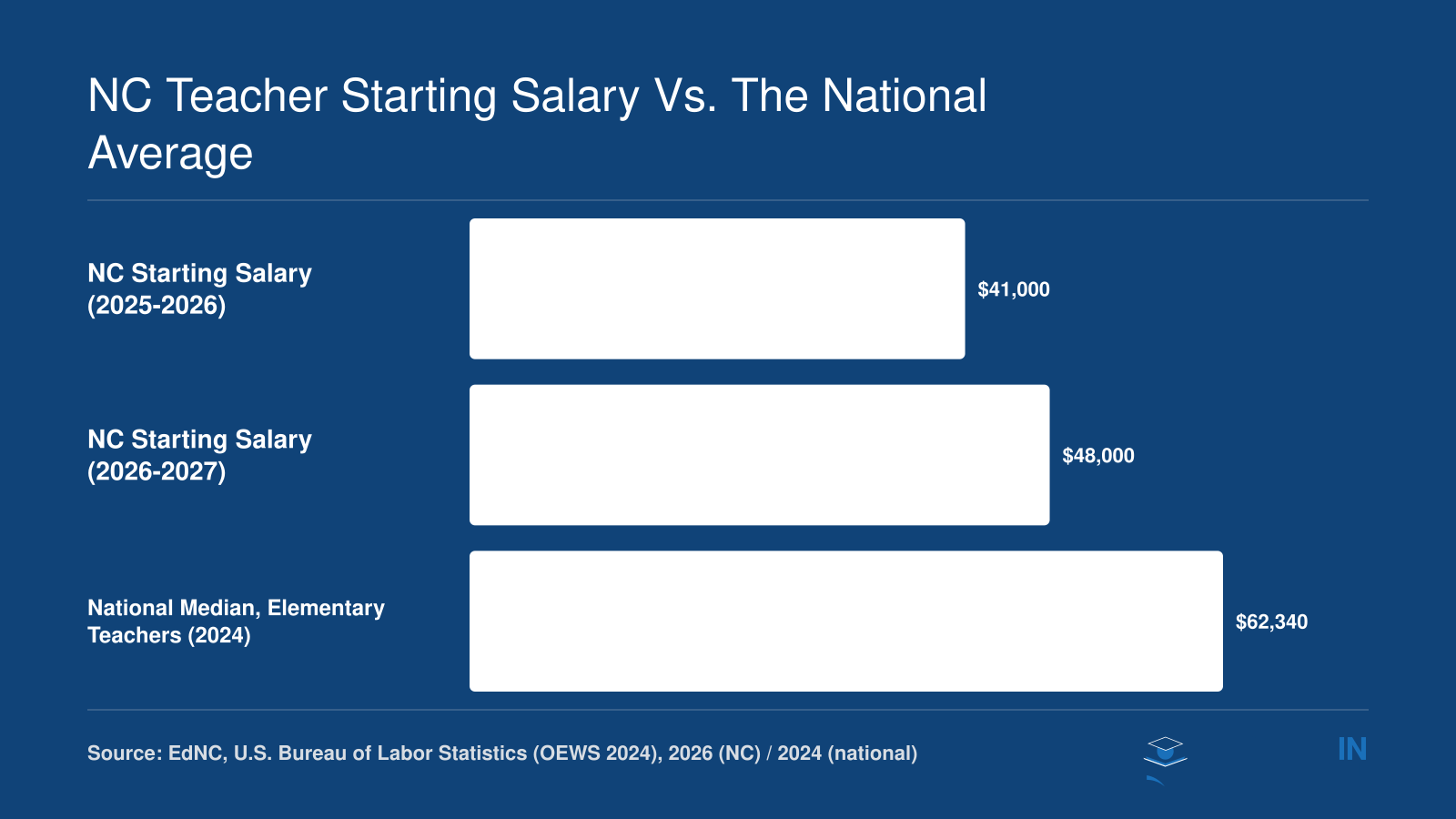
NC Teacher Starting Salary Vs. The National Average
The 2026-2027 state budget raises the base starting salary for North Carolina teachers to $48,000, up from $41,000 the previous year. This 8% increase narrows the gap with the national median for elementary school teachers ($62,340), making NC more competitive in attracting new educators. With local supplements, many teachers start closer to $53,000.
Literacy Funding: New Investments in Reading Programs
Piecemeal reading interventions have long been a stopgap in North Carolina classrooms, but the 2026 budget shifts toward a coordinated state literacy strategy with sustained, multi-year investments. The enacted spending plan directs substantial resources to early-grade reading, professional development, and direct student services, creating immediate demand for educators with specialized literacy training.
Where the new literacy dollars are going
The budget carves out more than $69 million across five distinct literacy initiatives. The largest single item is $31.2 million for K-8 literacy interventions, funding intensive support for struggling readers well beyond the primary grades.1 Summer reading camps receive $23 million to prevent backsliding for students identified as needing extra help.1 A $13.8 million appropriation targets middle school literacy professional development, acknowledging that the reading gap widens if not addressed in the upper elementary and middle years.1 Smaller but strategic allocations include $1.4 million to expand the DIBELS diagnostic screener into grades 4 and 5,2 and $500,000 for a Just Right Reader pilot that puts evidence-based decodable texts into the hands of early readers.2
Professional learning that builds career pathways
These dollars flow not just to student programs but to the educators who deliver them. The middle school literacy PD and embedded coaching models align with the state’s sustained commitment to the science of reading. North Carolina continues to invest in training like Literacy Essentials for Teachers and Administrators (LETA) and similar initiatives that equip educators with structured literacy methods. For teachers, this translates into fully funded professional growth and a clear incentive to pursue advanced credentials in reading.
Why an M.Ed. in reading is suddenly more valuable
School districts receiving new literacy coach positions and interventionist roles are actively recruiting, and they prioritize candidates who hold reading specialist certification, often earned through an M.Ed. in Literacy or Curriculum and Instruction with a concentration in reading. The state’s early-literacy emphasis in K-3, grounded in the science of reading, means that every elementary school is expected to have at least one highly trained reading expert. With the new funding, districts can finally create or expand those roles. For an M.Ed. graduate, this is a direct pathway into a teacher leadership position that commands a master’s degree pay premium while making a measurable difference in student outcomes.
M.ed. Pay Premium: Does a Master's Degree Still Pay Off in NC?
A master's degree in education once guaranteed a permanent salary bump in North Carolina, but since 2013, most new teachers haven't received an automatic supplement for advanced degrees.5 The 2026 state budget does not change that policy,1 leaving many M.Ed. holders to wonder if the degree still delivers a financial return.
The Status of Master's Pay in the 2026 Budget
Governor Josh Stein proposed restoring the master's pay supplement,4 but the final budget did not include new salary schedule rows for graduate degrees.1 Teachers hired after the 2013 cutoff remain ineligible for an automatic increase tied solely to a master's credential. The budget instead focused on raising base pay across all experience levels with an average 8% increase, bringing the starting salary to $48,000.1
What Grandfathered Teachers Receive
Educators who earned their master's and were hired before the 2013 cutoff continue to receive a monthly supplement. In 2025, that amounted to 10% of base pay plus an additional $350 flat amount each month.2 This supplement remains in place for those grandfathered employees, offering a clear financial incentive that newer hires do not share.
Calculating the Career Advantage of an M.Ed.
Without an automatic supplement, the direct salary difference for a first-year teacher with a master's versus a bachelor's is negligible on the state scale. However, over a 20- to 30-year career, teachers who leverage their M.Ed. to move into specialized roles often see substantial earnings growth, as the education job growth comparison illustrates. For example, literacy specialists, instructional coaches, and administrators typically sit on separate salary schedules that reward advanced degrees and added responsibilities. A reading specialist funded through the new literacy initiatives could command a salary well above the classroom teacher maximum, reflecting broader master's in education salary trends.
Specialized Credentials Pay Off Beyond Base Salary
The state's renewed focus on literacy, math, and research creates demand for educators with expertise in these areas. An M.Ed. in reading, ESOL, or special education positions you for roles that not only pay more but also offer greater job security. Additionally, pursuing National Board Certification, which carries a 12% supplement,3 is more attainable with graduate-level training and can add tens of thousands of dollars across a career.
For new teachers, the return on an M.Ed. isn't guaranteed by a line on the salary schedule. But by targeting high-need specializations and leadership pathways , a key strategy outlined in how to choose a masters in education specialization , the degree remains a powerful tool for moving up the earnings ladder in North Carolina education.
Related Articles
How NC Teacher Pay Compares to Neighboring States After 2026 Raises
North Carolina's 8% average teacher raise for 2026 propels its starting salary to $50,000, placing it ahead of neighboring South Carolina, Georgia, and Tennessee based on their most recently published salary schedules. While Virginia's average teacher pay remains higher, its starting salary is not directly comparable due to locality-based funding. For M.Ed. candidates, NC's improving competitiveness is a tangible advantage, especially when combined with local salary supplements in urban districts like Wake and Mecklenburg.
State
North Carolina South Carolina Tennessee Georgia
Estimated Starting Salary
$50,000 (2026-2027) $48,500 (2025-2026) $47,000 (2025-2026) $43,600 (2025-2026)
Long-Term Fiscal Outlook: Tax Cuts and Future Education Funding
Teacher compensation in North Carolina has advanced with the 2026 budget, but the state's fiscal direction remains shaped by ongoing tax policy decisions that could influence education funding capacity in the years ahead. The recently passed budget funds an 8% average raise and targeted literacy and math initiatives, yet it also continues a path of reducing personal income tax rates and eliminates the corporate income tax by 2030.1 While immediate classroom needs are addressed, the long-term revenue trajectory merits careful attention from educators planning their careers.
Understanding the Tax Policy Context
North Carolina's personal income tax rate is scheduled to decline further in coming years, and the corporate income tax is set to be fully phased out by 2030. These changes will reduce general fund revenues that historically support K-12 education. Even with current economic growth, structural reductions in tax collections can create tighter budget environments for future legislatures. For teachers and M.Ed. graduates, this means that salary gains won this year are not guaranteed to continue at the same pace, especially if overall state revenues grow more slowly or decline. Independent fiscal analysts, such as the NC Budget & Tax Center, periodically release reports examining how tax policy affects public services; these nonpartisan sources can help you track projected revenue trends and their potential impact on education.
Monitoring Local Funding Sources
Local school districts rely heavily on property taxes, and the November 2026 ballot measures would limit how much local governments can raise through this mechanism. If voters approve property tax caps or growth restrictions, districts could face constraints on supplementing state funding, potentially affecting teacher supplements, facility improvements, and program expansions. The exact language of the ballot proposals and their estimated fiscal impact are available through county election boards and analysis by organizations like the North Carolina Association of County Commissioners. Checking your district's budget documents and attending school board meetings provides direct insight into how these measures could reshape local resources.
Resources for Staying Informed
To make proactive career and education decisions, focus on authoritative, publicly accessible data sources:
- State budget details: The North Carolina General Assembly's website posts enacted budgets and fiscal research summaries. Look for the nonpartisan Fiscal Research Division's reports on education appropriations.
- Teacher salary data: The Bureau of Labor Statistics (BLS.gov) offers national, state, and metropolitan area wage data for educators, updated annually. This lets you compare NC pay to other states and historical trends.
- Professional advocacy groups: Organizations like the North Carolina Association of Educators (NCAE) provide analysis of policy changes and their effect on teacher working conditions and pay.
- Local school district websites: Many districts publish budget overviews and salary schedules, helping you see how state-level changes translate to your specific area.
By combining state revenue projections, local ballot outcomes, and national wage benchmarks, you can build a clearer picture of the fiscal landscape for your teaching career in North Carolina. Staying engaged with these resources positions you to adapt should funding constraints tighten, or to transition from teacher to policy advocate and effectively advocate for the sustained investment that literacy and math initiatives require.
Frequently Asked Questions About NC Teacher Pay and M.ed. Careers in 2026
The 2026 North Carolina budget brings significant changes for teachers, from average salary raises to literacy funding. Here are answers to common questions about pay, master's degree premiums, and career opportunities under the new spending plan.
Is NC the Right State for Your Teaching Career?
North Carolina’s 2026 budget makes a meaningful commitment to teacher pay, moving starting salaries closer to the national average.1 M.Ed. candidates with specializations in literacy, ESOL, or special education are particularly well-positioned, as new funding targets these areas. However, the same tax policies that help fund raises could constrain future education dollars. Before accepting a position, confirm the local salary supplement: many districts add thousands above the state base. This budget is progress, but educators should stay informed on fiscal debates as the 2027 session approaches.