
What you’ll learn in this article…
- Oklahoma issued 3,928 emergency teacher certifications for the 2025-26 school year.
- Some educators have renewed emergency certifications as many as eight times.
- Six universities launched new pathways to standard licensure in July 2026.
Oklahoma schools have issued 3,928 emergency teacher certifications for the 2025-26 school year, the highest number on record. That figure reflects a deep and persistent tension: districts need immediate classroom staffing, but the quality and stability of the teaching corps erode when unlicensed instructors fill over a third of beginning positions.
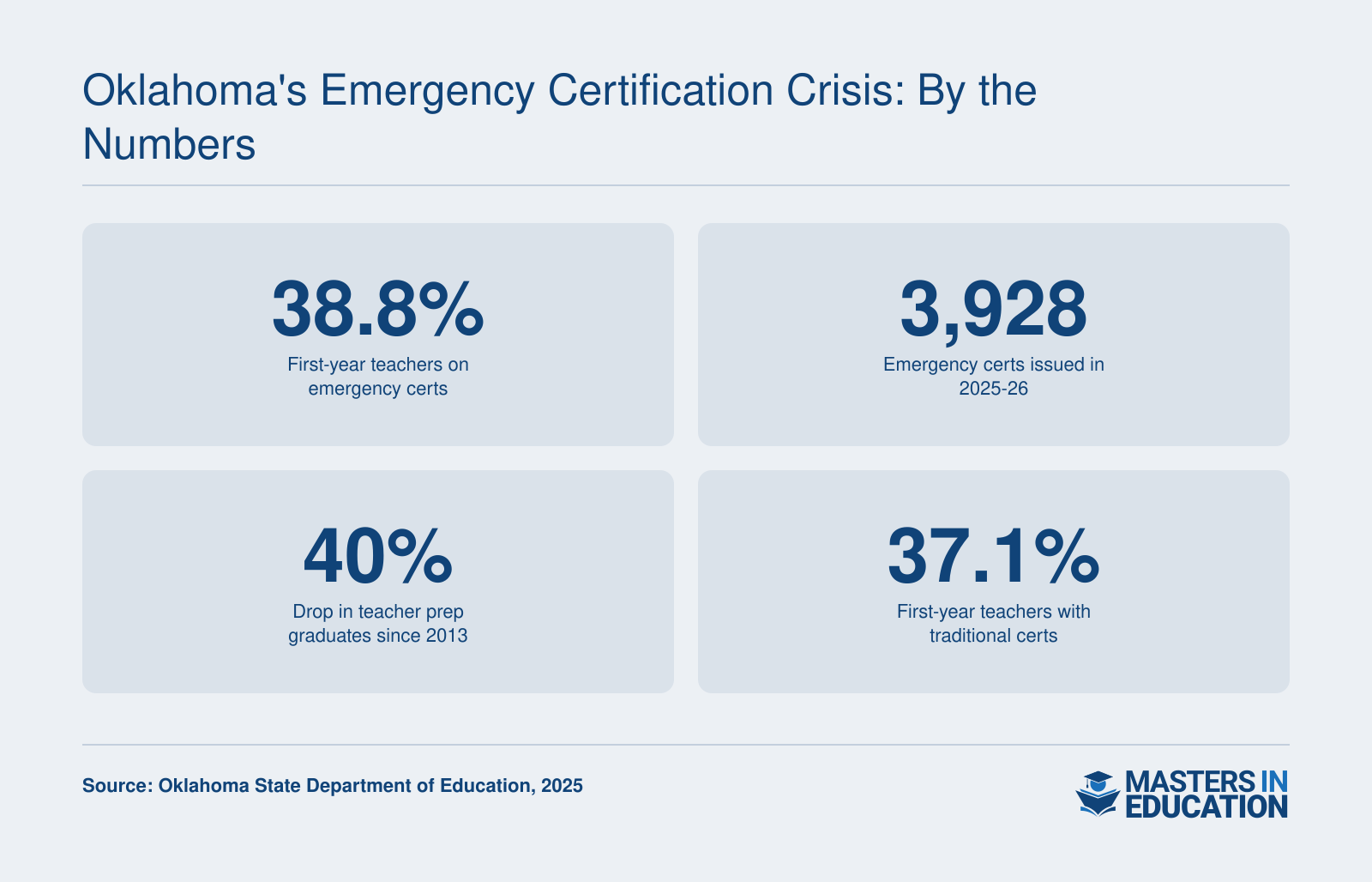
In 2010, emergency-certified first-year teachers made up just 0.5% of the incoming workforce. By 2025, that share had jumped to 38.8%. The pipeline has not merely widened: it has inverted. Where traditional certification once supplied nearly two-thirds of new teachers, it now accounts for just 37.1%.
Six new university pathways announced in July 2026 aim to convert thousands of emergency-certified educators into fully licensed professionals, directly addressing Oklahoma's reliance on provisional staffing.
Oklahoma's Emergency Certification Crisis: By the Numbers
Oklahoma's teacher pipeline has transformed over the last 15 years. Emergency certified educators now make up over a third of new teachers, while traditional certification has plummeted.
What Is Emergency Teacher Certification in Oklahoma?
Emergency certification in Oklahoma is a temporary, state-issued credential that allows school districts to fill immediate classroom vacancies with individuals who do not yet hold standard teaching licenses. The Oklahoma State Board of Education grants these certificates only when a district demonstrates a genuine staffing shortage and sponsors the applicant.1 While the emergency route opens a door into the classroom, it is designed as a short-term fix, not a replacement for full licensure or a long-term career path.
A Temporary Stopgap, Not a Career Credential
Unlike standard or alternative teacher certification pathways, an emergency certificate does not lead to a professional license. It is valid for one school year4 and can be renewed just once, for a maximum of two consecutive years of service.3 In practice, however, some Oklahoma districts have relied on repeated renewals for the same individuals, a sign of persistent shortages rather than regulatory intent. Emergency-certified teachers are expected to work toward full certification during their time in the classroom, often by enrolling in an approved educator preparation program, such as one of the best M.Ed. programs in Oklahoma.
Eligibility Requirements at a Glance
To qualify for an Oklahoma emergency certificate, candidates must meet a set of baseline requirements. First, a bachelor’s degree from an accredited institution is mandatory2, though some categories allow enrollment in a degree program for select grade levels. A criminal background check, completed through the Oklahoma State Bureau of Investigation and FBI, must be initiated no later than seven days before the state board meeting at which the application will be reviewed.2 Applicants must also be sponsored by a superintendent or designated district official, confirming the hiring need and the candidate’s suitability. There is a non-refundable $50 application fee2, but no fee is charged for the one-time renewal.
The Application Process: Step by Step
The process follows a clear sequence for the candidate. First, secure a job offer for a specific teaching position at an Oklahoma public school district. The district then submits sponsorship documentation through the Oklahoma Educator Credentialing System (OECS), an online portal managed by the state. The candidate’s application, including degree verification, background check results, and the fee, must be submitted at least 14 days before the State Board of Education meeting.2 Once approved, the emergency certificate takes effect on the first day of the month in which the completed application was received.5 It covers the current school year and expires the following summer, typically at the end of June.
Special Rules for PK-5 Elementary Emergency Certification
The state imposes additional guardrails for elementary emergency certificates, particularly in the PK-3 grade band. For PK-5 positions, the district must specify the exact grades and subjects to be taught. For PK-3, an emergency certificate further requires passing the Oklahoma Subject Area Test (OSAT) in Early Childhood/Elementary Education, along with at least one year of relevant work experience.3 These measures aim to ensure that the youngest learners, in grades where foundational literacy and numeracy are built, are not placed with wholly untested instructors. The OSAT requirement is a recent tightening and signals that even in emergencies, the state expects a demonstrable level of content knowledge for early childhood classrooms.
How Many Times Can You Renew an Oklahoma Emergency Certificate?
Some Oklahoma educators have renewed emergency teaching certificates as many as eight times, a striking signal of just how long these stopgap credentials now sustain classrooms. As of July 2026, the Oklahoma State Department of Education had approved 1,392 emergency certificates for the upcoming school year, and over 470 of those were renewals. Even more telling: on a single day in July, 60 of 638 applicants had already received emergency certifications more than three times.
Renewal Rules and Requirements
An Emergency Teaching Certificate is valid for one year.1 There is no hard statewide cap on the number of times it can be renewed2, but the process changes after the second year. For the first two years, the district initiates renewal through the Oklahoma Educator Credentialing System (OECS) portal and confirms the teacher still meets baseline eligibility.3 No additional professional development hours are required for emergency certificate renewal4, a sharp contrast to the 75-point requirement for a standard credential.5
- Renewal after year two: The teacher must submit a portfolio of work, demonstrate progress toward standard certification, and secure a district contract renewal.2 The superintendent must also provide a written justification stating that a standard-certified teacher could not be hired for the position.6 This employer attestation effectively shifts the renewal decision to the local level, where staffing shortages often make denial impractical.
Renewal Trends and Policy Shifts
The 2026-27 approval numbers reflect an increasingly entrenched pattern. Emergency renewals now make up more than one-third of all emergency certificates issued, signaling a growing population of teachers who remain in the classroom year after year without completing a standard preparation program. Legislative moves like SB 841 have extended renewal possibilities6, while OSDE’s 2026 proposed administrative rules aim to tighten documentation requirements.7 Still, no policy change has yet introduced a firm renewal limit or mandatory exit timeline.
The result is a cohort of teachers cycling through emergency status indefinitely, a dynamic that raises urgency for bridge programs like TeachForward, which currently helps 450 emergency-certified educators move toward standard licensure. For those stuck in the renewal loop, completing a university-based path while balancing balancing teaching and a master's degree remains the clearest off-ramp to job security and salary advancement.
Emergency Vs. Alternative Certification: Choosing the Right Path
Oklahoma's teacher pipeline now relies heavily on emergency credentials, making it essential for career-minded educators to understand the trade-offs between quick entry and a fully supported pathway. While both routes allow degree-holders to enter the classroom, they differ sharply in cost, structure, exam requirements, and long-term career standing.
What Sets Emergency Certification Apart
Emergency certification is a district-driven, year-to-year credential. A school district requests the certificate on behalf of a candidate who holds a bachelor's degree, and the Oklahoma State Department of Education approves it. There is no application fee, no minimum GPA, and no required subject-area exams. The total out-of-pocket cost, mostly for a background check, typically runs between $100 and $250. However, the credential is valid for only 12 months and does not lead directly to a standard license. Many teachers renew emergency certificates repeatedly, but each renewal remains contingent on district sponsorship and ongoing need.1
Alternative Certification: The Structured Route
alternative teacher certification programs, such as Oklahoma's Alternative Placement Program, are designed as a deliberate pathway to a standard Oklahoma teaching certificate. Candidates apply individually to the state, must hold a bachelor's degree with a 2.5 GPA, and often need two years of work experience4. They must pass the Oklahoma General Education Test (OGET), the appropriate Subject Area Test (OSAT), and the Oklahoma Professional Teaching Examination (OPTE), a set of state-specific teacher certification exams3. Total exam fees range from $340 to $4103, and program coursework, between 6 and 18 credit hours, adds $2,700 to $7,600 to the total cost4. Application fees are typically $40 to $502. These programs take 24 to 36 months to complete3 but include mentorship, supervised classroom experience, and pedagogical training that emergency pathways lack. Initiatives like TeachForward specifically help emergency-certified educators transition into these structured programs.
Cost and Time Commitment Compared
- Emergency certification: $100 to $250, no exams, 12-month validity, renewable annually with employer support.
- Alternative certification: $3,080 to $8,050 (including exams and coursework), 24 to 36 months, leads to a standard certificate.
Career Impact and Long-Term Standing
Emergency certification provides immediate classroom access but offers no professional development scaffolding or guarantee of continued employment. It can leave teachers in a cycle of uncertainty, dependent on district renewal policies. In contrast, alternative certification builds toward standard teaching licensure, which is portable, renewable, and recognized as a marker of professional preparation. As the state increasingly turns to emergency credentials, over 38% of first-year teachers in 2025 were emergency certified, fully certified educators become a smaller, more sought-after cohort, often first in line for leadership roles, higher pay, and job security.
Six New University Pathways for Emergency-Certified Oklahoma Teachers
Six Oklahoma universities have launched dedicated pathways to move emergency-certified teachers into standard licensure, directly addressing the state's reliance on uncertified educators. These programs, announced in July 20261, respond to the surge in emergency certifications, which now account for nearly 39% of the state's first-year teacher workforce. The new options offer accelerated, hybrid, and apprenticeship-based routes, many designed for working teachers balancing classroom duties with coursework.
A Closer Look at the Six New Pathways
The Jeannine Rainbolt College of Education at the University of Oklahoma-Norman Campus leads with PROPEL, a fully funded, 15-credit-hour alternative certification program delivered in a hybrid format. Designed specifically for emergency-certified pre-K, 12 teachers, the program spans four semesters and features reduced credit loads for secondary-level cohorts. A second fully funded cohort begins in May 2027.
The University of Central Oklahoma offers UCO ACTS, an alternative certification pathway delivered entirely through remote synchronous sessions. This format allows teachers to attend live online classes from any district, making it accessible for those in rural areas. UCO ACTS serves both emergency and alternatively certified educators.2
Four additional universities operate under the state's TeachForwardOK initiative, which is already serving 450 emergency-certified teachers working toward standard credentials.1 Oklahoma State University and Northeastern State University each offer accelerated certification pathways targeting career changers and alternative-certification candidates. Cameron University and Southwestern Oklahoma State University have adopted apprenticeship-style models that embed certification coursework within on-the-job training, ideal for current school employees and aspiring teachers who need to earn while they learn.
TeachForwardOK and the Apprenticeship Model
The TeachForwardOK pathways emphasize hands-on experience, with apprenticeships that pair teacher candidates with mentor educators. Cameron and SWOSU's programs allow participants to remain employed in schools while completing certification requirements, a design that directly addresses the financial and time barriers often cited by emergency-certified teachers. The OSU and NSU accelerated tracks condense preparation into intensive, shorter-term sequences, appealing to those who can commit to a faster-paced schedule.
Balancing Work and Study: Delivery Formats That Fit
Recognizing that most emergency-certified teachers are already leading classrooms, all six programs prioritize flexibility. OU PROPEL uses a hybrid model with in-person and online components, while UCO ACTS relies entirely on live, remote evening classes. The apprenticeship-based TeachForwardOK pathways integrate learning into the school day, minimizing outside commitments. No program is purely asynchronous, but many schedule sessions during evenings or weekends to accommodate full-time teaching loads.
Stacking Toward a Master's Degree
None of these pathways constitutes a full Master of Education, but several may serve as a stepping stone. OU's PROPEL, for instance, is a graduate-level certificate program; credits could potentially transfer into an M.Ed. at the same institution. Educators interested in long-term advancement should inquire directly about cross-listed courses and fallback options, as stacking certifications onto a master's can boost salary tier and leadership eligibility, a tangible benefit for those already in the classroom.
These six pathways represent a concerted effort by Oklahoma universities and the state to professionalize the emergency-certified workforce, offering structured routes to full licensure and, potentially, to advanced degrees that deepen pedagogical skills and career resilience.
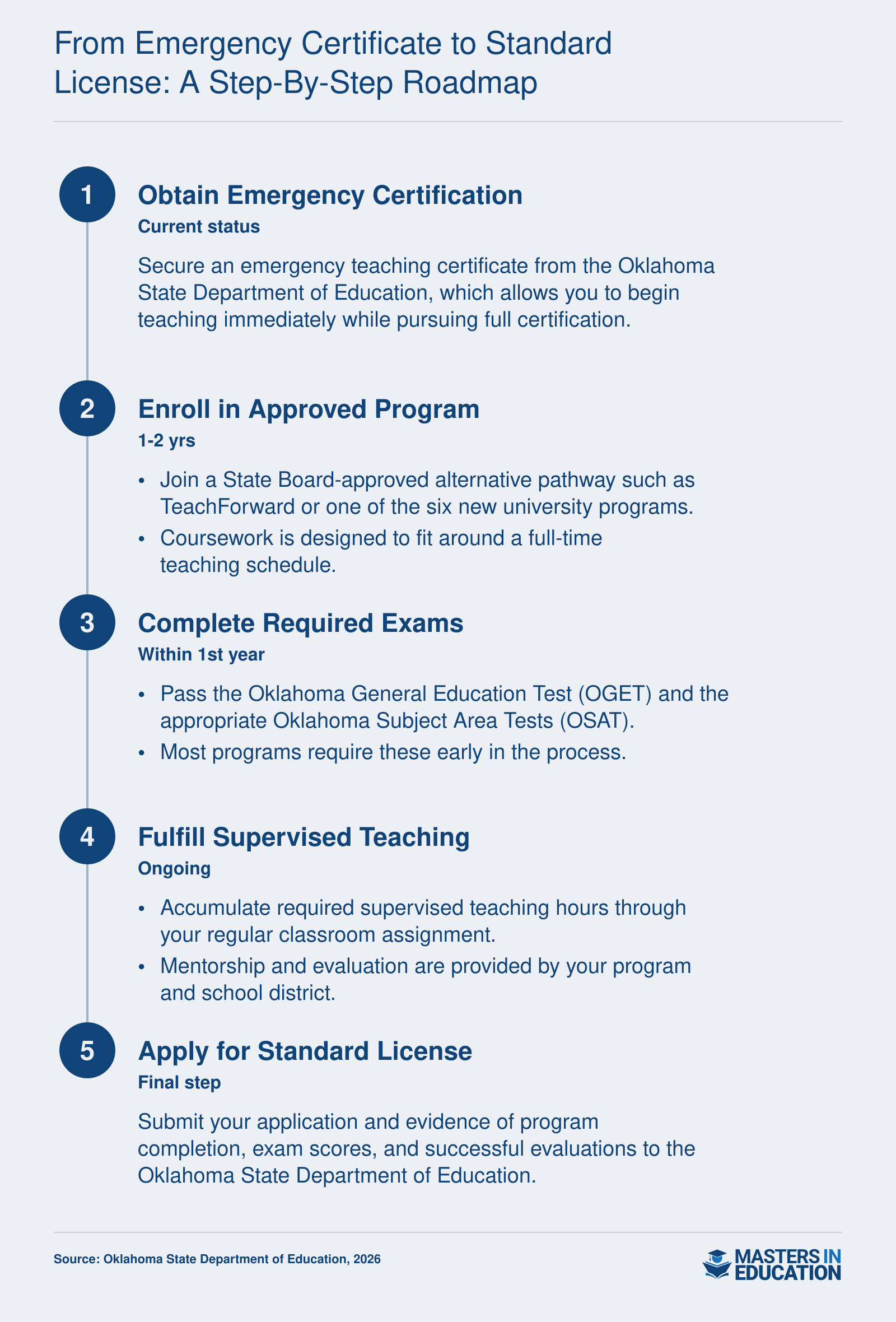
From Emergency Certificate to Standard License: A Step-By-Step Roadmap
For thousands of Oklahoma educators entering the classroom through emergency certification, the path to a standard license is clearly defined. By enrolling in a state-approved program, passing required assessments, and completing supervised teaching, you can transition from an emergency certificate to a full standard certificate while continuing to teach full time.
Policy Responses and What They Mean for Teacher Preparation Programs
Recent Policy Moves
Oklahoma has taken several steps to address the teacher shortage alongside the surge in emergency certifications. The state raised minimum teacher salaries, created scholarship programs for aspiring educators, and launched the TeachForward initiative, which is helping 450 emergency certified educators work toward standard certification. These policies acknowledge that while emergency certificates fill vacancies, they are not a long-term substitute for fully prepared teachers.
A Sustainable Solution or a Structural Problem?
Policymakers and education researchers remain divided on whether emergency certifications represent a sustainable fix or a symptom of a deeper collapse in the teacher preparation pipeline. The most striking structural headline is the roughly 40% decline in the number of graduates completing Oklahoma teacher preparation programs since 2013. Emergency certified educators now make up 38.8% of first-year teachers, while traditionally certified educators have fallen to just 37.1% of that same group. Some teachers have renewed emergency certificates as many as eight times, and as of July 2026, 60 of 638 applicants approved for emergency certificates had received them more than three times. This reliance raises concerns that expanding emergency pathways may inadvertently weaken the perceived value of rigorous nationally accredited nationally accredited M.Ed. and traditional preparation programs. Critics argue that while emergency certifications plug immediate gaps, they do not address root causes of the teacher shortage, such as working conditions and compensation competitiveness with other professions.
Implications for Teacher Preparation Programs
For university teacher preparation programs, these trends present both a challenge and an opportunity. Declining enrollment in traditional pathways pressures programs to adapt or shrink. However, the growing number of emergency certified teachers who need to earn standard licenses creates a new pipeline of potential students. Programs that design flexible, job-embedded master's degrees and certification pathways for these working educators could stabilize enrollment and strengthen the teacher workforce. By serving the emergency certified to standard license journey, M.Ed. programs can help Oklahoma move from a state of dependency on emergency credentials to a more fully prepared profession.
Career Outlook: Salary and Job Growth for Oklahoma Teachers
Oklahoma teacher salaries reflect the state's lower cost of living but often trail national averages. Data from the Bureau of Labor Statistics shows median annual wages for elementary teachers at $47,470 and secondary teachers at $49,170, with experienced educators in the 75th percentile earning over $57,000. A master's degree in education can strengthen candidacy for department head or instructional coach positions, which typically carry higher pay scales.
| Occupation | Total Employment | 25th Percentile | Median Annual Wage | 75th Percentile |
|---|---|---|---|---|
| Elementary School Teachers | 18,340 | $45,700 | $47,470 | $57,510 |
| Secondary School Teachers | 15,670 | $46,000 | $49,170 | $60,720 |
Common Questions About Oklahoma Emergency Teacher Certification
Navigating Oklahoma's teacher certification landscape can be confusing, especially with the rise of emergency credentials. Below are answers to the most frequent questions about emergency certification, including how to obtain it, renewal rules, and how it compares to alternative pathways.