
What you’ll learn in this article…
- The Education Department's July 2026 initiative opened 20 investigations in 15 states.
- Even non-criminal misconduct findings can now disrupt your teaching license.
- Districts risk losing federal funds if background checks and reporting fall short.
On July 17, 2026, the U.S. Department of Education opened 20 investigations across 15 states, targeting school districts that may have allowed teacher sexual misconduct to go unchecked. The enforcement push directly names the long-standing practice of "passing the trash" (quietly moving accused educators to other roles or districts without discipline) as a violation of Title IX and ESEA obligations. For every educator, the new scrutiny reshapes the professional landscape: a misconduct finding, even without criminal charges, now carries real consequences for licensure, background checks, and graduate program standing. Aspiring teachers face a reality where a clean record and transparent reporting aren't optional: they're the new baseline for entering and staying in the field.
The 2026 Federal Crackdown: What's Changing
A New Federal Enforcement Push
On July 17, 2026, the U.S. Department of Education launched a significant enforcement initiative targeting teacher sexual misconduct in public schools. The department opened 20 investigations across 15 states, with clusters in Georgia (three districts), Michigan (three), and California (two), as reported by Education Week. This coordinated action signals that the federal government is moving beyond issuing guidelines and is now actively scrutinizing how districts handle allegations against staff.
Targeting "Passing the Trash"
Central to the crackdown is the practice known as "passing the trash," where a school district allows an educator accused of sexual misconduct to resign quietly, transfer to another school, or move to a different role, often with a positive reference or a confidential settlement. This allows problematic teachers to continue working with students elsewhere. The urgency is backed by sobering data: a 2010 Government Accountability Office (GAO) report found that in six out of fifteen cases where employees had histories of sexual misconduct, those individuals went on to abuse additional children precisely because districts had allowed them to move on without discipline or transparent reporting.
The Limits of Federal Authority
The new guidance reminds schools of their existing obligations under Title IX and the Elementary and Secondary Education Act (ESEA) to respond promptly to allegations of staff sexual misconduct. However, the federal government's enforcement tools are limited. While the Education Department can withhold federal funding from noncompliant districts, it cannot revoke a teacher's license; teacher certification exams and licensing remain a state function. This creates a patchwork where a teacher could lose a job in one state but retain a license in another.
Secretary of Education Linda McMahon underscored the administration's intent: "Our schools must protect America’s children. Parents should never have to wonder whether their kids’ school employs and protects sexual predators." This statement reflects the high-level political pressure behind the initiative, which may prompt states to tighten their own licensing and background-check procedures. For educators, the message is clear: even unsubstantiated or non-criminal misconduct findings could now carry career-altering consequences as districts and states align with federal expectations.
How a Misconduct Allegation Impacts Your Teaching License
What actually happens to your teaching license when a misconduct allegation surfaces? For educators, an accusation alone can set in motion a chain of administrative and legal processes that threaten your career, even if you are never criminally charged. With the 2026 federal crackdown increasing scrutiny on how districts handle misconduct reports, understanding the license impact is more critical than ever.
Immediate Professional Consequences
Upon receiving an allegation of sexual misconduct, most school districts are required to place the educator on administrative leave pending investigation. This is a protective measure, not a disciplinary finding, but it immediately removes you from the classroom and can interrupt your M.Ed. degree progress if you are in a field placement or internship. During this period, the district will typically notify the state education agency, which can trigger a parallel review by the licensing board. The federal initiative reminds districts of their Title IX and ESEA obligations to respond promptly, meaning your case is likely to move forward without delay.
State Licensing Authority and Revocation Criteria
Teacher licensure is regulated at the state level, and each state department of education follows its own administrative code governing license suspension and revocation. A key distinction to investigate is whether your state requires a criminal conviction before taking action against a license. Some states can revoke based on a school district’s investigative findings that the educator engaged in immoral or unprofessional conduct, even if no charges are filed. For example, California law allows the Commission on Teacher Credentialing to pursue revocation based on findings of sexual misconduct from a school district, independent of a criminal case. Other states may have similar provisions, while some tie revocation more tightly to convictions. To understand the specific grounds in your state, review the education code sections on your state’s department of education website; often these are listed under “teacher discipline” or “license revocation.” The NASDTEC database, which tracks misconduct across states, relies on such state decisions and can affect your ability to teach elsewhere.
The Role of NASDTEC in Cross-State Tracking
The National Association of State Directors of Teacher Education and Certification (NASDTEC) operates a clearinghouse that shares adverse actions against educators among member states. When your license is suspended or revoked in one state, that information is often entered into the NASDTEC database, making it difficult to simply move to another state and obtain a new license. Even if you resign in lieu of termination, the district may still report the allegation, and that report can follow you. With the federal initiative targeting “passing the trash,” districts are now under more pressure to ensure such reports are made, closing loopholes that once allowed educators to escape their records.
Understanding Investigation Timelines
The length of a misconduct investigation varies significantly by state and the complexity of the case. Some state education departments aim to complete reviews within a few months, but contested cases can stretch beyond a year. During this time, your teaching license may be flagged or show a pending investigation, which can prevent hiring by other districts. For accurate local timelines, consult recent state auditor reports or education commission documents that publish case processing data. These reports often reveal patterns in how quickly allegations are resolved and can help you set realistic expectations.
Throughout the process, it is essential to engage legal counsel familiar with education law and to cooperate with investigations while protecting your rights. The 2026 crackdown signals that both districts and states will be less tolerant of delays or oversights, making a proactive approach vital for preserving your career.
Strengthened Background Checks and Reporting Requirements
For years, a flawed system let educators with misconduct allegations slip through the cracks; now, strengthened federal requirements are forcing districts to take a harder line on screening and reporting. The 2026 crackdown ties federal funding to compliance, leaving no room for the old practice of quietly ushering accused employees out the door.
Federal Mandates Tighten Reporting Obligations
The Education Department’s new initiative reinforces that school districts must promptly investigate every allegation of sexual misconduct, report substantiated findings to state licensing authorities, and never facilitate a "pass the trash" scenario. Under Title IX and the Elementary and Secondary Education Act (ESEA), districts that provide positive references for accused educators or fail to disclose misconduct findings risk losing federal funds. ESEA Section 8546 specifically requires that when a district learns an employee has engaged in sexual misconduct with a minor or student, it must disclose that information to any other district that inquires during the hiring process. This closes a loophole where educators could resign under investigation and start fresh elsewhere.
What to Expect During the Hiring Process
Prospective teachers should be ready for a multi-layered vetting process. Most districts now require fingerprint-based background checks that query state and federal criminal databases. Hiring committees will verify employment history and seek references that specifically ask about any past misconduct investigations or disciplinary actions. Additionally, districts increasingly cross-check candidates against state-maintained misconduct registries and the national NASDTEC Educator Information Clearinghouse.
How NASDTEC Prevents Passing the Trash
The NASDTEC Clearinghouse serves as a critical early-warning system, covering all 50 states, the District of Columbia, Department of Defense schools, Guam, and Ontario.2 It provides immediate alerts when a license is annulled, denied, suspended, revoked, invalidated, surrendered, or when other adverse actions like reprimands occur.2 Since 2024, local education agencies (LEAs) have been able to access the clearinghouse directly as associate members, giving them access to teacher misconduct data and allowing them to flag candidates with a problematic history before an offer is made. States like Virginia report all adverse actions to NASDTEC.3 Maryland now requires districts to register as associate members and screen all hires against the clearinghouse.4 By centralizing misconduct data and removing the ability of accused educators to simply move across state lines, the system directly undercuts the "pass the trash" culture.
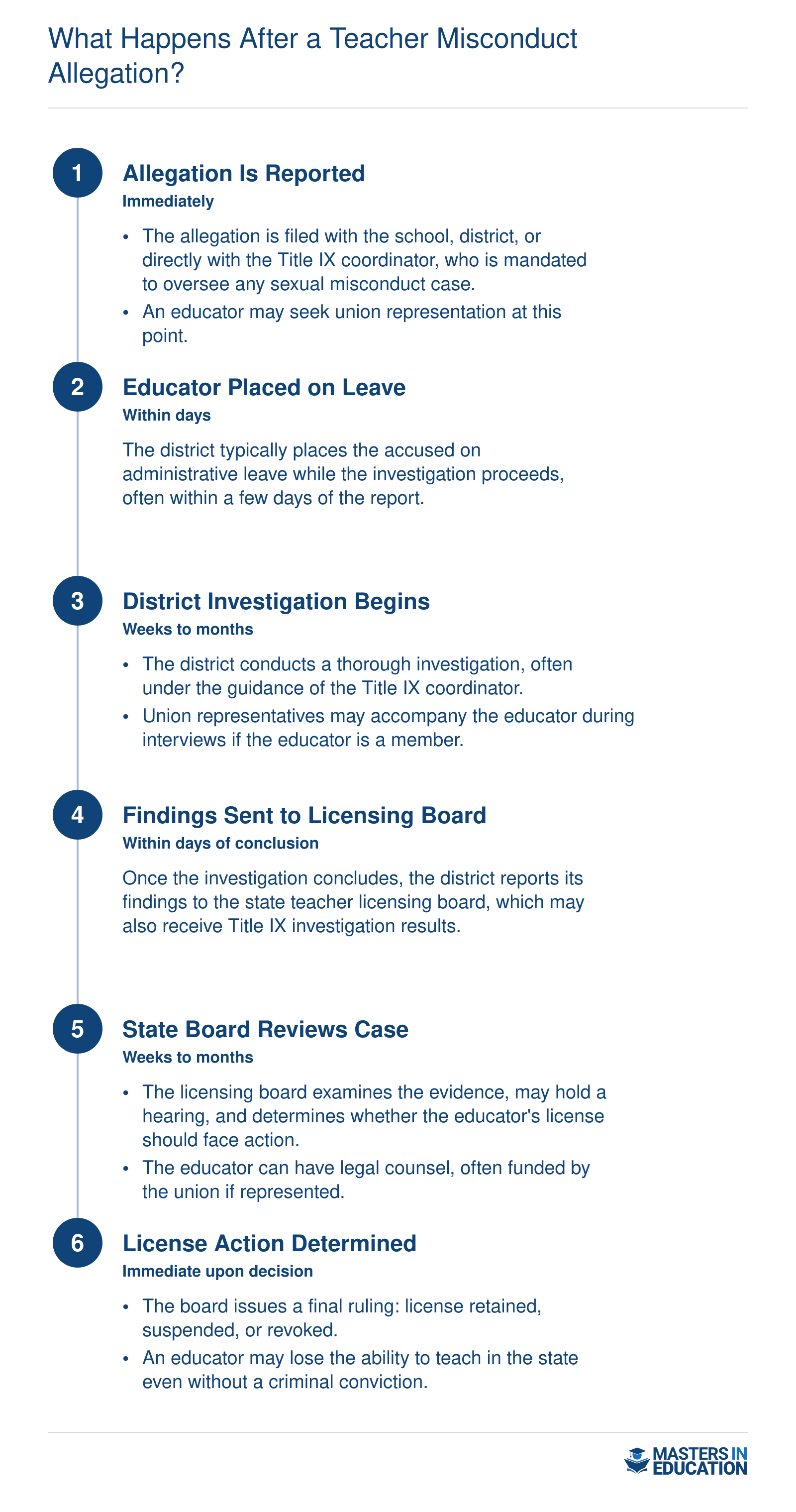
What Happens After a Teacher Misconduct Allegation?
When a teacher is accused of sexual misconduct, the path from allegation to final license decision follows a structured, multi-step process. Each stage carries strict reporting obligations under Title IX and often involves both district and state-level oversight.
Understanding the Teacher Misconduct Investigation Process
When an allegation surfaces, the investigative process follows two parallel tracks that educators must understand: the district-level employment investigation and the separate state licensing board review. Each operates under distinct rules, timelines, and standards of evidence, and the outcome of one can profoundly shape the other.
District-Level Investigation
The process typically begins when a school administrator or mandatory reporter notifies law enforcement or child protective services, as required by state law. Simultaneously, the district places the accused employee on administrative leave, often with pay pending the outcome. Human resources and legal counsel then launch an internal investigation, interviewing witnesses and reviewing personnel records to determine whether employment policies were violated, not necessarily whether a crime occurred. Though they may cooperate with law enforcement, the district investigation is an employment matter.
Title IX Coordinator's Role
Under Title IX, any school receiving federal funds must have a designated Title IX coordinator who oversees the response to sexual misconduct allegations. This coordinator ensures the school meets its obligations to investigate and address complaints involving adult employees. They may facilitate interim measures, such as schedule changes or restricted campus access, and coordinate with other investigators to avoid compromising a criminal case. The coordinator's involvement signals the matter is taken seriously at the institutional level.
State Licensing Board Involvement
State licensing boards typically become involved once a district investigation sustains misconduct findings, or earlier after a criminal arrest. The board operates independently, applying its own professional standards. Evidence gathered by the district is often shared through formal referral, but the board is not bound by district conclusions and may conduct its own inquiry. Notably, some states allow license action even without a criminal conviction, as the recent federal crackdown highlights.
Due Process and Union Representation
Educators retain due process rights throughout these proceedings. Before a licensing board revokes or suspends a credential, the individual receives notice of the allegations and an opportunity to respond, often through a formal hearing where they present evidence and call witnesses. Union contracts typically guarantee representation during district investigations; a representative can accompany the educator, ensure procedural rules, and influence timelines. Understanding these rights is critical, because missteps early in a district interview (the teacher interview mistakes to avoid) can cascade into license consequences that jeopardize your jobs with a masters in education.
What the Crackdown Means for M.ed. Students and Recent Graduates
For M.Ed. students and recent graduates, the federal crackdown on teacher sexual misconduct introduces a critical balance: pursuing an advanced degree while facing heightened scrutiny that can make every past action matter. Teacher preparation programs are responding by embedding stronger ethics and professional conduct requirements, which can affect everything from field placements to eventual licensure.
New Ethics Standards in Accredited Programs
This shift is driven by accrediting bodies that oversee national accreditation for M.Ed. degrees. The Council for the Accreditation of Educator Preparation (CAEP) now mandates that advanced-level programs, including M.Ed. and Ed.S. degrees, include explicit training in ethical practice and professional responsibilities. CAEP’s 2024 Advanced-Level Standards require candidates to demonstrate application of ethical principles, and its 2026 Accreditation Policies further require evaluators to disclose any conflicts or misconduct.2 Similarly, the Council for Accreditation of Counseling and Related Educational Programs (CACREP) requires adherence to the American Counseling Association Code of Ethics and written ethics policies.1 Consequently, many graduate programs have added standalone modules on sexual misconduct prevention, mandatory reporting, and legal obligations under Title IX, often including case studies on “passing the trash” and boundary violations.
Heightened Field Placement Scrutiny
Partner school districts are intensifying vetting for practicum and student teaching placements. Where a basic criminal background check once sufficed, many now require federal and state fingerprinting, searches of state educator misconduct databases, and detailed disclosure of any prior investigations, even those that did not result in criminal charges. For M.Ed. students, a disciplinary record from undergraduate years or a previous employment termination can delay or bar placement, jeopardizing program completion. This scrutiny mirrors the federal initiative’s emphasis on preventing known misconduct from being ignored.
Embedding Misconduct Prevention in Curriculum
In states where investigations are underway, including Georgia, Michigan, and California, state boards are increasingly requiring ethics coursework as part of teacher preparation. Some programs now mandate at least one course covering professional ethics, often integrating InTASC Standard 9 (Professional Learning and Ethical Practice).3 These courses train future educators to recognize grooming behaviors, understand consent in educational settings, and navigate reporting obligations. The goal is to produce graduates who not only avoid misconduct but actively safeguard students.
Advice for Current and Prospective M.Ed. Students
- Proactive disclosure: If you have any past conduct finding, discuss it early with your program advisor; some programs can provide guidance on potential licensure hurdles.
- Documentation: Keep thorough records of any prior allegations and their resolutions, as you may need to explain them during field placements or licensure applications.
- State variations: Licensure requirements differ, and a clean record in one state does not guarantee clearance in another, especially as federal guidance encourages interstate sharing of misconduct data.
- Expect rigor: During interviews and placements, anticipate detailed questions about your professional conduct history. Treat every interaction as a demonstration of your ethical judgment.
Related Articles
Protecting Your Career: Actionable Steps for Educators
When a misconduct allegation surfaces, educators face a clear fork in the road: wait passively for the process to unfold, or take immediate, structured action to safeguard their career. The new federal emphasis on accountability leaves little room for ambiguity; a proactive stance can be the difference between clearing your name and facing lasting professional damage.
Document Everything, Keep It Official
Maintaining clear, accessible records of professional interactions is no longer optional. Even a well-intentioned conversation can be misconstrued. Build habits now that create a verifiable paper trail.
- Use school platforms: Keep all student communication within official school email systems and learning management tools. Avoid private texting apps, personal social media, or unrecorded phone calls.
- Save everything: Automatically archive emails and message logs. If a student makes a concerning disclosure, write a contemporaneous note summarizing exactly what was said and to whom you reported it.
- Preserve context: If you witness or report questionable behavior by a colleague, record dates, times, and witnesses. In a delayed investigation, these details become critical.
Know Your State's Professional Conduct Standards
Each state's educator licensing board maintains a code of ethics and a list of actions that trigger mandatory reporting or license review. Familiarity with these standards helps you recognize when an incident must be escalated.
- Review the penalty for inaction: Many states require educators to report even a colleague's suspected misconduct. Failure to do so can be a separate violation.
- Understand non-criminal consequences: As recent federal guidance makes clear, the department is scrutinizing districts that allow resignations instead of discipline. A finding of misconduct by your employer, even without criminal charges, can now more readily lead to license suspension or revocation.
Engage Union Representation Immediately
If you are the subject of an allegation, your first call after notifying your administrator should be to your union representative. Most collective bargaining agreements specify procedural rights that must be invoked early.
- Chain of command protection: The contract often limits who can question you and requires a designated advocate in meetings.
- Time-sensitive steps: Some contracts contain deadlines for filing grievances or requesting a formal hearing. Missing these can waive your rights.
When to Seek Independent Legal Counsel
Union representation is valuable, but it may not cover all scenarios. If the allegation involves potential criminal charges, or if the union's institutional interests differ from your personal defense strategy, retain an attorney with experience in educator licensure law.
- Criminal overlap: A lawyer can advise you on self-incrimination risks that a union representative cannot.
- License-specific expertise: Not all attorneys understand the administrative hearing process for teaching licenses. Seek a specialist if your credential is at risk.
Advice for M.Ed. Students: Disclose Early
Before your clinical placement, review the Student Teaching Survival Guide from experienced teachers and speak with your program advisor. Surprises during background checks are always harder to manage than disclosed history.
- Review your record: Even a minor disciplinary notation from a previous job or undergraduate incident can surface.
- Be transparent: Advisors can often frame past issues in context or work with placement sites to mitigate concerns. A proactive conversation demonstrates professional maturity.
Frequently Asked Questions
The U.S. Department of Education’s 2026 crackdown on teacher sexual misconduct raises urgent questions for current and aspiring educators. Here are clear answers on how these changes affect your teaching license, career, and graduate education.