What you’ll learn in this article…
- UMass Lowell offers six 30-credit M.Ed. specializations, including initial licensure.
- Massachusetts teachers with a master's earn over $82,000 median salary.
- 93% of 2024 UMass Lowell graduates were employed or pursuing advanced study.
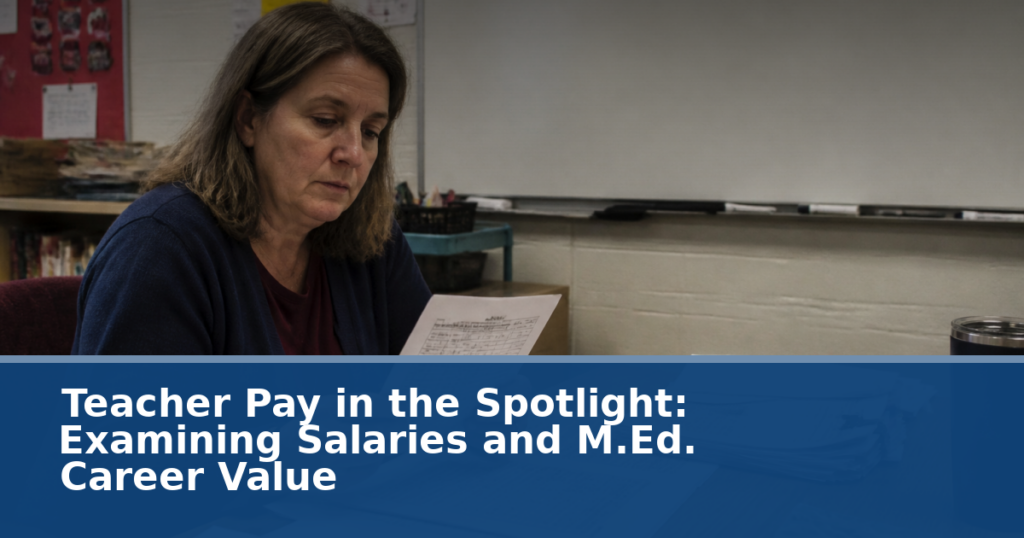
Massachusetts teachers with a master's degree earn 24-28% more than those with a bachelor's alone. In a state where median teacher pay exceeds $82,000, that premium adds up over a career.
UMass Lowell's M.Ed. programs, offered online and on campus, cover specializations from curriculum and instruction to initial licensure tracks. The School of Education has prepared educators since 1894.
Pursuing a master's in Massachusetts is as much a financial calculation as a professional one, and the measurable ROI makes it a strategic move in a competitive job market.
Master's in Education Programs at University of Massachusetts-Lowell
Secondary Education
- 3 concentration options
- 30 total credit hours
- 3.0 GPA minimum
- Prepares for MTEL
- Designed for initial licensure in Massachusetts
- Requires bachelor's in English, History, Math, or Science
- Integrates licensure students with in-service educators
- Emphasizes culturally sustaining practices
- Fast Track to Secondary Teaching option
- Accelerated bachelor's to master's option
- Prepares for teaching profession with confidence and skills
- Integrates research theory with field-based experiences
- 4 concentration options
- Entrance exam required
- 30 total credit hours
- 3.0 GPA minimum
- Prepares for MTEL
- Prepares for Massachusetts initial teaching license
- Focus on culturally sustaining practices
- Integrates with in-service educators
- Requires MTEL Communications and Literacy test
- Requires MTEL Content Area test
- Bachelor's degree in English required
- Includes internship and field practicum
- SEI Endorsement available
- 4 concentration options
- 30 total credit hours
- 3.0 GPA minimum
- Prepares for MTEL
- Prepares for initial Massachusetts teaching license
- Emphasizes culturally sustaining practices
- Integrates initial licensure students with in-service educators
- Requires bachelor's degree in content area
- Includes MTEL exams for licensure
- Focus on equity and inclusion
- Field-based experiences throughout program
- Offers 5-12 grade licensure in History
- 4 concentration options
- Entrance exam required
- 30 total credit hours
- 3.0 GPA minimum
- Prepares for MTEL
- Prepares for initial teaching licensure
- Culturally sustaining pedagogy focus
- Field-based experiences throughout program
- Integration with in-service educators
- Fast Track to Secondary Teaching available
- 30 total credit hours
- Science Education Option available
- Integrates culturally sustaining practices
- Research-based theory and practice
- Field-based experiences as appropriate
- Designed for experienced practitioners
- Complete within five years
- Integration of students and in-service educators
- Focus on diversity and equity
Music Education
Curriculum & Instruction
- 3 concentration options
- 30 total credit hours
- 3.0 GPA minimum
- Prerequisite courses required
- Accelerated Bachelor's to Master's option
- Integrates in-service and pre-service teachers
- Emphasizes culturally sustaining practices
- Requires MTEL tests for licensure
- Does not lead to licensure pathway
- ABA pathway fully online
- At least one year work experience preferred
- 3 concentration options
- 30 total credit hours
- 3.0 GPA minimum
- Prerequisite courses required
- Fully online program
- Requires ABA certificate with 3.0 GPA
- Transfer up to five certificate courses
- Does not lead to teaching license
- New pathways structure from fall 2022
- 4 concentration options
- No entrance exam required
- Test optional
- $470 per credit
- 12-Month program
- 30 total credit hours
- 9 total courses
- Rolling admissions
- Full-time and part-time options
- 3.0 GPA minimum
- 2 letters of recommendation (minimum)
- 300 clinical hours
- $50 application fee
- Financial aid available
- Scholarships available
- 100% online delivery
- Hands-on classroom experience
- Partnerships with local school districts
- Teacher licensure reciprocity
- Interactive virtual simulations
- SEI Endorsement included
- Prepares for middle and secondary teaching
Reading & Literacy
- 2 concentration options
- 30 total credit hours
- Work experience required
- Capstone required
- Massachusetts Tests for Educator Licensure: Communication and Literacy Skills and Reading Specialist
- Practicum in Massachusetts schools
- Courses in reading assessment and intervention
- Open to licensed Massachusetts teachers
- Non-licensure option for out-of-state
- Focus on diverse populations
- No entrance exam required
- $470 per credit
- 30 total credit hours
- 10 total courses
- Rolling admissions
- 3.0 GPA minimum
- 2 letters of recommendation (minimum)
- Work experience required
- $50 application fee
- Prepares for MTEL Reading Specialist Test
- Financial aid available
- Scholarships available
- Total cost under $15,000
- Ranked best online grad education program in New England
- Two practicum experiences required
- Mostly online with in-school practicum
- Requires valid Massachusetts teaching license
- No entrance exam required
- $470 per credit
- 18-Month program
- 30 total credit hours
- 10 total courses
- Rolling admissions
- 3.0 GPA minimum
- $91,000 median earnings
- 2 letters of recommendation (minimum)
- Work experience required
- Capstone required
- $50 application fee
- Financial aid available
- Scholarships available
- Top-ranked online program in New England
- Partners with upGrad for international students
- Required field experience in K-12 schools
- Focus on anti-racist and social justice literature
Higher Education & Adult Education
- Test optional
- $470 per credit
- 30 total credit hours
- Full-time and part-time options
- Synchronous and asynchronous options
- 2 letters of recommendation (minimum)
- $50 application fee
- Financial aid available
- Scholarships available
- Available entirely online
- Two-semester practicum included
- One of the most affordable tuitions
- Projected job growth +8.7%
- Median earnings $101.2K
- Career paths: administrator, dean, advisor
History
- 4 concentration options
- 30 total credit hours
- 3.0 GPA minimum
- Prepares for MTEL
- Initial teaching licensure in Massachusetts
- Prepares secondary teachers in History
- Culturally sustaining pedagogy focus
- Cohort integration with in-service educators
- SEI Endorsement included
- Prerequisite: bachelor's degree in History
- Accelerated bachelor's to master's option
- Internship and practicum required
University of Massachusetts-Lowell and Its School of Education
The School of Education at UMass Lowell has built a decades-long reputation for preparing educators who are ready to lead in diverse classrooms and school systems.
A History of Excellence in Teacher Preparation
Founded as a normal school in 1894 and later evolving into a comprehensive research university, UMass Lowell has always maintained a strong commitment to developing teachers. The university's mission emphasizes hands-on learning, community engagement, and social equity: values that directly shape its education programs. Today, graduate students benefit from a curriculum that blends theory with immediate classroom application, often through partnerships with more than 50 area school districts.
A Hub Within the College of Fine Arts, Humanities & Social Sciences
The School of Education resides in the College of Fine Arts, Humanities & Social Sciences, a structure that encourages interdisciplinary learning. This placement allows education students to collaborate with faculty in psychology, sociology, and the arts, enriching their understanding of student development and cultural contexts. The school offers several distinct Master of Education paths, including a Master of Education in Curriculum and Instruction, an M.Ed. in Education Administration (with a Higher Education option), and an Applied Behavior Analysis specialization, all designed to meet the needs of working professionals.
Accreditation and State Approval
UMass Lowell is institutionally accredited by the New England Commission of Higher Education. All teacher preparation programs are approved by the Massachusetts Department of Elementary and Secondary Education, ensuring graduates are eligible for state licensure.1 While the School of Education aligns its curricula with national professional standards, many programs also carry specialized recognition for their quality and rigor.
Faculty Expertise and Research
Graduate students learn from faculty who are active researchers and practitioners in fields such as literacy development, educational technology, and equity-based school reform. Their scholarship often directly informs course content, and many professors maintain ongoing relationships with local schools, providing students with real-world insights and research opportunities. This blend of academic depth and practical engagement defines the UMass Lowell educational experience.
Umass Lowell by the Numbers
A quick snapshot of University of Massachusetts-Lowell, highlighting key metrics that speak to its accessibility and value for graduate education students.

Master's in Education Specializations at Umass Lowell
UMass Lowell offers six distinct Master of Education (M.Ed.) specializations, each requiring 30 credit hours of coursework. These programs are designed to deepen your expertise, advance your career, and align with Massachusetts M.Ed. programs and educator licensure pathways.
Specializations at a Glance
- M.Ed. in Curriculum and Instruction (General Option): A flexible program for practicing educators that culminates in an Action Research capstone, allowing you to investigate and improve classroom practices.
- Curriculum & Instruction: Secondary Education Initial Licensure: For aspiring middle and high school teachers, this option leads to initial Massachusetts licensure and includes the Sheltered English Immersion (SEI) endorsement. Concentrations are available in English, History, Mathematics, Science, and Music Education.1
- Education Administration: Higher Education: Focused on administration in colleges and universities, this specialization includes a practicum experience and prepares you for leadership roles in student affairs, academic advising, and enrollment management.2
- Language Arts & Literacy: Designed for educators aiming to become reading specialists, this program offers a Teacher of Reading licensure pathway. Please note: as of the latest update, the university has temporarily paused new applications for this specialization3, so prospective students should confirm current availability.
Program Features and Career Alignment
Every specialization integrates research-based practice and is taught by faculty with real-world education experience. The Curriculum & Instruction general track is particularly suited for current teachers seeking to enhance their instructional strategies without pursuing initial licensure. The Secondary Education path, a master's in secondary education option, embeds full preparation for the Massachusetts Tests for Educator Licensure (MTEL) and includes supervised practicum hours, making it a direct route into the classroom. The Higher Education option stands out by blending online flexibility with a required practicum, giving you hands-on experience in a college setting. While the Language Arts & Literacy program is currently on hold, it historically supported the critical need for literacy coaches and reading interventionists in K-12 schools.
Below this section, you will find a dynamic, auto-inserted program listing that provides a complete, sortable table of all available M.Ed. options at UMass Lowell. This interactive tool lets you compare details like delivery modes, credit requirements, and licensure tracks side by side, ensuring you can find the specialization that best fits your goals. Every program is built to support your progression along Massachusetts' education career ladder, whether you are entering the profession or seeking an advanced role.
How You Can Earn Your M.ed.: Online, On-Campus, and Hybrid Options
A graduate degree designed around the realities of a teaching career is no longer a luxury. It's a necessity. UMass Lowell's Master of Education programs are built with that truth in mind, offering multiple pathways to fit your schedule, location, and learning style.
Three Paths to Your Degree
UMass Lowell delivers its M.Ed. programs in three flexible formats: fully online, on-campus in Lowell, and a hybrid blend of the two1. The M.Ed. in Curriculum & Instruction, the school's most popular specialization, can be completed entirely online, entirely on campus, or through a combination of both. The M.Ed. in Education Administration (PK-12) and the Higher Education option are designed primarily for online delivery, while the M.Ed. in Language Arts and Literacy, a master's in reading and literacy program, combines online coursework with required in-person practicum experiences. Regardless of the delivery method, you earn the same University of Massachusetts diploma and the same respected credential.
Inside the Online Classroom
UMass Lowell's online learning is hosted through Blackboard or Canvas, the university's learning management systems. A typical course is organized into weekly modules that include readings, pre-recorded lectures, discussion boards, quizzes, and written assignments. These are all accessible on your own time. Some programs, such as the Higher Education Administration option, also incorporate live online sessions during the fall and spring semesters, with fully asynchronous summer courses2. This mix allows you to engage directly with faculty and peers while preserving the flexibility you need.
Completing Fieldwork Remotely
If your program includes a practicum, like the 6-credit requirement in Curriculum & Instruction (secondary initial licensure track)1 or the two-semester sequence in Language Arts and Literacy3, you won't be left to find a placement on your own. UMass Lowell works with you to arrange field experiences at your own school or an approved site near you2. This approach lets you apply new skills immediately in your current classroom and meets all state requirements for licensure without disrupting your employment.
Flexibility for Working Educators
All M.Ed. programs accept both full-time and part-time students4, and the majority of coursework is asynchronous. You can watch lectures, complete assignments, and participate in discussions when it fits your schedule, early mornings, evenings, or weekends. There are no required on-campus intensives or residencies for the fully online tracks, so you can balance teaching and grad school while managing your responsibilities at work and home.
Admissions Requirements and Process
Applying to UMass Lowell's M.Ed. in Curriculum & Instruction is a straightforward process with rolling admissions. To complete your online application, gather the following materials.
- Bachelor's DegreeYou must have a bachelor's degree from an accredited institution with a minimum cumulative GPA of 3.0.
- Statement of PurposeA written statement explaining your academic and professional goals in the field of education.
- Letters of RecommendationTwo letters of recommendation from academic or professional references who can attest to your readiness for graduate study.
- RésuméA current résumé highlighting your work experience, especially any teaching or education-related roles.
- Application Fee & TranscriptsA $50 non-refundable application fee and official transcripts from all colleges and universities attended.
- No Entrance ExamsThe GRE or MAT are not required for admission, removing a common barrier for working professionals.
- International StudentsApplicants whose native language is not English may need to provide TOEFL or IELTS scores. Check the graduate admissions page for specific requirements.
- Application DeadlinesUMass Lowell operates on a rolling admissions basis, so you can apply for fall or spring entry at any time. Early application is recommended.
Questions to Ask Yourself
Tuition and Financial Aid: What to Expect
As graduate tuition continues to climb nationally, many working educators are weighing program cost against career impact more carefully than ever.
UMass Lowell structures its Master of Education programs with clear, per-credit pricing that makes it easier to plan your investment.
Online vs. On-Campus Costs
For the fully online M.Ed. tracks, the per-credit rate is $470 for all students, regardless of residency. With the required 30 credits, total tuition comes to $14,100 for the entire program.1 On-campus programs during the 2026-2027 academic year carry a total estimated cost of $17,522, though individual rates may vary slightly by specialization and additional course fees.2
This single-rate structure for online learners means you won’t pay more if you’re joining from outside Massachusetts, a meaningful advantage for out-of-state and international educators.3
Fees and Additional Expenses
Beyond tuition, you’ll encounter a few standard fees. The application fee is $50, and a $30 term registration fee applies each semester.1 Some specializations, such as the M.Ed. in Curriculum and Instruction, include a $150 pre-practicum field experience fee.2 Textbook and supply costs vary by course, but budgeting around $500-$1,000 per academic year is typical for digital and print materials.
Financial Aid and Funding Options
UMass Lowell offers multiple financial aid pathways: federal grants and loans (the FAFSA is required), institutional scholarships, graduate assistantships, and student employment opportunities.4 Assistantships often provide tuition remission and a living stipend in exchange for part-time work with faculty or campus offices. Many students also take advantage of employer tuition reimbursement programs or credit/waiver options through school district partnerships. The university’s financial aid office can help you identify which combination of these resources fits your situation.
Value Compared to Peers
When benchmarked against other graduate education programs in Massachusetts, such as University of Massachusetts-Amherst, UMass Lowell’s online M.Ed. total of $14,100 is competitive and often significantly lower than private university alternatives. The combination of transparent pricing, no residency surcharges, and robust aid options makes it a practical choice for educators seeking a strong return on their investment.
Nationally, teachers with a master's degree earn 24 to 28 percent more than those with only a bachelor's, according to the Bureau of Labor Statistics. In Massachusetts, where the median teacher salary exceeds $82,000, that premium can add up to tens of thousands of dollars over a career, making an M.Ed. a powerful financial move.
Licensure and Certification in Massachusetts
Which M.Ed. Tracks Lead to Licensure?
Not every M.Ed. at UMass Lowell leads to a teaching license. The M.Ed. in Curriculum & Instruction , Secondary Education Initial Licensure Option is specifically designed to prepare you for your first Massachusetts teaching license.1 If you choose the General Option or the Applied Behavior Analysis and Education Option, those are non-licensure tracks.2 Similarly, the M.Ed. in PK, 12 Education Administration does not lead to licensure,3 though the separate Ed.S. in Administration, Planning and Policy offers a licensure track for principal/administrator roles.
For practicing teachers seeking an additional endorsement, the M.Ed. in Language Arts and Literacy , Reading Specialist Licensure Track qualifies you for the Massachusetts Reading Specialist License (Teacher of Reading, PreK, 12).4 This is an add-on license, not an initial teaching credential.
Massachusetts Tests for Educator Licensure (MTEL)
Candidates for the Secondary Education Initial Licensure track must pass the Communication and Literacy Skills test (code 01) and the subject-matter MTEL for the teaching area they wish to pursue.5 Reading Specialist candidates need the Communication and Literacy Skills test (01) and the Reading Specialist (08) MTEL.4 These teacher certification exams are required by the state and must be completed before the practicum or during the program as directed by your advisor.
Clinical Experience Requirements
To earn the Initial Teacher License, you’ll complete a supervised practicum totaling 300 hours, with at least 100 of those hours involving full teaching responsibility in a classroom setting.5 This field experience is integrated into the program and arranged in partnership with local schools. The blended/online delivery allows some coursework to be done remotely while you fulfill your clinical hours in person.
For the Reading Specialist license, you must also document three years of professional teaching or relevant educational experience as part of the licensure requirements.4
Accreditation and Out-of-State Reciprocity
The UMass Lowell School of Education is state-approved by the Massachusetts Department of Elementary and Secondary Education (DESE),2 which means its licensure programs meet rigorous state standards. If you intend to teach in another state, you will need to research that state’s teacher license reciprocity policies. While Massachusetts participates in national agreements that often streamline the process, requirements vary. You should contact the licensing board in your desired state and consult the Massachusetts DESE website for the most current guidance on your licensure pathway.
All licensure candidates in Massachusetts must also undergo a state-required background check as part of the application process.6
Career Outcomes for Umass Lowell M.ed. Graduates
What salary growth and career roles can you expect after earning a Master's in Education from UMass Lowell?
UMass Lowell provides strong employment outcomes for its graduates. For the class of 2024, 93% of all graduates were employed or pursuing further study within one year of commencement1. While institution-wide figures include all disciplines, the School of Education reports that its alumni are heavily sought after by Massachusetts school systems. More than 80% of all UMass Lowell graduates work in-state, and the largest single employer of education alumni is Lowell Public Schools2.
Where UMass Lowell Education Grads Work
Graduates with an M.Ed. from UMass Lowell fill a variety of leadership and specialized roles in K-12 and higher education settings, reflecting the diverse careers for masters in education. Common job titles include:
- Instructional coach
- Curriculum director or coordinator
- Reading specialist
- Department head
- Higher education administrator
- Program director or principal (with additional licensure)
Many alumni also remain in the classroom as lead teachers or content specialists, where a master's degree often raises their salary step.
Salary Expectations in Greater Boston
Salaries for education professionals vary by role, experience, and district. Massachusetts data shows a median annual wage of $63,2002 for education occupations overall, but M.Ed. holders in the Boston metropolitan area typically earn significantly more, in line with national masters in education salary trends. Instructional coaches and reading specialists often start between $70,000 and $85,000, while curriculum directors and administrators can exceed $95,000. University-wide, the mean annual wage for UMass Lowell's 2024 graduates was $85,5921, giving you a realistic benchmark for potential earnings, though educator-specific salaries may skew slightly lower than that average.
Return on Investment
With tuition that is competitive for a public research university, the M.Ed. at UMass Lowell offers a clear return. Graduates frequently see a pay increase of $10,000 to $20,000 compared to their pre-master's salary, and the degree can also open doors to administrative roles that carry higher pay scales. For Massachusetts educators, the step-and-lane system often provides automatic raises for advanced degrees, meaning the cost of the program can pay for itself within a few years.
Many employers, including Lowell Public Schools, Boston Public Schools, and surrounding districts, actively recruit UMass Lowell graduates, which translates into faster job placement and stronger long-term career prospects.
Frequently Asked Questions About Umass Lowell's M.ed. Programs
Getting answers to your most pressing questions can help you decide if UMass Lowell is the right fit. Here are the most common inquiries from prospective Master's in Education students.
Does UMass Lowell offer fully online Master's in Education programs?
Yes, several M.Ed. tracks are available fully online, including M.Ed. in Curriculum & Instruction, Education Administration (PK, 12), and Higher Education. These programs are delivered by UMass Lowell's Online GPS division, designed for working professionals seeking flexibility. Some licensure-focused specializations require blended on-campus components.
What specializations are available in the M.Ed.?
UMass Lowell offers specializations in Curriculum & Instruction (with options like Applied Behavior Analysis and Secondary Education Initial Licensure) through its teacher licensure programs, Education Administration (PK, 12), Higher Education, and School Counselor Education. The Curriculum & Instruction track provides the most flexibility, including fully online non-licensure and hybrid licensure paths.
How much does the Master's in Education cost at UMass Lowell?
For online M.Ed. programs, Summer 2026 tuition is $470 per credit, totaling $14,100 for the 30-credit Curriculum & Instruction or Education Administration tracks. The School Counselor Education program requires 48 credits1, so costs are proportionally higher. Financial aid is available for students taking at least 6 credits per semester.
What are the admission requirements and deadlines?
Requirements include a bachelor's degree, a minimum 3.0 undergraduate GPA, and for some programs, at least one year of professional experience. The online M.Ed. in Curriculum & Instruction uses a rolling admissions deadline, and all applications are submitted electronically. Specific components like recommendation letters vary by specialization.
Is UMass Lowell accredited for teacher education?
UMass Lowell is accredited by the New England Commission of Higher Education (NECHE). The School of Education's programs are approved by the Massachusetts Department of Elementary and Secondary Education, ensuring that licensure-track pathways meet state standards for teacher certification and administrator endorsements.
Can I complete the program part-time while teaching?
Absolutely. Most students take two courses per semester and finish in two to three years, and UMass Lowell's graduate policies allow up to five years. The fully online format and flexible pacing make it possible to balance graduate study with a full-time teaching position. Some licensure programs require supervised fieldwork, which can be integrated into your current role.
What kind of career support does the university provide?
UMass Lowell's Career & Co-op Center offers personalized career advising, resume reviews, interview preparation, and job search tools. Education students benefit from dedicated networking events, virtual career fairs, and access to a large alumni network. For school counseling and licensure tracks, clinical placement assistance is also available.
Related Articles
Other Schools in Massachusetts
- American International College
- Bay Path University
- Berklee College of Music
- Boston College
- Boston University
- Brandeis University
- Bridgewater State University
- Cambridge College
- Clark University
- College of Our Lady of the Elms
- Curry College
- Endicott College
- Fitchburg State University
- Framingham State University
- Gordon College
- Harvard University
- Lasell University
- Longy School of Music of Bard College
- Massachusetts College of Liberal Arts
- Merrimack College
- Mount Holyoke College
- Northeastern University
- Northeastern University
- Regis College
- Salem State University
- Simmons University
- Smith College
- Springfield College
- Stonehill College
- University of Massachusetts-Amherst
- University of Massachusetts-Boston
- University of Massachusetts-Dartmouth
- Western New England University
- Westfield State University
- Worcester State University