
What you’ll learn in this article…
- Capstone Classical Academy sued North Dakota on June 10, 2026, over mandatory state licensure for private school teachers.
- Capstone spent over $10,000 trying to comply with licensing rules that apply identically to public and private schools.
- A ruling for the school could open alternative certification pathways for private school educators in North Dakota.
- North Dakota is among the few states that require private school teachers to hold exactly the same license as public school teachers.
In most states, private school teachers follow a separate credentialing path from public school teachers. In North Dakota, the two paths are legally identical, and that uniformity is now facing a federal lawsuit. On June 10, 2026, Capstone Classical Academy, a K-12 Christian school in Fargo, sued the North Dakota Department of Public Instruction and the Education Standards and Practices Board. The school had already spent more than $10,000 on compliance after receiving a licensing directive. If the suit succeeds, private schools may gain the freedom to hire teachers without state credentials, altering career options for M.Ed. graduates comparing charter and public school teaching. For now, the license remains the gatekeeper, but the case signals a significant tension between government oversight and religious educational liberty.
What the Capstone Classical Academy Lawsuit Is About
At its heart, the Capstone Classical Academy lawsuit is a direct challenge to North Dakota's authority to impose public-school teacher licensing requirements on private institutions. On June 10, 2026, the Fargo-based K-12 Christian school, founded in 2022 and serving approximately 300 students, filed a federal civil rights complaint against the North Dakota Department of Public Instruction (DPI) and the Education Standards and Practices Board (ESPB).1 The suit asks the U.S. District Court to declare that forcing private school teachers to be "licensed or approved" by the state, on the same terms as public school educators, violates constitutional rights to due process and equal protection.
The Financial Toll That Triggered the Lawsuit
The case did not emerge out of thin air. Capstone received a compliance letter from DPI in 2025, and since then the school has spent more than $10,000 attempting to meet the licensing mandates.1 For a young institution with a lean budget, that amount represents a significant diversion of resources away from the classroom. School leaders argue that the cost is not simply a one-time expense but an ongoing burden that threatens the school's ability to operate according to its mission. The $10,000 figure gives the lawsuit its immediate urgency: it is concrete evidence of regulatory overreach, not an abstract policy dispute.
The Plaintiffs and Their Legal Team
The school is not alone. Two Capstone parents have joined as co-plaintiffs: Kaylie Young, who is also a teacher at the school, and Paul Nelson. They are represented by the Institute for Justice, a libertarian-leaning public interest law firm that regularly challenges special education teacher certification requirements and other occupational licensing laws across the country. Their involvement signals that this lawsuit is part of a broader strategy to roll back state mandates that, in their view, improperly restrict individual liberty and institutional autonomy.
Constitutional Claims and a Call for Relief
The complaint alleges that North Dakota's licensing regime violates due process and equal protection under the Fourteenth Amendment.1 According to the plaintiffs, the law treats private school teachers differently from, say, Sunday school instructors or tutors, classifications they see as arbitrary. The relief requested is sweeping: an injunction that would prohibit enforcement of the licensing requirements against Capstone and all other private schools in the state.
"Designed for Public Schools": The School's Core Argument
At a June 10 press conference, founding headmaster Paul Fisher captured the school's position: "We are suing for freedom to deliver our distinct mission without the hindrance of state regulations that are designed for public schools." This sentence encapsulates the entire case. Capstone argues that a Christian classical academy should not be forced to operate under a framework built for secular public education. The lawsuit, then, is not just about licensing, but about defining the boundaries between government oversight and religious institutional identity.
North Dakota's Private School Teacher Licensing Requirements Explained
Teacher licensing in North Dakota does not distinguish between public and private school classrooms , the same legal standards apply to both. This uniform approach is rare nationally and sits at the center of the Capstone Classical Academy lawsuit, which argues that private educators should have greater autonomy. To understand the stakes, you first need to see exactly what the state currently requires.
The Legal Basis: NDCC § 15.1-06-06.1
Every classroom teacher in a North Dakota nonpublic school must hold a license or be approved by the Education Standards and Practices Board (ESPB).1 The statutory mandate comes from NDCC § 15.1-06-06.1, which states that no person may teach in a private school without presenting proof of licensure or approval before employment begins.2 The ESPB has consistently pointed to this language as its authority, noting in the Capstone case that it is "mandated by North Dakota law to ensure that all classroom teachers are properly licensed." The board says it has collaborated closely with Capstone's administration and faculty to help them meet the requirements.
What Licensure Requires
Obtaining full licensure follows a familiar path:
- License type: The standard entry point is the Initial Teaching License, which requires a bachelor's degree, completion of an approved teacher preparation program, and passing scores on content and pedagogy exams.2
- Application fee: The fee is set by ESPB administrative rule; it is not fixed in statute and may change. Current fee schedules are available on the ESPB website.3
- Renewal: An Initial License is typically issued for five years. To advance to a longer-term credential, a teacher must earn six reeducation credits, which moves them from a five-year to a 25-year license cycle.3
- Ongoing requirements: All license holders must meet continuing education requirements and follow the ESPB's code of professional conduct.
The "Approved" Alternative Explained
The statute offers a narrow path for those who do not yet hold a North Dakota teaching license. A teacher is considered "approved" if they fall into one of three categories: they previously held a North Dakota certificate or license; they hold a valid out-of-state teaching license; or they have filed a completed application for North Dakota licensure with the ESPB.2 In other words, "approved" status is largely a bridging mechanism. It is not a permanent waiver, and it still ties the teacher to the state licensing apparatus.
Why This Matters for Private School Teachers
If you are pursuing a Master of Education and hope to teach in a North Dakota private school, this law means your credentialing path looks nearly identical to that of a public school teacher. For context on what teacher licensing with a master's in education typically involves across states, North Dakota stands out for applying the same rules to private settings. Even if you never set foot in a public school classroom, you must satisfy the ESPB's requirements. For M.Ed. graduates who see private schools as an alternative to traditional licensure hoops, North Dakota currently offers no shortcut. Whether the Capstone lawsuit changes that remains to be seen.
Constitutional Claims: Due Process, Equal Protection, and Educational Liberty
The lawsuit rests on two distinct but related constitutional claims that strike at the heart of government authority over private education. Together, they challenge North Dakota's teacher licensing mandate as an unconstitutional intrusion on parental rights and an arbitrary burden on private schools.1
The Core Constitutional Claims
Capstone's complaint first argues that the licensing requirement violates the substantive due process rights of parents and schools under the Fourteenth Amendment. The plaintiffs assert that parents have a fundamental liberty interest in directing the upbringing and education of their children without undue state interference. Forcing private schools to hire only state-approved teachers, the argument goes, infringes on that interest by dictating who may teach in a religious school. The second claim, under the Equal Protection Clause, contends that the state imposes an irrational burden on private schools: it requires their teachers to meet public-school licensure standards despite no evidence that those standards are necessary to ensure quality instruction in a private setting. The complaint characterizes the regulation as a one-size-fits-all mandate designed for public institutions but applied with no rational relationship to any legitimate state interest in private education.
Precedent and the Legal Landscape
The due process argument draws heavily on Pierce v. Society of Sisters (1925), in which the Supreme Court struck down an Oregon law that effectively required all children to attend public schools.1 Pierce established that "the child is not the mere creature of the state" and recognized a parent's right to choose private education. But the Court also noted that states may regulate private schools reasonably, a tension that runs through later cases. Capstone's lawyers are likely to argue that teacher licensure strays beyond reasonable regulation and into impermissible control over a school's educational philosophy, especially where the curriculum and mission are faith-based.
More recent Supreme Court rulings signal a growing skepticism toward state laws that single out religious institutions. In Espinoza v. Montana Department of Revenue (2020), the Court held that religious schools cannot be excluded from generally available public benefits simply because of their religious status.1 Carson v. Makin (2022) extended that principle, ruling that a state cannot bar religious schools from a tuition assistance program if it allows secular private schools to participate. While neither case dealt directly with teacher licensure, their reasoning suggests that courts will scrutinize regulations that impose distinct burdens on religious schools. If North Dakota's licensing regime can be shown to burden religious exercise or to treat private schools differently without sound justification, the plaintiffs may have a stronger path under those precedents. Educators tracking teacher certification exams by state may want to watch how this case shapes the legal boundaries of licensure requirements.
Procedural Posture and Standard of Review
The case was filed in the U.S. District Court for the District of North Dakota on June 10, 2026.1 As of early July 2026, the state defendants have until early July to respond; no substantive motions have been publicly reported. The assigned judge and case number were not immediately available.
The standard of review will be pivotal. In cases involving neutral, generally applicable regulations that only incidentally affect education or religion, courts typically apply rational basis scrutiny, a low bar that requires merely a plausible legitimate purpose. Here, the state will likely argue that protecting K-12 students through consistent teacher quality standards is a rational basis. The plaintiffs, however, may press for a more demanding standard by framing the licensing mandate as a meaningful burden on the fundamental liberty of parents to direct their children's education, or as discriminatory against religious schools. If the court agrees that the law burdens a fundamental right or targets religion, it could apply strict scrutiny, which would require the state to show a compelling interest and narrow tailoring. The outcome may well depend on whether the court views licensing as a modest administrative requirement or a substantial constraint on educational freedom.
Did you know that while North Dakota requires all private school teachers to hold state licenses, it declared a critical teacher shortage in all content areas for the 2026-2027 school year? In 2025, an estimated 167 teaching vacancies went unfilled statewide, underscoring the tension between strict licensure mandates and the classroom reality.
How North Dakota Compares to Other States on Private School Teacher Licensing
Only a handful of states, including North Dakota, require private school teachers to hold the exact same state teaching license as their public school counterparts. The Capstone Classical Academy lawsuit places North Dakota among the most restrictive states for private school hiring, but the national landscape is far more varied. Understanding where your state falls and what exemptions exist can clarify career paths for M.Ed. graduates considering private or religious school settings.
A National Patchwork of Requirements
Private school teacher licensure rules split into three broad categories across the U.S.:
- Full state licensure required: North Dakota is one of a small minority that mandates private school teachers meet identical state certification standards as public school educators. No separate approval track or experience substitution exists.
- Partial or alternative approval: Some states, like Maryland, require state licensure or approval for *approved* private schools but allow pathways such as verifying five years of effective private school experience for initial certification.1 Approval often focuses on schoolwide accreditation rather than individual teacher credentials.
- No state licensure mandate: The majority of states leave teacher qualification decisions entirely to the private school. Religious schools frequently receive explicit carve-outs even where some rules exist for secular private schools.
The Minority of States Requiring Full State Licensure
North Dakota's requirement, that all private school teachers be "licensed or approved" under the same code as public school teachers, aligns with fewer than ten states. These states generally do not distinguish between public and private instructional staff, often citing educational quality and child protection. However, as the lawsuit argues, this approach can burden private institutions with regulatory processes designed for large public systems, including requirements for specific coursework or state-approved educator preparation programs that may not align with a school's mission.
States with No State Licensure Mandate for Private Schools
At the opposite end are states like Texas, California, and Illinois, where no state law requires private school teachers to hold a state teaching license.2 In Texas, while many private schools strongly prefer licensed candidates, especially for elementary roles, the licensure is not a legal mandate.2 Texas teacher certification through master's routes offers one structured option for educators who want credentials even when the law does not require them. Religious schools in these states are entirely free from state teacher-licensing oversight. This hands-off approach is the norm: a survey of state laws shows that most states, particularly in the South and West, fit this category.
Religious School Exemptions Add Another Layer
Even in states that impose licensure on some private schools, religious institutions often receive special treatment. Maryland, for instance, exempts "church-exempt" schools from licensure expectations that apply to other approved private schools.1 Utah's teaching licensure page focuses almost entirely on public educators, leaving religious private schools to set their own hiring criteria unless they participate in state programs.3 This patchwork means a teacher's career options can shift dramatically based on both geography and the school's religious affiliation.
Why the North Dakota Case Matters Nationally
For M.Ed. graduates eyeing private school roles, the North Dakota lawsuit could prompt a broader reexamination of whether states should enforce identical licensure standards across sectors. If the court rules that the law violates constitutional protections, other states with similar strict requirements might face challenges, potentially opening new employment doors for educators who hold a master's degree but not a state teaching license. Conversely, a ruling upholding the law would reinforce the state's authority to set uniform professional standards. For now, the contrast between North Dakota's all-teachers-must-be-licensed rule and the approach in Texas and Illinois underscores just how much an educator's work environment can depend on state borders.
How This Lawsuit Could Affect M.ed. Graduates and Certified Teachers
The North Dakota licensure requirement gives M.Ed. graduates and certified teachers a near-monopoly on private school teaching positions across the state. For now, a master's degree and state credential are not just valuable assets: they are the entry ticket. But the Capstone lawsuit directly threatens that arrangement, and its outcome will determine whether that ticket remains required or becomes optional.
The Current Employment Landscape
Today, every classroom teacher in North Dakota, whether in a public or private school, must hold a license issued by the Education Standards and Practices Board. For private schools like Capstone Classical Academy, this means hiring pools are limited to candidates who have completed state-approved educator preparation programs, often including a master's degree. An M.Ed. signals deep content knowledge and pedagogical training, and it eliminates the need for schools to evaluate candidates against their own internal standards. In a small state with a tight teacher labor market, that credential effectively guarantees access to both sectors.
Potential Outcomes for M.Ed. Graduates
If Capstone wins, private schools could choose to hire teachers without state licensure. That might open doors for subject-matter experts, career changers, or experienced educators from other states who lack North Dakota-specific credentials. For licensed M.Ed. holders, the immediate effect could be increased competition from unlicensed applicants who may accept lower salaries or bring specialized experience. However, many private schools, particularly those seeking accreditation or aiming to maintain rigorous academic reputations, will likely still prefer formally certified educators. An M.Ed. would remain a powerful differentiator in hiring decisions, even if the legal mandate disappears. Research on whether a master's in education is worth the cost suggests that the credential's value extends well beyond any single state's regulatory environment.
If the state prevails, nothing changes: private schools must continue hiring only licensed teachers. This preserves the credential's monopoly value and ensures that M.Ed. graduates face virtually no competition from unlicensed candidates for private school positions. The license remains the only path into North Dakota classrooms, and the investment in a master's program continues to pay direct, measurable dividends in employability.
Career Portability: The Long View
One advantage often overlooked in the immediate debate is career mobility. Teachers with a full M.Ed. and North Dakota license can seamlessly move between public and private schools within the state and, with standard reciprocity agreements, into other states. A teacher hired under a deregulated private school system, without any state credential, would likely struggle to transfer into public schools or relocate to another state. That portability is a substantial long-term asset, protecting against local school closures, changes in enrollment, or personal relocations. For educators weighing their options, the differences between teaching in charter and public schools offer a useful parallel: credential value and benefits often diverge sharply depending on the sector, even when formal licensing requirements overlap.
What This Means for Your Planning
If you are currently enrolled in an M.Ed. program or considering certification, this lawsuit should not derail your plans. The legal process will take months, and any legislative response could extend into 2027. Even if the licensing mandate is relaxed, a master's degree and state license will remain the most robust credential for building a teaching career in North Dakota. Complete your program, earn your license, and let the court battle play out. Your qualification will serve you regardless of the ruling, while betting on deregulation before it materializes carries unnecessary risk.
Questions to Ask Yourself
Alternative Certification Pathways: What Could Change for Private Schools
Capstone Classical Academy spent more than $10,000 on compliance efforts, yet could not resolve the licensing conflict under North Dakota's current rules. While the state does offer emergency teaching credentials and limited waiver options, these are designed to address short-term shortages, not to grant private schools the broad hiring autonomy Capstone seeks. Emergency authorizations and 'approved' teacher pathways still require state board sign-off and typically apply to individuals who have completed most of a traditional preparation program. For a school that objects to the very principle of state oversight over faculty qualifications, these narrow exceptions feel like an inadequate patch, not a real alternative.
Three Potential Post-Lawsuit Scenarios
- Full hiring autonomy: If a court blocks the licensing mandate for private schools, institutions like Capstone could hire instructors based on their own criteria, without requiring state credentials. M.Ed. graduates would still be attractive candidates, but no teaching license would be required.
- Legislative reform becomes the focus: If the court upholds the law, the legislative route, which Capstone already attempted, moves to center stage. The school plans to back legislation in the 2027-2029 session, and public debate could accelerate.
- Narrow religious exemption: A court might rule only that requiring religious schools to use state-licensed teachers violates certain constitutional protections, creating a carve-out that does not apply to all private schools.
What a Legislative Alternative Might Look Like
Even if the lawsuit fails, it has already sparked discussion about what an alternative certification pathway for private schools could include. A portfolio review system would let experienced professionals demonstrate competency through documented work, lesson plans, and student outcomes. Subject-matter testing, already used in many states for career changers, would verify content knowledge without a full education degree. Another model ties teacher approval to a school's accreditation status: if an institution meets recognized academic standards, its faculty would be deemed qualified, shifting oversight from individual licensure to institutional accountability.
Lessons from Other States
Several states already allow private schools to hire instructors who hold subject-matter expertise but not traditional teacher licenses. In practice, these alternative routes have expanded the talent pool for private schools, enabling them to bring in industry professionals, advanced degree holders, and content specialists. However, they also raise questions about pedagogical preparation and consistent instructional quality. For M.Ed. graduates, this landscape means that while a license may not always be mandatory in private settings, a credential backed by teaching licensure with a master's in education remains a strong signal of teaching competence and a versatile asset for moving between public and private sectors.
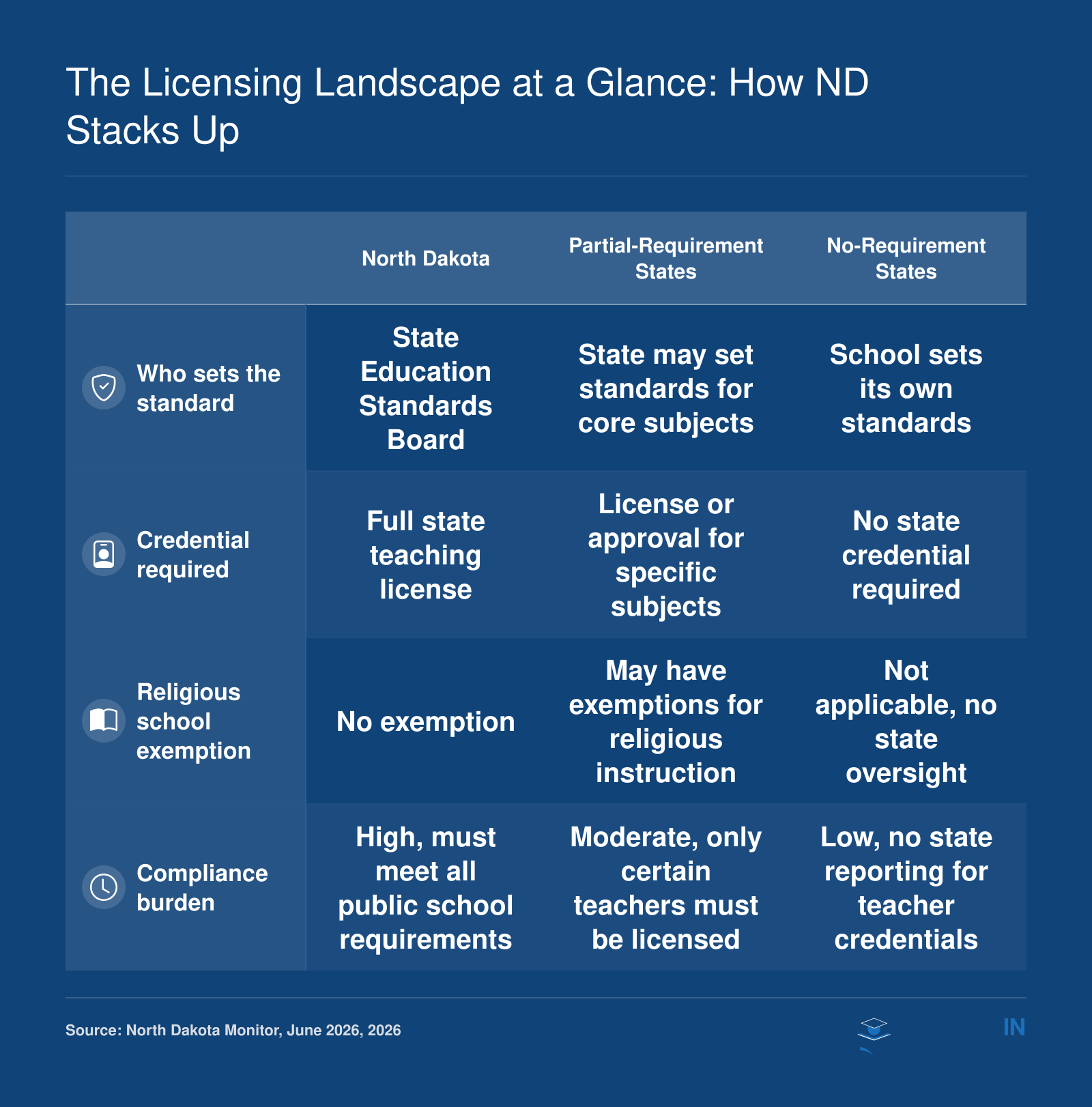
The Licensing Landscape at a Glance: How ND Stacks Up
Private school teacher licensing requirements vary widely across the U.S. This side-by-side comparison highlights how North Dakota's full-equivalence model stacks up against two other common regulatory approaches.
Possible Outcomes and What to Watch Next
The Capstone litigation will likely take years rather than months to resolve, and its trajectory will hinge on early procedural rulings. From the moment the complaint was filed, the path forward includes potential motions for a preliminary injunction, discovery, summary judgment, and a trial, with appeals almost certain to the Eighth Circuit. A realistic timeline sees a district court decision in 12-18 months, followed by another year or more on appeal.
Procedural Timeline and Likely Mileposts
The school will probably move quickly for a preliminary injunction to halt enforcement while the case proceeds. If granted, that would signal a judge sees a likelihood of success on the merits. If denied, the school faces continued compliance costs and the pressure to win at trial. Either way, expect the state to file a motion to dismiss, which could narrow the claims but is unlikely to end the case entirely.
Three Legal Outcomes and Their Ripple Effects
The case could end in three broad ways. A full plaintiff win would mean the court strikes down the licensing requirement as unconstitutional, freeing all North Dakota private schools from state teacher licensure mandates. A full state win would uphold the law, leaving the status quo intact. The most nuanced outcome is a narrow carve-out: the court could rule that applying the requirement to religious schools like Capstone burdens religious exercise, but leave it in place for secular private institutions. That would create a two-tier system within the private sector.
The 2027-2029 Legislative Session as a Parallel Track
Regardless of the lawsuit's speed, Capstone has made clear it will return to the legislature if necessary. The 2027 session could see bills to exempt private schools entirely or to craft an alternative approval pathway. Lawmakers may be more receptive if the litigation reveals widespread support or if the state loses at an early stage. Educators tracking these shifts should also follow North Dakota graduate programs in education, since curriculum on certification law may evolve as this case progresses.
Key Signals to Monitor
The clearest early indicator is whether the court grants a preliminary injunction. A decision to enjoin the law before trial would be a strong signal for the plaintiffs. Also watch the Education Standards and Practices Board; if it voluntarily adjusts enforcement, that could moot parts of the case. Finally, if other private schools in North Dakota join as plaintiffs, the pressure on the state will intensify.
National Implications for Private School Licensing
A favorable ruling for Capstone at the Eighth Circuit would create binding precedent in several Midwest and Plains states. While each state's laws differ, a decision rooted in the First Amendment or federal due process could embolden challenges in other jurisdictions that impose public-school-equivalent licensure on private school teachers. That could accelerate a patchwork of regulations nationwide, and educators considering masters in education specialization and licensure paths should watch how such precedents reshape program requirements across states.
Related Articles
What This Means for Your Education Career Planning
If you are pursuing or already hold an M.Ed., the Capstone Classical Academy lawsuit could reshape where and how you use your credential in North Dakota. Below are answers to the most pressing questions for education professionals watching this case.