
What you’ll learn in this article…
- Six Oklahoma universities launch new teacher prep programs in August 2026.
- TeachForwardOK funds accelerated and apprenticeship programs at four universities.
- New apprenticeship programs let you earn while getting certified.
More than 4,600 Oklahoma classrooms relied on emergency-certified teachers during the 2022, 2023 school year. That stopgap is beginning to recede, because August 2026 brings new certification pathways designed to get qualified educators into schools faster.
Six public universities launch programs in August 2026 under the TeachForwardOK initiative, funded by the Oklahoma Legislature. Accelerated certification at Oklahoma State University, University of Central Oklahoma, University of Oklahoma, and Northeastern State University targets career changers. Apprenticeship models at Cameron University and Southwestern Oklahoma State University let aspiring teachers earn credentials while working.
For elementary school teacher requirements and other classroom roles, these options remove the binary choice between paycheck and certification. Career changers weighing a classroom transition alongside graduate study may also find it useful to review how to balance full-time teaching and an M.Ed. program before committing to a path.
What Changed: HB 3076 and Teachforwardok Explained
For years, teacher certification in Oklahoma followed a single road through university-based preparation programs, but the signing of House Bill 3076 in 2026 has opened multiple new lanes for aspiring educators.1 This legislative shift, effective July 1, 2026, expands who can operate alternative teacher preparation programs and creates a new pilot initiative called TeachForwardOK.2
Broadening the Provider Pool
Before HB 3076, alternative teacher certification options existed but were largely confined to university partnerships. Now, the law explicitly authorizes public schools, regional service agencies, and private or nonprofit entities to run state-approved alternative teacher preparation programs.1 These providers can offer the alternative placement teaching certificate, a streamlined route designed for career changers and individuals with a bachelor's degree who want to enter the classroom quickly. To ensure quality, private and nonprofit organizations must earn accreditation from bodies like CAEP or AAQEP within three years, or risk losing their approval.1 The State Board of Education is also required to publish a list of all approved providers, adding a layer of transparency for aspiring teachers.
Introducing TeachForwardOK
TeachForwardOK is a two-year pilot program born directly from the legislation and funded with an emergency clause to speed its rollout.1 Managed by the Office of Educational Quality and Accountability (OEQA), the program aims to create flexible, high-standard pathways into teaching. Four universities, Oklahoma State University, University of Central Oklahoma, Cameron University, and Southwestern Oklahoma State University, receive OEQA grants to operate accelerated and apprenticeship-style programs. Meanwhile, the Oklahoma State Department of Education (OSDE) funds similar efforts at the University of Oklahoma and Northeastern State University. This split funding model ensures both quality control and geographic reach across the state's M.Ed. programs in Oklahoma.
What "Pilot" Means in Practice
As a pilot, TeachForwardOK runs through the 2027-2028 academic year, with results actively tracked by OEQA. The agency has 60 days to review and approve new programs, and it can require deficiency remediation if a program falls short.1 After two years, lawmakers and education leaders will evaluate outcomes, such as certification completion rates, placement data, and principal feedback, to decide whether to make the program permanent. OEQA Executive Director Michelle Seybolt emphasized that the goal is to "create flexible opportunities while maintaining high standards," ensuring that faster entry does not sacrifice teacher quality.
Oversight and What Comes Next
Compliance is monitored jointly by OEQA and the State Board of Education, with clear penalties for nonperforming programs. For aspiring teachers, this means more on-ramps into the profession, whether through an accelerated university program, an apprenticeship while working, or a new nonprofit provider. Knowing which teacher certification exams apply to your chosen pathway is an equally important next step. As these options take root, the teacher pipeline in Oklahoma may look very different by 2028.
All Oklahoma Teacher Certification Pathways Compared
Oklahoma's teacher certification landscape offers distinct paths for undergraduates, career changers, and current school staff, making it possible to enter the classroom through routes that match individual timelines and financial circumstances.
Traditional University-Based Certification
The conventional route runs through a state-approved teacher preparation program at an Oklahoma college or university. Candidates typically earn a bachelor's degree in education, complete student teaching, and pass required competency exams. This pathway builds deep pedagogical knowledge and leads to a standard teaching licensure. Many graduates later pursue a Master of Education (M.Ed.) to qualify for advanced certification levels or higher salary tiers, making it a natural fit for those planning a long-term classroom career.
Alternative Preparation Programs
For individuals who already hold a bachelor's degree in a non-teaching field, alternative programs provide an accelerated entry. Providers such as the American Board for Certification of Teacher Excellence (ABCTE) and Teach For America offer streamlined, non-degree routes that emphasize practical classroom skills. Candidates often begin teaching on a provisional license while completing the program's requirements. Eligibility generally includes a bachelor's degree, a passing score on subject-area exams, and a background check. Costs and timelines vary, so checking each provider's current offerings and application cycles is essential.
Accelerated and Apprenticeship Pathways
Recent legislative efforts have introduced apprenticeship-style models that let aspiring teachers earn a salary and benefits while training. These programs frequently partner with school districts and may be tied to university coursework. They are especially attractive for paraprofessionals, classroom aides, or career changers who need income during the certification process. In some cases, participants can earn graduate credits or even stack credentials toward a one-year M.Ed. program, bridging the gap between immediate employment and advanced education.
Finding the Right Pathway
Because eligibility rules and program formats differ, your first stop should be the Oklahoma State Department of Education website for the official list of approved providers and current requirements. Professional organizations like the Oklahoma Education Association and university schools of education also offer personalized guidance. The right pathway depends on your existing degree, work situation, and career goals. A traditional program offers a comprehensive foundation, while alternative and apprenticeship routes prioritize speed and practical experience. If you are weighing specialization options alongside certification, exploring how to choose a master's in education specialization can help you align credentials with long-term career goals. Comparing these options carefully helps you invest wisely in your teaching future.
Six Universities Launching New Programs in August 2026
In just a few years, Oklahoma has moved from a teacher shortage crisis to a laboratory for work-embedded certification models. Six public universities are now set to launch programs in August 2026 that dramatically shorten the path to the classroom, offering accelerated tracks and paid apprenticeship routes.
Accelerated Certification Pathways
Oklahoma State University, University of Central Oklahoma, University of Oklahoma, and Northeastern State University will all offer accelerated certification options under the TeachForwardOK umbrella. These programs compress the traditional teacher preparation timeline, often allowing career changers and bachelor's degree holders to earn a standard teaching credential in 12 to 18 months. Instead of returning to school full time, candidates complete intensive coursework, field experiences, and licensure exams in a streamlined sequence. In many cases, they can begin teaching with a provisional certificate before fully completing all requirements, a structure that makes the transition financially viable for mid-career professionals. For those weighing how quickly they can complete graduate-level work, accelerated master's in education programs offer useful comparison points on timelines and credit requirements.
Earn-While-You-Learn Apprenticeships
Cameron University and Southwestern Oklahoma State University are taking a different approach: apprenticeship-style programs that treat aspiring teachers as employees from day one. These models follow the federal Registered Teacher Apprenticeship design, which pairs candidates with a mentor teacher and provides a salary or stipend at or above the local substitute teaching rate.1 Apprentices work in real classrooms, gradually assuming teaching responsibilities while completing coursework toward a bachelor's degree and teaching credential.1 The model is especially attractive for paraprofessionals, current school employees, and others who need a steady paycheck while they train. While Cameron University's specific program details were not publicly available as of mid-2026,2 the general framework ensures participants receive compensation, mentorship, and eligibility for NEA Aspiring Educators support.1
Funding Streams and Their Implications
The Office of Educational Quality and Accountability (OEQA) funds the programs at OSU, UCO, Cameron, and SWOSU through the TeachForwardOK pilot. The Oklahoma State Department of Education (OSDE) funds the OU and Northeastern State programs. That distinction is more than bureaucratic: OEQA, as an accountability agency, often requires tighter data reporting and program evaluation, which can mean more structure and oversight. OSDE-funded pathways may integrate more directly with state department initiatives and professional development resources. For applicants, the key takeaway is that all six programs have publicly backed funding, ensuring stability and no out-of-pocket experimentation costs. Candidates who want to minimize expenses further may also want to review tuition-free teacher education options that pair M.Ed. coursework with service obligations.
How to Apply for August 2026 Launch
With programs starting in August 2026, application windows are likely to close in spring or early summer. Prospective candidates should visit each university's college of education website for specific deadlines, prerequisite coursework, and any required entrance exams. Many programs will offer information sessions or open houses in the coming months. Official announcements about each university's offerings were reported by Oklahoma universities launching new teacher certification programs and other outlets; interested readers should check those sources for links to program pages.
How M.ed. And MAT Programs Fit Into Oklahoma Certification
Southeastern Oklahoma State University alone offers 27 CAEP-accredited online M.Ed. programs, but none lead to initial teacher certification.1 That distinction matters for career changers and aspiring educators: most master's degrees in education are built for teachers who already hold a license, not for those entering the classroom for the first time.
Which Graduate Programs Lead to Initial Licensure?
A small number of programs explicitly pair graduate coursework with initial certification. Oklahoma Baptist University's Master of Arts in Teaching is partially online with multiple start dates, though the catalog does not clarify whether it routes to a first-time license.2 The University of Central Oklahoma's Secondary Education M.Ed. similarly leaves the initial-licensure pathway unspecified in published materials.3 Northeastern State University's M.Ed. in Mathematics Education states outright that it is not structured for initial certification,4 while the University of Oklahoma's graduate education offerings do not lead to a first credential.5 Oklahoma City University's M.Ed. in Instructional Design and Educational Technology also does not result in licensure, but offers stackable certificates that can reduce total coursework.6
One clear bridge is Oklahoma Wesleyan University's online M.Ed., which supports alternative certification candidates. The 33-credit program allows coursework taken for alternative licensure to count toward the master's degree, making it a direct route for career changers who need both a teaching job and a graduate credential.7 This model aligns with OSDE's alternative certification path, which requires a bachelor's degree, subject-area testing, and a provisional license while completing preparation.8
Stacking TeachForwardOK with a Master's Degree
TeachForwardOK, the pilot program funding accelerated and apprenticeship-style certification at six universities, is designed primarily for initial licensure. Candidates enrolled through Oklahoma State University, the University of Central Oklahoma, Cameron University, or Southwestern Oklahoma State University should ask program advisors whether completed coursework can be applied toward an M.Ed. or MAT later. University policies vary, but the legislative intent to expand access suggests that credit-stacking could become a formal feature. Oklahoma Wesleyan's existing model demonstrates how alternative certification coursework can feed into a degree, and TeachForwardOK participants may find similar transfer agreements if they inquire directly. Those weighing whether graduate study is the right first step can also explore enrolling in an M.Ed. program without teaching experience to understand how programs differ on entry requirements.
How to Verify Program Alignment
Start with the Oklahoma State Department of Education's approved list of teacher preparation programs.8 That directory is the definitive source for which pathways lead to initial licensure. When reviewing a university website, look for phrases like "initial certification," "first-time licensure," or "alternative placement." If language is vague, call the admissions office and ask specifically whether the program leads to an OSDE-recognized credential and which certification tests are required. Professional associations such as the American Association of Colleges for Teacher Education and the Oklahoma Education Association also maintain directories and can offer guidance on accredited options that match your career stage.
Related Articles
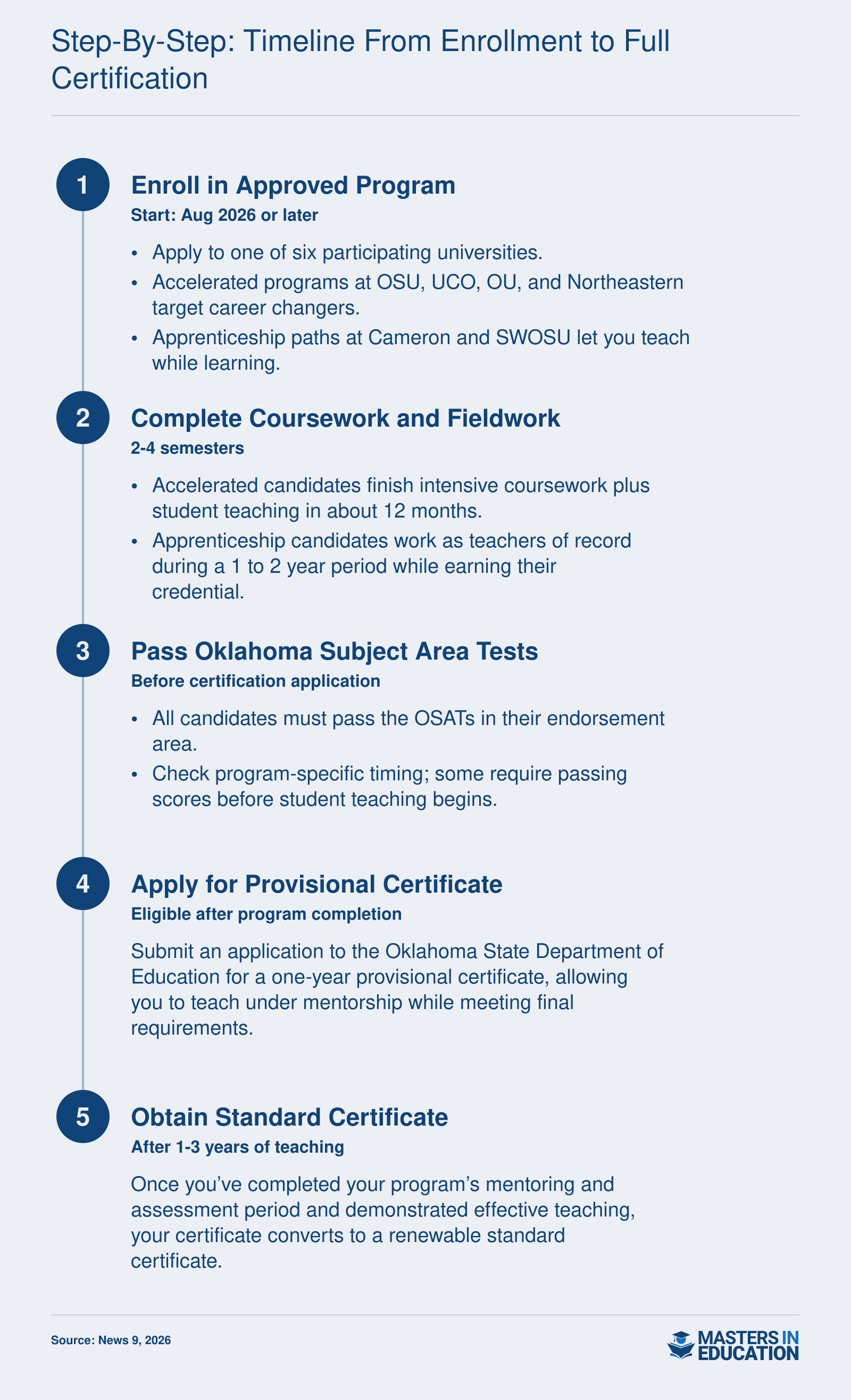
Step-By-Step: Timeline From Enrollment to Full Certification
The path from enrollment to a standard teaching certificate in Oklahoma follows a clear sequence. Depending on whether you choose an accelerated or apprenticeship program, your timeline may vary, but all pathways include these key milestones.
Which Pathway Is Right for You? Scenario-Based Guide
Your ideal Oklahoma certification pathway depends entirely on where you are starting from, not just where you want to go. The six new university programs launching in August 2026 create tailored on-ramps for distinct career situations, and choosing the right one can mean the difference between a seamless transition and unnecessary delays.
Career Changer with a Non-Education Bachelor's
If you hold a bachelor's degree in another field, the TeachForwardOK accelerated programs at Oklahoma State University, University of Central Oklahoma, University of Oklahoma, or Northeastern State University are your fastest entry. These tracks are designed for working adults, often featuring evening, hybrid, or online components. You can earn a preliminary teaching certificate in as little as 9 to 12 months while continuing to work in your current job. The curriculum compresses foundational pedagogy and content-specific methods, paired with a mentored classroom placement, so you transition directly into a paid teaching role upon completion.
Current Paraprofessional or School Employee
For paraprofessionals, aides, or other school staff already inside a district, the apprenticeship-style programs at Cameron University and Southwestern Oklahoma State University offer an ideal fit. You remain employed in your school while completing coursework and supervised field experiences, effectively earning your certification without leaving your paycheck behind. The model leverages your existing classroom familiarity and relationships, reducing the culture shock of a traditional student-teaching semester. Because you are already embedded in a school, your coursework assignments and practicum hours align directly with your daily responsibilities.
Out-of-State Certified Teacher
Oklahoma maintains a reciprocity pathway for educators holding a valid standard certificate from another state. The process is separate from the new pilot programs. You submit your out-of-state license, transcripts, and exam scores to the Oklahoma State Department of Education for review. While some requirements like the Oklahoma General Education Test and subject-area assessments may be waived if your home state's standards are deemed comparable, you will still need to complete the Oklahoma History and Constitution course and pass any required professional knowledge exams. For most, reciprocity takes weeks to a few months, far quicker than re-entering through an alternative program.
Recent Bachelor's in Education
If you just graduated with an education degree from a traditional preparation program, the most direct route is standard certification: pass your subject-area and pedagogy exams, apply through your university's recommendation, and submit fingerprints for a background check. The accelerated TeachForwardOK tracks are not designed for you unless your degree did not include a teacher preparation component. In that case, a university-based MAT or post-baccalaureate certification-only option may fill the gap more efficiently than a full new program.
Mid-Career Professional Seeking an M.Ed. with Certification
For professionals targeting a master's degree alongside certification, many Oklahoma universities embed certification coursework within M.Ed. or MAT programs. These typically span 30 to 36 credit hours and take 1.5 to 2 years full-time or 2 to 3 years part-time. The trade-off is clear: an M.Ed. can increase your salary placement on the district salary schedule and opens doors to instructional coaching or administrative roles, but it delays full-time teaching and costs more than a standalone certification program like TeachForwardOK. If your long-term goal includes a master's, consider whether balancing full-time teaching and an M.Ed. program is feasible before committing to the added timeline and tuition.
The right pathway balances your current credentials, life flexibility, and career goals. Oklahoma's expanded options mean you no longer have to quit your job or wait years to step into the classroom.
Questions to Ask Yourself
Oklahoma Teacher Salaries by Degree Level and Metro Area
Median annual wages for Oklahoma teachers vary by metro area and grade level, according to 2024 Bureau of Labor Statistics estimates. While the data below reflects all education levels combined, many school districts add a master's degree stipend, often $3,000 to $5,000 per year, which can significantly improve the return on investment for an M.Ed. Oklahoma salaries generally run below national medians, so career changers should weigh potential earnings against student loan obligations, especially when considering income-driven repayment plans. Employment totals give a rough sense of job availability in each market.
| Metro Area | Occupation | Total Employment | 25th Percentile | Median Annual Wage | 75th Percentile |
|---|---|---|---|---|---|
| Oklahoma City, OK | Elementary School Teachers | 5,840 | $46,750 | $48,310 | $64,080 |
| Oklahoma City, OK | Secondary School Teachers | 6,130 | $46,000 | $49,250 | $61,330 |
| Tulsa, OK | Elementary School Teachers | 4,050 | $46,370 | $49,460 | $65,670 |
| Tulsa, OK | Secondary School Teachers | 3,700 | $47,180 | $57,760 | $65,610 |
| Lawton, OK | Elementary School Teachers | 460 | $45,560 | $45,560 | $50,610 |
| Lawton, OK | Secondary School Teachers | 380 | $46,210 | $47,560 | $58,790 |
| Enid, OK | Elementary School Teachers | 300 | $41,660 | $45,800 | $48,930 |
| Enid, OK | Secondary School Teachers | 200 | $40,830 | $48,690 | $49,910 |
Costs, Funding, and Financial Aid for Oklahoma Certification
Out-of-Pocket Certification Costs
Regardless of the preparation pathway, every Oklahoma teacher candidate must budget for state-mandated fees. The Oklahoma State Department of Education (OSDE) charges a $50 application fee1 and a $25 transaction fee for the initial teaching credential.1 A fingerprint-based background check runs $58.25.2 Subject area assessments add another layer: the Oklahoma Subject Area Test (OSAT) carries a base fee of $118, though some exams range from $65 to $155 depending on the subject.3 If a professional knowledge assessment is required, plan for $145 to $300.3 In total, a bare-bones certification tab lands between $300 and $600 before any program tuition.
TeachForwardOK Accelerated Pathway Tuition
The six universities launching new programs in August 2026 offer streamlined, cost-predictable routes. TeachForwardOK alternative preparation programs require 15 credit hours and carry a total program cost of $8,000.3 This one-time investment covers all coursework and field experiences needed for a standard teaching certificate. Payment schedules vary by institution, and some allow per-course billing. Because these are graduate-level credits, candidates can often apply federal financial aid if they enroll in a degree-granting track such as an M.Ed. Prospective candidates researching M.Ed. scholarships and full-tuition awards may find additional ways to offset these costs.
Apprenticeship Programs: Earn While You Learn
At Cameron University and Southwestern Oklahoma State University, apprenticeship-style programs flip the traditional funding model. Participants who are already employed as paraprofessionals or support staff by a partner school district may continue receiving their regular salary during training. In some cases, the district covers a significant portion of program fees, bringing out-of-pocket tuition close to zero. Even career changers new to a district can negotiate a paid apprenticeship slot, effectively reducing net cost while gaining hands-on classroom experience.
Federal Loan Forgiveness and State Incentives
Oklahoma teachers who work in high-need schools or shortage subject areas can leverage two major federal programs. Public Service Loan Forgiveness (PSLF) forgives remaining direct loan balances after 120 qualifying monthly payments while employed full-time by a public school district. The Teacher Loan Forgiveness program offers up to $17,500 in forgiveness for highly qualified math, science, and special education teacher certification candidates who complete five consecutive years in a low-income school. Oklahoma also maintains the Teacher Shortage Employment Incentive Program, which provides annual stipends or reimbursement for tuition and fees to certified educators who commit to teaching in designated shortage fields such as special education and secondary STEM subjects.
Bottom Line Calculation
A career changer pursuing the TeachForwardOK accelerated route should budget about $8,000 in tuition plus $300-$600 in certification fees. If that same candidate qualifies for apprenticeship placement, the net cost can shrink dramatically, potentially to just the state fees. Factor in federal loan forgiveness after five years of service and whether a master's in education is worth the cost, and the long-term financial picture becomes even more favorable.
During the 2022–2023 academic year, more than 4,600 Oklahoma classrooms were staffed by teachers with emergency certifications, a clear signal of the state’s persistent educator shortage. New accelerated and apprenticeship-based pathways launching in 2026 aim to replace these stopgap measures with fully qualified professionals.
Common Questions About Oklahoma Teacher Certification in 2026
As Oklahoma's new teacher certification pathways open, educators and career changers have important questions about eligibility, costs, and program structures. Here are clear answers to the most common inquiries for 2026.