
What you’ll learn in this article…
- UNLV and UNR are Nevada's two flagship M.Ed. providers, each charging identical tuition for online and on-campus formats.
- District lane-change salary increases and state financial aid can significantly reduce out-of-pocket M.Ed. costs.
- Popular specializations include curriculum and instruction, educational leadership, and endorsement-aligned concentrations.
- Instructional coordinators in Las Vegas and Reno enjoy strong earning potential according to BLS wage data.
Nevada faces a persistent teacher shortage, with the state routinely posting hundreds of unfilled positions each school year, and district salary schedules reward a master's degree with permanent lane-change increases that can add thousands of dollars annually. For educators weighing the investment, the state's options are concentrated at two flagship institutions: UNLV and UNR. In-state graduate tuition starts around $7,000 per year at both, but program formats, specialization depth, and endorsement pathways differ considerably.
UNLV's M.Ed. in curriculum and instruction alone offers 14 concentration options on campus, while UNR delivers a fully online, cohort-based Educational Leadership program. That split reflects a broader reality: choosing the right Nevada M.Ed. depends less on prestige and more on which format, specialization, and licensure outcome fits your current role and next career move.
Best Master's in Education Programs in Nevada: Rankings Overview
Nevada's two flagship public universities each offer a distinct portfolio of M.Ed. programs, giving educators across the state clear but complementary pathways to advance their careers. The rankings below weigh institutional net price, graduation outcomes, and the breadth of delivery formats available to working teachers. Keep in mind that the graduation rates shown reflect institution-wide undergraduate data, not program-specific completion figures for graduate students.
- Net price after financial aid
- Institution-wide graduation rate
- Delivery format diversity
- Program specialization breadth
- Graduate outcomes data
- Internal program database
- NCES-IPEDS federal institutional data — nces.ed.gov
- College Scorecard graduate earnings — collegescorecard.ed.gov
- Independent program research
| Rank | School | Location | Net price | Best for | |
|---|---|---|---|---|---|
| #1 | University of Nevada-Reno | Reno, NV | $16,000/yr (net price) | Online learners statewide seeking flexibility | |
The University of Nevada, Reno pairs a strong online infrastructure with a wide M.Ed. catalog that spans educational leadership, special education, elementary education, and secondary education. UNR's College of Education recently climbed to No. 63 among U.S. News' Best Online Master's in Education Programs, reflecting growing national recognition. With an institution-wide graduation rate of about 61% and a net price near $15,927, UNR delivers solid value, particularly for educators outside the Las Vegas metro who need flexible, fully online options.
| |||||
| #2 | University of Nevada-Las Vegas | Las Vegas, NV | $10,000/yr | Las Vegas educators diversifying their specializations | |
The University of Nevada, Las Vegas anchors Southern Nevada's teacher pipeline with M.Ed. programs in curriculum and instruction, educational policy and leadership, higher education, and secondary teaching. UNLV's curriculum and instruction degree alone offers 14 emphasis areas, from educational technology to STEM education, making it one of the most customizable M.Ed. options in the state. At a net price of roughly $10,359, UNLV is the more affordable choice, and its hybrid educational leadership track meets Nevada administrator endorsement requirements.
| |||||


UNLV vs. UNR: How Nevada's Top M.Ed. Programs Compare
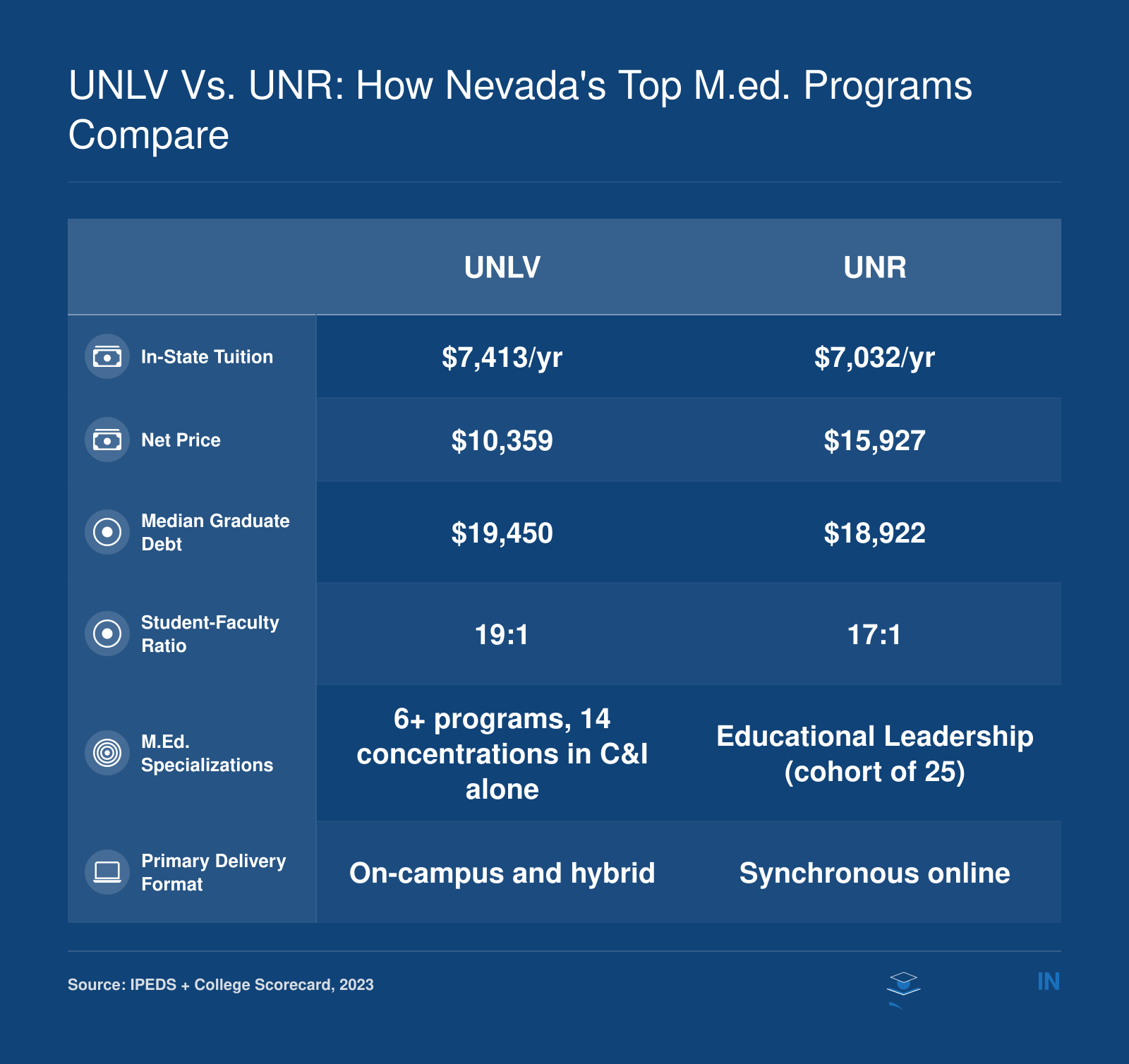
Nevada's two flagship universities each bring distinct strengths to their Master's in Education offerings. UNLV stands out for its breadth of specializations and lower net price, while UNR's cohort-based Educational Leadership program offers a fully synchronous online format with a tighter student-faculty ratio. Program-level earnings and debt data are not yet published for these specific M.Ed. programs, so the institutional figures below provide a useful baseline for comparison.
Nevada M.Ed. Tuition, Financial Aid, and District Reimbursement Programs
Understanding what you will actually pay for a master's in education in Nevada requires looking beyond the sticker price. Between state scholarships, district reimbursement programs, and tuition reciprocity agreements, many Nevada educators can reduce their out-of-pocket costs significantly.
In-State vs. Out-of-State Tuition at Nevada's Flagship Universities
Graduate tuition varies considerably depending on residency status. At the University of Nevada, Las Vegas (UNLV), in-state graduate tuition runs approximately $7,400 per year, while out-of-state students pay around $25,600. At the University of Nevada, Reno (UNR), in-state graduate tuition is roughly $7,000 per year, climbing to about $25,200 for nonresidents. These figures cover tuition and mandatory fees for listed M.Ed. programs, though actual costs may shift depending on credits taken per semester and any program-specific fees.
To put those numbers in context, institution-wide estimates suggest that the average net price after financial aid at UNLV is approximately $10,400, while UNR's is closer to $15,900. Keep in mind that these net price figures reflect all undergraduate and graduate students at each university and include varying levels of grants, scholarships, and other aid. Your individual cost will depend on your own financial aid package, enrollment status, and program.
Nevada-Specific Scholarships for M.Ed. Students
Several scholarship programs target educators pursuing graduate degrees in the state:
- Teach Nevada Scholarship: Covers 100% of in-state tuition and fees for master's candidates enrolled in programs that include a student teaching component. This is one of the most generous awards available to aspiring Nevada teachers.1
- Incentivizing Pathways to Teaching: Provides up to $4,800 for candidates in their final clinical year of a teacher preparation program.1
- UNLV College of Education Scholarships: Multiple awards are earmarked specifically for licensed Nevada teachers returning for advanced study.2
- NSEA Loretta Harper Scholarship: Offered through the Nevada State Education Association to Nevada public high school graduates pursuing education degrees. Applications are typically due in mid-April.3
- Nevada State University Scholarships: The university will match outside scholarships up to $500 per semester, providing a small but meaningful boost for students who secure external funding.4
Note that two commonly mentioned Nevada programs, the Governor Guinn Millennium Scholarship and the Western Undergraduate Exchange (WUE), apply only to undergraduate students and are not available for graduate study.56
District Tuition Reimbursement Programs
If you are already teaching in Nevada, your district may help cover the cost of a master's degree. Clark County School District (CCSD), the state's largest employer of educators, has historically offered tuition reimbursement for teachers pursuing advanced degrees tied to their teaching assignment or endorsement areas. Washoe County School District has a similar program for its educators. Reimbursement amounts and eligibility criteria change with each bargaining cycle, so check directly with your district's human resources or professional development office for current terms before you enroll.
Tuition Reciprocity for Out-of-State Online Programs
Nevada participates in the Western Regional Graduate Program (WRGP), which allows residents to enroll in select graduate programs at participating universities across the western states at reduced tuition rates. If a specialization you want is not offered within Nevada, the WRGP can make an out-of-state best online master's in education program substantially more affordable. Eligibility is program-specific, so verify that the exact degree you are considering is covered under the agreement.
Framing the Total Cost of Borrowing
Program-level debt and repayment figures for Nevada M.Ed. programs are not currently published, but institution-wide data offers a rough benchmark. Median undergraduate and graduate debt at UNLV and UNR generally falls in the range of $19,000 to $19,500. For a graduate student borrowing a similar amount, a standard 10-year repayment plan would translate to roughly $190 to $210 per month, depending on interest rates. Actual borrowing for an M.Ed. may be higher or lower based on your program length, scholarship awards, and whether you attend full-time or part-time while working.
The bottom line: Nevada educators have multiple levers to pull when financing a master's degree. Start by confirming your district's reimbursement policy, apply for every state scholarship you qualify for, and compare in-state costs against WRGP-eligible options before committing to a program.
Related Articles
Online vs. On-Campus M.Ed. Options in Nevada
Nevada's major universities offer M.Ed. programs in online, on-campus, and hybrid formats, giving working educators real flexibility in how they earn their degree. Both UNLV and UNR charge the same tuition rate regardless of delivery mode, so your choice comes down to learning style, schedule, and professional goals rather than cost. Our rankings data confirm which programs offer online, campus, or both formats, making it easier to filter options that match your situation.
- Online M.Ed. programs let working teachers complete coursework on evenings and weekends without missing classroom time.
- UNLV and UNR charge identical tuition for online and on-campus students, removing a common financial barrier.
- Online delivery eliminates the need to relocate, a key advantage for rural Nevada educators hours from Reno or Las Vegas.
- Hybrid options at select programs combine the convenience of online lectures with periodic in-person intensives for hands-on learning.
- Asynchronous course formats allow educators to progress through content at their own pace during busy school semesters.
- On-campus cohorts build stronger peer networks through regular face-to-face collaboration and group projects.
- In-person students benefit from direct practicum supervision, mentoring, and real-time feedback from faculty.
- Campus-based learners have immediate access to university libraries, research labs, writing centers, and career services.
- Online students may find it harder to form study groups or connect informally with classmates and professors.
- Some specialized endorsement tracks, particularly those requiring clinical hours, may have limited availability in fully online formats.
Questions to Ask Yourself
Popular M.Ed. Specializations Available in Nevada
Nevada's two flagship universities offer M.Ed. specializations that map directly to high-demand roles in the state's school districts. Understanding which concentration aligns with your career trajectory can save you time, money, and frustration when you sit down to apply.
Curriculum and Instruction
Curriculum and Instruction is the most widely offered M.Ed. concentration in Nevada and one of the most versatile. UNLV's Master of Education in Curriculum and Instruction alone features 14 emphasis areas, covering everything from elementary education and online teaching to diversity studies and curriculum development. Graduates of C&I programs typically pursue roles as instructional coaches, literacy specialists, curriculum developers, and online training coordinators. If you are a classroom teacher looking for a degree that keeps multiple career doors open, this is often the strongest starting point.
Educational Leadership
The University of Nevada, Reno offers a fully online Master of Education in Educational Leadership built around a cohort model of 25 teachers. The 36-credit program spans two years and includes synchronous Zoom sessions, an embedded internship, and mentorship from practicing principals. This specialization is designed for educators who want to move into building-level administration, whether as an assistant principal, principal, or district-level director. Because the internship is woven into the coursework, you can fulfill practicum requirements without stepping away from your current teaching position.
Special Education and STEM Education
Beyond the two flagship concentrations, Nevada institutions also offer pathways in special education and STEM education. A special education focus prepares you for roles such as special education director or case manager, both areas of persistent need in Clark County and Washoe County school districts. Masters in STEM education concentrations, meanwhile, position graduates for instructional coordinator roles that support science and math programming across grade levels.
Accelerated and Flexible Timelines
UNR's cohort-based Educational Leadership program completes in two years with a spring start and a November 15 application deadline. UNLV's Curriculum and Instruction program is campus-based, which allows for more scheduling flexibility depending on the emphasis area you choose. If speed matters, look closely at cohort programs that lock in a defined timeline. Educators who need to balance full-time teaching with graduate coursework will benefit from online or hybrid formats that limit time away from the classroom.
Matching a Specialization to Your Career Track
Graduates who move into leadership or specialist positions often see meaningful salary increases, a trend reflected in national masters in education salary data. A quick way to narrow your options:
- Instructional coordinator or curriculum developer: Curriculum and Instruction, with an emphasis in curriculum development or online teaching.
- Literacy coach or reading specialist: Curriculum and Instruction, with an emphasis in literacy or language arts.
- Assistant principal or principal: Educational Leadership, ideally a program with an embedded internship.
- Special education director or compliance lead: Special Education, paired with relevant Nevada endorsement coursework.
- STEM program coordinator: STEM Education or Curriculum and Instruction with a math or science emphasis.
Choosing the right specialization early keeps your coursework aligned with licensure endorsements and district hiring priorities, so you graduate ready to step into the role you actually want.
Nevada Teacher Licensure and M.Ed. Endorsement Pathways
Earning a master's in education in Nevada does more than deepen your expertise. It can also unlock new licensure endorsements, satisfy requirements for advanced teaching roles, and position you for leadership credentials. Understanding how your M.Ed. coursework connects to state regulations is essential before you enroll.
Understanding NAC 391 and Recent Regulatory Changes
Nevada's teacher licensure framework is governed by Nevada Administrative Code (NAC) Chapter 391, which outlines requirements for standard, professional, and special licenses as well as endorsement pathways. The Nevada Department of Education (NDE) periodically updates these regulations, and changes can directly affect what master's-level teachers need to demonstrate for licensure advancement or new endorsements. Visit the NDE website and search for "NAC 391" to review the most current language, including any amendments that took effect during the 2025-2026 cycle.
Adding Endorsements Through an M.Ed. Program
One of the most practical reasons to pursue a master's in education is the ability to add endorsements to your existing license. Nevada recognizes endorsements in areas such as English language learner (ELL) instruction, special education, gifted and talented education, reading specialist, school counseling, and educational leadership, among others. The NDE maintains documents, including an endorsement manual and licensure application materials, that list every available endorsement alongside its required coursework and assessment benchmarks. Before committing to a program, download the latest version of these documents from the NDE licensure page so you can confirm that your intended M.Ed. concentration satisfies every requirement.
Alternative Routes to Licensure
Nevada offers alternative licensure pathways designed for career changers and professionals who hold a bachelor's degree in a non-education field. Many of these pathways accept M.Ed. coursework in place of a traditional teacher preparation program, though specific conditions vary. For a broader overview of how graduate credentials intersect with state certification, see our guide on teaching licensure with master's in education. The NDE publishes an Alternative Routes to Licensure guide that details eligibility criteria, required testing (such as Praxis exams), and supervised teaching expectations. The Nevada State Education Association (NSEA) can also provide updated guidance on how recent policy shifts affect alternative route candidates.
Verifying Program Alignment With NDE Requirements
Not every M.Ed. program automatically satisfies Nevada's endorsement or licensure standards. Before you apply, cross-reference your chosen program with the NDE's approved programs list. Both UNLV and UNR maintain state-approved educator preparation programs, but individual concentrations, such as curriculum and instruction or educational psychology, may or may not map to specific endorsements. Contact the program's licensure officer and the NDE directly to confirm that your planned coursework will be accepted. If you are still comparing options across the country, our M.Ed. programs by state directory can help you evaluate alternatives. Taking this step early prevents costly surprises after graduation.
- Check NAC 391: Search the NDE site for the latest regulatory text affecting master's-level educators.
- Review the endorsement manual: Confirm which endorsements your M.Ed. concentration supports before enrolling.
- Explore alternative routes: If you are transitioning into teaching, verify that your M.Ed. coursework qualifies under the NDE's alternative licensure pathway.
- Cross-reference approved programs: Match your university's program with the NDE's approved list to ensure full alignment with current requirements.
Career Outcomes and Salary Expectations for Nevada M.Ed. Graduates
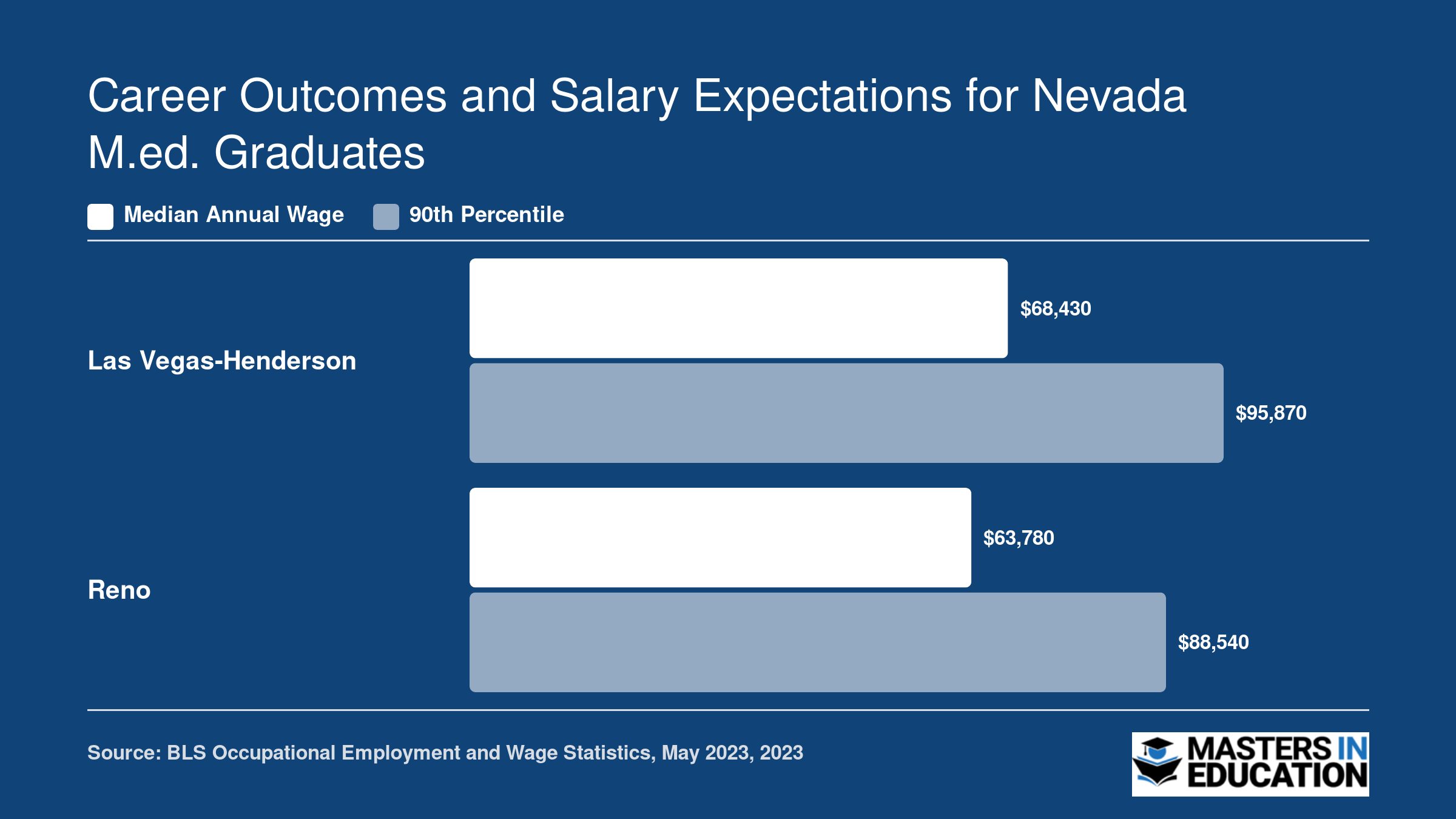
Instructional coordinators represent one of the most common career paths for M.Ed. graduates in Nevada. BLS wage data for this role shows strong earning potential in both of the state's major metro areas, with Las Vegas-Henderson and Reno each offering competitive salaries. Program-level earnings data for Nevada M.Ed. programs are not yet available, but institution-wide median earnings 10 years after enrollment provide useful context: approximately $60,600 for University of Nevada, Reno graduates and $55,000 for UNLV graduates.
Admissions Requirements and How to Apply to Nevada M.Ed. Programs
Getting into a Nevada M.Ed. program requires careful planning, and requirements can shift from one admissions cycle to the next. Below is a practical guide to help you navigate the process at both UNLV and UNR, along with tips for staying current on policies that may change before you apply.
Typical Admissions Criteria
While specific thresholds vary by program and concentration, most M.Ed. applicants at Nevada's two flagship universities should be prepared to submit the following:
- Undergraduate GPA: Many programs look for a cumulative GPA of 2.75 to 3.0 or higher, though some concentrations set a higher bar.
- GRE scores: Policies on the GRE have fluctuated in recent years. Some programs have moved to optional or waived requirements, while others still list the exam. Always confirm the current policy directly with the department.
- Teaching experience or licensure: Certain concentrations, particularly in curriculum and instruction or educational leadership, may expect applicants to hold a valid teaching license or document relevant classroom experience. Not every M.Ed. track requires this, so check the specific program page.
- Letters of recommendation: Most programs ask for two or three professional references, ideally from supervisors or colleagues who can speak to your work in educational settings.
- Statement of purpose: A concise essay outlining your professional goals and reasons for pursuing a graduate degree in education.
- Portfolio or interview: A smaller number of concentrations may require a professional portfolio or an admissions interview, especially in areas like special education or counselor education.
Application Deadlines and Cohort Timing
Both UNLV and UNR typically accept applications for fall and spring entry, though not every concentration offers a spring start. Deadlines can range from early in the calendar year for fall cohorts to mid-fall for spring admission. Some programs operate on a rolling basis until seats are filled, so applying early works in your favor. If you are considering accelerated options, one-year M.Ed. programs may offer a faster path to completion. Check the program's admissions page or FAQ for cohort-specific deadlines, as these are often posted well before the general university deadline calendar is updated.
Verify State-Level Prerequisites
Before you apply, visit the Nevada Department of Education website to confirm whether the M.Ed. track you are considering requires any state-level teacher certification prerequisites. If you are pursuing an endorsement pathway (for example, in English language learning or administration), the state may require specific coursework or testing before you can be fully admitted to certain program components. Applicants interested in English language learning endorsements may also want to explore a master's in TEFL for additional preparation. Understanding these requirements early prevents surprises down the road.
Stay Current on Changing Policies
Admissions standards at both institutions have evolved in recent cycles, particularly around GRE waivers and minimum GPA expectations. The most reliable sources for up-to-date information are the official UNLV College of Education and UNR College of Education websites. When in doubt, contact the graduate admissions office directly. Admissions coordinators can clarify portfolio expectations, confirm whether a teaching license is required for your chosen concentration, and flag any new requirements that have not yet been reflected online. A quick phone call or email can save weeks of uncertainty during the application process.
Frequently Asked Questions About M.Ed. Programs in Nevada
Choosing a master's in education program raises practical questions about cost, format, and career impact. Below are answers to the most common questions Nevada educators ask when exploring M.Ed. options.