

What you’ll learn in this article…
- Most ECE coordinator positions require at least a bachelor's degree, and a master's degree significantly strengthens advancement prospects.
- The BLS reports a median annual wage near $52,000 for preschool and daycare administrators, with top metro areas exceeding $75,000.
- Head Start programs mandate specific credentials, while state licensing rules for coordinators vary widely across all 50 states.
- Transitioning from classroom teacher to coordinator typically takes three to five years of progressive leadership experience.
Demand for qualified early childhood education coordinators continues to outpace the supply of candidates who combine hands-on classroom expertise with program administration skills. The role sits at the intersection of curriculum design, staff development, regulatory compliance, and family engagement, typically requiring at least a bachelor's degree and, increasingly, a master's in early childhood education or a related field. Median salaries for preschool and daycare administrators nationally fall roughly between $47,000 and $57,000 according to Bureau of Labor Statistics data, though pay varies widely by state, metro area, and program type.
For experienced teachers weighing this move, the central tension is practical: credential and skill requirements are rising even as federal projections show essentially flat employment growth in the field through 2034. This guide breaks down the steps, education requirements, certifications, salary benchmarks, and advancement paths you need to plan a deliberate transition into this leadership role.
What Does an Early Childhood Education Coordinator Do?
An early childhood education coordinator oversees the design, implementation, and continuous improvement of programs that serve young children, typically from birth through age five. The exact scope of the role depends heavily on the setting, which means two coordinators in the same city can have vastly different day-to-day responsibilities. Understanding these differences is essential before you map out a career path.
Core Responsibilities Across Settings
Regardless of where they work, most ECE coordinators share a common set of duties:
- Curriculum alignment: Selecting or developing age-appropriate curricula, ensuring consistency across classrooms, and aligning instruction with state early learning standards.
- Staff development: Coaching teachers, organizing professional development sessions, and conducting classroom observations to improve instructional quality.
- Compliance monitoring: Tracking licensing requirements, maintaining documentation for audits, and ensuring health and safety standards are met.
- Family engagement: Building communication systems between educators and families, coordinating parent workshops, and connecting families with community resources.
- Data and assessment: Overseeing developmental screenings, analyzing child outcome data, and using results to guide program decisions.
How the Role Differs by Setting
School district coordinators typically focus on Pre-K programs that align with the broader K-12 system. Their work often centers on curriculum articulation between preschool and kindergarten, teacher evaluation frameworks, and district-level policy. They may manage budgets tied to state Pre-K funding and report to a director of elementary education or a superintendent. In many districts, the position overlaps significantly with instructional coordinator responsibilities, particularly around curriculum review and teacher support.
Head Start coordinators operate within a federally regulated framework. The Head Start Program Performance Standards, codified in 45 CFR Part 1302, spell out detailed requirements for education, health, nutrition, and family services. A coordinator in this setting might oversee CLASS observation cycles, coordinate with disability services managers, and prepare for federal monitoring reviews. Duties here are more prescriptive than in most other ECE environments.
Private childcare coordinators, by contrast, often wear more hats. They may handle enrollment, marketing, staff scheduling, and parent communication alongside curriculum oversight. Their compliance obligations are shaped by state licensing rules. California's Title 22 regulations and the Texas Minimum Standards for Child-Care Centers are two well-known examples, and each state defines staffing ratios, facility requirements, and health protocols differently.
Where to Find Reliable Role Information
If you want a grounded picture of what the job entails, start with primary sources. The Bureau of Labor Statistics profiles for Preschool and Childcare Center Directors provide useful salary benchmarks and general occupational data that overlap with coordinator functions. For federally funded programs, reviewing the Head Start Performance Standards directly will show you the regulatory backbone of the role.
Real job postings are equally valuable. Search school district career portals for titles like "Early Childhood Coordinator" or "Pre-K Program Specialist" to see how districts define the position. Head Start grantee websites often list openings with detailed descriptions of required competencies and reporting structures.
Professional associations such as the National Association for the Education of Young Children (NAEYC) and state-level affiliates publish sample job descriptions and host communities of practice where coordinators discuss role expectations. These resources can help you identify common threads and regional variations before you commit to the credential and experience requirements covered later in this guide. For a broader look at how this role fits within education leadership, explore careers for masters in education.
The ECE coordinator role sits at the intersection of instructional leadership, regulatory compliance, and community partnership. Knowing how the position looks in different contexts will help you target the right preparation steps and the right employers.
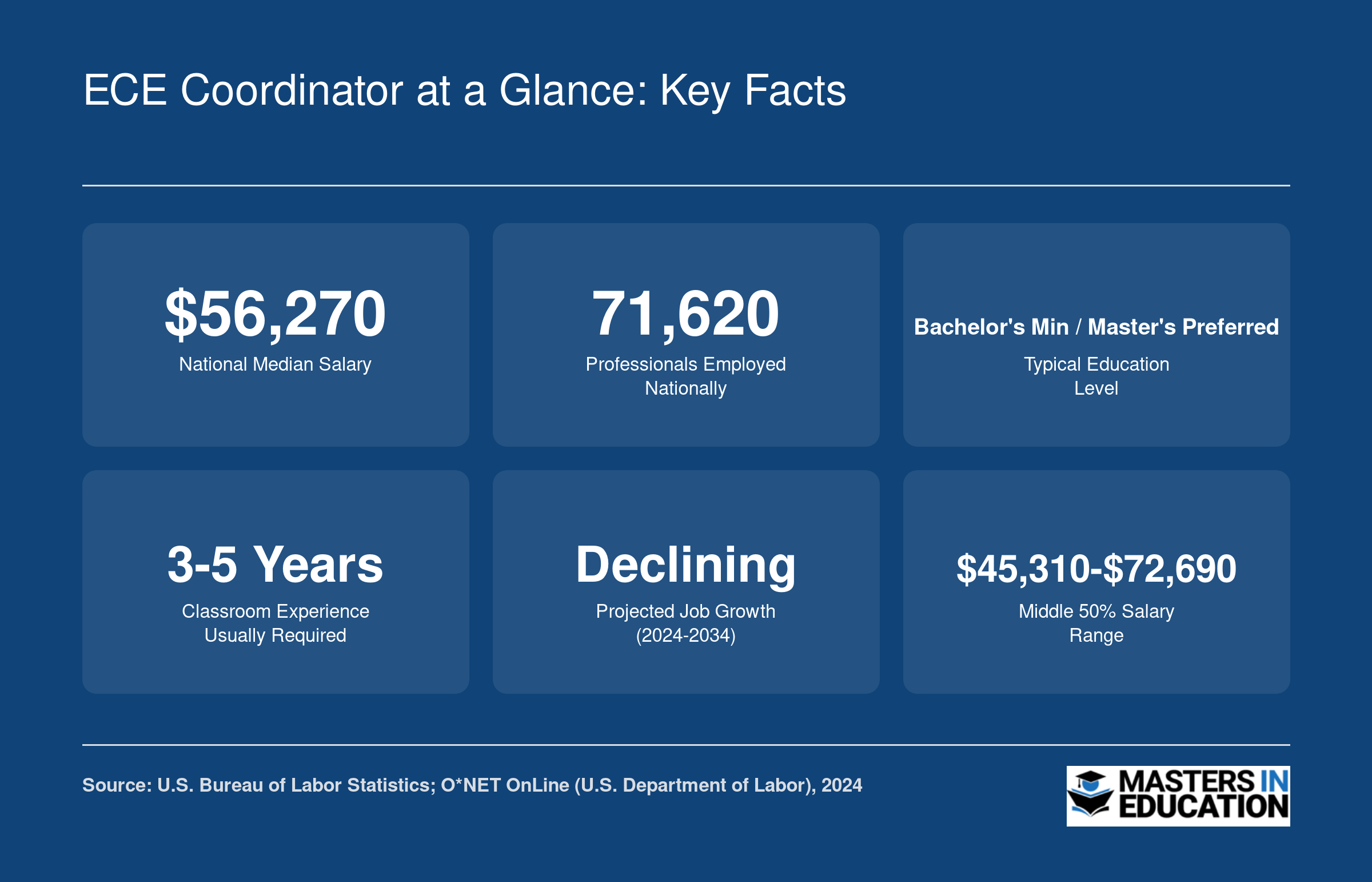
ECE Coordinator at a Glance: Key Facts
Before exploring each step in detail, here is a quick-reference snapshot of the early childhood education coordinator career path. These figures reflect national data for education and childcare administrators at the preschool and daycare level.
Steps to Become an Early Childhood Education Coordinator
Moving from the classroom to a coordinator role is a deliberate process that rewards planning. The roadmap below outlines five concrete steps, along with realistic timelines and alternate pathways for career changers.
Step 1: Earn a Bachelor's Degree in ECE or a Related Field
A bachelor's degree in early childhood education, child development, elementary education, or a closely related discipline is the standard entry point.1 This four-year credential gives you the foundational knowledge of developmentally appropriate practice, family engagement, and curriculum design that every coordinator draws on daily. If you already hold a degree in social work, public health, or psychology, you may qualify for lateral entry later, but plan on supplementing your coursework with ECE-specific content.
Step 2: Build Classroom and Leadership Experience
Hiring managers consistently expect candidates to have direct teaching experience before stepping into a coordinator role. Most job postings list a minimum of two years of classroom work, though three to five years is the preferred range.2 Beyond seat time, employers look for evidence that you have moved into leadership responsibilities: mentoring newer teachers, facilitating professional development sessions, or serving as a lead or mentor teacher. Supervisory experience and a demonstrated ability to deliver training to adult learners are frequently listed as requirements, reflecting the reality that coordinators spend much of their time coaching staff rather than working directly with children.3
Step 3: Pursue a Master's Degree or Graduate Certificate
While a bachelor's degree meets the minimum threshold, a master's degree is the preferred qualification at most organizations.3 Graduate programs in ECE leadership, curriculum and instruction, or educational administration sharpen the strategic and analytical skills the role demands. If you are weighing related leadership paths, the role of curriculum developer shares many of the same graduate-level competencies. A graduate certificate can be a faster alternative if you are already working full time. Many educators overlap this step with Step 2, enrolling in evening or online programs while they continue teaching.
Step 4: Obtain Relevant Certifications or State Credentials
Depending on your state and employer, you may need a specific teaching license, an administrative credential, or a program-specific certification. Some positions also prefer bilingual proficiency, which can strengthen your candidacy in communities with diverse family populations.3 Research the requirements in your target state early so you can build them into your graduate coursework or professional development plan.
Step 5: Apply Strategically and Build a Leadership Portfolio
When you are ready to apply, compile a portfolio that documents your leadership impact: training agendas you designed, program improvement data you collected, observation feedback you provided to teachers, and letters of recommendation from supervisors. Tailor each application to the specific job description, highlighting your experience with adult learning, curriculum alignment, and supervisory responsibilities.
Realistic Timeline
From your first day of college to your first coordinator position, expect a span of roughly six to ten years: four years for a bachelor's degree, two to four years of teaching experience, and one to two years of graduate study. Overlap is common, especially when educators begin a master's program while still in the classroom, which can compress the timeline by a year or two. For educators curious about long-term advancement, reviewing masters in education salary data can help you weigh the return on your graduate investment.
Lateral Entry for Career Changers
Professionals from social work, child development, or public health backgrounds can transition into ECE coordinator roles if they bring relevant experience working with young children and families. Employers generally expect these candidates to demonstrate equivalent knowledge of early childhood pedagogy, often through graduate coursework or a recognized credential.1 If you are considering this path, look for bridge programs or graduate certificates designed specifically for professionals entering early childhood leadership from adjacent fields.
Questions to Ask Yourself
Education Requirements for ECE Coordinators
The path to becoming an early childhood education coordinator is shaped largely by the educational credentials you bring to the table. While entry points vary, employers at every level are placing greater emphasis on advanced preparation in child development, curriculum leadership, and program management.
The Degree Baseline
A bachelor's degree in early childhood education, child development, or elementary education is the minimum requirement for most ECE coordinator positions. This foundational credential signals that you understand developmental milestones, classroom pedagogy, and age-appropriate practice. However, a bachelor's degree alone will increasingly limit your options. District-level administration roles, Head Start program coordinators, and positions in state-funded pre-K systems now commonly prefer or require a master's degree. If you are planning a long-term career in program coordination, treat a graduate degree as an essential investment rather than an optional credential.
Graduate Programs Worth Exploring
Several types of master's programs align well with the coordinator track. Program titles vary from one university to the next, but the most relevant options generally fall into a few categories:
- M.Ed. in Early Childhood Education Leadership: Focuses on administrative and supervisory competencies within early learning settings.
- M.A. in Curriculum and Instruction with an ECE concentration: Builds expertise in designing, evaluating, and improving instructional programs for young learners.
- M.S. in Child Development: Emphasizes the research and science behind how children grow, learn, and interact, which is valuable for coordinators who oversee assessment and program quality.
When comparing programs, look beyond the degree title. Review course offerings, practicum requirements, and whether the program addresses leadership in early childhood contexts specifically.
Graduate Certificates as a Strategic Alternative
Professionals who already hold a master's degree in a different field, such as social work, psychology, or general education, may not need a second master's to qualify for coordinator roles. A graduate certificate in early childhood administration or early childhood program leadership can fill knowledge gaps efficiently, often in 12 to 18 credit hours. These certificates are designed for working professionals and can be completed alongside a full-time position.
Coursework Employers Value Most
Regardless of the specific degree or certificate you pursue, certain coursework areas carry weight with hiring committees and help you perform effectively on the job:
- Early childhood curriculum design: Understanding how to build, adapt, and align curricula with state learning standards.
- Program evaluation: Knowing how to measure program effectiveness using data and structured review processes.
- Child assessment methods: Familiarity with developmental screening tools and formative assessment strategies used in pre-K through third-grade settings. Professionals drawn to this specialization may also explore assessment coordinator education requirements.
- Family and community partnerships: Strategies for engaging families and connecting programs with community resources, a core expectation in Head Start and publicly funded programs.
- Early childhood policy: Awareness of federal and state regulations, funding mechanisms, and quality rating systems that shape how programs operate.
Choosing a program that covers these areas positions you to step into a coordinator role with both the credential and the applied knowledge employers expect.
Certifications, Licenses, and Credentials You May Need
The credential landscape for early childhood education coordinators is anything but uniform. Requirements vary significantly depending on your state, the type of program you work in, and whether the program receives federal or state funding. Head Start programs, for example, must comply with federal performance standards that specify minimum qualifications for education coordinators and managers. Private child care centers, on the other hand, follow state licensing rules that differ widely from one jurisdiction to the next. Understanding which credentials apply to your situation is essential before you invest time and money.
Widely Recognized ECE Coordinator Credentials
The table below outlines the most common credentials you will encounter when pursuing coordinator roles across the country.
| Credential | Issuing Body | Typical Requirements | Best For |
|---|---|---|---|
| CDA (Child Development Associate) | Council for Professional Recognition | High school diploma or GED; 120 clock hours of training; 480 hours of work experience; professional portfolio; verification visit; CDA exam | Child care centers, Head Start, family child care homes, school-age programs |
| National Administrator Credential (NAC) | Private organizations (state-specific) | 40 to 150+ hours of specialized administration training; assessments; sometimes a portfolio or program improvement plan | Center directors and assistant directors; accepted in many states |
| Aim4Excellence National Director Credential | McCormick Center for Early Childhood Leadership (Erikson Institute) | Online director credential program; 40 to 150+ hours; assessments; portfolio | Recognized by some states and quality rating systems |
| California Child Development Permit, Site Supervisor | California Commission on Teacher Credentialing | BA or higher with specified ECE/child development and administration units, or AA plus additional units; supervised field experience | Licensed child care centers in California, state preschool, Head Start |
| California Child Development Permit, Program Director | California Commission on Teacher Credentialing | BA or higher with upper-level ECE/child development and administration/management units; additional supervisory experience | Licensed child care centers in California, state preschool, Head Start |
| State-Level Director Licenses | State departments of education or child care licensing agencies | Variable; typically an AA or BA degree, specified ECE and administration credits, one to four years of experience, background checks, sometimes a director-specific course | Licensed child care centers, state-funded pre-K programs |
Matching the Right Credential to Your Career Path
If you are just entering the field, the CDA is often the most accessible starting point and is recognized across a wide range of settings.1 Coordinators who plan to manage or direct programs should look into the National Administrator Credential or the Aim4Excellence credential, both of which focus specifically on leadership and program administration competencies.
California stands out for its structured permit system. Professionals working in that state should review the tiered permit levels issued by the Commission on Teacher Credentialing, because each tier unlocks different responsibilities, from site supervision to full program direction.
State Variation Is the Rule, Not the Exception
Beyond the credentials listed above, many states maintain their own director credential or administrator endorsement tied to a teaching license.2 Some states require specific college-level coursework in program administration, while others accept a combination of experience and professional development hours. Always check with your state's department of education or child care licensing agency to confirm what is required in your jurisdiction. If you hold a teaching license and want to move into coordination, ask whether your state offers an administrative endorsement that can be added to your existing credential, as this is a common and efficient pathway for classroom teachers making the transition. Educators interested in related leadership positions, such as how to become a school principal, will find that many of the same administrative coursework requirements overlap.
Key Skills and Competencies for ECE Coordinators
Moving from the classroom to a coordinator role means expanding your skill set well beyond lesson planning and child development expertise. While ECE content knowledge remains essential, coordinators operate at a systems level, overseeing staff, managing budgets, ensuring regulatory compliance, and aligning programs with community needs. The competencies below separate effective coordinators from strong classroom teachers.
Staff Supervision and Coaching
Coordinators spend a significant portion of their time observing teachers, delivering constructive feedback, and facilitating professional development. This requires more than pedagogical knowledge. You need the ability to assess instructional quality against established frameworks (such as CLASS or the ERS scales), coach educators with varying experience levels, and design PD sessions that address real performance gaps rather than generic topics. If the coaching dimension of this role appeals to you, explore what an instructional coach does for a related career path that centers entirely on teacher support.
Budgeting and Resource Management
ECE programs often run on tight, grant-dependent funding. Coordinators must understand line-item budgets, track expenditures against funding requirements, and make strategic decisions about staffing ratios, materials, and facility improvements. Comfort with spreadsheets and basic financial reporting is a practical necessity in nearly every coordinator role.
Regulatory Compliance and Licensing
State licensing standards, federal Head Start Performance Standards, and accreditation criteria from organizations like NAEYC all govern how programs operate. Coordinators are typically the point person for ensuring that every classroom, staff credential, and health and safety protocol meets current requirements. Falling out of compliance can jeopardize funding and enrollment, so detail orientation in this area is non-negotiable.
Family and Community Engagement
Strong coordinators build genuine partnerships with families and local organizations. This includes leading parent workshops, coordinating referrals to community services, and creating feedback loops so family input shapes program decisions. Cross-cultural communication skills are especially important in diverse communities where language barriers and differing cultural expectations around education can affect engagement.
Data-Driven Program Evaluation
Coordinators collect and interpret data on child outcomes, teacher performance, enrollment trends, and family satisfaction to guide program improvements. Many of the analytical competencies involved overlap with those required of a testing and assessment coordinator. Translating numbers into actionable changes, and then communicating those changes to staff and stakeholders in clear terms, is a skill that distinguishes high-performing coordinators.
Building These Skills While You Are Still Teaching
You do not have to wait for a coordinator title to start developing these competencies. Consider these steps:
- Volunteer for curriculum committees: Leading a committee gives you practice in facilitating adult collaboration and aligning instruction across classrooms.
- Mentor student teachers or new hires: Coaching another educator builds your observation and feedback skills in a low-stakes setting.
- Lead a parent workshop or family event: Organizing even one event helps you practice community engagement and event logistics.
- Track classroom data systematically: Go beyond what your center requires. Analyze attendance patterns, assessment results, or supply costs and present findings to your director.
- Study your state licensing regulations: Familiarity with compliance requirements signals readiness for administrative responsibility.
Soft Skills That Set Coordinators Apart
Beyond technical competencies, the coordinators who thrive tend to excel in conflict resolution, navigating disagreements between staff members or between families and the program with diplomacy and fairness. They communicate effectively across cultural and linguistic differences, and they possess a rare ability to translate policy language into concrete classroom practice so that teachers understand not just what to do, but why it matters. These interpersonal strengths are difficult to teach in a course, which is why building them through real experience while you are still in the classroom is so valuable.
Early Childhood Education Coordinator Salary by State
Early childhood education coordinator salaries vary significantly depending on where you work. The table below draws on the latest Bureau of Labor Statistics data for education and childcare administrators at the preschool and daycare level, which is the closest federal classification to the ECE coordinator role. States with higher costs of living, such as New York, California, and Washington, tend to offer the highest pay, while southern states generally fall at the lower end of the range.
| State | Median Annual Salary | 25th Percentile | 75th Percentile | Mean Annual Salary |
|---|---|---|---|---|
| New York | $79,660 | $61,190 | $99,990 | $92,820 |
| District of Columbia | $76,270 | $53,850 | $103,930 | $82,190 |
| Massachusetts | $68,660 | $59,470 | $80,810 | $72,470 |
| New Mexico | $67,780 | $59,000 | $78,700 | $71,900 |
| New Jersey | $66,360 | $57,130 | $98,900 | $79,390 |
| California | $65,420 | $57,960 | $81,760 | $76,280 |
| Washington | $64,360 | $53,380 | $95,020 | $82,090 |
| Delaware | $63,950 | $47,030 | $74,910 | $64,630 |
| Hawaii | $63,220 | $52,480 | $72,120 | $63,660 |
| Nebraska | $61,590 | $46,700 | $76,890 | $65,590 |
| Colorado | $61,150 | $50,170 | $76,580 | $66,680 |
| Connecticut | $60,300 | $47,500 | $81,330 | $67,870 |
| Nevada | $60,200 | $43,560 | $76,320 | $60,540 |
| Minnesota | $59,850 | $48,170 | $72,080 | $63,530 |
| Virginia | $59,420 | $46,730 | $70,530 | $59,740 |
| Utah | $59,400 | $42,470 | $93,140 | $67,460 |
| Vermont | $58,260 | $51,990 | $63,690 | $61,960 |
| Wisconsin | $57,790 | $40,380 | $61,680 | $54,420 |
| South Dakota | $55,270 | $40,660 | $58,640 | $56,620 |
| Michigan | $55,100 | $45,530 | $64,680 | $57,500 |
| Oregon | $54,510 | $46,760 | $70,350 | $59,090 |
| Montana | $52,300 | $42,440 | $59,740 | $53,910 |
| Kansas | $51,670 | $45,170 | $60,280 | $55,490 |
| Maine | $50,620 | $44,680 | $57,120 | $53,920 |
| Pennsylvania | $50,540 | $45,300 | $60,180 | $53,910 |
| North Carolina | $50,270 | $45,470 | $64,630 | $59,250 |
| Indiana | $50,250 | $45,380 | $63,140 | $57,660 |
| Rhode Island | $50,130 | $49,600 | $51,990 | $52,870 |
| New Hampshire | $50,000 | $45,570 | $66,440 | $57,920 |
| Florida | $49,990 | $39,220 | $60,400 | $57,430 |
| Arizona | $49,220 | $41,600 | $57,610 | $52,720 |
| Illinois | $48,580 | $40,990 | $61,260 | $54,840 |
| Texas | $48,510 | $41,760 | $59,680 | $53,380 |
| Wyoming | $47,230 | $36,450 | $65,470 | $51,800 |
| Ohio | $47,140 | $40,920 | $59,470 | $55,190 |
| South Carolina | $46,650 | $42,230 | $62,320 | $55,210 |
| Iowa | $46,550 | $37,300 | $56,780 | $50,120 |
| North Dakota | $46,300 | $42,790 | $61,360 | $58,700 |
| Tennessee | $45,620 | $42,530 | $57,110 | $54,240 |
| Georgia | $44,510 | $42,590 | $61,990 | $56,190 |
| West Virginia | $44,240 | $35,950 | $58,440 | $49,500 |
| Oklahoma | $44,110 | $38,640 | $56,050 | $50,910 |
| Arkansas | $42,430 | $34,470 | $54,080 | $46,650 |
| Alabama | $41,150 | $34,270 | $56,750 | $45,640 |
| Mississippi | $40,630 | $30,200 | $55,700 | $46,180 |
| Louisiana | $40,220 | $34,240 | $56,850 | $48,790 |
| Missouri | $39,370 | $29,330 | $55,010 | $46,300 |
| Kentucky | $38,860 | $36,070 | $56,440 | $47,720 |
Highest-Paying Metro Areas for ECE Coordinators
Location plays a major role in early childhood education coordinator salary. The table below ranks the highest-paying metropolitan areas by mean annual wage for education and childcare administrators in preschool and daycare settings, based on the latest Bureau of Labor Statistics data. Coastal and tech-hub metros consistently top the list, though cost of living should factor into any relocation decision.
| Metro Area | Total Employment | Mean Annual Wage | Median Annual Wage | 25th Percentile | 75th Percentile |
|---|---|---|---|---|---|
| New York, Newark, Jersey City (NY, NJ) | 4,740 | $91,640 | $79,000 | $60,590 | $100,610 |
| San Jose, Sunnyvale, Santa Clara (CA) | 680 | $87,670 | $77,120 | $61,220 | $93,630 |
| Seattle, Tacoma, Bellevue (WA) | 950 | $86,060 | $77,390 | $55,640 | $95,950 |
| San Francisco, Oakland, Fremont (CA) | 1,490 | $84,470 | $76,580 | $63,240 | $91,700 |
| San Diego, Chula Vista, Carlsbad (CA) | 690 | $78,880 | $62,530 | $46,870 | $78,630 |
| Boston, Cambridge, Newton (MA, NH) | 1,730 | $73,170 | $71,240 | $59,470 | $81,520 |
| Los Angeles, Long Beach, Anaheim (CA) | 2,810 | $71,810 | $61,880 | $50,370 | $81,600 |
| Denver, Aurora, Centennial (CO) | 710 | $70,810 | $64,180 | $51,460 | $84,210 |
| Sacramento, Roseville, Folsom (CA) | 500 | $69,720 | $59,790 | $47,660 | $80,240 |
| Washington, Arlington, Alexandria (DC, VA, MD, WV) | 1,480 | $69,580 | $61,490 | $50,400 | $76,380 |
| Minneapolis, St. Paul, Bloomington (MN, WI) | 860 | $65,350 | $60,630 | $49,190 | $73,960 |
| Philadelphia, Camden, Wilmington (PA, NJ, DE, MD) | 2,280 | $63,480 | $55,490 | $48,090 | $72,460 |
| Charlotte, Concord, Gastonia (NC, SC) | 490 | $61,840 | $58,730 | $47,660 | $71,390 |
| Austin, Round Rock, San Marcos (TX) | 580 | $61,420 | $58,900 | $46,590 | $65,760 |
| Portland, Vancouver, Hillsboro (OR, WA) | 1,000 | $61,100 | $54,680 | $47,080 | $70,900 |
Where Do ECE Coordinators Work?
Early childhood education coordinators fill essential roles across a range of settings, and the expectations, salaries, and qualifications can differ substantially from one employer to the next. Understanding these distinctions helps you target your job search and tailor your credentials accordingly.
School Districts
Public school districts hire ECE coordinators to oversee pre-kindergarten and early elementary programming.1 Common titles include early childhood curriculum coordinator, pre-K program specialist, and district early learning coach. These roles center on curriculum alignment with state standards, instructional coaching for classroom teachers, and regulatory compliance. Districts typically require at least a bachelor's degree, and many prefer or mandate a master's degree in early childhood education or a related field along with a valid teaching licensure. Salary ranges tend to be the highest in this sector, generally falling between $55,000 and $95,000 depending on district size and location.1
Head Start and Early Head Start Programs
Federally funded Head Start programs employ coordinators responsible for comprehensive services that extend well beyond academics, including health screenings, nutrition support, and family engagement.2 Job titles in this space include education coordinator, site coordinator, and content area manager. Under the Head Start Act, the minimum educational requirement for these positions is an associate's degree, though a bachelor's is increasingly preferred and sometimes required at the regional or grantee level. Salaries typically range from $45,000 to $80,000.2 Day-to-day work balances compliance monitoring with coaching teaching staff and ensuring program quality.
Private Childcare Centers
Private and for-profit childcare centers often hire coordinators whose work leans more toward operations than curriculum design.3 These roles may carry titles like program director, center coordinator, or education director. Responsibilities include managing state licensing requirements, handling staffing and scheduling, and maintaining enrollment targets. Minimum education requirements tend to be lower in this setting; some states allow entry with a high school diploma combined with a Child Development Associate (CDA) credential, though a bachelor's degree strengthens a candidate's competitiveness. Salaries are typically more modest, ranging from $35,000 to $60,000.3
Community-Based Organizations
Nonprofits, United Way affiliates, and other community organizations employ ECE coordinators to bridge families with early learning resources.4 Titles such as early childhood program coordinator, family services coordinator, and community outreach specialist are common. The primary focus is building partnerships among providers, connecting families to support services, and managing referral networks. A bachelor's degree in early childhood education, social work, or human services is generally expected. Salaries in this sector range from about $40,000 to $70,000, with variation based on the organization's funding and geographic region.4
Choosing the Right Fit
Each setting rewards a slightly different skill set. If you thrive on curriculum development and data-driven coaching, a school district may suit you best. If wraparound family services motivate you, Head Start or a community organization could be the stronger match. Candidates transitioning from the classroom should weigh the credential investment each path requires against the salary potential and mission alignment that matter most to their career goals.
Career Outlook and Advancement Opportunities
The career outlook for ECE coordinators requires honest context. According to the Bureau of Labor Statistics, employment for education and childcare administrators in preschool and daycare settings is projected to decline by about 1 percent from 2024 to 2034, compared to a 3.1 percent growth rate across all occupations.1 Despite this overall projection, the BLS still anticipates roughly 5,500 job openings over the decade, driven largely by retirements and turnover in existing positions.2 That means opportunities will continue to emerge even if the field is not expanding rapidly in raw numbers.
Why Demand Still Exists
Several forces create pockets of strong demand that the aggregate numbers may not fully capture. Many states are expanding publicly funded PreK programs, and these initiatives require qualified coordinators to design curricula, train teachers, and ensure compliance with state standards. Federal investments in childcare infrastructure, including grant programs aimed at stabilizing the early childhood workforce, further support hiring in this space. The growing adoption of quality rating and improvement systems (QRIS) across states also means organizations need professionals who can lead continuous improvement efforts, manage data collection, and guide programs toward higher quality benchmarks. If you position yourself with the right credentials and experience, you can tap into these demand drivers even in a field where overall growth is modest.
Advancement Paths to Consider
One of the advantages of starting as an ECE coordinator is the clear set of upward trajectories available to you. Two common pathways include:
- Center-based leadership track: ECE coordinator to program director to executive director of a multi-site organization. This path deepens your operational expertise and eventually puts you in charge of budgets, staffing, and strategic planning across several locations.
- Public-sector leadership track: ECE coordinator to district-level early childhood specialist to assistant superintendent of early learning. This route suits professionals drawn to systems-level change, policy implementation, and large-scale program oversight.
Both paths typically require a master's degree, substantial leadership experience, and a strong record of improving program outcomes. You can explore a broader range of masters in education jobs to see how coordinator experience translates across the education sector.
The Doctoral Advantage
For professionals with ambitions beyond site or district leadership, a doctoral degree (Ed.D. or Ph.D.) can open additional doors. Doctoral-prepared ECE leaders are well positioned for state-level early childhood policy roles, higher education faculty appointments, or research positions at think tanks and advocacy organizations. These roles allow you to shape the broader landscape of early childhood education rather than operating within a single program or system. A doctorate is not necessary for most coordinator or director roles, but it becomes a meaningful differentiator when you aim for positions that influence policy or prepare the next generation of early childhood professionals.
While the overall employment picture for this occupation is not one of rapid expansion, the combination of ongoing openings, policy-driven demand, and well-defined advancement paths makes the ECE coordinator role a practical launching point for a meaningful career in early childhood leadership.
Frequently Asked Questions About Becoming an ECE Coordinator
Below are answers to some of the most common questions prospective early childhood education coordinators ask. Each response draws on the qualification, salary, and career details discussed throughout this guide.
Explore Careers
- Child Development Specialist
- College Admissions Counselor
- Curriculum Developer
- District Administrator
- Diversity & Inclusion Coordinator
- Academic Advisor
- Adult Education Instructor
- Arts Educator
- Arts Integration Specialist
- E-Learning Designer
- EdTech Specialist
- Educational Administrator
- Educational Psychologist
- Elementary School Teacher
- ESL Coordinator
- ESL Teacher