What you’ll learn in this article…
- Jason Updegraph now teaches math after finishing SRU's online M.Ed.
- Math teacher shortages hit 31 states and science hit 34 in 2022-23.
- Alternative certification costs range from under $2,000 to over $10,000 by state.
Across 31 states, school districts reported math teacher shortages in 2022-23; science shortages affected 34 states. That gap is now a direct opening for engineers, scientists, and other STEM professionals considering how to become a science teacher without an education degree.
You can enter the classroom without starting over: most states offer alternative certification routes that recognize prior technical coursework and industry experience. The real decision is not whether you qualify, but which pathway fits your timeline, budget, and long-term goals shaped by the teaching job outlook 2024 to 2034.
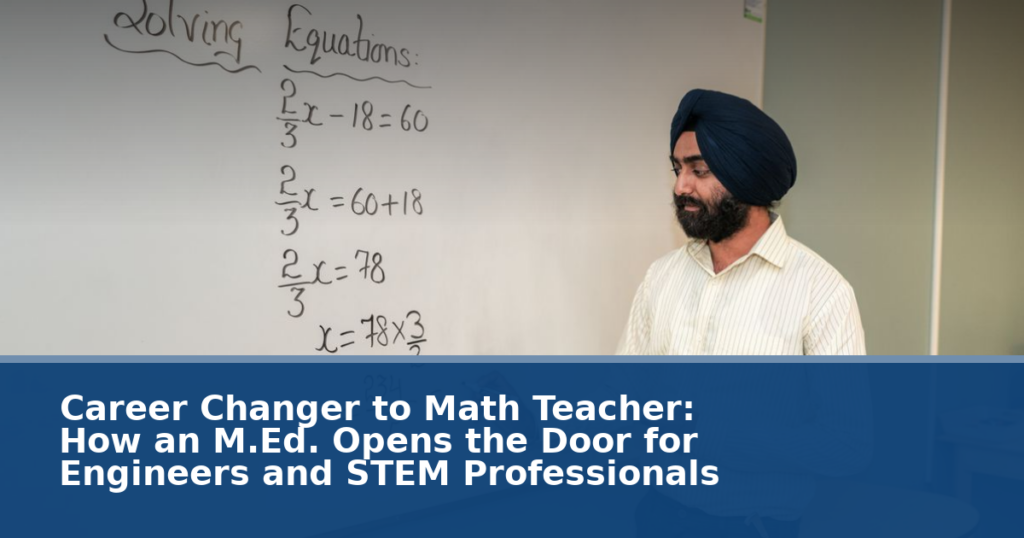
A former Navy engineer with a bachelor's in naval architecture finished an online secondary physics M.Ed. in December 2025 and was hired to teach math in a Pennsylvania district for fall 2026.
Why STEM Professionals Make Strong Teacher Candidates
An undergraduate education major learns physics through lab exercises and textbook cases. A former engineer learns physics by diagnosing failures, confirming load limits, and signing off on designs that have to work. Districts increasingly favor that second profile, especially in subjects where applied knowledge changes how students engage.
Real-World Context Districts Value
STEM professionals bring an application layer that teacher-prep programs often cannot simulate. A candidate who has used statistics for quality control or calculus for structural analysis can answer the question "when will I use this?" with specific examples. School leaders in many states report actively recruiting this background, not merely tolerating it.
Shortage Subjects and Faster Eligibility
Math and science remain perennial shortage areas across most U.S. states. That shortage gives real leverage to career changers considering teaching as a second career: a STEM degree frequently satisfies content-area requirements under alternative teacher certification pathways or CTE endorsements, allowing candidates to bypass or compress foundational content coursework and concentrate on pedagogy, assessment, and classroom management. The latest federal employment data puts the scale in perspective: about 1.07 million secondary school teaching jobs exist, with a median annual wage of $72,040. Teaching is not a windfall career, but it is a stable, scalable option for experienced STEM professionals.
Pipeline Programs and CTE Routes
State and national initiatives specifically recruit STEM professionals. 100Kin101 and its successor Beyond100K2 have focused on bringing industry-experienced candidates into classrooms. TNTP Teaching Fellows3 targets career changers already working in STEM professions in Baltimore, Indiana, Nevada, and New Orleans. California's EnCorps STEM Teaching Fellowship4 accepts candidates with deep STEM work or research experience, a 2.50 minimum GPA, and places fellows in middle and high school STEM or CTE classrooms. Washington's CTE Business and Industry Route5 goes further, allowing significant industry experience to substitute for a bachelor's degree in 2026. These routes are built for the exact profile engineers and technical professionals already hold.
Alternative Teacher Certification Pathways for Career Changers
Alternative certification for career changers is a state-approved route to a teaching license that replaces the traditional four-year education degree, often allowing candidates to teach while they complete requirements. In most states, the route begins with a provisional or emergency certificate: a temporary license that lets a district hire and pay you as the teacher of record while you finish coursework, exams, and supervised teaching hours.
A provisional certificate is not a lower bar. It is a time-limited credential tied to a state-approved preparation program, and it usually is not renewable unless you meet the state's completion milestones. Requirements vary widely by state, so a route that is quick in one state may not exist in another.
Three Main Models Career Changers Encounter
- District-based residency programs: You work in a classroom with a mentor while earning a credential. Some programs pay you during training; Colorado's Cherry Creek Aspiring Educator Pathway reports an annual salary of $47,5001 and New Mexico has offered paid student teaching stipends of around $10,450 per semester.2
- State-run alternative programs: The state issues a temporary or emergency license after you meet basic requirements. Oklahoma, for example, requires a bachelor's degree in a content area, a 2.5 GPA, two years of work experience, and the OSAT exam.3 Ohio's Alternative Resident Educator License uses a content area exam and a background check.4
- University-based post-baccalaureate programs: These serve bachelor's degree holders and often lead to a certificate or M.Ed. Texas programs show typical expectations: Lone Star College requires a 2.75 GPA5 and Texas State University requires the same GPA or a lower score with a content exam and resume review.6
CTE and Vocational Routes
Vocational and career and technical education pathways often have the lowest barriers for industry professionals. Some states accept years of work experience in place of specific coursework. For STEM professionals moving into a related CTE field, documented engineering or technical work experience can sometimes substitute for college education credits, but the exact policy depends on the state and endorsement area. Idaho's 12-month emergency certificate is an exception in the other direction: it accepts an associate's degree or 48 credits, but it excludes CTE, special education, administrators, and pupil service staff.7
Standards Still Apply
Alternative does not mean lower standards. Most routes still require teacher certification exams such as Praxis or edTPA and supervised student teaching hours. Michigan's alternative route requires a bachelor's degree and a 3.0 cohort GPA plus a background check8 and Texas State expects 15 subject credits for math or science above seventh grade.6 New York's COVID-era emergency certificates, for example, expired on August 31, 2025, so career changers there need a current route rather than relying on pandemic flexibilities.9
How Alternative Certification Timelines and Costs Compare Across States
Published 2025-2026 data from Texas and Florida show that alternative certification costs and timelines vary by provider even within a state. The table below uses representative state-approved programs in those two states, where detailed cost and duration figures are publicly available. Other states may have similar routes, but readers should check their own state education agency for current numbers.
| State | Program Cost Range | Typical Duration | Teach While Certifying? | STEM Fast-Track? |
|---|---|---|---|---|
| Texas (general ACP) | $4,500-$5,500 total, including program, state, and testing fees | 12-18 months | Yes: paid intern with supervision | No single statewide STEM-only fast track specified |
| Texas (iteach) | $4,949 program fee, excluding state certification fees | 12-18 months; instructional coursework in as little as 3 months | Yes: full-time teaching in as little as 8 weeks while completing program | No distinct STEM-only fast track specified |
| Texas (Teachers of Tomorrow ACP) | $5,495 program fee plus monthly access fees | Coursework in as little as 3 months; completion in as little as one year | Yes: Texas state policy allows paid internship | No separate STEM-only fast track specified |
| Texas (ECAP) | $4,490 total | Approximately one school year, with 300 hours of training | Yes: Texas state policy allows paid internship; fee schedule includes months once teaching | No separate STEM-only fast track specified |
| Texas (Lamar University online ACP) | $7,561 total tuition for 18-21 graduate credit hours | As few as 12 months | Yes: one-year paid internship option | No separate STEM-only fast track specified; math and science certification available |
| Texas (Texas State University ACE) | $4,400 for 15 credit hours | Accelerated route; exact months not stated in cited program page | Yes: Texas state policy allows paid internship; cited program page does not explicitly state paid teaching during enrollment | No separate STEM-only track specified |
| Florida (Palm Beach State College EPI) | $2,359 for Florida residents, including tuition and books | One year | Not specified in cited materials; completion plus FTCE provides eligibility for five-year Professional Certificate | No separate STEM-only fast track specified |
| Florida (St. Johns River State College EPI) | $3,800-$4,000 for in-state tuition, textbooks, and fees, excluding state exams and DOE fees | As little as 12 months, or three semesters | Not specified in cited materials; EPI plus FTCE leads to Professional Certificate | No separate STEM-only fast track specified |
M.ed. Programs Built for Working Professionals
Choosing Between an M.Ed. and Alternative Certification
Career changers often face two routes: alternative certification gets you into a classroom faster, usually through non-degree or short-term licensure programs. An M.Ed. or MAT adds a graduate credential that may increase long-term pay, open leadership and curriculum roles, and satisfy full licensure requirements in states with stricter rules. Some educators choose the faster route first and add the master's later; others find that one bundled program saves time.
Online and Cohort Formats for Working Adults
Several universities now offer online M.Ed./MAT programs with cohort scheduling for people who cannot stop working. Examples from current program listings include:
- University of Louisiana at Monroe: fully online MAT.
- University of West Alabama: online Alternative A Mathematics 6-12, 24 months, 39 credits, $429 per credit.
- Mississippi State: fully online MAT elementary and secondary routes, $602.50 per credit plus a $25 instructional support fee; secondary route is 30 credits.
- Saint Xavier University: MAT Middle Level online or on campus, 12-15 months, 26-32 credits, $575 per credit, about $18,400 total.
- MCLA: M.Ed. with initial licensure, fully online evening courses, 18-24 months, $466 per credit.
Missouri State's MAT covers biology, chemistry, earth science, math, and physics for certification, while NYIT's MAT Adolescence Education offers online, hybrid, and face-to-face formats. These programs show the variety available, but timelines and costs change, so check current program pages.
Admissions and Licensure in One Package
Typical prerequisites for career-changer M.Ed. tracks include a bachelor's degree in any field, with STEM degrees preferred for secondary math or science licensure, plus passing subject-area exams and a background check. GRE scores are increasingly waived or not required at many of these programs. Some programs also ask for an interview or teaching philosophy statement, but requirements vary by state. The advantage is that most M.Ed. programs bundle state licensure coursework, so graduates exit with both the degree and the teaching certificate. Slippery Rock University's online secondary education M.Ed. illustrates this model: it allowed former naval engineer Jason Updegraph to complete certification while managing family and graduate assistant duties, and he was hired to teach math in fall 2026. That combination of affordability, local reputation, and flexible online delivery is what many career changers should look for when comparing programs.
Related Articles
From Your First Inquiry to Your First Classroom: A Practical Transition Roadmap
The fastest route from an engineering desk to a classroom does not start with a graduate application; it starts with your state's department of education (DOE) website. Every state publishes approved alternative certification pathways, including which bachelor's degrees satisfy subject-area requirements. A naval architecture degree, for example, typically clears the content knowledge threshold for secondary math or physics teaching, but you need to confirm your transcript against the state's specific coursework matrix before you pay an application fee.
Start with State Certification Rules
Search your state DOE site for "alternative route to certification" or "career and technical education licensure." Confirm two things: that your degree meets the content standard for the subject you want to teach, and whether the state offers a provisional certificate while you complete an educator preparation program. Many states let STEM professionals begin teaching under a provisional license if they are enrolled in an approved program and have passed subject tests. After confirming eligibility, apply to one or two state-approved educator preparation programs, including online m.ed. programs for working teachers with evening or asynchronous options. Most programs require transcripts, a resume, and a short statement explaining your interest in teaching; ask whether prior engineering coursework can satisfy any pedagogy prerequisites.
Understand the Exam Sequence
The exam landscape has three common parts. Praxis Core tests basic reading, writing, and math skills; many states waive it for candidates with a STEM bachelor's degree or a qualifying SAT or ACT score. Praxis Subject Assessments measure content knowledge in areas such as mathematics, physics, or chemistry. You usually take these before student teaching or before a provisional assignment. The edTPA is a teaching performance portfolio that asks you to plan lessons, teach, and reflect on student learning. Some states accept alternative performance assessments, so verify the current requirement on the DOE site.
Plan Student Teaching and Hiring Timing
Traditional student teaching runs 10 to 16 weeks, but alternative routes often compress this or allow it to overlap with a paid teaching position. Districts in STEM shortage areas frequently hire provisional teachers before full licensure is complete, especially for math and physics. Applying early in the spring can position you for fall placement.
The financial anchor: the national median annual salary for secondary school teachers is $72,040, according to federal occupational data. That figure helps weigh program costs and M.Ed. scholarships against the near-term career outcome.
Costs, Financial Aid, and Scholarships for Career Changers Entering Teaching
Paying for a teaching transition usually looks different from paying for an engineering or STEM career move. The good news is that several aid sources, including M.Ed. scholarships, are designed specifically for people entering high-need subjects like math and science.
Federal TEACH Grant: Free Money With Strings Attached
The Teacher Education Assistance for College and Higher Education (TEACH) Grant offers up to $4,000 per year.1 Actual disbursements may be reduced by federal sequestration, and some institutions report adjusted awards around $3,772 for 2025-2026.2 Eligibility requires enrollment in an eligible program, a cumulative GPA of at least 3.25 or a qualifying test score in the 75th percentile, and intent to teach in a high-need field.1
The obligation is serious: you must teach full-time in a low-income school for four years within eight years of completing your program.1 If you do not meet that service obligation, the grant converts to an unsubsidized loan with retroactive interest. Graduate students face an aggregate cap of $8,000, while undergraduate and postbaccalaureate students have a $16,000 cap.3
Loan Forgiveness for Existing Engineering or STEM Debt
Public Service Loan Forgiveness (PSLF) can help career changers with prior student debt from an engineering or STEM degree. After 120 qualifying payments, typically ten years, while working full-time for a public school or qualifying nonprofit, the remaining balance may be forgiven.4 Teaching in math, science, or special education may also qualify you for Teacher Loan Forgiveness of up to $17,500 after five consecutive years in a low-income school, but you generally cannot count the same service period toward both PSLF and Teacher Loan Forgiveness.5 Planning the order matters.
State and District Incentives
State programs vary widely, and published dollar amounts are often scarce. Some states advertise incentives in the $5,000 to $20,000 range for shortage-area teachers, but confirm current terms with your state education agency.
Many urban and rural districts also offer signing bonuses and tuition reimbursement to attract STEM talent. These are frequently not listed in federal databases, so ask district HR offices directly during your job search; career changers often overlook them.
Budgeting for the Income Gap
If you leave a higher-salary industry role, expect a 12 to 24 month window of adjusted income before a full teacher salary with a master's degree and any forgiveness benefits take effect. Build a transition budget that covers licensure costs, graduate tuition not covered by aid, and a reduced paycheck during student teaching.
In 2022-23, U.S. Department of Education data showed math teacher shortages in 31 states and science teacher shortages in 34 states. That means more than three out of five states reported difficulty keeping core STEM classrooms staffed, a scale worth weighing if you are considering the switch.
A Naval Engineer's Path to the Math Classroom: Jason Updegraph's Story
Alternative certification has become one of the fastest routes for experienced engineers to enter high-need STEM classrooms. Jason Updegraph's path shows how a technical career, a focused online master's program, and student teaching can produce an immediate job offer.
From Naval Engineering to Student Teaching
After 17 years as an engineer for the U.S. Navy, including work at the Naval Surface Warfare Center, Carderock Division, Updegraph paused his career to be a stay-at-home dad. When he decided to return to work, he chose teaching rather than another industry role. He enrolled in Slippery Rock University's online master's in secondary physics education, citing SRU's affordability and local reputation as a Portersville native. His undergraduate training at Webb Institute, a small naval architecture and marine engineering school in New York, gave him the quantitative foundation that math classrooms often need. He completed the degree in December 2025.
Fast Translation in the Classroom
Updegraph's student teaching placement showed how quickly engineering expertise translates to the classroom. He taught AP physics and took over three classes within his first two weeks. He also worked as a graduate assistant at SRU's Macoskey Center for Sustainability Education and Research and received the Student Teacher of the Semester award from the College of Education. That recognition mattered because it came from the same College of Education faculty who assessed his readiness for a full-time teaching license.
Immediate Employment in His Home Region
The Slippery Rock Area School District hired Updegraph to teach mathematics starting in fall 2026, a direct step toward becoming a high school teacher. His adviser, Jason Hilton, professor of curriculum, instruction, and educational leadership, supported the transition. For readers weighing a similar move, Updegraph's bachelor's degree from Webb Institute and 17 years of engineering were enough with an online M.Ed.; no undergraduate education degree was required. The sequence underscores a practical reality: state-approved alternative certification for master's in education holders can recognize prior technical competence while pairing it with supervised classroom practice. The full Slippery Rock University news story is available.
Teacher Salaries Career Changers Can Expect
National data from the U.S. Bureau of Labor Statistics shows secondary school teachers earned a median annual wage of $72,040 in 2025, with the middle half of earners ranging from $59,980 to $92,570. By comparison, elementary school teachers earned a median of $63,970 and middle school teachers $64,370, which is why many STEM career changers target secondary openings. For professionals leaving six-figure engineering or technical roles, starting teacher pay is often a step down, but summers off, pension benefits, loan forgiveness options, and schedule flexibility can offset part of that gap. In some top-paying states, secondary teacher medians exceed $90,000, narrowing the difference considerably for career changers in high-cost metro areas.
| Teaching role | Median annual wage | 25th percentile wage | 75th percentile wage |
|---|---|---|---|
| Elementary school teachers | $63,970 | $57,710 | $81,450 |
| Middle school teachers | $64,370 | $58,530 | $80,490 |
| Secondary school teachers | $72,040 | $59,980 | $92,570 |