

What you’ll learn in this article…
- SBEC set a November 2 deadline for National Board to comply with DEI law.
- Nearly 620 Texas teachers receive TIA raises through National Board certification.
- Noncompliance could strip the credential's $9,000 annual pay boost.
On July 27, 2026, the State Board for Educator Certification voted to require the National Board for Professional Teaching Standards to revise its materials by November 2 or face exclusion from Texas’s Teacher Incentive Allotment.1 Roughly 620 certified teachers currently receive raises up to $9,000 per year through that program.1 The deadline puts current certificate holders at risk of an immediate pay drop and forces M.Ed. graduates to ask: is a master’s in education worth it? A nationally recognized mark of accomplished teaching is now being examined through a political lens, and its alignment with state law will determine whether it remains a dependable path to higher pay in Texas.
What's Happening: The Texas DEI Law and the National Board Certification Review
On July 24, 2026, the State Board for Educator Certification (SBEC) voted to require the National Board for Professional Teaching Standards to revise its certification materials to comply with Texas' anti-DEI law, as covered by the Texas Tribune's report on the decision. The decision came after a two-phase compliance review that began in January 2026, with a phase one report delivered in April. While the National Board was found largely compliant with state teaching requirements, such as allowing phonics without three-cueing and avoiding Common Core alignment, certain examples used to illustrate exemplary teaching were flagged as potentially conflicting with Texas' DEI ban.
Why the Review? The Scope of House Bill 2
The review is no narrow regulatory tweak; it stems from House Bill 2, a sweeping nearly $8.5 billion school funding package enacted in 2025.2 Among its many provisions, the law mandated that educator preparation programs and credentialing bodies undergo compliance checks for state education laws, including prohibitions on DEI practices. National Board Certification, a voluntary advanced credential recognized by many states, was swept into this review because it serves as a pathway to Texas' teacher evaluation tiered supports system, the Teacher Incentive Allotment (TIA), which awards up to $9,000 per year in raises to qualifying teachers.
What SBEC Found and the November 2 Deadline
SBEC's final report acknowledged that the National Board's materials met nearly all statutory requirements. However, a handful of illustrative teaching scenarios were deemed problematic under the DEI ban. At the July 24 meeting, National Board CEO Peggy Brookins testified that the organization is committed to working with Texas to address the concerns. SBEC set a firm deadline: the National Board must submit revised materials by November 2, 2026. Failure to comply could lead to the board's authorization being excluded from the TIA, meaning certified teachers would no longer be eligible for those pay raises. A final decision on this exclusion must be made by December 31, 2026; if no action is taken by then, the authorization is revoked by default.1
A Legal Review, Not a Judgment on Quality
SBEC member Bobbie Lynn Weir, who herself holds National Board Certification, made clear that the board's review was strictly about legal alignment, not an assessment of the certification's educational value. "We are here to look at compliance with state law, not to grade the program," she noted. This distinction is important for the roughly 1,200 Texas teachers who hold the credential, especially since about 620 of them currently benefit from TIA stipends.1 The next SBEC meeting window in September 2026 will likely provide updates on the National Board's progress toward compliance.
What Texas Law Actually Prohibits: Understanding House Bill 2 and SB 17
What exactly do Texas's new laws prohibit when it comes to diversity, equity, and inclusion content, and how does that reach teacher certification materials?
Senate Bill 17, passed in 2023, and House Bill 2, enacted in 2025, together create a specific set of prohibitions that extend beyond classroom instruction into the policies and training materials of any organization seeking state recognition or funding linkage. At their core, they ban mandatory training or credentialing activities that promote or endorse certain concepts related to race, color, ethnicity, gender identity, or sexual orientation.1 The statutes also forbid hiring or admissions practices that give preferential treatment based on these same categories, and they specifically outlaw the use of diversity, equity, or inclusion statements as a condition of employment or advancement.
Key Concepts That Cross the Line
The laws target language and frameworks that many educators consider standard professional development. For example, training modules that present systemic racism as an established fact rather than a theoretical lens, or that ask teachers to examine their own implicit biases, can be flagged. Portfolio prompts that require candidates to describe how they address equity by naming specific student identity groups may also run afoul of the rules. Phrases like "marginalized groups," "antiracism," "social justice," and "intersectionality" are explicitly mentioned in SB 17 as prohibited when used to frame a required activity or statement.2
Why Credentialing Bodies Must Comply
Although SB 17 originally applied to public universities, the state's authority extends to any credential that triggers taxpayer-funded pay incentives. Because National Board Certification is linked to the Teacher Incentive Allotment, which provides raises up to $9,000 annually, the State Board for Educator Certification can require the National Board to scrub its materials of banned concepts. If the National Board does not comply, Texas can simply exclude that certification from the program, leaving teachers who hold it without the financial benefit they expected.
What Compliance Does (and Doesn't) Mean
Compliance does not mean stripping all diversity-related content. Academic course instruction, scholarly research, and discussions in student organizations are explicitly exempt. What changes is the framing. M.Ed. programs in Texas can still teach about culturally responsive pedagogy, but they cannot require candidates to adopt a specific ideological stance or self-identify based on race or gender. Prompts that once asked "How do you advance equity for underrepresented students?" might be reworded to focus on observable student outcomes and instructional strategies without identity-based labeling.
How National Board Certification Works, and Why the Pay Link Matters
National Board Certification is the profession's most respected credential, but for many Texas teachers, its tangible value hinges on a direct line to higher pay. The process demands years of deep reflection and a significant financial investment; without the Teacher Incentive Allotment, the incentive to pursue it diminishes considerably.
The Certification Process: A Rigorous Multi-Year Commitment
Earning National Board Certification is not a one-time test. Candidates compile a detailed portfolio of classroom practice, including video recordings of lessons and evidence of student learning. They also pass a demanding content-knowledge exam that assesses their command of their subject area. Most teachers spend between one and three years meeting all requirements, and once achieved, the credential must be renewed every five years through a scaled-down portfolio submission. The financial cost, including registration and component fees, can exceed $1,900, not counting preparation resources or time away from the classroom.
Why the Texas Teacher Incentive Allotment Matters
For the small number of Texas educators who hold the certification, that investment yields a tangible dividend. Out of roughly 382,000 teachers statewide, only about 1,200 are nationally certified, and roughly half, around 620, currently receive a raise through the Teacher Incentive Allotment.1 Under the program, qualified teachers with active National Board credentials are designated “Recognized” and can see annual pay boosts of up to $9,000, depending on district funding and placement in a high-need school.2 The raise continues as long as both the teaching certificate and National Board certificate remain valid; if either lapses, the designation expires. This tie is by design: the state intentionally linked the credential to the allotment to reward accomplished teaching, but it also means compliance with state law is non-negotiable. Without that link, the certification reverts to a professional honor alone, stripping away the financial incentive that helps many teachers justify the time and expense, a scenario now in play after a recent State Board vote, as KWTX reported.
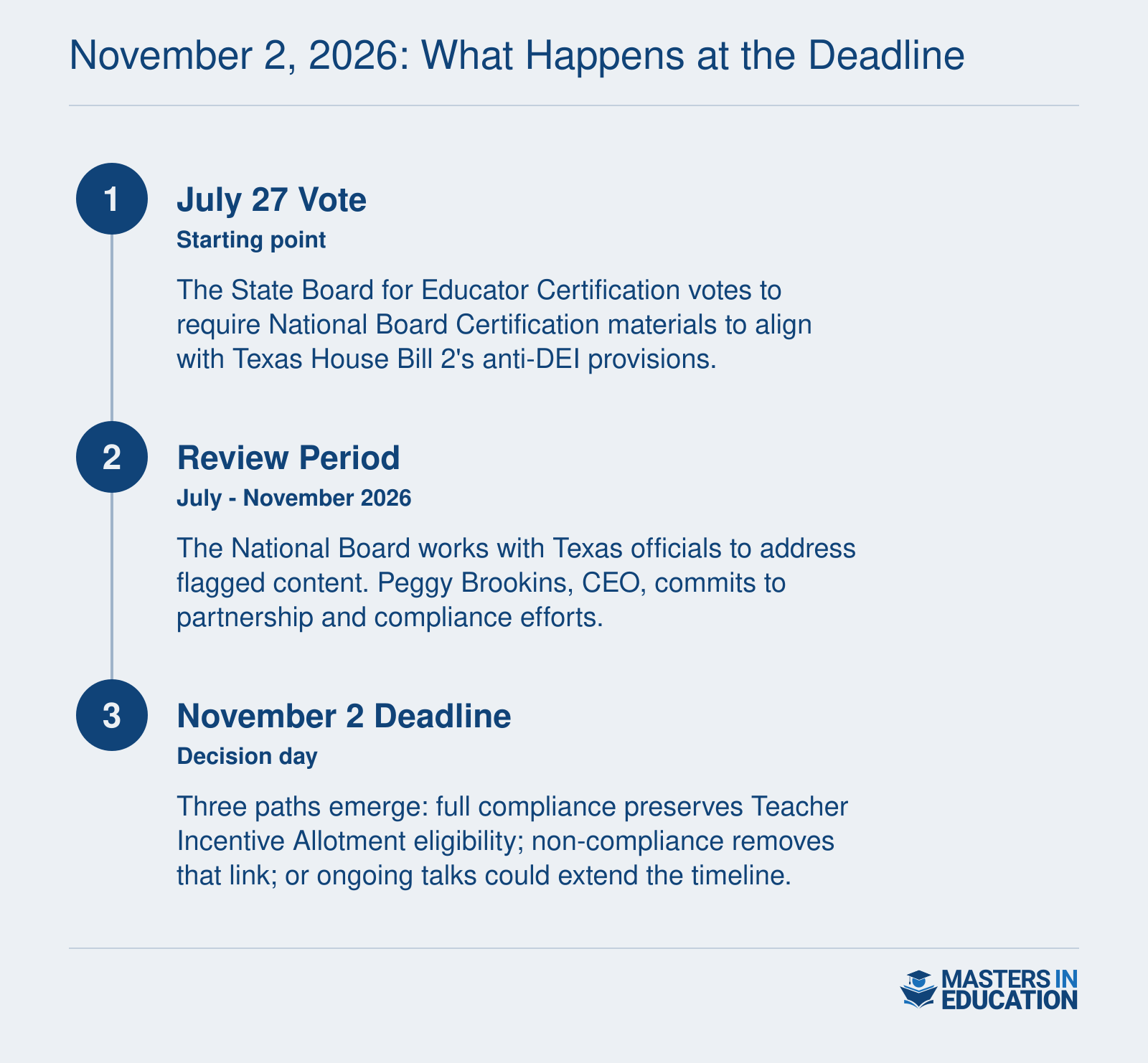
November 2, 2026: What Happens at the Deadline
The State Board for Educator Certification voted on July 27, 2026 to require National Board Certification to update materials and comply with Texas anti-DEI law. The decision sets a November 2 deadline that could determine whether educators with that credential remain eligible for significant pay increases through the Teacher Incentive Allotment.
Will Current Teachers Lose Their Raises, and How Will Districts Handle the Uncertainty?
For teachers already collecting a Teacher Incentive Allotment raise tied to National Board Certification, the immediate question is simple: am I losing my pay boost? For those in the renewal pipeline, the calculus is murkier: should I invest time and money in a credential whose state funding link may vanish? As the State Board for Educator Certification review unfolds, the answer depends on a mix of TEA policy, district practice, and a fast-approaching compliance deadline.
Current Allotment Recipients: What's Safe and What's at Risk
TIA entitlements are legally guaranteed for the year in which they are earned.3 This means a teacher who received a National Board-linked stipend this school year does not face a clawback; that money is secure. The risk is forward-looking. Because there is no explicit statutory grandfather clause for the NBCT designation within TIA,2 future annual allotments are tied directly to whether the board stays compliant with state law. If the National Board fails to scrub materials by the state's deadline and the SBEC removes the designation from eligible credentials, districts would need to stop paying that TIA component for subsequent school years. For now, the designation remains in a temporary, pending status while the review plays out.
District Payroll Decisions: How and When Raises Could Change
Without clear legislative protection, pay adjustments hinge on district-level timelines. Many Texas districts, such as Corsicana ISD, pay 100% of TIA allotments in a lump sum during August. Others spread them across paychecks. If NBCT certification is dropped from the approved list after the 2026, 2027 allocation cycle, the change would likely first appear in the following year's allotment calculations, typically notified to districts in late April.3 Districts then have until August 31 to spend the funds. A removal would therefore affect the 2027, 2028 pay cycle, not the current one. Still, a district could proactively remove the component from its compensation plan if the SBEC ruling makes the funding contingent, though most districts will likely await formal TEA direction.
TEA's Posture: Official Guidance Leaves Districts in a Holding Pattern
The Texas Education Agency has not yet issued a blanket directive to halt or continue NBCT-linked TIA payments. The designation is listed as temporary pending the SBEC review1, and TEA's public materials reiterate that TIA funds for a given year are guaranteed once earned3. This creates a holding pattern: districts continue to pay eligible teachers under current rules, but with the understanding that future allotment may be voided. No district is required to promise renewal-year funding for a credential under active compliance review.
The Renewal Question: Is NBCT Worth the Investment Right Now?
Teachers whose National Board certification cycle falls during this window face a tough choice. Renewal requires a portfolio submission and a $1,900 fee, a significant outlay if the state severs its link to TIA stipends of $3,000 to $9,000.1 Since the National Board must comply by November 2, 2026,1 a prudent step is to monitor whether the board announces changes before committing to renewal. If a teacher's deadline arrives before that clarity emerges, weighing the certification's intangible benefits, instructional advancement and professional recognition, against the potential loss of state pay becomes essential. Some may choose to pause, while others will renew and bank on grandfathering or a state compromise.
Related Articles
What M.ed. Grads and Certification Candidates Should Do Right Now
What should Texas teachers do right now about National Board Certification and their TIA raises?
For Teachers Already Holding National Board Certification
Your current Teacher Incentive Allotment stipend is not vanishing overnight. Unless your National Board certificate expires or the State Board for Educator Certification formally votes to remove NBCT eligibility, the annual $3,000 to $9,000 allotment continues through July 31 following your certificate’s expiration.1 The November 2 deadline is a compliance trigger for the National Board to update materials, not a date when existing stipends are canceled. Stay alert: watch TEA and SBEC announcements, and avoid making financial assumptions before any final rule change.
For M.Ed. Students and Teachers Considering National Board Certification
If you are weighing the $1,900 fee and yearlong commitment as part of a master's degree with teacher certification in Texas, pause to recalculate the return on investment. Without TIA eligibility, the financial upside shrinks dramatically. Professional recognition still holds value, and some districts may continue to prefer NBCTs for leadership roles or local incentives. But if your primary motivator is the state pay boost, consider waiting until the November 2 deadline passes and the path forward is clearer. Talk to your district about how it views the credential right now.
Alternative Pathways to the Teacher Incentive Allotment
National Board Certification is not the only door to TIA raises. Districts can design local designation systems based on classroom observation and student growth data, granting Recognized, Exemplary, or Master levels, the same tiers that carry the $3,000 to $9,000 allotments.2 If your district already runs a local system, you may qualify without NBCT. The designation remains valid for five years. Focus on your teaching practice and performance metrics to earn a designation through your district’s process, and learn how to maximize your Texas Teacher Incentive Allotment, regardless of what happens with the National Board.
How Teachers Can Advocate During the Review Process
The SBEC rule revision under 19 TAC Chapter 150, Subchapter DD will move forward with a public comment period of at least 30 days before adoption, expected before the end of 2026.2 Groups like ATPE and TSTA are already monitoring, testifying, and readying action alerts. Individual educators can submit comments, attend hearings, or contact board members. Your voice carries weight, especially since only about 1,200 Texas teachers hold the National Board credential, making the impact narrowly focused but consequential. Join your professional association’s advocacy network and be ready to weigh in when the comment window opens.
Frequently Asked Questions About National Board Certification and Texas DEI Law
Texas policymakers are reviewing National Board Certification's alignment with state anti-DEI laws, creating uncertainty for National Board Certified Teachers (NBCTs) who receive Teacher Incentive Allotment stipends. Below are answers to common questions from educators navigating this change.
Explore Texas Resources
- Best Master's in Education Programs in Texas
- Texas Tech University
- Texas State University
- Texas Woman's University
- East Texas A&M University
- Texas Southern University
- Texas Wesleyan University
- University of North Texas
- West Texas A & M University
- Concordia University Texas
- Texas Christian University
- East Texas Baptist University
Two groups face differing decisions: current NBCTs should monitor SBEC and TEA updates closely, while prospective candidates must weigh the Teacher Incentive Allotment uncertainty before investing time and money. The November 2 deadline will bring clarity, but educators cannot afford to wait passively. Whatever the outcome, National Board Certification retains its status as a mark of accomplished teaching. For now, however, its direct link to Texas pay raises remains temporarily unsettled.