

What you’ll learn in this article…
- Governor Greg Abbott launched the Texas Classroom Commission in July 2026.
- Chair Courtney Boswell MacDonald will deliver recommendations before the 2027 legislature.
- M.Ed. graduates can leverage their policy skills for commission leadership opportunities.
In July 2026, Texas allocated historic sums for teacher pay raises and the Teacher Incentive Allotment, yet the same month, the State Board of Education largely disregarded classroom educators when mandating biblical references in social studies curricula. Governor Greg Abbott's Texas Classroom Commission, launched in response, aims to rewire that dynamic by seating practicing teachers at the policy table. For careers for masters in education graduates, the commission signals new leadership pathways: its work on certification standards and legislative recommendations will require exactly the policy analysis and instructional expertise that advanced programs cultivate.
What Is the Texas Classroom Commission?
For years, Texas education policy largely flowed from the top down, with state boards and lawmakers driving curriculum and certification decisions. The Texas Classroom Commission, launched by Governor Greg Abbott in July 2026, flips that script, putting practicing educators at the center of policy formation. The commission is charged with developing classroom-informed recommendations for the Texas legislature, giving teachers a direct line to shape the rules and standards that affect their daily work.
A Teacher-Led Structure, Not Another Advisory Panel
The commission is explicitly designed to be teacher-led. Unlike many state task forces packed with administrators, lobbyists, or think tank representatives, this body centers the voices of current classroom teachers. Governor Abbott tasked the commission with gathering input directly from educators across the state and translating that into actionable legislative proposals. The structure signals a deliberate shift away from policy crafted in isolation and toward reforms rooted in the practical realities of Texas schools. For educators weighing advanced credentials, a M.Ed. in teacher leadership provides exactly the policy-fluency and leadership skills this kind of engagement demands.
Why 2026 Marks a Pivot Point for Texas Education
The launch comes amid record state investment in teachers. The 2026 legislative session already allocated historic funding for teacher pay raises, expanded the Teacher Incentive Allotment, and bolstered pensions for retired educators. These moves reflect a growing appetite in Austin for teacher-focused reform. The Classroom Commission extends that priority into the policy arena, ensuring that the people who instruct Texas students also have a formal seat at the table when laws are written. Teachers pursuing or completing M.Ed. programs in Texas are especially well-positioned to step into these emerging roles.
Breaking from Top-Down Mandates
The commission was announced just months after the State Board of Education largely dismissed teacher feedback on social studies curriculum changes, including a controversial mandate to teach over 200 biblical texts. That decision, along with the flawed Bluebonnet curriculum that required $8.4 million in corrections, reinforced a pattern of top-down mandates that many educators felt ignored their expertise. The commission directly responds to that frustration by creating a structured channel for classroom insight.
A Formal Channel for Classroom Expertise
What makes this moment different is the commission's institutional weight. Rather than relying on ad hoc feedback or occasional testimony, the commission will deliver formal recommendations to the legislature ahead of the 2027 session. For teachers ready to move beyond the classroom, pathways in education advocacy careers with an M.Ed. are a natural next step. For the first time in recent memory, teachers are not simply reacting to policy changes after the fact; they are being asked to help author the next chapter of Texas education.
Who Leads the Commission: Courtney Boswell Macdonald's Background
Courtney Boswell MacDonald's appointment as chair of both the Texas Classroom Commission and the State Board for Educator Certification places a teacher-turned-policy-leader at the nexus of classroom practice and statewide certification standards.
A Classroom Foundation
MacDonald began her career as a math teacher in Richardson ISD and Dallas ISD, giving her firsthand experience with the challenges of delivering curriculum, managing diverse classrooms, and navigating state-level mandates. That classroom perspective is not a distant memory; it is the lens through which she evaluates policy proposals and Texas master teacher certification requirements.
From the Classroom to Policy Leadership
After leaving the classroom, MacDonald moved into influential policy roles, serving as executive director for Texans for Education Reform, the Texas Institute for Education Reform, and Texas Aspires. In these positions, she bridged the gap between teacher voice and legislative action, advocating for policies grounded in classroom realities. Her dual appointment means the commission's recommendations can directly influence educator preparation, professional standards, and continuous improvement requirements for certified teachers.
What This Means for M.Ed. Graduates
For current and aspiring M.Ed. holders, MacDonald's career trajectory offers a concrete model: advanced training in curriculum, assessment, and educational leadership careers can open doors to policy roles beyond the classroom. Her leadership signals that Texas is placing a premium on teacher expertise in shaping the systems that govern certification and school improvement. However, the commission's credibility will ultimately be tested by whether its recommendations translate into durable legislative action in 2027, not by the resume of its chair. M.Ed. professionals who engage with the commission should focus on contributing actionable, evidence-based insights that can survive the political process.
Commission Membership, Focus Areas, and How Members Are Selected
Teacher voice in education policy is gaining institutional footing as states move from top-down mandates toward practitioner-informed decision-making. The Texas Classroom Commission, launched in July 2026, is designed to channel classroom expertise directly into legislative recommendations, but its membership composition and selection process are still taking shape.1
Who Serves on the Commission?
The commission is explicitly teacher-led, with eligibility limited to current or former Texas public school classroom teachers.1 While a full roster has not been released, the chair, Courtney Boswell MacDonald, brings a background as a former math teacher in Richardson and Dallas ISDs and now serves as chair of the State Board for Educator Certification.2 This dual role ensures the commission maintains a direct pipeline to teacher certification exams and credentialing standards. The governor's office has indicated that the commission will include educators from across the state, but specific numbers, grade-band representation, or subject-area balance have not been publicly detailed.
How Members Are Selected
Teachers interested in serving apply through the governor's formal appointments process by emailing [email protected]. The governor makes the final selections.1 Beyond the baseline requirement of being a current or former Texas public school teacher, no additional selection criteria or rubric have been published.3 This streamlined approach emphasizes a commitment to broad teacher representation without imposing narrow professional prerequisites, but it also means the final makeup may reflect the applicant pool rather than a structured sampling of Texas classrooms.
Policy Focus Areas
The commission's stated goal is "bolstering classroom instruction."1 That broad mandate likely encompasses curriculum quality, instructional materials, testing policies, and possibly teacher supports like compensation and working conditions, areas where classroom teachers can offer immediate insight. For M.Ed. graduates weighing careers for master's in education graduates, the commission signals that policy-facing roles are growing in visibility at the state level. However, no detailed policy agenda or subcommittee structure has been announced, which leaves open which specific issues will generate the most detailed recommendations for the 2027 legislative session.
Coordination with TEA and Other Agencies
The commission is not a TEA sub-body; it operates with a direct line to the Texas Education Agency, formally providing recommendations.1 The State Board of Education has no prescribed role in the commission's work, which may reflect a deliberate pivot away from recent SBOE-led curriculum decisions. Meanwhile, the chair's leadership of the SBEC creates a strong institutional link to educator preparation and certification policy.3 Notably, the commission is exempt from the Texas Open Meetings Act, which could allow for more candid internal deliberation but reduces public visibility into its proceedings.2
How Commission Recommendations Could Shape the 2027 Legislative Session
The 90th Texas Legislature convenes at noon on January 12, 2027,1 giving the Texas Classroom Commission a hard deadline to deliver its recommendations before lawmakers begin filing and debating education bills. With the regular session ending May 31,2 the commission's work must be largely complete by late 2026 to influence early legislation and committee agendas.
The Legislative Schedule and Commission Deadlines
The commission will need to package its findings into a report or series of policy proposals well before the session's start. In Texas, many bills are prefiled as early as November 2026, and the first weeks of session are dominated by bill introductions and committee assignments. If the commission's recommendations are not ready by December 2026, they risk missing the prefiling window and the critical early momentum when education committee chairs set their priorities.
How Commission Ideas Become Bills
The commission does not have the power to introduce legislation directly. Its deliverables will likely be submitted to the governor's office and the House and Senate Education Committees. From there, a legislator must champion each recommendation by drafting and filing a bill. The political weight of the governor's support and the commission's teacher-led credibility can help move proposals forward, but success depends on finding sponsors who will shepherd them through the committee process and floor votes.
High-Impact Policy Areas and Potential Pitfalls
Given the commission's origin in response to top-down curriculum mandates, curriculum review processes are almost certain to feature in its recommendations. Teacher certification pathways and the Teacher Incentive Allotment pay structures are also likely targets, as the commission's chair has deep experience in certification and the state has recently invested heavily in teacher pay. Teachers who have pursued graduate-level work can explore how to choose a master's in education specialization to align their credentials with the policy areas the commission is most likely to affect. However, all recommendations are advisory. Even widely supported ideas can stall without a legislative champion or if they arrive after session deadlines for bill passage. If the commission's work continues into early 2027, its proposals may not be reflected until the 2029 session, leaving an immediate impact on classrooms out of reach.
From Classroom to Commission: Leadership Opportunities for M.ed. Graduates
M.Ed. Competencies That Map to Commission Work
The Texas Classroom Commission's teacher-led model draws on the same skill set that Master of Education programs cultivate. Core M.Ed. areas, such as policy analysis, curriculum development, and instructional leadership, are directly relevant to the commission's task of crafting classroom-informed recommendations for the legislature. Graduates who have completed coursework in education policy, school improvement, or teacher evaluation will recognize the commission's work as an applied extension of their training. The ability to assess policy proposals, weigh evidence from practice, and communicate with stakeholders mirrors the analytical and leadership skills emphasized in M.Ed. programs.
Formal Pathways for Advanced Credentials
The commission signals a broader shift in Texas education policy: the state is creating formal avenues for teachers with advanced credentials to influence decisions, rather than simply implementing them. M.Ed. graduates who hold or are pursuing Texas certification are well positioned to engage with the commission's outputs, especially if recommendations touch certification standards or teacher preparation. Even if not serving on the commission directly, educators can contribute through public comment periods, professional organizations, and by staying attuned to policy briefs generated by the commission. This engagement demonstrates how an M.Ed. serves as a credential for leadership, not just classroom teaching. Understanding how alternative teacher certification compares to a master's in education can help candidates decide which pathway best prepares them for these emerging policy roles.
Career Advancement Through Policy Roles
This teacher-led model elevates careers for master's in education graduates that blend instructional expertise with policy insight. Roles such as instructional coach, curriculum director, or testing and assessment coordinator align with the kind of practitioner expertise the commission represents. M.Ed. graduates who step into these roles can bridge daily classroom realities and systemic reform. The commission's existence acknowledges that effective education policy requires voices from those who understand both pedagogy and the complexities of implementation. For M.Ed. holders, this validates the degree's purpose: preparing educators to lead reform processes, not just follow them.
How Texas Teachers Can Provide Input to the Commission
The Texas Classroom Commission marks a shift toward teacher-led policy, but engaging with it requires understanding the distinct channels available, some formal and others indirect. Teachers who want to see their classroom perspectives reflected in the commission's recommendations have several actionable pathways.
Formal Membership: Applying for a Seat
Classroom teachers who are Texas residents can apply directly for membership on the commission.1 The governor's office is accepting applications through [email protected]. Becoming a member means you could help shape the recommendations that go directly to the legislature. Because the commission is an advisory committee under Chapter 2110 of the Government Code, applying does not guarantee appointment.1 Members are selected by the governor's office, and criteria beyond the basic eligibility of being a current classroom teacher have not been publicly disclosed. If you are interested, submit a statement of interest and your teaching credentials early; application windows for such bodies can close without public announcement.
Beyond Direct Membership: Submitting Comments and Testimony
As of July 2026, the commission has not scheduled any public meetings or hearings, and it is not subject to the Open Meetings Act, so its internal deliberations will likely remain closed.1 Still, teachers can influence outcomes indirectly. The Texas Education Agency routinely accepts public comments on proposed rules, many of which intersect with the commission's work.2 Comments can be emailed to [email protected], and relevant rule proposals are posted on the TEA proposed commissioner rules page with defined comment periods. Teachers can also plan for the 2027 legislative session: once the commission's recommendations are introduced as bills, educators may testify before the House Public Education Committee or Senate Education Committee. Recent TEA public hearings have offered both in-person sessions at the Barbara Jordan Building in Austin and virtual sign-in options,3 making it easier for teachers statewide to participate.
Leveraging Professional Associations
Organizations such as the Texas Classroom Teachers Association (TCTA) and the Texas State Teachers Association (TSTA) can amplify individual voices. These groups often survey members, develop position statements, and submit collective comments on policy proposals. Even if you are not a member of the commission, communicating your concerns through your association helps ensure they reach the decision-makers. Subject-area organizations like the Texas Council for the Social Studies may also engage on curriculum-related issues that fall within the commission's purview. Teachers looking to move into formal policy roles should also consider how careers for master's in education graduates can extend beyond the classroom into advocacy and advisory work.
Using the TEA's Existing Feedback Loops
The Texas Education Agency maintains a public comment form on its website and a rulemaking contact line at 512-475-1497.2 While these channels are not specific to the Classroom Commission, they allow educators to weigh in on the broader policy environment the commission will influence. Teachers can use these avenues to highlight issues the commission should address, such as classroom curriculum standards or certification requirements. The commission, housed under TEA, is likely to consider input received through these mechanisms as it finalizes its report.
By combining a direct application, organized association input, and engagement with TEA's established processes, Texas educators can ensure their expertise shapes the policies that will define the state's classrooms for years to come.
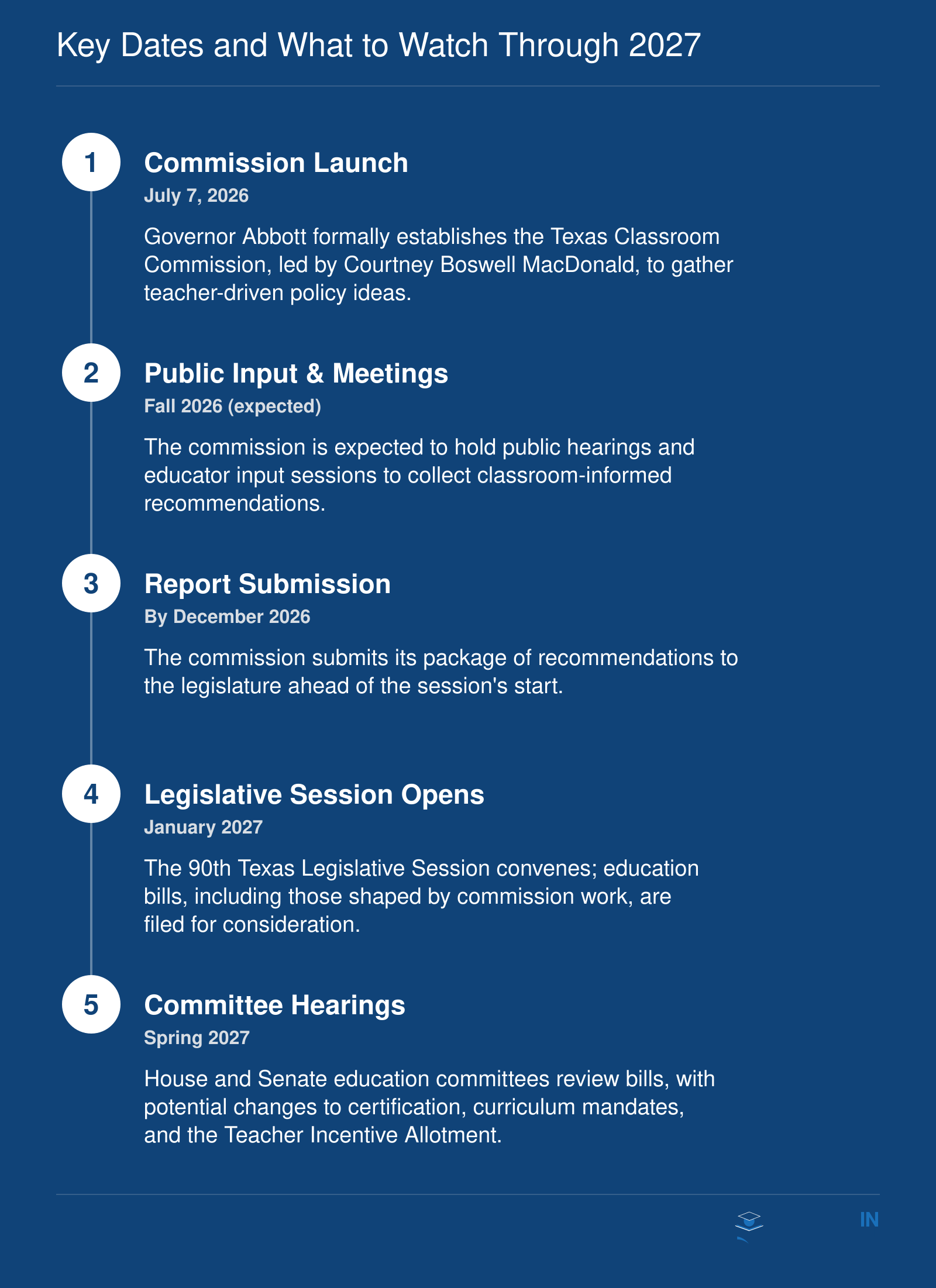
Key Dates and What to Watch Through 2027
The commission's work will unfold over several months, with recommendations shaping the 2027 legislative session. Educators should watch for opportunities to provide input and follow how proposals influence certification, curriculum, and pay policies.
Frequently Asked Questions About the Texas Classroom Commission
The Texas Classroom Commission marks a significant shift toward teacher-driven education policy. Below are answers to common questions about its purpose, how teachers can participate, and what this means for the state's education landscape.