
What you’ll learn in this article…
- Kutztown University’s ASPIRE program pays an $8,000 stipend for a tuition-free, 15-month special education certification.
- Truly tuition-free M.Ed. programs eliminate all out-of-pocket tuition, often including living stipends.
- Accelerated special education master’s degrees can be completed in 10 to 18 months.
- Forty-five states reported special education teacher shortages in 2024-2025, driving state-funded M.Ed. initiatives.
Forty-five states reported special education teacher shortages in 2024-2025, the largest gap in a decade. That persistent demand is driving new funding streams: states and universities now cover full tuition, often with a living stipend, for special education M.Ed. students.
These aren't discounted programs; they are truly $0-cost pathways with accelerated timelines as short as 12 months and a service commitment that secures dual certification.
Kutztown University's ASPIRE initiative, launched in May 2026, exemplifies the trend: 27 graduate credits, no tuition, an $8,000 stipend, and a direct route to a full master's. For educators ready to explore special education master's degrees, the opportunity to earn a debt-free advanced credential in a high-demand field is real, and the most accessible window is right now.
What Makes a Special Education M.Ed. Truly Tuition-Free?
Some programs advertise an "affordable" price tag of under $20,000; a truly tuition-free M.Ed. means you pay zero tuition out of pocket, often while earning a stipend. Understanding the difference is the first step to avoiding surprise debt.
Tuition-Free Is Not Just "Low Cost"
A tuition-free program eliminates the sticker price entirely through grants, institutional waivers, or service commitments. An affordable program may still require you to borrow or pay from savings. The real distinction: at the end of a funded program, you hold a degree with no new student loans. At the end of an affordable one, you may still owe tens of thousands of dollars. Fully funded master's in education options do exist, but they require a different application strategy than a typical low-cost program.
Four Common Paths to a Debt-Free Degree
- Graduate assistantships: Many universities offer tuition remission and a living stipend in exchange for research or teaching work. These positions are competitive and often cover the full cost of attendance.
- State grant-funded initiatives: State departments of education sometimes fund accelerated certification programs, like Pennsylvania's Accelerated Program for PK-12 Special Education Teacher Certification. These grants cover tuition and may include a stipend for accepted candidates.
- Service-for-tuition commitments: Some programs require you to teach in a high-need district for a set number of years after graduation. If you do not complete the service, the tuition converts to a loan with backdated interest.
- Federal TEACH Grants: The Teacher Education Assistance for College and Higher Education Grant awards up to $4,000 per year for students pursuing a high-need field, including special education.1 Over four years, you could receive up to $16,000.2 The trade-off: you must teach full-time in a low-income school for at least four years within eight years of finishing your program.1 Missing that deadline converts the entire grant amount into a Direct Unsubsidized Loan with interest dating back to the original disbursement.2 Note that financial need is not required to qualify, but you must meet a minimum GPA of 3.25 or score above the 75th percentile on an admissions test.1
Limited Seats, Early Deadlines
Most special ed master's degree programs with full funding accept small cohorts, often 10 to 20 candidates. The ASPIRE program at Kutztown University, for instance, fills its tuition-free slots through partner districts and a competitive application. Because the funding pool does not expand with demand, applying early, typically months before the start date, gives you a real advantage.
Zero-Cost vs. Paid-While-You-Learn
A program may cover your tuition but not your living expenses. Others, like ASPIRE, combine a tuition waiver with an $8,000 living stipend and allow you to earn additional income through embedded internships. If you need to replace a salary during the program, prioritize models that include a stipend or paid work. A tuition-only free program still saves you significant money, but it may require separate financial planning for rent and other costs.
Best Tuition-Free and Fully Funded Special Education M.Ed. Programs
When funding matters most, net price, the amount you actually pay after grants and scholarships, is the only number that determines true affordability. The programs below rank from lowest effective net price upward, spotlighting where generous aid packages drive costs to near-zero and, in some cases, cover tuition entirely through grants like OSEP personnel preparation or institutional fellowships. Use this list to compare your bottom-line investment alongside each school’s graduate earnings and completion culture.
- Lowest effective net price
- Program format flexibility
- Graduate earnings data
- Institutional graduation rates
- Program-specific highlights
- NCES-IPEDS federal institutional data — nces.ed.gov
- College Scorecard graduate earnings — collegescorecard.ed.gov
- Independent program research
- Internal program database
| Rank | School | Location | Net price | Best for | |
|---|---|---|---|---|---|
| #1 | The University of Texas Rio Grande Valley | Edinburg, TX | $0 – $5,000/yr | Texas educators seeking border-state tuition waivers | |
UTRGV’s entirely online M.Ed. in Special Education ranks among the nation’s most affordable, with an effective net price of just $4,831. The program serves Texas and border-region educators especially well, thanks to the state’s bordering-county waivers and the new Education Savings Account program for students with disabilities that will increase demand for special-education teachers. Federal data show UTRGV graduates earn a median of $49,620 a decade after entry.
| |||||
| #2 | University of Florida | Gainesville, FL | ~$7,000/yr (est.) | Career-changers needing a nationally ranked online M.Ed. | |
The University of Florida’s online M.Ed. in Special Education pairs top-tier rankings (No. 2 nationally) with an effective net price of $6,541. Delivered asynchronously, it fits working educators who want to advance into leadership or policy without leaving the classroom. Institutional earnings data show a strong return: median earnings of $71,588 ten years after starting at UF.
| |||||
| #3 | Eastern New Mexico University | Portales, NM | $5,000/yr | Early intervention teachers seeking asynchronous online training | |
Eastern New Mexico University offers a fully online Master of Special Education with distinct early childhood and general tracks at a net price of just $4,904. The early childhood emphasis fills a critical need for birth-to-five specialists in rural and underserved areas. Typical ENMU graduates earn $38,550, and the program’s tuition waivers and TEACH grants can push out-of-pocket costs even lower.
| |||||
| #4 | Southern Utah University | Cedar City, UT | $7,000 – $21,000/yr | ||
Southern Utah University’s online M.Ed. in Special Education leads to a Utah professional teaching license in mild/moderate disabilities and has an effective net price of $10,462. The 30-credit program blends practitioner research with evidence-based practices, making it a solid choice for licensed teachers or those pursuing alternative licensure. Graduates from SUU earn a median of $50,296.
| |||||
| #5 | Florida Atlantic University | Boca Raton, FL | $5,000 – $17,000/yr | ||
Florida Atlantic University’s fully online M.Ed. in Special Education offers four concentrations, including Applied Behavior Analysis and Autism Spectrum Disorders, with an effective net price of $8,752. The program’s low total tuition (around $14,000) and flexible synchronous/asynchronous options appeal to budget-conscious students seeking BCBA certification or Florida endorsements. Institutional median earnings are $56,746.
| |||||
| #6 | University of Central Florida | Orlando, FL | $10,000/yr | ||
UCF’s online Exceptional Student Education M.Ed. serves certified Florida teachers with a 33-credit curriculum that includes an Applied Behavior Analysis track. At a net price of $10,411, it balances affordability with a strong completion culture (78% graduation rate). Earnings data show a median of $58,308 for UCF graduates, reflecting robust demand in the region.
| |||||
| #7 | East Central University | Ada, OK | $8,000 – $18,000/yr | ||
East Central University’s online M.Ed. in Special Education reports a 100% job placement rate and costs $8,683 in effective net price. The 32-credit, CAEP-accredited program uses 8-week terms to complete in 1.5 years, focusing on mild/moderate disabilities. Institutional median earnings are $44,962, with strong regional placement.
| |||||
| #8 | Florida Gulf Coast University | Fort Myers, FL | $13,000/yr | ||
Florida Gulf Coast University’s online M.Ed. in Special Education targets general educators and career changers, with a 90%+ employment rate and a net price of $12,568. Its ties to a five-district community in southwest Florida provide strong internship pipelines. Median graduate earnings are $54,560.
| |||||
| #9 | University of Houston | Houston, TX | $10,000 – $23,000/yr | ||
University of Houston’s online M.Ed. in Special Populations with a Special Education emphasis features five tracks and no GRE requirement. The effective net price is $14,276, and the program addresses the national special-education teacher shortage. UH graduates earn a median of $62,377, reflecting the strong Houston job market.
| |||||
| #10 | Arkansas State University | Jonesboro, AR | $8,000 – $15,000/yr | ||
Arkansas State’s online MSE in Special Education, Instructional Specialist K-12 is built for licensed teachers seeking leadership roles. Its net price is $12,366, and the 36-credit program uses accelerated 7-week courses. Median earnings for A-State graduates are $42,617, with a strong regional placement tradition.
| |||||
| #11 | Portland State University | Portland, OR | ~$10,000/yr (est.) | ||
Portland State University’s online Master’s in Early Intervention Special Education uses a cohort model with one-on-one faculty interaction, ideal for those seeking a preliminary special education license in Oregon. The net price is $9,552, and PSU graduates earn a median of $57,906, underscoring strong earning potential in early childhood special education.
| |||||
| #12 | Northeastern State University | Tahlequah, OK | $13,000/yr | ||
Northeastern State University’s online M.Ed. in Special Education with an Autism Spectrum Disorders concentration is TEACH Grant-eligible and carries a net price of $12,710. The 33-credit program includes an embedded graduate certificate and an accelerated B.S.Ed.-to-M.Ed. pathway. Median earnings for NSU graduates are $45,379.
| |||||
| #13 | University of Mississippi | University, MS | $10,000 – $15,000/yr | ||
The University of Mississippi’s online M.Ed. in Special Education concentrations in Applied Behavior Analysis and Special Populations lead to BCBA Pathway 2 coursework. Net price is $13,314, and 45 clinical hours are built in. Ole Miss graduates earn a median of $50,994, with the ABAI-accredited ABA track especially valuable for aspiring behavior analysts.
| |||||
| #14 | Southern Arkansas University | Magnolia, AR | $10,000 – $15,000/yr | ||
Southern Arkansas University’s online M.Ed. in Special Education is built for licensed teachers and ranks among the most affordable nationally with a net price of $14,027. The 30-credit program aligns with CEC standards and offers out-of-state tuition waivers. Graduates earn a median of $42,386.
| |||||
| #15 | Mayville State University | Mayville, ND | $10,000 – $15,000/yr | ||
Mayville State University’s 34-credit online M.Ed. in Special Education is designed for licensed teachers aiming to become special education coordinators. Its net price is $11,456, and the program includes practicum experiences in three disability areas. Institutional median earnings are $47,828.
| |||||


Spotlight: Kutztown University's ASPIRE Program, Paid to Learn, Credentialed to Teach
Pennsylvania is moving decisively to address special-education teacher shortages with funded, fast-track credentialing, and Kutztown University's newly launched ASPIRE program makes that shift tangible for individual educators.1
On May 28, 2026, Kutztown University unveiled the Accelerated Special Education Program for In-Service Resident Educators (ASPIRE), a 15-month, tuition-free pathway that pays participants an $8,000 stipend while they earn a PK-12 special education certification and graduate credits applicable to a master's degree.
A Fully Funded, 15-Month Sprint
The ASPIRE program compresses initial special education preparation into 27 graduate credits, delivered through a blend of online coursework and an embedded internship. Participants are placed in partner school districts , Antietam, Brandywine Heights, Kutztown Area, Schuylkill Valley, and Tulpehocken Area , where they work directly with students while completing academic requirements. The accelerated timeline is designed for working adults: the 15-month structure allows recent graduates and credentialed teachers to re-specialize without taking years out of the workforce.
Earn While You Learn: The Financial Breakdown
ASPIRE removes two of the biggest barriers to advanced credentials: cost and time away from paid employment.
- Tuition: Covered in full by a grant from the Pennsylvania Department of Education's Accelerated Program for PK-12 Special Education Teacher Certification.1
- Living stipend: Each participant receives $8,000 distributed across the program to offset living expenses.
- Income potential: Participants may hold outside employment or continue existing teaching positions while enrolled, because the internship is embedded within the school day in partner districts.
This package effectively lets educators earn a credential while maintaining, or even building, income.
The Dual Credential: Certification That Builds Toward a Master's
Successful completion yields immediate, practical results:
- PK-12 special education add-on certification, authorizing the holder to teach students across all grade levels with a wide range of support needs.
- The 27 graduate credits may be applied directly to Kutztown University's Master of Education in Multicultural Education with a specialization in special education. Participants leave the program not only dual-certified but also more than halfway to a full master's degree.
For educators weighing the financial side of graduate study, M.Ed. programs in Pennsylvania vary widely in cost and structure, making state-funded options like ASPIRE especially compelling.
Who Can Apply and How to Get Started
ASPIRE is open to two groups:
- Recent college graduates who hold an initial teaching certification.
- Certified teachers who have not yet secured a permanent position.
Candidates commit to a 15-month intensive experience that positions them for high-demand roles across Pennsylvania. For application details, contact Dr. Kathy Stanfa at [email protected] or 610-683-4300. District partnership inquiries can be directed to Dr. Tracy Driehaus at [email protected] or 610-683-4256.
In 2024-2025, 45 states reported special education teacher shortage areas, according to the Learning Policy Institute. That persistent gap is driving states and universities to create tuition-free, fast-track programs like the ASPIRE initiative, aiming to fill critical classroom roles by removing financial barriers.
Fast-Track vs. Traditional Timelines: How Quickly Can You Finish a Funded M.Ed.?
If you are asking how fast you can earn a funded special education degree, the direct answer is: accelerated programs can be completed in as few as 10 to 18 months, while a traditional M.Ed. typically takes two to three years of part-time study. The difference comes down to credit load, scheduling, and whether the program embeds clinical practice directly into the coursework.
What "Fast-Track" Actually Means
Fastest accelerated online M.Ed. programs compress the degree timeline by delivering 30 to 36 credits in a continuous calendar, often with summer terms and year-round enrollment. The College of Mount Saint Vincent, for example, offers a 30-credit M.S. in Special Education that can be finished in just 10 months.1 University of Southern Maine and University of Texas Rio Grande Valley both structure their 30-credit programs around a 12-month completion window.23 These accelerated options typically move in lockstep cohorts, so every student takes the same sequence of courses at the same pace.
In contrast, a traditional special education M.Ed. might spread 36 credits over six semesters, with students taking one or two classes at a time while working full-time. This path often takes 24 to 36 months, giving more breathing room but delaying the pay bump or certification upgrade.
Why Grants Push Accelerated Timelines
Many funded programs move fast because their dollars are tied to state or federal grant cycles. A grant may require a cohort to start and finish within a specific window, often 18 months, to demonstrate impact on teacher shortages. The Kutztown ASPIRE program fits this mold: 27 graduate credits delivered in 15 months, with an embedded special education internship, funded by a Pennsylvania Department of Education grant. That compressed schedule is not just a feature; it is a requirement of the funding.
The Trade-Off: Full-Time Intensity
Accelerated programs usually demand full-time enrollment, which can make it impossible to hold a separate job. The ASPIRE model directly addresses this constraint by providing an $8,000 living stipend and allowing participants to earn income through the internship placement itself. Not all fast-track programs offer such support, so prospective students should weigh the loss of outside wages against the speed of completion.
Online Fast-Track: Flexible but Less Common
If you need geographic flexibility, online options tend to follow slightly longer timelines. Miami University's online M.Ed. in Special Education, for instance, can be finished in 15 to 18 months depending on prior credits.4 Norfolk State University's online M.A. in Special Education is structured around 39 credits and an 18-month completion window.5 Fully online programs are less likely to be compressed into a single year, because they often serve working adults who need to self-pace. That said, accelerated online tracks do exist, and they may still carry full or substantial funding.
Online vs. On-Campus: Where Full Funding Actually Follows You
The path to full funding depends heavily on whether you choose an online, on-campus, or hybrid program. While online degrees offer maximum flexibility, they rarely come with the kind of assistantship packages that fully cover tuition and pay a living stipend. On-campus and state-funded hybrid programs like Kutztown University's ASPIRE initiative are where the most generous funding actually lives.
| Online Programs | On-Campus Programs | Hybrid Programs |
|---|---|---|
| TEACH Grants, employer tuition reimbursement, and scholarships are primary. A few schools (e.g., Eastern New Mexico University) offer graduate assistantships with tuition waivers, but these are less common. | Graduate assistantships, teaching assistantships, and research fellowships typically cover full tuition and provide a living stipend. Common at large public universities. | State grants like Pennsylvania's Accelerated Program for PK-12 Special Education Teacher Certification cover full tuition, and some (e.g., ASPIRE) provide an $8,000 living stipend. |
| Asynchronous, self-paced options allow working teachers to continue earning income. No required campus visits. | Fixed class schedules with in-person attendance required; often cohort-based with a set progression. | Online coursework paired with an embedded internship in partner schools, requiring some in-person fieldwork but with a structured, accelerated timeline. |
| Partial tuition coverage is typical; full funding is rare. Many students still pay a portion of costs or rely on outside aid. | Assistantships often waive all tuition and provide a stipend, making the net cost nearly zero for funded students. | Full tuition coverage and a living stipend are built into the program (e.g., ASPIRE offers $8,000 plus employment income). |
| University of Texas Rio Grande Valley online M.Ed. ($13,750 total, TEACH Grant eligible); Arkansas State University online M.S.E. ($12,600 total, 16 months). | Many state universities with on-campus M.Ed. programs offer assistantships (e.g., research or teaching positions) that cover tuition and pay a stipend. | Kutztown University ASPIRE Program: 15-month, tuition-free, PK-12 special education add-on certification, $8,000 stipend, 27 graduate credits. |
Related Articles
Career Outcomes and Earning Potential After a Funded Special Education M.Ed.
When your master’s degree is fully funded, the salary increase it unlocks becomes pure net gain. The 80/20 rule explains consistent demand: roughly 80% of a special education teacher’s caseload involves mild-to-moderate disabilities, so credentialed specialists are needed at every grade level. The national wage data below shows what you can expect to earn in high-demand special education settings.
| Occupation | Employment (2023) | 10th Percentile Wage | Median Annual Wage | 90th Percentile Wage |
|---|---|---|---|---|
| Special Education Teachers, Preschool | 28,200 | $40,540 | $69,820 | $111,530 |
| Special Education Teachers, Kindergarten and Elementary School | 231,570 | $46,100 | $66,490 | $104,350 |
| Special Education Teachers, Middle School | 95,330 | $48,390 | $67,880 | $106,130 |
Eligibility and Funding Requirements: Who Actually Qualifies?
The appeal of a tuition-free M.Ed. is obvious, but these programs aren't giveaways , they are strategic investments with specific eligibility gates and post-completion obligations. Most fully funded special education master's tracks are designed for candidates who already hold a teaching license, meet a minimum grade-point average, and are ready to commit years of service to high-need schools after graduation. Understanding who these programs are built for, and who they aren't, can save you months of chasing options that will never unlock.
The Baseline: Who Gets Through the Door
Admission requirements across tuition-free and grant-backed M.Ed. programs follow a consistent pattern. A current initial teaching license is nearly always the starting point; some programs accept a bachelor's degree in education with a clear path to certification, but career-changers without any classroom credential rarely qualify for the fastest-moving funded tracks. Grade-point thresholds typically land between 2.75 and 3.0, though competitive cohorts may tilt higher. Increasingly, programs like Kutztown's ASPIRE require proof of employment in or acceptance by a partner school district, which ties the funding tightly to local workforce pipelines. These filters ensure that tuition dollars are directed toward educators who can immediately step into shortage-area special education roles.
The Service Commitment: What "Free" Actually Costs
Service-for-tuition is the engine behind many of these programs. After completing the degree, participants must teach in a designated high-need district or subject shortage area for a set period, often two to four years. The agreement is contractual, not aspirational. If a graduate leaves the placement early or teaches outside the shortage field without a waiver, the tuition waiver or grant can convert into a loan, with interest sometimes accruing from the original disbursement date. This repayment trigger isn't hidden; it's the program's mechanism to ensure the public investment results in actual classroom coverage. For candidates who already plan to build a career in underserved schools, the commitment aligns with their goals; for those uncertain about location or longevity, it's a risk that demands careful thought.
Federal TEACH Grant: A Separate Path with Its Own Rules
Distinct from institution-based service programs, the federal TEACH Grant offers up to $4,000 per year for graduate study in high-need fields, and special education master's degrees consistently qualify. The strings are significant: recipients must teach full-time for four years in a high-need school within eight years of finishing the program. If the service is not completed, the grant transforms into an unsubsidized loan, with interest backdated to the first payout. The TEACH Grant can stack with state or university funding, but it adds a separate compliance layer that requires annual certification of employment intent. Missing a paperwork deadline can trigger the conversion, so organized recordkeeping is non-negotiable.
Small Cohorts, Early Deadlines
Tuition-free special education M.Ed. slots are not mass-produced. ASPIRE-style programs frequently accept between ten and twenty participants per cycle, and some are funded through one-time state grants that may not renew. Early application is critical; rolling review windows mean a cohort can fill before the published deadline. Waiting for a spring notice when applications open in late fall often means starting a year later, or not at all. A practical step is to identify two or three funded programs and track their cycle dates months in advance, preparing materials before calls go out.
When You Don't Fit the Mold
Candidates without any teaching background or initial certification should understand that the fastest-moving, fully funded special education master's programs are not built for them. These degrees assume existing pedagogical readiness and move quickly into advanced practice. If you are exploring education for the first time, alternative certification or bridge programs exist, but they rarely carry the full-tuition-plus-stipend packages described here. In those cases, a longer, more foundational route, possibly with partial funding or federal loan forgiveness, may be the realistic entry point.
Questions to Ask Yourself
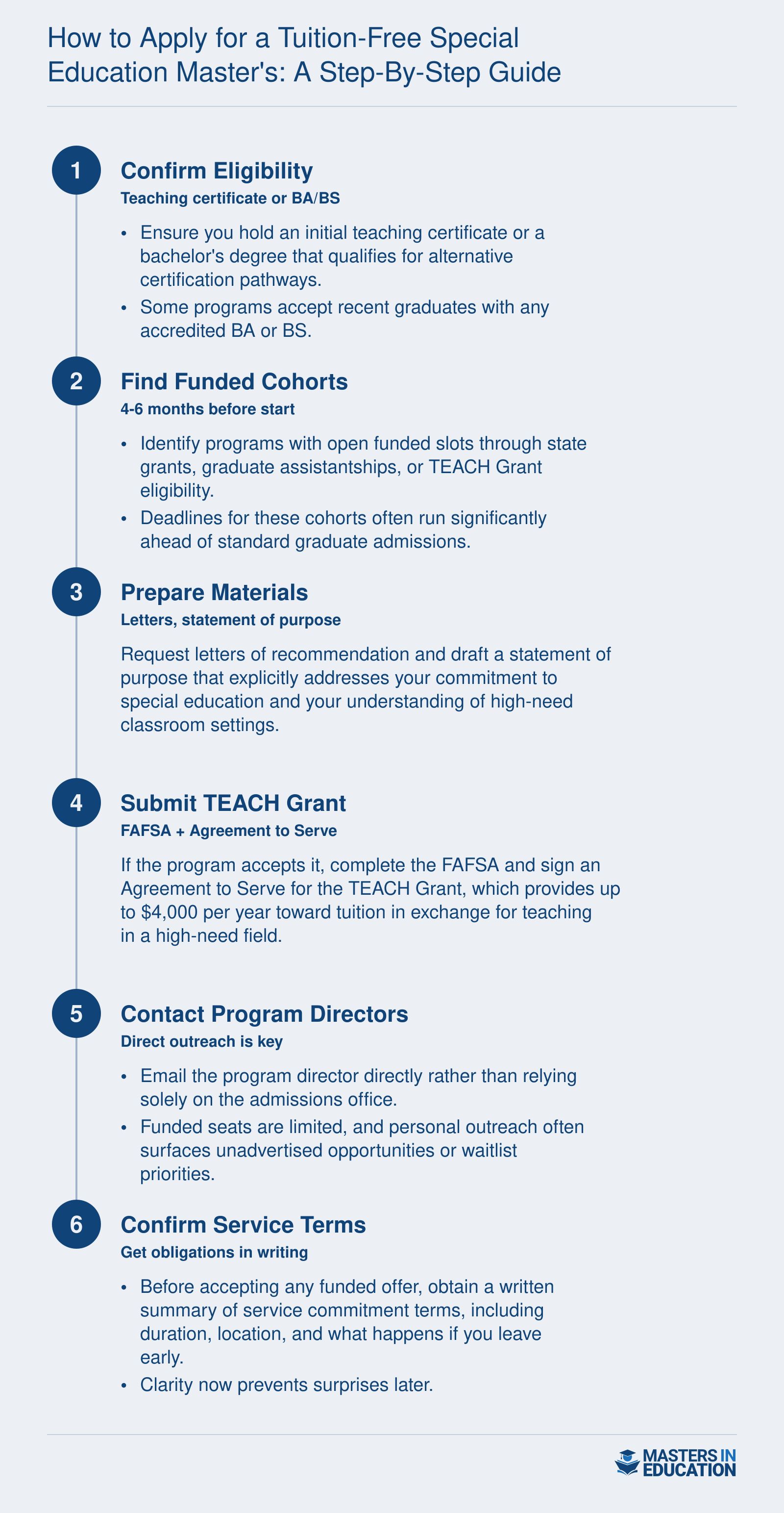
How to Apply for a Tuition-Free Special Education Master's: A Step-by-Step Guide
Securing a funded slot in a fast-track special education M.Ed. program requires a proactive, early approach. Follow these steps to position yourself ahead of standard admissions timelines and avoid missing out on grant-supported cohorts.
Common Questions About Tuition-Free Special Education M.Ed. Programs
Tuition-free special education M.Ed. programs remove financial barriers, but the details matter. Below, clear answers to common questions about funded, accelerated, and online pathways, so you can navigate eligibility, timelines, and true costs confidently.
More Funded Special Education M.Ed. Programs to Explore
If your state or schedule wasn't served by the programs above, this directory of additional schools may offer a fit. These programs are organized by state for easy scanning. Remember that funding availability varies by cohort year, so contact program offices directly to confirm funded slots for 2026-2027 enrollment.