

What you’ll learn in this article…
- Illinois offers over a dozen accredited M.Ed. programs, with net prices starting below $10,000 per year at several public universities.
- Most ranked programs no longer require the GRE, making admissions more accessible for working teachers across the state.
- Teachers with a master's degree in Illinois can earn significantly more through district salary schedules, especially after five or more years.
- Fully online M.Ed. options are available from multiple Illinois institutions, covering specializations like curriculum and instruction and educational leadership.
Illinois offers 26 ranked master's in education programs spanning public flagships like the University of Illinois Urbana-Champaign, selective private institutions like Northwestern, and smaller colleges with notably low tuition. Estimated program costs range from under $9,000 at schools like Greenville University to more than $54,000 at Northwestern, and delivery formats include fully online, hybrid, and traditional campus options.
The central challenge for Illinois educators is matching the right program type to their career stage. Teachers seeking an initial Professional Educator License need a different track than those adding a principal endorsement or a reading specialist credential, and the degree title itself (M.Ed., M.S.Ed., or M.A.T.) carries real implications for licensure eligibility. Most programs in the state no longer require the GRE, which has lowered one traditional barrier, but admissions standards, clinical hour requirements, and endorsement pathways still vary widely. Illinois educators considering flexible scheduling may also want to explore best online master's in education degree programs, many of which accept students nationwide.
Best Master's in Education Programs in Illinois, Ranked
Illinois is home to a deep bench of graduate education programs, from flagship research universities to mission-driven private institutions across the Chicago metro and beyond. The 10 programs below stand out for their combination of affordability, strong institutional outcomes, and practical relevance to Illinois educators. Whether you are a career changer seeking initial licensure, a classroom teacher adding an endorsement, or an aspiring principal, this list highlights your strongest options in 2026.
- Tuition and net price
- Institutional graduation rate
- Graduate debt levels
- Alumni earnings outcomes
- Program breadth and concentration options
- NCES-IPEDS federal institutional data — nces.ed.gov
- College Scorecard graduate earnings — collegescorecard.ed.gov
- Independent program research
- Internal program database
| Rank | School | Location | Net price | Best for | |
|---|---|---|---|---|---|
| #1 | Northwestern University | Evanston, IL | $29,000/yr (net price) | Aspiring teachers seeking intensive Chicago placements | |
Northwestern University's School of Education and Social Policy offers tightly structured, cohort-based master's programs in elementary and secondary education grounded in a social justice mission. Graduates earn an Illinois Professional Educator License and benefit from clinical placements in diverse Chicago-area schools each quarter, contributing to the program's reported 100% job placement rate. With a 6:1 student-to-faculty ratio and an institution-wide graduation rate of 95.1%, Northwestern delivers intensive mentorship, though its tuition of $54,655 and net price of $29,167 place it at the higher end of this list.
| |||||
| #2 | University of Illinois Urbana-Champaign | Champaign, IL | $14,000/yr | Online learners wanting a research-university credential | |
The University of Illinois Urbana-Champaign offers one of the broadest M.Ed. portfolios in the state, spanning early childhood education, elementary education, and a fully online curriculum and instruction degree with four distinct concentrations. In-state tuition of $19,278 and a net price of $14,355 make UIUC significantly more affordable than many peers, while an 85.1% institution-wide graduation rate and median alumni earnings of $81,054 reflect strong long-term value. Assistantships, fellowships, and tuition waivers further lower costs for qualified candidates.
| |||||
| #3 | University of Illinois Chicago | Chicago, IL | ~$11,000/yr (est.) | Urban educators focused on equity and inclusion | |
The University of Illinois Chicago centers its M.Ed. offerings on equity in urban education, with programs in urban higher education and special education that draw on partnerships with Chicago Public Schools and city colleges. In-state tuition sits at $17,550 with one of the lowest net prices on this list at $10,974. No GRE is required for the higher education track, and evening classes accommodate working professionals. The institution-wide graduation rate is 61.6%, though the College of Education is nationally recognized for its urban-focused mission.
| |||||
| #4 | Wheaton College | Wheaton, IL | $27,000/yr | ||
Wheaton College's accelerated Master of Arts in Teaching lets current undergraduates earn an Illinois teaching license and a master's degree in just one additional year. The campus-based program pairs any undergraduate major with graduate teacher training, covering methods, literacy, and classroom management alongside biblical and theological studies. Graduate tuition is $20,160 with a net price of $26,975, and the institution posts an 84.8% overall graduation rate and a 10:1 student-to-faculty ratio.
| |||||
| #5 | Lewis University | Romeoville, IL | $17,000/yr | ||
Lewis University in Romeoville provides a broad set of education master's pathways, including curriculum and instruction tracks with reading, literacy, and ESL endorsements, plus an educational leadership program with principal endorsement. The university's partnerships with Illinois school districts and dioceses offer tuition discounts and site-based coursework. Graduate tuition is $15,800 with a net price of $17,028, and the institution-wide graduation rate is 66.6%. Note that the Technology, Learning, and Design concentration stopped admitting new students after fall 2024.
| |||||
| #6 | University of St Francis | Joliet, IL | $13,000/yr | ||
The University of St. Francis in Joliet offers an Elementary Education with Licensure M.Ed. designed for career changers who hold a bachelor's degree outside education. The 24-month program blends online and in-person coursework at $515 per credit, making total costs competitive. Candidates can add endorsements in Special Education, Bilingual Education, or ESL to boost their marketability in high-need Illinois areas. The institution-wide graduation rate is 66.8%, with a net price of $13,006.
| |||||
| #7 | Southern Illinois University-Carbondale | Carbondale, IL | $10,000 – $15,000/yr | ||
Southern Illinois University Carbondale anchors graduate education in the southern part of the state, with a 36-credit M.S.Ed. in Curriculum and Instruction and a four-semester MAT in multiple science and math disciplines. In-state tuition of $14,220 and a net price of $13,297 make SIU Carbondale one of the most affordable options on this list. Students work with a personal faculty adviser, and MAT candidates complete a year-long clinical placement in an Illinois public school, with priority given to teacher-shortage subject areas.
| |||||
| #8 | Elmhurst University | Elmhurst, IL | $24,000/yr | ||
Elmhurst University's M.S.Ed. in Special Education is a hybrid cohort program built for licensed Illinois teachers who want to add an LBS1 endorsement. Classes meet every other week on campus or online, with evening sessions that fit working schedules. Total program tuition is listed at $18,360, notably lower than the institution's sticker price, and grant-funded scholarships through EXCEMPILS and Project RISE reduce costs further. The institution-wide graduation rate stands at 70%.
| |||||
| #9 | Southern Illinois University-Edwardsville | Edwardsville, IL | $15,000/yr | ||
Southern Illinois University Edwardsville offers several online and hybrid M.S.Ed. pathways, including a CAEP-accredited principal preparation program completable in as few as 12 months and a 10-month instructional technology degree. A flat tuition rate for in-state and out-of-state students keeps costs low, with the principal preparation track totaling roughly $17,968. SIUE participates in the Illinois School Leader Pipeline Program and its programs are approved for both Illinois principal endorsement and Missouri initial administration certification. The institution-wide graduation rate is 57%.
| |||||
| #10 | DePaul University | Chicago, IL | ~$31,000/yr (est.) | ||
DePaul University's College of Education in Chicago provides one of the widest arrays of education master's programs in the state, spanning curriculum studies, educational leadership, special education, early childhood, and secondary education with up to eight concentration options per degree. Programs are grounded in a social justice mission and leverage DePaul's partnerships with Chicago Public Schools and the Archdiocese of Chicago. Graduate tuition is $23,358, the net price is $30,902, and the institution-wide graduation rate is 67.8%.
| |||||


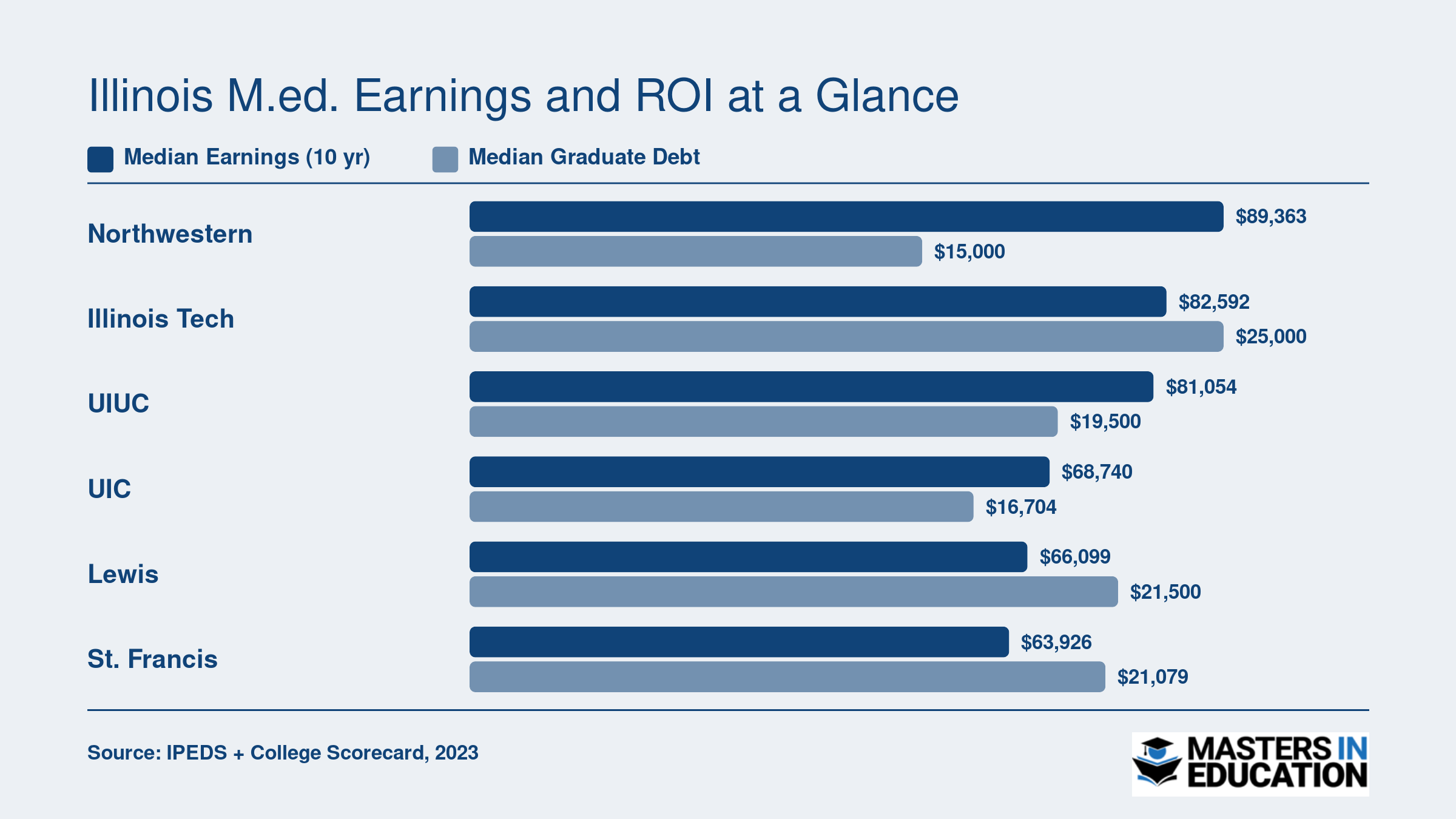
Illinois M.Ed. Earnings and ROI at a Glance
The chart below compares institution-wide median earnings ten years after enrollment with median graduate debt for the top Illinois M.Ed. programs ranked by return on investment. These are College Scorecard figures reported at the institutional level; program-level earnings for M.Ed. completers are not yet available for these schools. Lower debt paired with higher earnings signals a stronger early return on your graduate investment.
Most Affordable M.Ed. Programs in Illinois
Cost is a major factor for educators weighing graduate programs, especially those already working on a teacher's salary. The table below ranks Illinois M.Ed. programs by estimated net price, which reflects the average cost after institutional and federal aid. All tuition figures are based on the most recent IPEDS data available. Note that graduate tuition rates may differ from the undergraduate figures shown here, so contact each school directly for current M.Ed. pricing.
| School | In-State Tuition | Out-of-State Tuition | Estimated Net Price | Student-to-Faculty Ratio | Median Earnings (10 Years After Entry) |
|---|---|---|---|---|---|
| University of Illinois Chicago | $17,550 | $27,748 | $10,974 | 17:1 | $68,740 |
| Chicago State University | $10,294 | $16,162 | $12,335 | 9:1 | $42,778 |
| Eastern Illinois University | $11,647 | $23,214 | $12,786 | 14:1 | $51,989 |
| Western Illinois University | $13,683 | $13,683 | $12,937 | 12:1 | $54,163 |
| University of St. Francis | $14,757 | $14,757 | $13,006 | 15:1 | $63,926 |
| Southern Illinois University Carbondale | $14,220 | $31,122 | $13,297 | 11:1 | $53,390 |
| Northern Illinois University | $9,176 | $9,176 | $13,391 | 15:1 | $57,808 |
| University of Illinois Urbana-Champaign | $19,278 | $34,406 | $14,355 | 20:1 | $81,054 |
Online M.Ed. Programs in Illinois
Several Illinois universities offer fully online or hybrid M.Ed. programs that let working teachers earn an advanced degree without leaving the classroom. The table below highlights programs with confirmed online or hybrid delivery, along with key cost and outcome data to help you compare options. Tuition figures reflect graduate program rates where available; median earnings represent institution-wide outcomes ten years after enrollment.
| University | Delivery Format | Specialization | In-State Tuition | Out-of-State Tuition | Median Earnings (10 Yr) | Student-to-Faculty Ratio |
|---|---|---|---|---|---|---|
| Eastern Illinois University | Online | Curriculum and Instruction | $11,647 | $23,214 | $51,989 | 14:1 |
| Western Illinois University | Online | Early Childhood Education | $13,683 | $13,683 | $54,163 | 12:1 |
| Southern Illinois University, Edwardsville | Online | Educational Administration (Principal Prep) | $10,488 | $10,488 | $56,346 | 15:1 |
| Concordia University, Chicago | Online | Elementary Education (MAT) | $10,782 | $10,782 | $54,089 | 13:1 |
| Greenville University | Online | Special Education | $8,784 | $8,784 | $46,827 | 13:1 |
| Olivet Nazarene University | Online | Curriculum and Instruction | $12,450 | $12,450 | $53,213 | 15:1 |
| North Central College | Online | Educational Leadership | $15,922 | $15,922 | $60,123 | 12:1 |
| McKendree University | Online | Teaching (MAT) | $9,450 | $9,450 | $58,572 | 16:1 |
| Lewis University | Hybrid | Curriculum and Instruction (Technology, Learning, and Design) | $15,800 | $15,800 | $66,099 | 13:1 |
| Illinois Institute of Technology | Hybrid | Teaching (MAT, Secondary STEM) | $35,222 | $35,222 | $82,592 | 14:1 |
| Elmhurst University | Hybrid | Special Education | $34,460 | $34,460 | $61,462 | 15:1 |
| DePaul University | Hybrid | Curriculum Studies | $23,358 | $23,358 | $68,751 | 17:1 |
Illinois M.Ed. Programs That Don't Require the GRE
The GRE has long been a gatekeeper for graduate admissions, but the landscape has shifted dramatically. Since the pandemic, a growing number of Illinois M.Ed. programs have dropped the exam entirely or made it optional, and most have kept those policies in place for the 2025-2026 admissions cycle. For working teachers juggling classrooms and families, and for career changers entering education from other fields, the removal of this barrier can save hundreds of dollars in test fees and weeks of prep time.
No-GRE Programs Across Illinois
The following programs do not require any standardized entrance exam for admission. Instead, they rely on undergraduate GPA, professional materials, and sometimes letters of recommendation or a personal statement.
- University of Illinois Urbana-Champaign: Online M.Ed. programs require a minimum 3.0 GPA; no standardized test needed.2
- University of Illinois Chicago: M.Ed. programs require a 3.0 GPA and use a holistic review process.3
- Northern Illinois University: M.S.Ed. programs ask for a 2.75 to 3.0 GPA depending on the specialization.
- Illinois State University: M.Ed. programs require a 3.0 GPA with no entrance exam.
- Loyola University Chicago: M.Ed. programs require a 3.0 GPA and a personal statement.4
- DePaul University: M.Ed. and M.A. programs in education require a 2.75 to 3.0 GPA.
- Concordia University Chicago: M.Ed. programs accept applicants with a 2.75 to 3.0 GPA.
- National Louis University: M.Ed. programs have one of the more accessible GPA thresholds, ranging from 2.5 to 3.0.
- Governors State University: M.Ed. programs require a 2.75 to 3.0 GPA.
- University of St. Francis: M.Ed. programs do not require an entrance exam.5
- Southern Illinois University Edwardsville: Online M.S.Ed. programs require a minimum 2.5 GPA and relevant work experience.
- Northwestern University: The M.S. in Education does not require the GRE.
No GRE vs. GRE Optional: Know the Difference
All of the programs listed above have fully eliminated the GRE from their admissions requirements for the current cycle. However, at some institutions across the state, you may encounter a slightly different policy: GRE-optional with waiver criteria. In those cases, applicants who fall below a certain GPA threshold (often 3.0) or who lack teaching experience may still be asked to submit scores. Always check whether a program's test-free policy is unconditional or conditional.
In practice, the distinction matters most for career changers who may not have a strong undergraduate GPA in a related field. If your GPA falls below a program's stated minimum, ask the admissions office whether professional experience, a writing sample, or supplemental coursework can compensate. This is also worth considering if you are pursuing teaching licensure with a master's in education, since licensure-track programs sometimes carry stricter admissions criteria.
Verify Before You Apply
Admissions policies are not static. A program that waived the GRE for 2025-2026 may reinstate it for a future cycle, and individual specializations within the same university sometimes carry different requirements. Before investing time in an application, contact the admissions office directly or check the program's official graduate catalog for the most current policy. This is especially important if you are applying to a concentration in educational administrator career guide or school counseling, where professional licensure standards may influence what a program requires at the admissions stage.
M.Ed. vs. M.S.Ed. vs. M.A.T.: What's the Difference?
Illinois universities label their graduate education degrees in several ways, and the distinctions matter when you are choosing a program.1 The three most common titles are the Master of Education (M.Ed.), the Master of Science in Education (M.S.Ed.), and the Master of Arts in Teaching (M.A.T.). Each serves a different audience and carries a different curricular emphasis, yet all three count equally toward salary lane advancement in Illinois school districts.2
M.Ed.: The Practitioner Degree
The M.Ed. is the most common graduate credential for teachers who already hold an Illinois Professional Educator License. Programs emphasize applied coursework in areas like curriculum and instruction, teacher leadership, or literacy. Most M.Ed. tracks do not require a thesis, opting instead for capstone projects or portfolios. This degree is designed for educators who want to deepen classroom practice, move into administration, or add an endorsement.
M.S.Ed.: A Research-Leaning Alternative
The M.S.Ed. closely mirrors the M.Ed. in scope but tends to include more research methodology and may require a thesis or research project. Some Illinois institutions use the M.S.Ed. label for content-specific concentrations, such as mathematics education or special ed masters degree tracks.1 Candidates considering doctoral study later often find the research component valuable.
M.A.T.: Built for Career Changers
The M.A.T. is a practice-focused degree aimed at individuals who hold a bachelor's degree in a field other than education and need initial teacher licensure.1 Coursework centers on pedagogy, classroom management, and supervised student teaching. If you are switching careers and want to enter an Illinois classroom, the M.A.T. is typically your most direct path.
How Illinois Treats These Degrees
The Illinois State Board of Education bases licensure decisions on whether a program itself is state-approved, not on the specific degree title.2 An ISBE-approved M.Ed., M.S.Ed., or M.A.T. program can all lead to the appropriate license or endorsement. Likewise, Illinois school districts recognize each of these degrees as a master's for salary schedule purposes. The key factor is program approval, not the letters after the degree name.
When choosing among these options, start with your career goal. Already licensed and looking to advance? An M.Ed. or M.S.Ed. is likely the right fit. New to education and need licensure? Look for an M.A.T. program. In every case, confirm the program holds current ISBE approval before you enroll.
Licensure Pathways: Initial Licensure vs. Advanced Endorsement in Illinois
Illinois M.Ed. programs generally fall into two distinct tracks, and choosing the right one depends entirely on where you are in your teaching career. Understanding the difference before you apply can save you time, money, and frustration.
Track 1: Initial Licensure for Career Changers
If you hold a bachelor's degree in a non-education field and want to enter the classroom, you need a program that leads to the Professional Educator License (PEL). These programs are approved by the Illinois State Board of Education (ISBE) and bundle graduate coursework with the clinical experiences required for licensure.1 Key requirements include:
- Bachelor's degree: You must already hold a bachelor's from an accredited institution.
- Content-area exam: You will need to pass a content-area test in your intended teaching subject.3
- Student teaching: Expect 12 to 16 weeks of supervised clinical placement, though candidates who have completed at least one year of teaching on a Substitute Teaching Authorization with a proficient or higher evaluation may qualify for a waiver.3
- Age and eligibility: Candidates must be at least 19 years old and authorized for employment in the United States.4
- edTPA status: The edTPA portfolio assessment is currently waived through August 31, 2029, so it is not a barrier for candidates completing programs in the near term.3
Programs like the Master of Education with Professional Educator License at the University of St. Francis (34 to 46 credit hours) and ISBE-approved pathways at Governors State University are designed specifically for this track.54
Track 2: Advanced Endorsements for Licensed Teachers
If you already hold a PEL, many M.Ed. programs are built to deepen your expertise or add endorsement areas without repeating initial licensure coursework. These programs assume you are a working educator and focus on specialized content, leadership preparation, or research skills.
Some endorsements require completion of an ISBE-approved program at a specific institution, while others function as optional professional enhancements. Endorsements that typically require ISBE program approval include:
- ESL or bilingual endorsement: Candidates may also need to demonstrate language proficiency through assessments such as the TOEFL, IELTS, or Cambridge exams at a B2 level or higher, or hold a degree in English or the target language.6
- Reading specialist: Programs must meet ISBE standards for the reading specialist requirements, including supervised practicum hours.
- LBS1 (Learning Behavior Specialist 1): This special education masters degree endorsement requires completion of an ISBE-approved sequence, including fieldwork with students who have disabilities.
By contrast, concentrations such as curriculum and instruction, educational technology, or higher education administration often enhance your resume and may qualify you for salary-lane advancement on district pay schedules, but they do not necessarily carry a separate ISBE endorsement.
How to Self-Sort
Ask yourself one question: Do I currently hold an Illinois Professional Educator License?
- If the answer is no, focus your search on ISBE-approved initial licensure programs that include student teaching and content-area test preparation. Confirm the program's approval status directly with the institution, since ISBE requirements can change without notice.7
- If the answer is yes, look for programs that offer the specific endorsement you want (ESL, reading specialist, LBS1, administration) or that align with National Board Certification preparation. Verify whether the endorsement requires an ISBE-approved program or is available through elective coursework.
Taking the time to match your current credentials to the right program track ensures you meet Illinois licensing standards efficiently and positions you for the career move you are actually trying to make.
Popular M.Ed. Specializations at Illinois Universities
Illinois universities offer a wide range of M.Ed. specializations, from curriculum and instruction to educational leadership and special education. The table below maps popular focus areas to the schools that offer them, along with graduate tuition and delivery format, so you can compare options side by side.
| Specialization | University | Graduate Tuition | Delivery Format |
|---|---|---|---|
| Elementary Education | Northwestern University | $54,655 | Campus |
| Early Childhood Education | University of Illinois Urbana-Champaign | $19,278 (in-state) | Campus |
| Urban Higher Education | University of Illinois Chicago | $17,550 (in-state) | Campus |
| Teaching (Elementary Education) | Wheaton College | $20,160 | Campus |
| Curriculum and Instruction: Technology, Learning, and Design | Lewis University | $15,800 | Hybrid |
| Elementary Education with Licensure | University of St. Francis | $14,757 | Campus and Online |
| Curriculum and Instruction | Southern Illinois University Carbondale | $14,220 (in-state) | Campus |
| Special Education | Elmhurst University | $34,460 | Hybrid |
| Educational Leadership (Principal Preparation) | Southern Illinois University Edwardsville | $10,488 | Online |
| Curriculum Studies | DePaul University | $23,358 | Hybrid |
| Teaching | Aurora University | $16,463 | Campus |
| Early Childhood Education | Northern Illinois University | $9,176 | Campus |
| Educational Leadership | North Central College | $15,922 | Online |
| Curriculum and Instruction | Eastern Illinois University | $11,647 (in-state) | Online |
| Teaching (Elementary Education) | Millikin University | $21,333 | Campus |
| Curriculum and Instruction | Olivet Nazarene University | $12,450 | Online |
| Teaching | McKendree University | $9,450 | Online |
| Special Education | Greenville University | $8,784 | Online |
| Teaching (Elementary Education) | Concordia University Chicago | $10,782 | Online |
| Teaching (Secondary STEM Education) | Illinois Institute of Technology | $35,222 | Hybrid |
| Early Childhood Education | Western Illinois University | $13,683 | Online |
| Curriculum and Instruction | Quincy University | $12,038 | Campus |
What Illinois Teachers With a Master's Degree Earn
Earning a master's degree in education is one of the most reliable ways for Illinois teachers to boost their lifetime earnings. The salary picture varies depending on where you teach, what you specialize in, and how far along you are on your district's pay scale, but the financial case for a graduate degree is strong across the board.
Baseline Teacher Salaries in Illinois
Illinois consistently ranks above the national average for teacher pay. According to Bureau of Labor Statistics data, the median annual wage for elementary school teachers in Illinois was approximately $67,840 as of May 2023, compared to a national median of roughly $62,340.1 Secondary school teachers in the state earn in a similar range.2 These figures reflect all education levels combined, so teachers with only a bachelor's degree will generally fall below the median while those holding a master's typically land above it.
The Master's Degree Salary Bump
Illinois uses district-specific salary schedules rather than a statewide pay scale, which means the master's degree bump varies by employer.3 In Chicago Public Schools, moving from a bachelor's lane to the master's lane can add several thousand dollars per year, with the gap widening at higher experience steps. Many suburban districts offer comparable or even larger increases. Over a 10-year teaching career, a salary-lane bump of $4,000 to $8,000 annually can translate to $40,000 to $80,000 or more in cumulative additional earnings.
ROI Across Illinois M.Ed. Programs
Program-level earnings data for specific M.Ed. programs at Illinois schools is not yet available through federal reporting, but we can estimate return on investment using program costs and statewide salary trends. Among the top-ranked programs in our analysis, estimated tuition ranges from around $15,000 at public universities like the University of Illinois Urbana-Champaign (in-state) to roughly $55,000 at Northwestern University. With median graduate debt for education programs at these schools ranging from about $15,000 to $26,000, even the most conservative salary-bump estimates suggest graduates recoup their investment within a few years and see meaningful net returns over the course of a career. You can compare costs and outcomes for master's degree in education by state to see how Illinois stacks up.
Specialization Matters
Not all M.Ed. paths lead to the same paycheck. Teachers who pursue administration and leadership specializations, particularly those leading to a principal endorsement, position themselves for roles with median salaries well above classroom-teacher pay. Instructional coordinators and curriculum directors, including those in fields like STEM curriculum development, also tend to outearn their classroom peers. By contrast, specializations that keep educators in a traditional teaching role still benefit from the salary-lane increase but may not see the same ceiling. If maximizing earnings is a priority, consider how your chosen concentration aligns with higher-paying roles in your district or region.
Admissions Requirements for Illinois M.Ed. Programs
Requirements for M.Ed. programs across Illinois share a common core, but the details vary enough from school to school and year to year that verifying each program's current expectations is essential before you apply.
Standard Application Materials
Most Illinois M.Ed. programs ask for some combination of the following:
- Completed bachelor's degree: Typically from a regionally accredited institution.
- Minimum GPA: Usually 2.75 to 3.0 on a 4.0 scale, though some programs accept conditional admits below that threshold.
- Transcripts: Official transcripts from every institution attended.
- Statement of purpose or personal essay: Programs want to understand your professional goals and how the degree fits into them.
- Letters of recommendation: Two or three, often from supervisors or faculty who can speak to your readiness for graduate work.
- Resume or CV: Highlighting teaching or education-related experience.
- Standardized test scores: Some programs still request the GRE or MAT, while a growing number have dropped that requirement entirely. Check each program's current policy.
Prerequisite coursework requirements also differ. Programs geared toward initial licensure may require introductory education or psychology courses, while advanced programs may expect an active Professional Educator License.
Deadlines: Rolling vs. Fixed
Some programs at institutions like National Louis University and Concordia University Chicago use rolling admissions, meaning you can apply and start in multiple terms throughout the year. Others, including certain cohort-based programs at the University of Illinois Urbana-Champaign and Loyola University Chicago, operate on fixed deadlines that can fall months before the term begins. If you are weighing an accelerated timeline, one-year M.Ed. programs tend to have especially tight application windows. Contact admissions offices directly for the most accurate timeline, as deadlines can shift from one cycle to the next.
State-Specific Considerations
If your M.Ed. program leads to an Illinois educator license or endorsement, the Illinois State Board of Education (ISBE) may impose additional requirements beyond what the university asks. These can include content-area testing, background checks, or specific clinical hours. Visit the ISBE website to confirm what applies to your intended credential so you are not caught off guard late in your program.
Where to Confirm Requirements
Always treat the official program page at each university as the definitive source. Schools like Northern Illinois University, Illinois State University, and DePaul University update their admissions pages regularly, and what applied last cycle may not hold for the next. For broader workforce and salary trends, reviewing careers for masters in education can provide useful context, but neither general research nor professional organizations replace the admissions office when it comes to specific application criteria. When in doubt, pick up the phone or send an email to the program's admissions coordinator. A five-minute conversation can save weeks of guesswork.
Frequently Asked Questions About Illinois M.Ed. Programs
Below are answers to some of the most common questions prospective students ask about pursuing a master's in education in Illinois. Each response includes a pointer to the section of this article where you can find more detailed coverage.
More Illinois M.Ed. Programs to Consider
Below are additional Illinois M.Ed. programs from our ranked list, organized by region for easy browsing. Each entry includes school name, location, program format, in-state tuition, and available concentrations.