
What you’ll learn in this article…
- Most positions require a bachelor's degree, and a master's degree is preferred for supervisory or program design roles.
- The Certified Workforce Development Professional (CWDP) credential is the most recognized industry certification for this career.
- National median salaries for closely related roles range from roughly $64,000 to $120,000 depending on job level.
- From entry to coordinator title, the typical credentialing path spans approximately 5 to 7 years.
Employer demand for professionals who can match job seekers with targeted training programs has risen steadily, with the Bureau of Labor Statistics projecting 6% job growth for training and development specialists through 2033. Workforce development coordinators sit at the center of that demand, operating across government agencies, nonprofits, community colleges, and private-sector human resources departments to close skills gaps in local labor markets.
The role requires a mix of program management, data analysis, and relationship-building, and most positions call for at least a bachelor's degree. Yet the real differentiator for competitive candidates is often a master's degree or a specialized credential like the Certified Workforce Development Professional designation, which narrows the applicant pool considerably.
What Does a Workforce Development Coordinator Do?
At its core, the workforce development coordinator role exists to bridge a persistent gap: the distance between what employers need and what job seekers can offer. These professionals design, implement, and manage training programs that equip individuals with marketable skills while ensuring that local businesses and industries have access to a pipeline of qualified talent. The work is equal parts strategic planning, relationship building, and hands-on case management.
Core Responsibilities
While day-to-day tasks vary by employer and setting, the role generally falls into several distinct buckets.
- Employer engagement: Building and maintaining partnerships with local businesses, industry associations, and economic development agencies to identify hiring needs, emerging skill gaps, and apprenticeship or on-the-job training opportunities.
- Training program design: Developing curricula, workshops, and credentialing pathways that align with labor market data. This can range from short-term digital literacy boot camps to multi-semester career and technical education sequences. Professionals who focus specifically on building instructional content may find the curriculum developer role a natural complement.
- Grant management: Writing proposals, tracking expenditures, and ensuring compliance with funding requirements. Many positions involve administering federal, state, or philanthropic grants that carry strict reporting timelines.
- Data tracking and reporting: Collecting participant outcomes (completion rates, job placement figures, wage gains) and compiling reports for funders, boards, and regulatory bodies.
- Participant case management: Guiding individual job seekers through intake assessments, career counseling, skills training, and post-placement follow-up to support long-term retention.
How the Role Differs by Sector
The setting shapes the work in meaningful ways. Coordinators employed by government workforce development boards typically manage federal Workforce Innovation and Opportunity Act (WIOA) funding and must navigate detailed federal performance metrics. In nonprofit organizations, the emphasis often shifts toward serving underserved or historically marginalized populations, with programming tailored to remove barriers like transportation, childcare, or language access. Roles that center equity work in this way share common ground with the diversity and inclusion coordinator career path. Higher education coordinators tend to focus on continuing education pipelines, helping adult learners stack industry credentials and transfer them into degree programs. In the private sector, the role may center on internal upskilling, working with HR departments to design training that moves existing employees into hard-to-fill roles.
Tools of the Trade
Regardless of sector, coordinators spend a significant portion of their time inside digital systems. Workforce management databases are used to track participant enrollment and outcomes. Customer relationship management (CRM) platforms help coordinators maintain employer contacts and document outreach activities. Learning management system (LMS) software supports the delivery and tracking of online or hybrid training. Familiarity with data visualization and reporting tools is increasingly expected as funders and leadership teams demand clearer evidence of program impact.
Understanding the full scope of this role is important because it reveals the blend of competencies you will need to develop, from grant writing and data analysis to interpersonal counseling and community outreach. The sections ahead break down the education, certifications, and skills that prepare you for each of these responsibilities.
Steps to Become a Workforce Development Coordinator
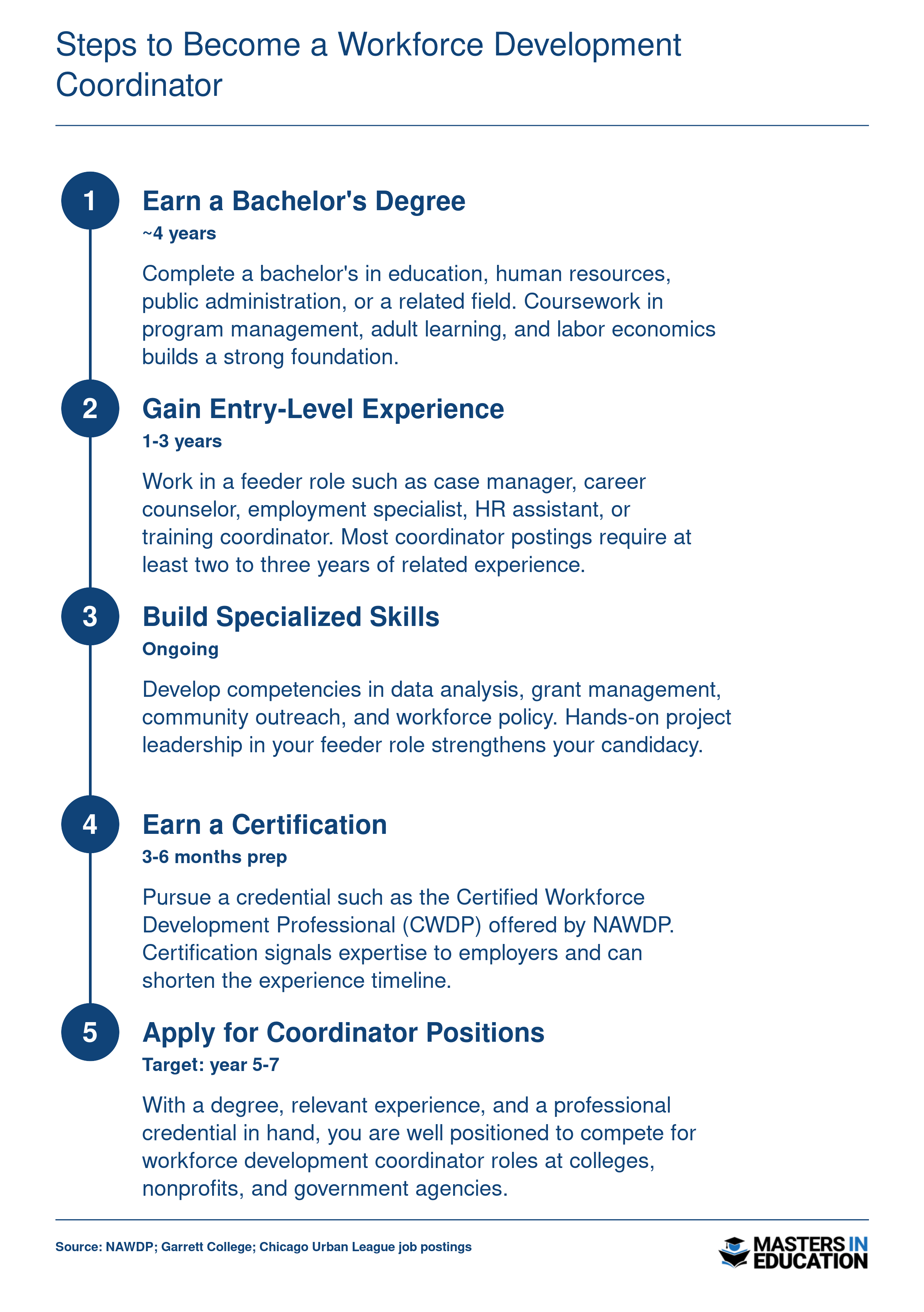
The path from college enrollment to a workforce development coordinator title typically spans 5 to 7 years. Below is a five-step credentialing ladder that maps the journey, with approximate timelines for each milestone.
Education and Degree Requirements
Most workforce development coordinator positions require at least a bachelor's degree, and many employers prefer candidates who hold a master's degree, particularly for roles with supervisory or program-design responsibilities. Understanding the most commonly requested degree fields will help you target the right academic path.
Common Undergraduate Majors
Job postings for workforce development coordinators consistently highlight a handful of degree fields. When you search current listings on sites like Indeed or LinkedIn using the exact title, you will see these majors appear again and again:
- Human Resources: Provides a foundation in talent management, employment law, and organizational behavior.
- Public Administration: Covers policy analysis, program evaluation, and government operations, all relevant to publicly funded workforce programs.
- Adult Education or Training and Development: Focuses on how adults learn, curriculum design, and instructional delivery.
- Social Work: Builds skills in case management, community outreach, and working with underserved populations.
- Organizational Development: Emphasizes change management, strategic planning, and performance improvement.
Related fields such as business administration, counseling, and sociology also appear in postings, though less frequently. The Bureau of Labor Statistics notes that training and development managers, a closely related occupation, typically hold a bachelor's degree in a relevant field, and many hold a master's degree. Human resources specialists follow a similar pattern.
Why a Master's Degree Can Set You Apart
While a bachelor's degree meets the minimum threshold for many entry-level coordinator roles, a master's degree can accelerate your path into leadership. Programs in adult education, public administration (MPA), human resource development, or organizational leadership sharpen the strategic and analytical skills that employers look for when filling senior coordinator or director positions. A graduate credential also opens doors to related roles such as curriculum developer positions. If you already work in the field, an online or hybrid graduate program lets you build credentials without stepping away from your career. For a broader look at where advanced education can take you, explore careers for masters in education.
How to Verify Degree Expectations
Education requirements can vary by employer and region. A few practical steps will keep your research current:
- Search O*NET OnLine for the job title or related titles, then review the education tab to see typical degree levels and fields reported by workers in the occupation.
- Check the BLS Occupational Outlook Handbook entries for Training and Development Managers and Human Resources Specialists; their education sections outline degree norms that overlap heavily with workforce development roles.
- Browse at least 15 to 20 current job postings on major boards, noting the specific majors and degree levels each employer lists. Patterns emerge quickly.
- Reach out to the National Association of Workforce Development Professionals (NAWDP) or your local workforce development board. Both often publish career guides or conduct surveys that outline degree preferences across the field.
By cross-referencing government occupational data, employer postings, and professional association resources, you can build a reliable picture of what hiring managers expect and choose a degree program that positions you competitively.
Questions to Ask Yourself
Certifications and Professional Development
Earning a professional credential signals specialized expertise and can set you apart in a competitive job market. Three certifications tend to come up most often for workforce development coordinators, though they serve different professional contexts.
CWDP: The Industry-Specific Credential
The Certified Workforce Development Professional (CWDP), issued by the National Association of Workforce Development Professionals (NAWDP), is the credential most directly aligned with this career path.1 It validates competencies specific to workforce program design, employer engagement, case management, and labor market analysis.
- Eligibility: Candidates generally need a combination of education and relevant work experience, along with a current role in workforce development. NAWDP may also require completion of a competency exam or approved training.2
- Approximate cost: Around $125 for the exam, making it one of the most affordable professional certifications available.2
- Best for: Professionals working in public workforce agencies, community-based organizations, One-Stop Career Centers, and nonprofit employment programs.
Because the CWDP is tailored to the workforce development field, it carries particular weight with employers in government-funded and community-focused settings.
SHRM-CP and PHR: HR-Adjacent Options
The SHRM Certified Professional (SHRM-CP) from SHRM and the Professional in Human Resources (PHR) from HRCI are broader human resources credentials. Both cover talent management, employee development, compliance, and organizational strategy. They are widely recognized in the private sector and corporate HR departments.
These certifications typically require a mix of HR-related education and professional experience, with exam fees that run significantly higher than the CWDP, often several hundred dollars. Their eligibility windows and recertification cycles differ, so candidates should consult SHRM and HRCI directly for the most current details.
If your career goals lean toward corporate training, talent pipeline management, or employer-side workforce planning, one of these HR credentials may complement or even substitute for a CWDP. For roles grounded in public or nonprofit workforce services, the CWDP is generally the stronger signal to hiring managers.
NAWDP Membership as a Professional Development Strategy
Even before pursuing certification, joining NAWDP can be a smart move. Membership provides access to an active professional network, annual conference programming, webinars, and a dedicated job board that lists workforce development openings across the country. These resources help you stay current on federal workforce policy, learn best practices from peers, and discover advancement opportunities. Membership is not a prerequisite for the CWDP, but many candidates find that the community support makes exam preparation easier and helps them build relationships that pay off throughout their careers.
Choosing the Right Credential
The best certification depends on where you plan to work. Professionals who design training programs or learning experiences may also find value in exploring the e-learning designer career path alongside their certification strategy. A quick framework:
- If you serve job seekers through government or nonprofit programs, start with the CWDP.
- If you coordinate workforce initiatives inside a corporate HR department, the SHRM-CP or PHR aligns more closely with employer expectations.
- If your role bridges both worlds, stacking a CWDP with an HR certification over time can position you for senior leadership roles that require fluency in public and private workforce systems.
Regardless of which path you choose, ongoing professional development through conferences, peer learning, and policy updates is just as important as any single credential on your resume.
Essential Skills for Workforce Development Coordinators
Success in workforce development coordination depends on a blend of technical proficiency and interpersonal finesse. Employers increasingly expect candidates to arrive with measurable hard skills while also demonstrating the relationship-building abilities that keep programs running smoothly. Below is a practical breakdown of both categories, along with how each skill shows up in day-to-day work.
Hard Skills
- Grant writing: Many coordinator positions are themselves funded by federal or state workforce grants, so drafting the next competitive proposal is quite literally writing your own job security.
- Data analysis and reporting: Coordinators pull participant-level data on wage gains, credential attainment, and employment retention to satisfy funder reporting cycles, often on quarterly or even monthly timelines.
- Labor market research: Before launching a new training cohort, you need to analyze regional occupation projections and employer demand data to ensure the program leads to actual jobs.
- Learning management system (LMS) proficiency: Coordinators use platforms like Canvas or Moodle to track participant progress through training modules, flag at-risk learners, and document completion rates.
- Customer relationship management (CRM) tools: Systems such as Salesforce or specialized workforce platforms help you manage employer partnerships, schedule outreach, and log every touchpoint in one place.
Of these, data literacy is the fastest-growing demand area. Funders at the federal and state level now expect coordinators to demonstrate measurable outcomes, not just anecdotal success stories. Professionals in related roles, such as a testing coordinator career path, rely on the same analytical toolkit. If you can build a dashboard that shows participant wage gains before and after program completion, you will stand out in any applicant pool.
Soft Skills
- Employer engagement: Building trust with local businesses means translating their hiring pain points into training curricula they actually want to invest in.
- Cross-cultural communication: Participant populations often span multiple languages, education levels, and life circumstances, so adapting your communication style is a daily requirement.
- Case management empathy: When a participant faces housing instability or childcare barriers, a coordinator who listens without judgment and connects them to wrap-around services can be the difference between program completion and dropout.
- Stakeholder negotiation: You may sit at a table with community college deans, county officials, and private employers who all have competing priorities, and your job is to find the shared outcome everyone can support.
Bringing It All Together
The strongest coordinators weave these two skill sets into a single workflow. For example, you might use labor market data to persuade an employer partner that sponsoring a welding cohort aligns with regional demand, then draft the grant narrative that funds the training, and finally pull outcome reports that justify continued investment. Each step requires both analytical rigor and the ability to communicate clearly with people who may never look at a spreadsheet.
If you are assessing your own readiness, consider which column needs the most development. Hard skills can often be built through coursework or professional certificates, while soft skills tend to sharpen through mentorship and hands-on experience in community-facing roles. Exploring a broader list of masters in education jobs can also help you benchmark where your current skill set fits across the field.
Workforce Development Coordinator Salary: National Overview
Because the Bureau of Labor Statistics does not track workforce development coordinators as a standalone occupation, salary estimates are best understood by examining the closely related roles these professionals overlap with. The table below shows national wage data for three BLS categories that commonly encompass workforce development coordinator responsibilities. Entry level coordinators typically align with the Training and Development Specialists category, while those who advance into leadership may see earnings closer to the Training and Development Managers range.
| Occupation | Total Employment | 25th Percentile | Median Salary | Mean Salary | 75th Percentile |
|---|---|---|---|---|---|
| Training and Development Specialists | 436,610 | $48,900 | $65,850 | $73,760 | $91,550 |
| Human Resources Specialists | 917,460 | $55,870 | $72,910 | $79,730 | $97,270 |
| Training and Development Managers | 44,960 | $96,110 | $127,090 | $140,590 | $169,310 |
Workforce Development Coordinator Salary by State
Workforce development coordinator salaries vary significantly depending on where you work. The table below draws on federal wage data for training and development specialists, which is the closest occupational category for this role. States with higher costs of living and larger concentrations of corporate or government employers generally offer the strongest compensation. Washington, D.C., and several coastal states lead in median pay, while opportunities exist across the country at competitive wages.
| State | Total Employment | 25th Percentile | Median Salary | 75th Percentile | Mean Salary |
|---|---|---|---|---|---|
| District of Columbia | 1,930 | $70,800 | $84,460 | $102,510 | $89,560 |
| Washington | 9,270 | $61,550 | $82,910 | $108,780 | $92,210 |
| Wyoming | 820 | $54,650 | $83,450 | $94,260 | $76,990 |
| Connecticut | 3,310 | $53,040 | $79,660 | $104,650 | $85,040 |
| Delaware | 1,240 | $60,050 | $79,320 | $101,780 | $87,940 |
| New Jersey | 8,790 | $52,180 | $76,660 | $100,900 | $81,030 |
| Virginia | 15,290 | $56,050 | $76,250 | $100,500 | $81,200 |
| Minnesota | 8,760 | $60,920 | $75,980 | $97,040 | $80,390 |
| Alaska | 460 | $60,640 | $75,010 | $100,090 | $80,580 |
| New York | 25,510 | $53,300 | $73,550 | $99,430 | $79,360 |
| Massachusetts | 11,880 | $50,310 | $73,480 | $104,740 | $80,520 |
| Maryland | 8,680 | $46,350 | $73,220 | $98,380 | $75,700 |
| California | 44,750 | $49,460 | $72,930 | $101,760 | $82,040 |
| Colorado | 11,040 | $50,160 | $72,790 | $98,270 | $76,600 |
| Rhode Island | 1,250 | $51,490 | $72,600 | $105,820 | $84,380 |
Where Do Workforce Development Coordinators Work?
Workforce development coordinators operate across four main sectors, and the one you choose will shape your daily responsibilities, the populations you serve, and your earning potential. Understanding these differences helps you target your job search toward a setting that aligns with your professional values and strengths.
Community Colleges and Higher Education
In this sector, coordinators typically carry titles such as Career Services Coordinator, Workforce Education Specialist, or Continuing Education Program Manager. Funding flows primarily from tuition revenue, state appropriations, and federal grants like Perkins V or WIOA Title II allocations. The populations served are adult learners, dislocated workers returning for credentials, and traditional students transitioning to careers. Work tends to follow an academic calendar, and pay generally falls in the mid-range for the field, often anchored to institutional salary scales. Professionals interested in how masters in education salary data compares across education roles will find this sector's compensation relatively predictable.
Government Workforce Boards
State and local workforce development boards hire coordinators under titles like Workforce Development Manager, Workforce Program Specialist, or WIOA Case Manager. Funding comes almost entirely from federal and state grants, which means the work is closely tied to performance metrics and compliance reporting. The population served is broad: unemployed or underemployed residents, veterans, individuals with disabilities, and youth aging out of foster care. Public-sector pay can be competitive at the management level. For example, a Workforce Development Manager in Santa Cruz County, California, earns between roughly $123,000 and $164,000 annually, reflecting the cost of living and scope of that role.1
Nonprofit Organizations
Nonprofits employ coordinators with titles such as Employment Program Coordinator, Job Training Specialist, or Community Workforce Navigator. Funding is grant-dependent, drawing from foundations, corporate sponsors, and government contracts. This sector typically serves targeted populations, including refugees, formerly incarcerated individuals, or residents of specific communities. The work environment is mission-driven, and pay tends to be the lowest of the four sectors, though it varies considerably by organization size and region.
Private Employers and Staffing Firms
Corporations and staffing agencies use titles like Workforce Development Specialist, Talent Development Coordinator, or Learning and Development Associate. Budgets come from corporate operating funds rather than external grants, which can make funding more stable year to year. The population served is internal: current employees and new hires. A corporate workforce development role in a metro area like Milwaukee, Wisconsin, lists in the range of roughly $67,000 to $100,000.2 Private-sector positions often emphasize upskilling, retention metrics, and alignment with business goals rather than community outcomes.
Choosing the Right Sector
As you weigh your options, consider these distinguishing factors:
- Funding stability: Corporate budgets tend to be more predictable than grant cycles in the nonprofit or government space.
- Mission alignment: Government boards and nonprofits focus on equity and community impact, while private employers prioritize organizational performance.
- Population served: Higher education and government boards serve the widest range of participants; private employers focus inward.
- Earning potential: Government roles at the management level and corporate positions generally pay more, while nonprofit positions may offer less compensation but greater flexibility in program design.
Matching these attributes to your own priorities, whether that is salary, population impact, or job stability, will help you land in a sector where you can build a lasting and satisfying career.
Career Advancement and Job Outlook
Workforce development is a field with a clearly defined promotion ladder and strong demand projections, making it an appealing long-term career choice for educators and human services professionals alike.
The Typical Promotion Ladder
Most professionals enter the field as a workforce development coordinator, managing day-to-day program operations, employer partnerships, and participant services. From there, a common trajectory looks like this:
- Coordinator: Handles program logistics, participant intake, and employer engagement at the ground level.
- Senior Coordinator or Program Manager: Oversees multiple programs or a larger geographic region, supervises staff, and takes on budget responsibilities.
- Director of Workforce Development: Sets strategic direction for an organization's workforce initiatives, manages grant portfolios, and reports outcomes to funders and governing boards.
- VP of Workforce or Community Partnerships: Leads cross-departmental or multi-agency collaborations, shapes policy at the institutional or regional level, and represents the organization to legislators and industry coalitions.
Each step up typically requires a broader skill set, not just more years in the role. Coordinators who add data analytics competencies or grant management expertise tend to be best positioned for director-level jumps, because those abilities directly address the metrics-driven accountability that funders and boards demand.
Job Growth Projections
The Bureau of Labor Statistics does not publish a standalone projection for workforce development coordinators, but two closely related occupations serve as reliable proxy indicators.
Training and development specialists are projected to grow by about 10.8 percent from 2024 to 2034, translating to roughly 43,900 new positions over the decade.1 That rate far outpaces the 3.1 percent average projected across all U.S. occupations.2 Human resources specialists, another neighboring category, are expected to grow by 6 to 7 percent during the same window, adding an estimated 40,000 to 50,000 new jobs.2 Both figures signal healthy, sustained demand for professionals who connect people with employment and training opportunities.
Why This Field Is More Recession-Resilient
Federal investment plays a stabilizing role that distinguishes workforce development from many private-sector HR positions. The Workforce Innovation and Opportunity Act (WIOA) channels billions of dollars into state and local workforce systems, and ongoing discussions around WIOA reauthorization and sector-based training grants continue to reinforce that funding pipeline. When economic downturns hit, demand for workforce services typically increases rather than contracts, because displaced workers need retraining and re-employment support.3 That counter-cyclical dynamic offers coordinators a level of job security that is uncommon in adjacent fields.
Healthcare and technology remain the fastest-growing sectors through 2034, and both rely heavily on workforce pipelines to fill persistent talent gaps.3 Coordinators who specialize in these industries, or who develop fluency in labor market data and outcome reporting, position themselves at the intersection of public investment and private-sector need. That is exactly where the most compelling director and VP opportunities emerge, and it is one reason the role appears consistently among jobs for masters in education graduates.
Frequently Asked Questions About Workforce Development Coordinators
Below are answers to some of the most common questions prospective workforce development coordinators ask. Each response draws on the information covered earlier in this guide.
The fastest route into this field follows a clear sequence: earn a bachelor's degree in human resources, public administration, or a related field, then gain experience in an entry-level feeder role such as career services or training assistance, and pursue the CWDP certification to demonstrate specialized competence. That credentialing ladder, as outlined earlier, typically spans five to seven years from enrollment to coordinator title.
If you want an immediate, low-cost action step, consider joining the National Association of Workforce Development Professionals. Membership connects you with practitioners, job boards, and CWDP exam resources. With growing federal investment in skills training and an urgent nationwide skills gap, demand for coordinators is only increasing. The window to enter this field is wide open.
Explore Careers
- Child Development Specialist
- College Admissions Counselor
- Curriculum Developer
- District Administrator
- Diversity & Inclusion Coordinator
- Academic Advisor
- Adult Education Instructor
- Arts Educator
- Arts Integration Specialist
- E-Learning Designer
- Early Childhood Education Coordinator
- EdTech Specialist
- Educational Administrator
- Educational Psychologist
- Elementary School Teacher
- ESL Coordinator
- ESL Teacher