
What you’ll learn in this article…
- A master's degree in school counseling, typically 48 to 60 credit hours, is required in every state for licensure.
- CACREP-accredited programs streamline licensure portability and are increasingly preferred or mandated by state boards.
- The national median salary for school counselors is $65,140, with California topping states at $94,320.
- Career changers with a bachelor's degree can complete the credentialing process in roughly three to four years.
Student mental health referrals have surged in K-12 settings since 2020, and the Bureau of Labor Statistics projects roughly 8% employment growth for school counselors through 2032. That demand is real, but so are the credentialing barriers: becoming a school counselor requires a master's degree in school counseling, 600 or more hours of supervised clinical experience, and a state-issued license or certification. From freshman year of college to first day on the job, the typical timeline runs six to eight years.
The practical tension for most candidates is cost versus payoff. National median pay sits near $65,140, yet salaries range from the mid-$40,000s in some Southern states to over $94,000 in California. Program accreditation, state-specific exam requirements, and loan forgiveness eligibility all shape the return on that investment.
What Does a School Counselor Do?
The term "guidance counselor" still lingers in popular culture, but the profession has evolved well beyond helping students pick electives. Today's school counselors design and deliver comprehensive programs that address academic achievement, social-emotional development, crisis intervention, and college and career readiness. They function as advocates, data analysts, mental health first responders, and collaborative partners to every adult in a student's life.
A Typical Day by School Level
What fills a school counselor's calendar depends heavily on the age group they serve.
- Elementary (K-5): Counselors at this level often lead classroom lessons on topics like conflict resolution, empathy, and self-regulation. They conduct parent conferences, coordinate behavioral referrals, and work closely with teachers to identify students who may need early intervention for learning or emotional challenges.
- Middle school (6-8): The focus shifts toward group counseling sessions, course scheduling, and helping students navigate the social turbulence of early adolescence. Transition planning, both from elementary school and toward high school, is a recurring priority.
- High school (9-12): Daily tasks can include transcript reviews, college application support, scholarship guidance, career exploration workshops, and mental health triage. High school counselors frequently serve as the bridge between students in crisis and outside clinical providers.
Across all levels, no two days look the same. A morning might start with a scheduled parent meeting and pivot to an emergency check-in with a student by mid-morning.
Caseload Realities
The American School Counselor Association (ASCA) recommends a ratio of 250 students per counselor. The national average, however, sits closer to 385-to-1 as of the most recent data. That gap shapes almost every aspect of daily practice. Counselors managing large caseloads spend more time in reactive mode, addressing urgent needs rather than delivering the proactive, prevention-oriented programming that research supports. Understanding this tension is important for anyone considering the profession, because it defines the pace and intensity of the work.
Collaboration as a Core Function
School counselors do not operate in isolation. On any given day they may consult with classroom teachers about a struggling learner, sit in a team meeting with administrators to review discipline data, or coordinate with outside agencies such as child protective services, community mental health providers, or juvenile justice liaisons. This collaborative dimension makes strong communication skills and professional flexibility just as essential as counseling techniques. Many of the same relationship-building competencies apply in related roles such as student affairs coordinator positions or college admissions counselor work. If you thrive in a role that requires constant engagement across multiple stakeholders, the school counseling profession rewards that strength every day.
Steps to Become a School Counselor
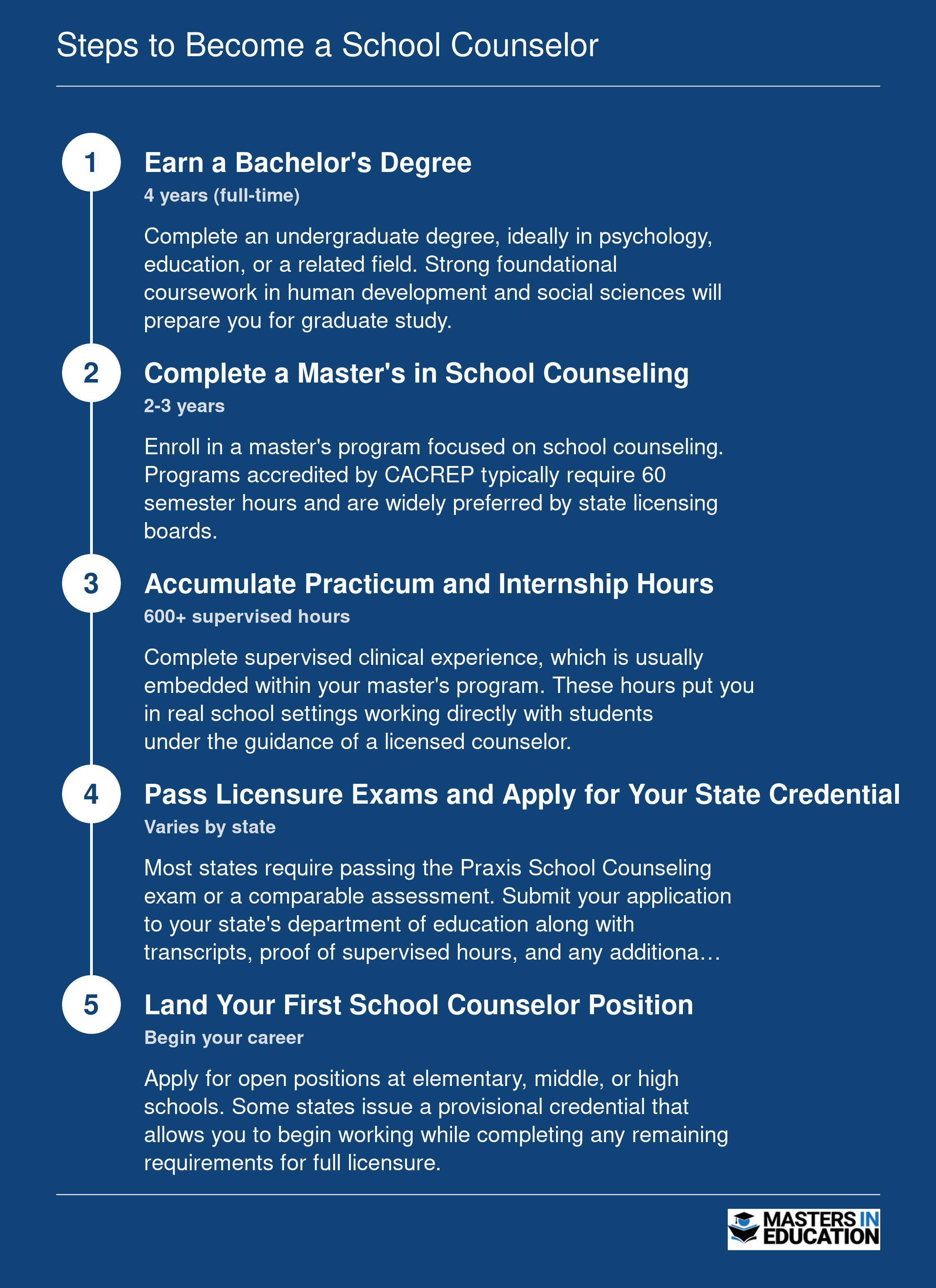
The path to becoming a school counselor follows a structured credentialing ladder. Traditional students can expect a cumulative timeline of roughly 6 to 7 years, while career changers who already hold a bachelor's degree can reach the finish line in about 3 to 4 years.
Education Requirements: Bachelor's and Master's Degrees
Becoming a school counselor is a two-degree process, but the path to that first degree is more flexible than many people expect. Understanding what each stage demands will help you plan your timeline and budget realistically.
Undergraduate Preparation
There is no single required undergraduate major for aspiring school counselors. Psychology, education, and sociology are popular starting points because they introduce foundational concepts you will encounter again at the graduate level, yet admissions committees at most master's programs accept applicants from any discipline. If you already hold a bachelor's in English, business, or biology, you are not starting over. What matters more is a solid GPA, relevant volunteer or work experience with young people, and strong letters of recommendation. Candidates with a psychology background may also want to explore how to become an educational psychologist if they are weighing related career paths.
Some programs ask for prerequisite coursework in areas like introductory psychology or human development. Reviewing admissions requirements early, ideally a full year before you plan to apply, gives you time to fill any gaps without delaying your start date.
The Master's Degree: A Non-Negotiable Credential
Every U.S. state requires a master's degree in school counseling or a closely related field for licensure. Programs accredited by CACREP (the Council for Accreditation of Counseling and Related Educational Programs) require a minimum of 60 semester credit hours under the 2024 standards.1 Non-CACREP programs may list slightly fewer credits, sometimes in the 48 to 54 range, but a growing number of states require or strongly prefer graduation from a CACREP-accredited program, making those extra credits a worthwhile investment in licensure portability.
Core coursework typically spans several domains:
- Child and adolescent development: Understanding cognitive, social, and emotional growth across the PK through 12 spectrum.
- Group counseling techniques: Facilitating small-group interventions around topics like grief, social skills, and academic motivation.
- Ethics and professional identity: Navigating confidentiality, mandated reporting, and the ASCA Ethical Standards.
- Multicultural competency: Serving students from diverse racial, cultural, linguistic, and socioeconomic backgrounds equitably.
- Assessment and data use: Interpreting standardized tests, needs assessments, and outcome data to guide programming decisions.
These courses build the clinical and theoretical foundation you will rely on every day in a school setting.
Format Options and Timeline
Graduate programs in school counseling are offered in fully online, hybrid, and traditional on-campus formats. Full-time students often finish in two to three years. Part-time students, many of whom are working teachers or career changers, typically complete their degrees in three to four years. Online and hybrid formats have expanded access considerably, but keep in mind that field placements still happen in person regardless of how you attend class.
Practicum and Internship Requirements
Hands-on clinical experience is woven directly into the master's curriculum. Under the 2024 CACREP standards, students must complete a practicum of at least 100 clock hours (with a minimum of 40 hours of direct service to students) plus an internship totaling at least 600 clock hours (with at least 240 hours of direct service).2 All field experiences take place in PK through 12 school settings and include both individual or triadic supervision and group supervision from qualified site and faculty supervisors.3
These hours are not optional add-ons. They are built into your program sequence, meaning you will be working in real schools, running real groups, and meeting with real students well before you graduate. Many students find the internship phase to be the most demanding semester of their program and also the most clarifying, because it confirms whether the day-to-day realities of the role align with their expectations.
Planning ahead for practicum and internship logistics, including potential schedule changes at your current job and transportation to your placement site, can prevent last-minute complications that slow your progress toward graduation and teaching licensure.
CACREP vs. Non-CACREP Programs: Why Accreditation Matters
When choosing a master's program in school counseling, accreditation from the Council for Accreditation of Counseling and Related Educational Programs (CACREP) is one of the most consequential factors to weigh. CACREP sets curriculum standards, practicum hour requirements, and faculty qualifications that align with what state licensure boards and employers expect. Understanding the practical differences between CACREP and non-CACREP programs can save you time, money, and frustration down the road.
What CACREP Accreditation Signals to Employers
A growing number of states either require or strongly prefer graduation from a CACREP-accredited program for school counselor licensure. Employer perception surveys conducted by organizations such as the American Counseling Association and various state licensure boards consistently show that hiring committees view CACREP credentials as a reliable quality indicator. In competitive school districts, candidates from accredited programs often move to the front of the applicant pool simply because their training meets a recognized national standard.
Transparency in Outcomes Data
CACREP-accredited programs are required to publish graduation rates, licensure exam pass rates, and employment outcomes. You can find these figures directly on each program's website, which makes it straightforward to compare options side by side. Non-accredited programs may report similar data voluntarily, but there is no mandate, so gaps in reporting are common. When a program does not disclose these outcomes, it becomes harder to judge whether graduates are passing exams and landing jobs at comparable rates.
Using Public Data to Compare Your Options
Beyond what programs self-report, the Bureau of Labor Statistics Occupational Outlook Handbook offers salary data and employment projections for school counselors across settings and states. Cross-referencing BLS figures with program-level outcomes gives you a clearer picture of the return on your investment. For additional context, searching professional association directories or platforms like LinkedIn for alumni career trajectories can provide anecdotal evidence of where graduates end up and what they earn several years out. If you are weighing school counseling against other paths, exploring careers for masters in education can help you benchmark salaries and demand across related roles.
Key Differences at a Glance
- Licensure portability: CACREP graduates often qualify for reciprocity agreements across state lines, while non-CACREP graduates may face additional coursework requirements when relocating.
- Clinical hours: CACREP programs require a minimum of 600 hours of supervised clinical experience, which exceeds many states' baseline expectations.
- Exam eligibility: Certain national exams, including the National Counselor Examination, may streamline registration for CACREP graduates.
- Long-term career flexibility: Some advanced credentials and doctoral programs list CACREP graduation as a prerequisite for admission.
Choosing a CACREP-accredited program is not the only path to becoming a licensed school counselor, but it is the most widely recognized one. If you are considering a non-accredited program, verify that it meets your target state's specific licensure requirements before enrolling.
Questions to Ask Yourself
State Licensure and Certification Requirements
Every state requires school counselors to hold a state-issued credential, and the specific rules vary considerably.1 Earning your master's degree is only part of the equation. You also need to complete supervised fieldwork, pass one or more exams, and submit an application to your state's education department. Below is a closer look at what the process involves and how requirements differ across the states that employ the most school counselors.
Common Requirements Across States
Despite state-by-state variation, most credentialing pathways share the same core elements:
- Master's degree: A graduate degree in school counseling (typically 48 to 60 credits) is required in all 50 states.
- Supervised experience: States mandate anywhere from 300 to 700 hours of supervised clinical or field experience, usually completed during your graduate program.
- Examination: Most states require a content-area exam. Pennsylvania, for example, requires the Praxis School Counseling and Guidance exam (test code 5422), while Texas, Florida, and Illinois each administer their own state-specific tests. California is a notable exception, requiring no exam at all.
- Background check: Fingerprinting and a criminal background review are standard virtually everywhere.
How the Largest States Compare
The credential names and supervised-hour thresholds differ across the top states by school counselor employment:1
- California: Issues a Pupil Personnel Services (PPS) Credential in School Counseling. Requires 600 supervised hours and no exam.
- Texas: Grants a Standard School Counselor Certificate after 300 to 600 supervised hours and passage of the TExES School Counselor exam.
- New York: Offers an Initial Certificate followed by a Professional Certificate. Candidates need 700 supervised hours and must pass state-specific educator exams.
- Illinois: Awards a Professional Educator License with a School Counselor endorsement. Requires 600 supervised hours and the Illinois School Counselor content exam.
- Florida: Issues a PreK through 12 School Counselor Certification after 600 supervised hours and the FTCE School Counseling exam, plus additional Florida-specific components in areas like reading and ESOL.
- Pennsylvania: Grants an Educational Specialist Certificate for School Counselors (PK through 12) after 600 supervised hours and the Praxis 5422.
Georgia, North Carolina, Ohio, and Virginia each maintain their own frameworks as well, so always check directly with your state's department of education for the most current rules.
Moving Between States
If you anticipate relocating, pay close attention to reciprocity. Most of the states listed above participate in the NASDTEC Interstate Agreement, which can streamline the transfer process, but participation does not guarantee automatic licensure.1 California, for instance, still requires out-of-state counselors to meet its PPS standards. New York may require additional coursework such as Dignity for All Students Act (DASA) training. Texas typically expects candidates to pass the TExES exam even when transferring in.
None of these top states currently mandate CACREP accreditation for licensure eligibility, though graduating from a CACREP-accredited program can simplify reciprocity and is increasingly preferred by employers. The credentialing process for school counselors shares structural similarities with special education teacher certification requirements by state, where state-specific exams and supervised hours also vary widely. The American School Counselor Association maintains a regularly updated directory of state requirements1 that is worth bookmarking as you plan your next steps.
School Counselor Salary by State
School counselor salaries vary significantly depending on where you work. California leads the nation with a median annual wage of $94,320, while states in the Midwest and Southeast generally fall below the national median. The table below shows median, 25th percentile, and 75th percentile annual wages for educational, guidance, and career counselors and advisors across all 50 states and territories with available data, based on the latest Bureau of Labor Statistics figures.
| State | Total Employment | 25th Percentile | Median Salary | 75th Percentile | Mean Salary |
|---|---|---|---|---|---|
| California | 44,160 | $66,500 | $94,320 | $122,160 | $96,440 |
| Washington | 5,910 | $64,680 | $83,930 | $109,390 | $87,560 |
| District of Columbia | 1,800 | $61,930 | $80,280 | $101,050 | $80,820 |
| Alaska | 660 | $61,000 | $80,020 | $88,860 | $75,070 |
| Massachusetts | 11,850 | $63,800 | $78,840 | $100,250 | $82,910 |
| New Jersey | 7,590 | $64,900 | $77,940 | $99,180 | $82,460 |
| New Mexico | 1,760 | $56,930 | $76,490 | $84,460 | $76,030 |
| Maryland | 6,210 | $61,860 | $74,970 | $97,910 | $79,410 |
| Oregon | 3,330 | $57,540 | $74,000 | $98,090 | $79,550 |
| Delaware | 1,750 | $51,710 | $72,450 | $86,980 | $71,140 |
| Rhode Island | 1,400 | $55,760 | $71,590 | $87,890 | $74,350 |
| Connecticut | 3,670 | $54,800 | $70,400 | $93,630 | $75,070 |
| New York | 22,660 | $56,000 | $69,900 | $95,210 | $77,720 |
| New Hampshire | 1,530 | $57,780 | $68,410 | $83,910 | $72,660 |
| Virginia | 8,810 | $54,070 | $67,350 | $81,640 | $70,720 |
| Louisiana | 4,890 | $54,560 | $67,070 | $84,300 | $68,170 |
| Hawaii | 1,800 | $57,850 | $66,720 | $88,600 | $71,590 |
| Nebraska | 2,120 | $54,100 | $66,650 | $80,020 | $69,480 |
| Texas | 32,350 | $48,940 | $65,660 | $78,690 | $65,140 |
| Wyoming | 770 | $55,840 | $65,070 | $77,400 | $67,530 |
| Nevada | 2,300 | $53,150 | $64,960 | $84,670 | $67,600 |
| Kentucky | 5,030 | $48,310 | $64,390 | $77,420 | $64,400 |
| Georgia | 10,890 | $49,920 | $63,990 | $81,060 | $70,130 |
| Colorado | 6,220 | $55,430 | $63,900 | $77,350 | $68,400 |
| Wisconsin | 5,280 | $54,040 | $63,690 | $76,450 | $66,620 |
| Michigan | 7,950 | $48,860 | $63,240 | $78,490 | $66,020 |
| Minnesota | 4,440 | $56,800 | $63,230 | $75,770 | $68,080 |
| Utah | 3,680 | $49,400 | $62,500 | $82,780 | $68,290 |
| Ohio | 13,030 | $48,870 | $61,960 | $81,740 | $68,730 |
| Pennsylvania | 11,500 | $50,080 | $61,460 | $78,930 | $67,540 |
| Illinois | 12,790 | $50,140 | $61,210 | $81,790 | $69,870 |
| Vermont | 970 | $53,330 | $60,920 | $75,830 | $64,900 |
| Alabama | 4,510 | $47,240 | $60,530 | $74,080 | $61,330 |
| Idaho | 2,010 | $50,630 | $60,340 | $71,970 | $62,640 |
| North Dakota | 770 | $52,760 | $60,330 | $69,560 | $62,500 |
| Arkansas | 2,310 | $49,850 | $60,110 | $69,970 | $61,310 |
| Mississippi | 2,540 | $47,740 | $59,630 | $68,080 | $58,570 |
| Montana | 860 | $45,680 | $59,480 | $79,270 | $64,770 |
| Maine | 1,610 | $50,090 | $59,160 | $74,560 | $61,790 |
| Tennessee | 6,090 | $49,630 | $59,090 | $68,780 | $60,390 |
| Kansas | 2,980 | $48,860 | $58,430 | $67,640 | $58,950 |
| Arizona | 6,060 | $49,970 | $57,940 | $68,110 | $62,310 |
| South Carolina | 7,170 | $45,690 | $57,400 | $74,250 | $59,780 |
| North Carolina | 9,630 | $46,380 | $57,100 | $64,160 | $56,920 |
| Indiana | 5,450 | $47,480 | $56,470 | $67,990 | $59,040 |
| Iowa | 3,580 | $47,950 | $55,910 | $69,640 | $58,910 |
| West Virginia | 1,390 | $44,360 | $55,420 | $63,160 | $54,910 |
| Florida | 21,080 | $47,710 | $54,080 | $71,130 | $59,820 |
| Missouri | 8,960 | $46,100 | $53,790 | $62,720 | $57,120 |
School Counselor Salary: National Overview and Highest-Paying Metros
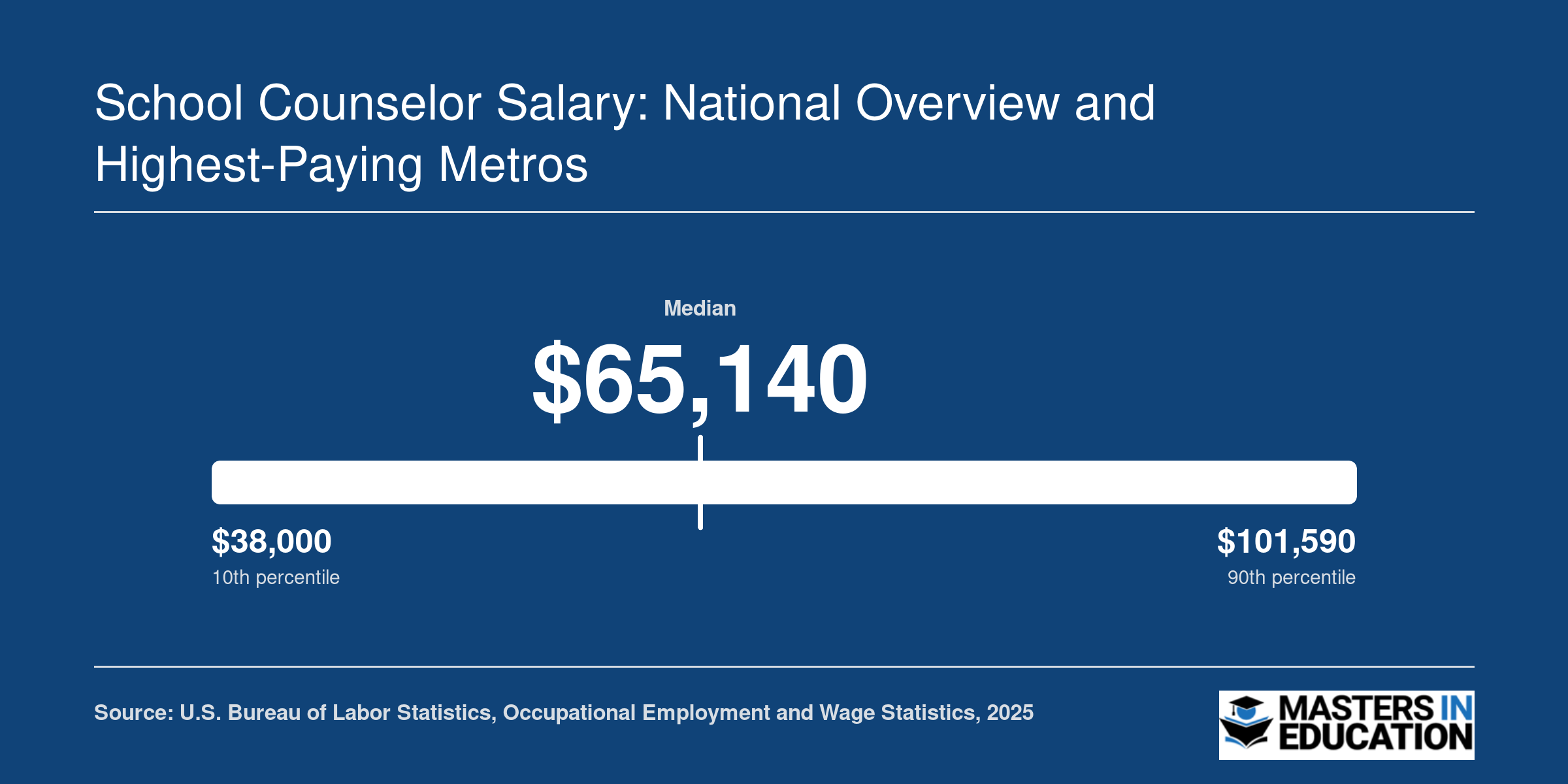
The national median salary for educational, guidance, and career counselors and advisors is $65,140, based on roughly 342,350 professionals employed across the country. The mean salary sits slightly higher at $71,520, reflecting upward pull from higher-paying metro areas. Given that the role requires a master's degree, the earning range is worth weighing against your investment: the middle 50% of earners take home between $51,690 and $83,490. Keep in mind that most school counselors work a school-year calendar, meaning summers are typically off, a schedule benefit that effectively raises the per-hour value of those earnings.
Job Outlook and Demand for School Counselors
The job market for school counselors remains steady, with several forces converging to create consistent demand across the profession. Understanding these trends can help you plan your education and career timeline with confidence.
Projected Growth and Openings
According to the Bureau of Labor Statistics, employment of school and career counselors is projected to grow about 4 percent over the current decade, which is roughly in line with the average for all occupations.1 While that headline number may seem modest, it tells only part of the story. The BLS estimates approximately 29,100 openings per year in this field, driven not only by new positions but also by the need to replace professionals who retire, transfer to other roles, or leave the workforce entirely.1 Burnout-driven turnover, a persistent challenge in school-based mental health roles, adds meaningfully to the volume of available positions beyond net new job creation.
What Is Driving Demand
Several structural factors are pushing districts to hire more counselors:
- State mental health legislation: A growing number of states have passed or expanded laws requiring schools to employ dedicated counseling staff. These mandates are creating positions in districts that previously relied on shared or part-time arrangements.
- Federal funding increases: Recent federal investments in school-based mental health services have given districts additional resources to expand their counseling teams.
- Movement toward the 250:1 ratio: The American School Counselor Association recommends a maximum student-to-counselor ratio of 250 to 1. Many states still exceed that threshold significantly, which means thousands of additional counselors would be needed to meet the benchmark nationwide.
Taken together, these drivers suggest that real-world demand may outpace the BLS baseline projection in states that are actively working to close staffing gaps.
Where the Shortages Are Most Acute
Not every community faces the same hiring landscape. Rural districts and Title I schools (those serving high concentrations of students from low-income families) consistently report the most difficulty attracting and retaining qualified counselors. Geographic isolation, lower salary schedules, and limited professional development resources all contribute to these shortages. For candidates willing to serve in high-need settings, this dynamic can translate into stronger job prospects, signing incentives, and eligibility for loan forgiveness programs. Professionals who transfer to other roles, such as academic advisor qualifications, may also create additional openings.
If you are weighing a career in school counseling, the combination of steady national growth, policy-driven expansion, and acute local shortages points to a profession where qualified candidates should find reliable employment opportunities for years to come.
Career Paths for Teachers and Career Changers
Whether you are transitioning from a classroom teaching role or entering education for the first time, the path to becoming a school counselor is accessible, though it requires targeted graduate preparation. Understanding how your background shapes your route can save time and money.
The Teacher-to-Counselor Pipeline
Experienced teachers often make strong candidates for school counseling programs and positions. Years in the classroom build rapport-building skills, knowledge of student development, and familiarity with school systems, all of which give former teachers a noticeable hiring advantage. Some states also allow documented teaching experience to count toward a portion of the supervised practicum or internship hours required for licensure. This can shorten your clinical timeline, but the specifics vary considerably from state to state, so cross-reference the licensure table earlier in this article for details on your state.
One critical point: holding a master's degree in teaching or curriculum does not qualify you for school counselor licensure. You will still need to complete a master's program specifically in school counseling, typically 48 to 60 credits, that includes coursework in counseling theory, assessment, ethics, and multicultural competence.
Career Changers from Non-Education Fields
You do not need a teaching license or an education-related bachelor's degree to pursue school counseling in most states. Programs such as the Ed.M. in Psychological Counseling at Teachers College, Columbia University accept applicants from any undergraduate major, requiring only a minimum 3.0 GPA and no specific prerequisite courses.1 Other programs set different expectations. St. John's University, for example, requires 18 prerequisite credits, often in areas like psychology, human development, or statistics, which applicants without a social science background may need to complete before starting graduate work.2
Career changers should also be prepared for substantial fieldwork. Monmouth University's hybrid M.S.Ed. in Educational Counseling, for instance, requires 700 hours of clinical experience across its 60-credit curriculum.3 Teachers College requires a full year of supervised fieldwork.1 If counseling is one of several careers for masters in education paths you are evaluating, compare the fieldwork commitments carefully before committing.
Flexible Formats for Working Adults
Many programs now cater to professionals who cannot stop working while they earn their degree. Common formats include:
- Full-time, two-year tracks: Intensive schedules that allow you to finish quickly while completing practicum requirements during the school day.
- Part-time, three-year tracks: Spread coursework over more semesters, with evening or weekend classes. Brooklyn College's 60-credit M.S.Ed. in School Counseling, for example, offers evening classes designed for working students.4
- Weekend cohort models: Alfred University partners with CITE to deliver its school counseling master's in a weekend cohort format, minimizing weekday commitments.5
- Online and hybrid options: Wilmington University offers an M.Ed. in Elementary and Secondary School Counseling primarily online, with limited on-campus components and 200 hours of practicum.6 Monmouth University uses a hybrid model combining online coursework with in-person sessions.3
These flexible structures make it realistic to continue earning a paycheck while completing a rigorous graduate program, an important consideration for career changers who may not have the financial cushion to leave the workforce entirely.
Long-Term Career Growth and Advancement
A school counseling credential opens more doors than many educators realize. Whether you want to climb the administrative ladder, shift into a related specialty, or influence policy at the state level, the profession offers clear pathways for growth.
Advancing Within K-12 Counseling
The most direct trajectory keeps you in the school counseling world while expanding your scope of responsibility. A typical progression looks like this:
- Lead counselor: After three to five years of direct service, many counselors take on scheduling coordination, mentor newer staff, and serve as the building-level point person for crisis response.
- Department head or grade-level coordinator: This role adds budget oversight and program evaluation duties, usually requiring five to seven years of experience.
- District counseling coordinator: Responsible for aligning counseling programs across multiple schools, this position often calls for seven to ten years of experience plus a track record of data-driven program improvement.
- Director of student services: At the district or regional level, directors oversee counseling, social work, psychology, and related support services. Most districts expect candidates to hold advanced credentials or administrative licensure.
Each step generally requires a combination of documented experience and additional credentials, so planning ahead pays off.
Lateral Moves Into Related Fields
School counselors who want a broader scope of practice have several options:
- Earning licensure as a licensed professional counselor (LPC) allows you to open a private practice or work in community mental health settings.
- Transitioning into school psychology typically requires a specialist-level (Ed.S.) or doctoral degree, but the overlap in coursework can shorten the path.
- Pursuing principal certification or an administrative endorsement positions you for roles like assistant principal or dean of students, where your counseling background becomes a strategic advantage in school culture and discipline reform.
Counselors considering the principal track can review the steps outlined in our guide on how to become a school principal. Those drawn to district level administration may find that their systems-level perspective from coordinating counseling programs translates well into broader leadership roles.
Doctoral Pathways and Policy Roles
A doctorate in counselor education, whether an Ed.D. or a Ph.D., opens doors that a master's degree alone cannot. University faculty positions, clinical supervision roles, and state-level policy advisor appointments all become accessible. If you are drawn to research, curriculum design for counselor preparation programs, or shaping legislative priorities around student mental health, a doctoral degree is the standard entry point.
Boosting Credentials Without Leaving the Classroom
Not every form of advancement requires a career change. National Board Certification in school counseling signals expertise to employers and often qualifies you for salary supplements that vary by state but can add several thousand dollars per year. The American School Counselor Association also offers specialty credentials, such as the Recognized ASCA Model Program (RAMP) leadership designation, that strengthen your professional profile. These certifications enhance both credibility and compensation while keeping you in the K-12 setting where your daily work makes the most immediate difference for students. For a broader look at how advanced credentials affect pay across education roles, see our masters in education salary guide.
Frequently Asked Questions About Becoming a School Counselor
Prospective school counselors often have overlapping questions about degrees, timelines, and day-to-day realities. Below are concise, fact-based answers to the questions educators and career changers ask most frequently.
Explore Careers
- Child Development Specialist
- College Admissions Counselor
- Curriculum Developer
- District Administrator
- Diversity & Inclusion Coordinator
- Academic Advisor
- Adult Education Instructor
- Arts Educator
- Arts Integration Specialist
- E-Learning Designer
- Early Childhood Education Coordinator
- EdTech Specialist
- Educational Administrator
- Educational Psychologist
- Elementary School Teacher
- ESL Coordinator
- ESL Teacher