
What you’ll learn in this article…
- Most states require a bachelor's degree, a state-approved preparation program, and passing scores on licensure exams like the Praxis.
- Alternative certification programs let career changers enter the classroom in one to two years, often at lower cost than traditional pathways.
- The BLS reports a median annual salary of roughly $63,670 for elementary school teachers, with significant variation by state.
- Hidden costs for exams, background checks, and application fees can add $500 to $1,500 beyond tuition.
The Bureau of Labor Statistics projects roughly 121,000 elementary teaching positions opening annually through 2032, yet many states still report persistent shortages, particularly in high-need districts. For candidates weighing this career, the practical challenge is that no single path leads to the classroom. Licensure requirements, accepted exams, and approved preparation programs differ from state to state, and so do the costs and timelines involved.
A career changer with an existing bachelor's degree may reach licensure in under two years through an alternative certification program. A traditional candidate typically invests four to five years and anywhere from $20,000 to $60,000 or more in tuition alone. Both routes lead to the same credential, but the financial and scheduling tradeoffs are significant. Those who want to accelerate their timeline may want to explore One-Year M.Ed. degree programs designed for working professionals. Understanding these tradeoffs early saves time and money, and the step-by-step guide below breaks down exactly what each pathway requires.
What Does an Elementary School Teacher Do?
Elementary school teachers are generalists. Depending on the state, they work with children in kindergarten through fifth or sixth grade, teaching multiple core subjects to a single class throughout the school day. That broad scope sets elementary educators apart from their middle and high school counterparts, who typically specialize in one subject area. As a generalist, you are responsible for reading, math, science, social studies, and often writing instruction, all tailored to the developmental needs of young learners.
A Realistic Look at the Day-to-Day
The work extends well beyond delivering lessons. A typical day involves:
- Lesson planning: Designing activities aligned to state standards, often across four or more subject areas each week.
- Differentiated instruction: Adjusting content, pacing, and assessment so that advanced learners, English language learners, and students with learning differences can all access the curriculum.
- Classroom management: Establishing routines, setting behavioral expectations, and creating an environment where 20 to 30 children can learn safely.
- IEP and 504 collaboration: Working alongside special education staff, school psychologists, and counselors to implement accommodations and modifications for students with documented needs.
- Parent and family communication: Sending progress updates, holding conferences, and responding to concerns, sometimes daily.
- Assessment and test preparation: Administering formative checks, analyzing data, and preparing students for state-mandated standardized assessments.
Most elementary teachers also supervise lunch, recess, or dismissal and attend faculty meetings and professional development sessions outside of instructional hours.
The Skills That Matter Most
Content knowledge alone will not carry you through a career at the elementary level. Patience is essential when a student needs to hear the same concept explained five different ways. Adaptability matters because no lesson survives first contact with a room full of seven-year-olds exactly as planned. Cultural responsiveness is increasingly central to the role, as classrooms grow more diverse and educators are expected to honor students' backgrounds while maintaining high academic expectations.
Perhaps most importantly, elementary teachers serve as social-emotional anchors. Young children are still learning how to manage frustration, resolve conflicts, and develop self-regulation. Teachers often spend as much time coaching these skills as they do teaching phonics or fractions. If you are drawn to working with even younger age groups, comparing an Early Childhood vs. Elementary M.Ed. can help clarify which path is right for you.
Where Elementary Teachers Work
Elementary educators are employed across a range of settings, including traditional public schools, charter schools, magnet programs, and private or parochial institutions. The distinction matters for your career planning: public schools in every state require a valid teaching license, while many private schools do not mandate state certification, though they may prefer or require it. Charter school requirements vary by state. Understanding these differences early helps you choose the right preparation pathway. Our guide on teaching licensure covers the licensing process in detail, and the sections ahead will break down each step for aspiring elementary educators.
Steps to Become an Elementary School Teacher
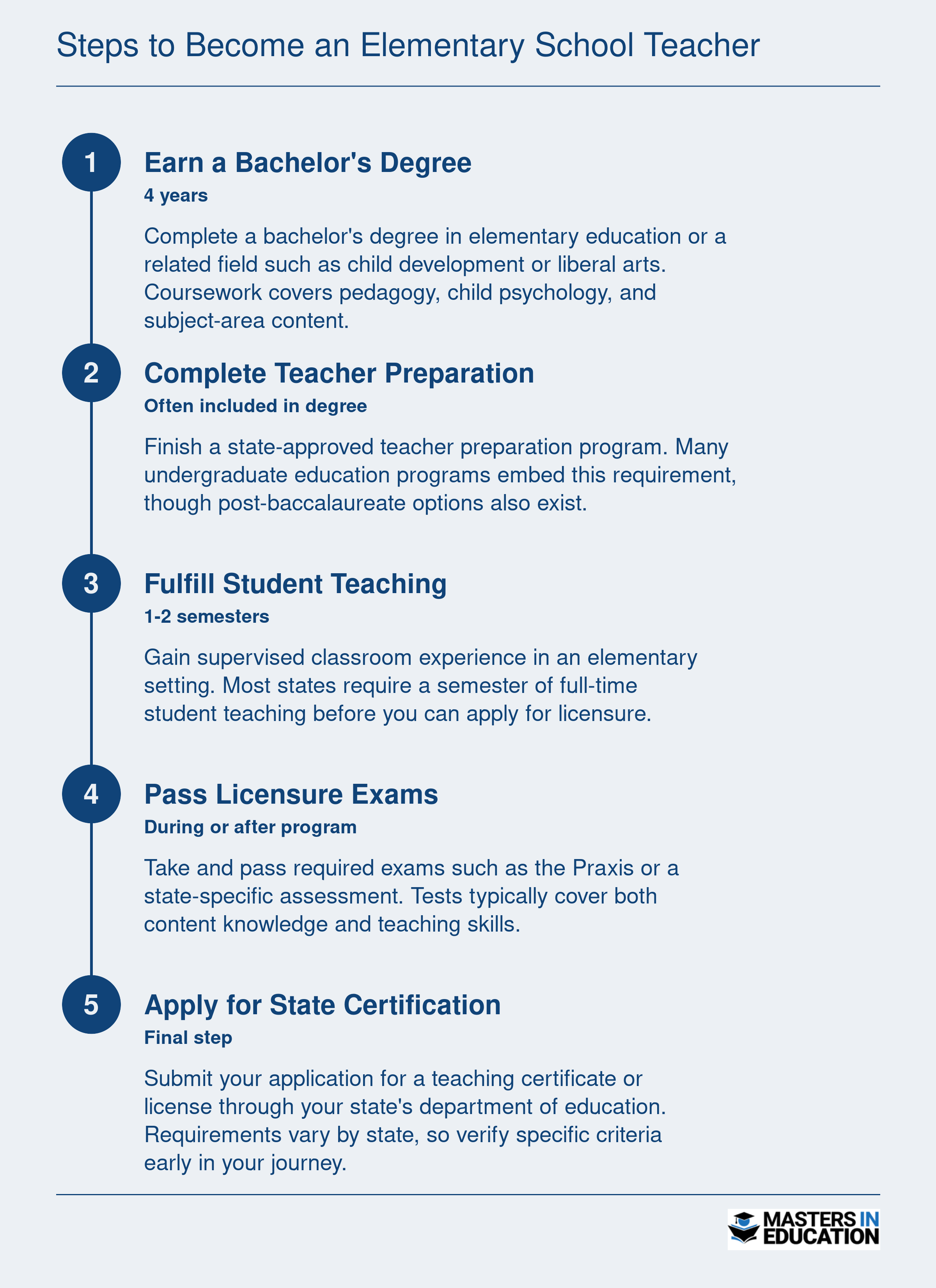
The traditional route to becoming an elementary school teacher typically spans four to five years. Alternative certification pathways may compress or reorder some of these steps, especially for career changers who already hold a bachelor's degree in another field.
Education Requirements: Traditional vs. Alternative Pathways
Every state requires at least a bachelor's degree for full teaching licensure, but the degree itself does not have to be in elementary education as long as it is paired with a state-approved teacher preparation program. That flexibility opens the door to several distinct pathways, each suited to different life circumstances, budgets, and career timelines.
Traditional BA in Elementary Education
A four-year bachelor's degree in elementary education remains the most common route. Coursework covers child development, curriculum design, classroom management, and content-area methods. Student teaching is built into the final year, and graduates typically qualify for an initial license upon passing their state's required exams.
- Typical timeline: 4 years (full-time)
- Cost range: Roughly $40,000 to $120,000 or more, depending on institution type
- Best for: High school graduates or early-career students who can commit to a full undergraduate program
- Student teaching required: Yes
Post-Baccalaureate Certification
Designed for career changers who already hold a bachelor's degree in another field, post-baccalaureate programs compress teacher preparation into one to two years.1 Candidates complete education coursework and a supervised student teaching placement, then sit for licensure exams.
- Typical timeline: 1 to 2 years
- Best for: Career changers with a bachelor's degree who want to enter the classroom relatively quickly
- Student teaching required: Yes
Master of Arts in Teaching (MAT)
An MAT program also targets degree holders, but it adds a graduate credential on top of the certification coursework. Programs generally run 12 to 18 months and include a clinical student teaching component.2 Graduates earn both a master's degree and eligibility for teaching licensure, which can translate to a higher starting salary on many district pay scales. For those interested in exploring Master's in Education, Elementary Education programs specifically, a range of options exists at the graduate level.
- Typical timeline: 12 to 18 months
- Best for: Candidates who want a strong academic credential and are willing to invest additional time and tuition
- Student teaching required: Yes
Alternative and Emergency Certification Routes
Several non-traditional pathways let candidates begin teaching before completing all preparation requirements.1
- Teach For America: A two-year commitment placing corps members in high-need schools. Participants receive intensive pre-service training but do not complete a traditional student teaching semester. Many earn a teaching credential along the way.
- State emergency or provisional licenses: Issued when districts face acute shortages, these licenses allow candidates to teach for one year, often renewable for up to two or three years, while they complete coursework and exam requirements on the job.
- Paraprofessional-to-teacher bridge programs: Current classroom aides and paraprofessionals can transition into a teaching role through programs that build on their existing school experience.3 Timelines vary: roughly one to two years for those who already hold a bachelor's degree, and two to three years for those starting with an associate's degree.
None of these alternative routes waive the bachelor's degree requirement for a standard, non-provisional license. They simply restructure when and how candidates complete preparation coursework and clinical hours.
Choosing the Right Fit
The pathway that makes sense depends on where you are right now. If you already have a degree and want to teach as soon as possible, a post-baccalaureate program or alternative certification may be the most practical choice. If earning a higher credential matters to you, or if your district's salary schedule rewards a master's degree, an MAT is worth the extra time. And if you are already working inside a school as support staff, a bridge program lets you build on experience you have already gained without starting from scratch.
Questions to Ask Yourself
Certification, Licensure, and Exams Explained
Before you can lead your own classroom, every state requires you to earn a teaching license or certificate. The process typically involves passing a combination of exams, completing a background check, and submitting an application to your state's department of education. Most aspiring elementary teachers sit for two or three exams in total: at least one content-knowledge test and, increasingly, a performance-based assessment. For a broader look at the licensure process, see our guide on how to get a teaching license.
Content-Knowledge Exams vs. Performance Assessments
Content-knowledge exams measure what you know about the subjects you will teach, such as reading, mathematics, science, and social studies. These are standardized, multiple-choice-heavy tests you take at a testing center. Performance assessments, by contrast, evaluate how you teach. The most widely used performance assessment, edTPA, requires you to submit video recordings of your instruction, lesson plans, and student work samples during your student teaching semester. Think of it this way: content exams confirm you understand the material, while performance assessments confirm you can deliver it effectively to real students.
Major Licensure Exams at a Glance
The table below compares the exams elementary education candidates encounter most often. Fees, passing scores, and retake rules can shift from year to year, so verify current details with each testing organization before you register.
- Praxis 5001 (Elementary Education: Multiple Subjects): Accepted in many states; check ETS state requirements for specifics.1 The fee is approximately $180, and passing scores range from 139 to 159 depending on your state.23 You must wait 28 days between attempts, but there is no cap on retakes.4
- Praxis 5018 (Elementary Education: Content Knowledge): Required in Pennsylvania, New Jersey, and several other states.1 Fees range from roughly $130 to $180, and the passing score varies by state.56 The same 28-day waiting period applies, with unlimited attempts.4
- CBEST (California Basic Educational Skills Test): Used primarily in California and Oregon as a basic-skills screening. The fee is about $30. You need a combined score of 123 with at least 37 on each section. You may retake any section you did not pass once your scores are released.4
- TExES Core Subjects EC-6 (391): Required in Texas. Fees fall between $116 and $130. You must score at least 240 on each subject area. A 45-day waiting period applies between attempts, and candidates are limited to five total attempts.4
- edTPA (Performance Assessment): A portfolio-based assessment used in over 40 states, including California and New York. The submission fee is approximately $300. Passing score thresholds and retake rules vary by state.4
How Many Exams Will You Take?
Most candidates take two or three exams. A teacher in New York, for example, might complete a content-knowledge test plus the edTPA. A candidate in Texas would take the TExES Core Subjects EC-6 and possibly a pedagogy exam (our overview of Texas teacher certification routes covers that pathway in detail). California candidates often face the CBEST for basic skills, a CSET (California Subject Examinations for Teachers) for content, and the edTPA or a state-approved alternative for performance. Always check your state education agency's website for the exact combination you need.
Background Checks and Fingerprinting
Regardless of which exams you pass, every state requires a criminal background check and fingerprinting before issuing a teaching license. This is a universal step with no exceptions. You will typically submit fingerprints through a state-approved vendor, and the results are sent to both state and federal databases. Processing fees generally range from $40 to $100, and clearance can take anywhere from a few days to several weeks. Some states also require a child-abuse history clearance or additional screening. Plan to initiate this process early in your final semester so it does not delay your license application after graduation.
Is Your Teaching License Valid in Another State?
If you are considering a move, one of the first questions to sort out is whether your elementary teaching license will carry over. The short answer: it depends on where you are going and how proactive you are about the process.
The NASDTEC Interstate Agreement
The closest thing the United States has to national license reciprocity is the NASDTEC Interstate Agreement. All 50 states and Guam participate on a voluntary basis, and the agreement establishes that a teaching license earned through a state-approved program in one jurisdiction can serve as a recognized basis for licensure in another.1 However, participation does not mean automatic acceptance. Each state retains the authority to apply its own rules, and no license is simply transferred from one state to another.2 You will still need to apply, submit transcripts, provide test scores, and often obtain an institutional recommendation from your preparation program.
A newer initiative, the Interstate Teacher Mobility Compact, is also being developed by NASDTEC, the Council of State Governments, and the Department of Defense. It aims to streamline the process further, but it is still being enacted across states as of 2026.3
Common Hurdles When Transferring
Even between participating states, you may encounter several additional requirements:
- State-specific exams: Many states require you to pass their own licensure tests, even if you already hold a valid license elsewhere.
- Coursework mandates: Some states require courses in areas like state history, English language learner (ELL) instruction, or reading methods that may not have been part of your original program.
- Background checks: A new fingerprint-based background check in the receiving state is almost always required.
- Provisional license timelines: You may receive a provisional or temporary license first and have one to three years to complete any remaining requirements before earning a full credential.
Smooth vs. Difficult Reciprocity in Practice
Kentucky offers a relatively smooth path for out-of-state teachers. The state accepts credentials from out-of-state preparation programs, though it may still require you to pass state-approved exams.4 Wyoming also recognizes licenses from all states but adds a specific requirement: you must pass a test on the U.S. and Wyoming Constitutions and clear a state background check.5
Contrast those examples with states that layer on multiple coursework requirements, such as mandating specific ELL endorsements or state history courses that were not part of your original training. In those cases, you could spend months and additional tuition dollars meeting conditions before your license converts from provisional to full.
Start the Process Early
License transfer processing can take anywhere from 8 to 16 weeks, and that timeline does not include the time you may need to study for and pass additional exams. If you know you are relocating, visit your target state's department of education website as soon as possible. Look for their out-of-state educator application, review every requirement, and submit your materials well before you plan to start teaching. Waiting until the last minute can leave you in limbo, unable to begin a new position on schedule.
Student Teaching: What to Expect
Student teaching is the capstone of most elementary education programs and, for many candidates, the most demanding stretch of their preparation. Understanding the logistics ahead of time helps you plan your finances, your schedule, and your mindset.
How Long It Lasts and What You Will Do
Most programs require 12 to 16 weeks of full-time, supervised classroom experience, often spanning an entire semester. Placements are typically arranged by your university's field experience office, which matches you with a cooperating teacher at a local elementary school. You generally cannot choose your exact school, though many programs let you express grade-level or geographic preferences.
Responsibilities ramp up gradually. In the first few weeks you observe, assist with small groups, and co-teach individual lessons. By the midpoint you are planning and delivering instruction for most of the school day. Near the end of the placement, you take on the full teaching load, including grading, parent communication, and classroom management, while your cooperating teacher steps into an advisory role. A university supervisor visits periodically to evaluate your performance and provide feedback.
Can You Work a Side Job?
This is one of the most common concerns, and the honest answer is that holding another job during student teaching is very difficult. You are expected to keep the same hours as the cooperating teacher, which typically means arriving before the first bell and staying well after dismissal to plan and debrief. Most programs discourage or even prohibit outside employment during this period because burnout directly affects your classroom performance and your evaluation.
Paid Models and Residency Programs
A growing number of districts and university partnerships now offer paid student teaching placements or residency programs that provide a stipend. Some residencies pair candidates with a mentor teacher for an entire academic year and include a living allowance or tuition support. These models are expanding, but they are still not the norm. If cost is a major concern, research residency options early in your program search; candidates weighing expenses may also want to explore cheapest Master's in Education programs.
What About Alternative-Route Candidates?
If you are pursuing certification through an alternative pathway, your state may allow supervised employment in place of traditional student teaching. In these arrangements you teach on a provisional or emergency license while completing coursework, and your on-the-job experience counts toward the clinical requirement. Not every state offers this option, so check your state education agency's guidelines before assuming you can skip a formal student teaching placement.
Regardless of the pathway you follow, treat the student teaching semester as a job audition. Many new teachers receive their first job offer from the school or district where they completed their placement, so professionalism and strong relationships matter from day one. Once you are licensed, the Master's in Education Jobs Guide can help you map out longer-term career options.
How Much Does It Cost to Become an Elementary School Teacher?
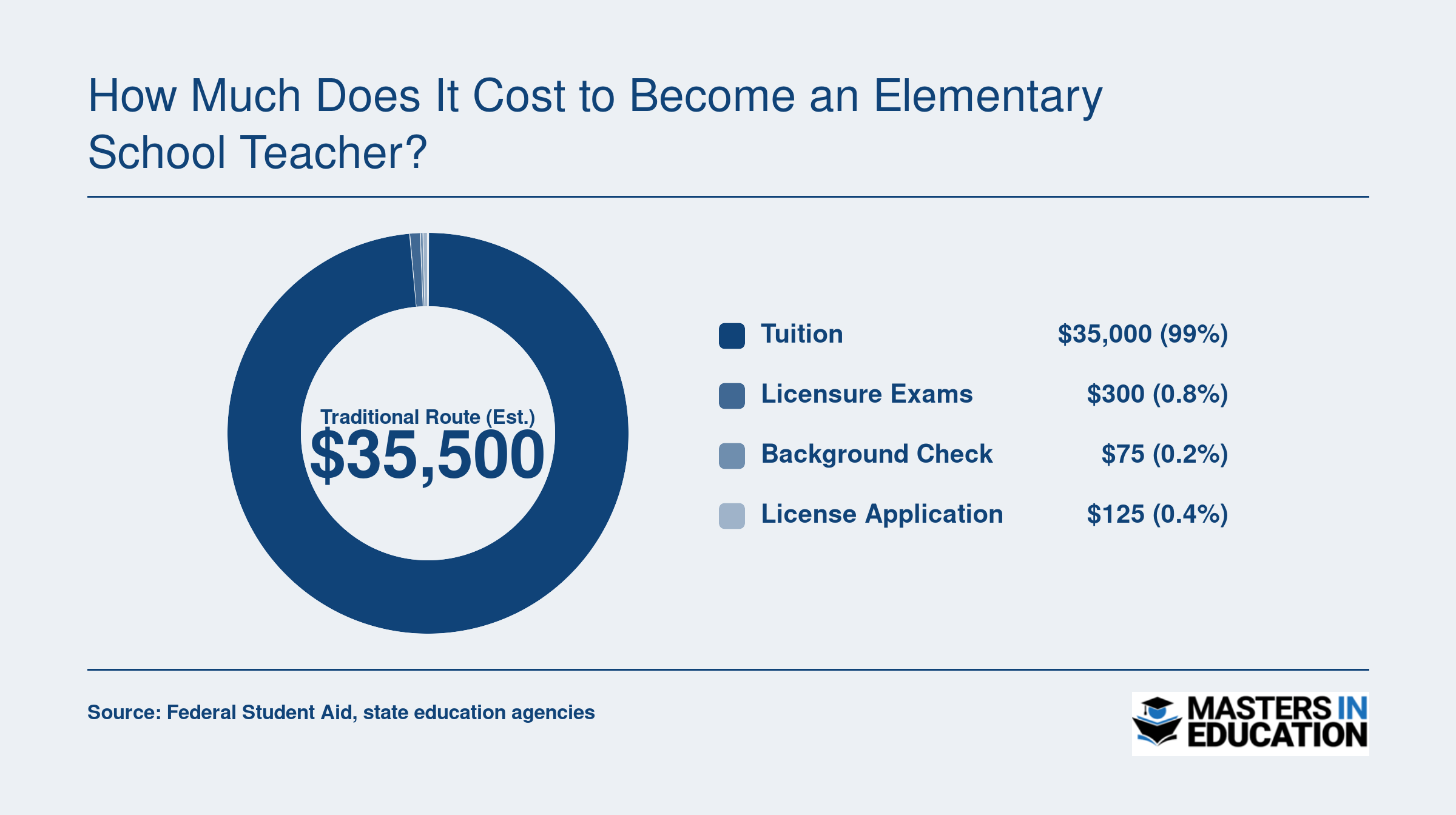
The total investment to become a licensed elementary school teacher varies widely depending on whether you follow a traditional or alternative pathway. A traditional route through a four-year bachelor's degree typically runs between $20,000 and $60,000 or more, while alternative certification programs may cost $5,000 to $20,000. Fortunately, several programs can offset these costs: the TEACH Grant provides up to $4,000 per year for education majors who commit to teaching in high-need fields for four years within eight years of graduating; federal Teacher Loan Forgiveness offers $5,000 to $17,500 after five years of service at a low-income school; and Public Service Loan Forgiveness forgives remaining federal loan balances (tax-free) after 120 qualifying payments while employed by a public school district. Some states offer additional incentives, such as California's Golden State Teacher Grant ($20,000), Arkansas's State Teacher Education Program (up to $6,000 per year), and Iowa's Teach Iowa Scholar Program (up to $4,000 per year for up to five years).
Elementary School Teacher Salary and Job Outlook
Understanding what elementary school teachers earn, and where demand is heading, can help you make smarter decisions about your education investment and where you choose to teach.
National Salary Overview
According to the Bureau of Labor Statistics, the national median annual wage for elementary school teachers (excluding special education) was $63,680 as of May 2023.1 That figure sits near the midpoint of a wide pay range. Teachers at the 10th percentile earned roughly in the low-to-mid $40,000s, while those at the 90th percentile brought home salaries well above $100,000, depending on experience, district, and credentials. With approximately 1.41 million elementary teachers employed across the country, this remains one of the largest occupational groups in education.1
These figures reflect base salary data and do not always capture supplemental pay such as stipends for coaching, mentoring, or curriculum development work that many teachers take on.
Where Teachers Earn the Most
Salaries vary dramatically from state to state, driven largely by cost of living, state funding formulas, and local district budgets. Among the highest-paying states for elementary teachers:
- New York: mean annual wage of $94,600 with about 105,770 teachers employed
- California: mean annual wage of $93,880 with roughly 151,820 teachers employed
- Illinois: mean annual wage of $70,880 with approximately 59,510 teachers employed
- Texas: mean annual wage of $62,130 with about 136,580 teachers employed
- Florida: mean annual wage of $60,370 with roughly 74,030 teachers employed
States like New York and California top the pay charts, but higher wages in those states often correspond to a significantly higher cost of living.1 A teacher earning $94,000 in the New York City metro area may have less disposable income than a teacher earning $62,000 in a mid-sized Texas city. Always weigh salary against local housing costs, tax rates, and benefits packages before assuming one state offers a better deal than another.
Job Outlook and Demand
The BLS projects a slight decline of about 2 percent in elementary teaching positions over the 2024 to 2034 period.2 That projection reflects demographic trends such as declining birth rates in some regions and shifting enrollment patterns. However, national projections can obscure significant local variation. Thousands of openings will still arise each year as teachers retire, change careers, or move between districts.
Certain shortage areas continue to create strong demand and, in some cases, signing bonuses or loan forgiveness incentives. Bilingual education, special education, and rural school districts consistently struggle to fill vacancies. Teachers with endorsements or dual certifications in these high-need areas often find themselves in a much stronger negotiating position, even in states where overall hiring has softened.
Putting the Numbers in Context
While the national median gives you a useful benchmark, the salary you can realistically expect depends on a combination of factors:
- District wealth and funding: Suburban districts with strong tax bases often pay more than rural or underfunded urban districts.
- Advanced degrees: Most districts use a salary schedule that rewards a master's degree with higher placement on the pay scale, sometimes adding $5,000 to $15,000 or more annually.
- Years of experience: Salary schedules typically include step increases for each year of service, with the largest jumps often occurring in the first 10 to 15 years.
- Shortage-area premiums: Districts facing acute shortages may offer hiring bonuses, relocation assistance, or accelerated placement on the salary schedule.
To understand how an advanced degree affects your earning potential over time, explore our guide on Master's in Education salary. If you are early in your career planning, researching salary schedules for specific districts you are considering can give you a much clearer picture than national averages alone. Many districts publish these schedules on their websites, allowing you to project your earnings trajectory over 10, 20, or even 30 years of service.
Career Advancement Paths for Elementary Teachers
An elementary teaching career does not have to follow a single track. Whether you want to stay in the classroom, move into leadership, or pivot outside of traditional schools, your experience lays the groundwork for a range of next steps.
Leadership and Specialist Roles Inside the School
Several in-school positions build directly on classroom expertise. Each one typically requires a master's degree, additional certification, or both.
- Instructional coach: Mentors fellow teachers on pedagogy and data-driven instruction. Most districts require at least a master's degree and several years of teaching experience.
- Reading or math specialist: Works with small groups of students and coaches teachers on content-specific strategies. Many states require a specialist endorsement on top of a master's degree.
- Curriculum coordinator: Designs and evaluates curriculum at the school or district level. An M.Ed. in curriculum and instruction is the most common credential.
- Assistant principal and principal: Moving into administration almost always requires a master's degree in educational leadership and an administrator license, plus a set number of years in the classroom.
If you are interested in shaping instruction across an entire building or district, learn more about how to become an Instructional Coordinator. Those drawn to mentoring colleagues one on one can explore how to become an Instructional Coach.
Earning More Without Leaving the Classroom
National Board Certification is one of the most respected credentials a teacher can earn. The process takes one to three years and involves rigorous portfolio work and content assessments. Depending on your state, achieving this distinction can add roughly $2,000 to $10,000 to your annual salary, and you never have to leave the students you love teaching.
Pivots Beyond the School Building
Not every career move has to keep you inside a school. Former elementary teachers regularly transition into roles such as:
- Educational technology specialist: Designs digital learning tools or trains districts on ed-tech platforms. A background in instructional design or a related graduate certificate strengthens your candidacy.
- School counselor: Requires a separate master's degree in school counseling and its own licensure, but your classroom insight gives you a strong foundation.
- Corporate trainer: Instructional skills transfer well to corporate learning and development departments, where demand for skilled facilitators continues to grow.
For a deeper look at the ed-tech path, see our guide on how to become an EdTech Specialist.
The Role of Graduate Education
An M.Ed. or Ed.S. is the gateway credential for most of the roles listed above. Many programs are designed for working teachers and can be completed in one to two years of part-time study. Choosing a program that aligns with your target role, whether that is reading specialist, administration, or counseling, helps you build the right credential set from the start.
Tips for Choosing an Elementary Education Program
Selecting the right elementary education program is one of the most consequential decisions you will make on your path to the classroom. The program you choose affects your licensure eligibility, your preparation for the realities of teaching, and your long-term career flexibility. Here is what to evaluate before you commit.
Start With Accreditation
Not all education programs carry the same weight with state licensing boards or school district hiring committees. Look for programs accredited by the Council for the Accreditation of Educator Preparation (CAEP) or the Association for Advancing Quality in Educator Preparation (AAQEP). These are the two nationally recognized accrediting bodies for teacher preparation.
Why does this matter so much? First, graduating from an accredited program simplifies the licensure process, especially if you ever want to teach in a different state. Many interstate reciprocity agreements hinge on whether your program held national accreditation. Second, employers view accredited credentials as a baseline quality signal. A degree from an unaccredited program can raise questions during hiring, even if you hold a valid license. To understand how we choose the best education degrees and programs, review our methodology for evaluating accreditation and outcomes data.
Check Licensure Exam Pass Rates
Most states require their teacher preparation programs to report pass rates on licensure exams such as the Praxis series or state-specific assessments. These numbers are often published by state departments of education or by the programs themselves. Treat a pass rate below 80 percent as a red flag. It may indicate thin curriculum coverage, inadequate test preparation, or weak academic support structures. Programs with consistently high pass rates tend to embed exam content into coursework and offer dedicated test prep resources, a meaningful differentiator worth asking about during your search.
Evaluate Clinical Placement Quality
Field experience is where theory meets practice, so look closely at how a program handles clinical placements. Key questions to ask:
- Timing: Does the program place you in real classrooms early in the curriculum, or only during a final student teaching semester?
- Diversity of settings: Will you gain experience across different school environments, including Title I schools, multilingual classrooms, and suburban or rural districts?
- Mentorship: Are cooperating teachers carefully selected and trained to support candidates?
Programs that wait until the very end to introduce clinical work leave you less time to integrate what you observe with what you study. Early and varied field experiences build stronger, more adaptable teachers.
Weigh Format, Flexibility, and Financial Aid
Practical considerations matter just as much as academic quality. Think honestly about your life circumstances:
- If you are working full time or raising a family, look for part-time evening, weekend, or online cohorts that let you maintain an income while studying.
- If you thrive on face-to-face collaboration and want immersive campus experiences, a full-time on-campus program may be the better fit.
- Ask about financial aid, scholarships specifically earmarked for education majors, and federal programs like TEACH Grants that can offset tuition in exchange for a service commitment.
If finishing quickly is a priority, explore fastest Master's in Education degree programs designed for working professionals. Finally, ask whether the program includes integrated preparation for the Praxis or your state's required exams. Programs that build test readiness into coursework, rather than leaving it entirely to candidates, can save you time, money, and stress as you approach licensure. It is also worth researching M.Ed. programs by state, since state-level requirements can vary significantly and influence which program best fits your goals.
Frequently Asked Questions About Becoming an Elementary School Teacher
Prospective elementary school teachers often have questions about requirements, timelines, and job prospects. Below are answers to the most common questions, grounded in current requirements and projections as of 2026.
The path to the classroom comes down to matching the right preparation route to your circumstances. A traditional bachelor's degree, a post-baccalaureate program, a Master of Arts in Teaching, or an alternative certification pathway can all lead to the same destination: a valid teaching license and your own classroom. Your timeline, budget, and career stage should drive that choice.
Start by visiting your state's department of education website to confirm its specific licensure requirements, then look for a CAEP- or AAQEP-accredited program that fits your preferred format. If you want to research M.Ed. programs by state, comparing options side by side can sharpen your decision. With teacher shortages persisting across the country, the profession needs motivated, well-prepared educators now more than ever. The demand is real, and the work matters.
Explore Careers
- Child Development Specialist
- College Admissions Counselor
- Curriculum Developer
- District Administrator
- Diversity & Inclusion Coordinator
- Academic Advisor
- Adult Education Instructor
- Arts Educator
- Arts Integration Specialist
- E-Learning Designer
- Early Childhood Education Coordinator
- EdTech Specialist
- Educational Administrator
- Educational Psychologist
- ESL Coordinator
- ESL Teacher