Table of Contents
Master’s in Education – STEM Education
Robotics clubs, coding labs, and maker spaces are reshaping today’s classrooms, yet many schools still struggle to transform standalone math and science lessons into integrated, inquiry‑driven experiences. A master’s in STEM (science, technology, engineering, and mathematics) education equips teachers with the interdisciplinary design skills, industry partnerships, and project-based learning (PBL) frameworks needed to prepare students for future careers. Demand for graduate-trained STEM educators is soaring as districts compete for grant dollars and meet workforce-development mandates. Whether you teach algebra, oversee a middle‑school makerspace, or coach science Olympiad, this degree provides the research‑backed methods and leadership tools to elevate your practice—and your pay grade.
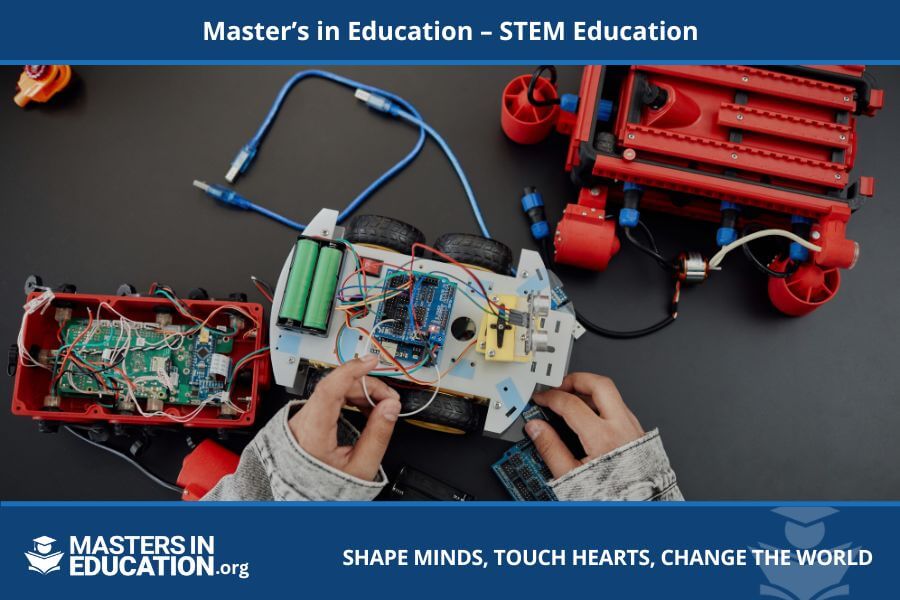
What Is an M.Ed. in STEM Education?
Before diving into course lists, understand that a STEM education master’s fuses content‑rich pedagogy with engineering design thinking. You’ll explore phenomenon-based science, integrated math and coding units, and equity-focused strategies that widen participation among girls and underrepresented minorities. Candidates include K–12 teachers seeking a STEM endorsement, curriculum specialists rolling out Next Generation Science Standards (NGSS), and corporate engineers transitioning into education.
Is an M.Ed. in STEM Education Worth It?
Investing in graduate study can feel daunting, so let’s weigh the numbers. Online STEM M.Ed. programs typically cost $15,000–$23,000. Districts frequently award annual stipends of $3,000–$8,000 for STEM endorsements, and STEM curriculum developers or instructional coordinators typically earn $75,000–$92,000. That means most graduates recover their tuition in three to five years while gaining grant-writing clout and industry-partnership perks. Check our Education Salary Guide for state‑specific figures and long‑term ROI projections.
State Licensure and Endorsement Pathways
Certification rules vary, so review your state’s educator‑licensure website early. An M.Ed. in STEM Education often aligns with:
- STEM Curriculum Developer or STEM Specialist endorsement (K–12)
- Integrated Science (Grades 5–9) license add‑on
- Computer Science or Technology Education endorsement
- Project Lead The Way (PLTW) certification (select universities embed modules)
Practicum hours usually span both math and science settings. Confirm seat-time totals and Praxis requirements before enrolling.
Admissions Requirements for an M.Ed. in STEM Education
Narrative preview: Competitive programs assess both content knowledge and teaching potential. Expect to submit the following:
- Bachelor’s degree with at least 15 STEM content credits, GPA 2.75–3.0
- Valid teaching license or significant STEM‑industry experience
- Résumé spotlighting robotics coaching, coding clubs, or lab research
- Statement of purpose connecting STEM innovation to student equity goals
- Two professional recommendations—one from a supervisor, one from a STEM colleague
- GRE is often waived for a GPA 3.2+ or three years of teaching
M.Ed. STEM Education Curriculum: What Classes Will I Take?
Knowing course themes helps you plan professional development overlap. Programs average 33 credits balanced across pedagogy, integration, and leadership.
- Foundations of Integrated STEM Pedagogy
- Engineering Design for Educators
- Computational Thinking and Coding in the Classroom
- Inquiry‑Based Science & Mathematics Methods
- Culturally Responsive STEM Teaching
- Data Analytics and Authentic Assessment in STEM
- Grant Writing and Industry Partnerships
- Capstone: Design, implement, and assess a PBL STEM unit aligned to NGSS and math standards
Most tracks embed 150–180 practicum hours. Candidates facilitate maker‑space challenges, coordinate STEM fairs, and analyze student growth via rubrics and sensor data.
Sample Program Timeline
Before reading the table, note that accelerated calendars compress two years of content into five mini-terms. Expect to spend weekly lab hours in addition to reading.
| Term | Focus | Key Milestones |
|---|---|---|
| Fall (8 weeks) | Foundations; Inquiry Methods | Draft driving question and phenomenon map |
| Fall II (8 wks) | Engineering Design; Coding | Prototype Arduino‑based project and debug code |
| Spring (8 wks) | Culturally Responsive STEM; Assessment | Collect formative‑assessment data during pilot lessons |
| Spring II (8 wks) | Data Analytics; Grant Writing | Submit STEM‑lab grant proposal to local foundation |
| Summer (8 wks) | Capstone Seminar | Present PBL unit results and reflection to faculty and industry panel |
Online vs. On‑Campus Program Formats
STEM M.Ed. programs leverage technology to model best practice:
- Fully online cohorts use virtual labs, 3‑D simulators, and cloud coding sandboxes
- Hybrid models pair weekend maker‑space residencies with online discussion boards
- Evening on‑campus sessions partner with local STEM industries for site visits
Verify remote shipping of lab kits (sensors, microcontrollers) and platform access if you study online.
Funding and Scholarships for STEM Educators
Before scanning the bullet list, note that STEM fields attract unique public and private funding streams.
- Federal TEACH Grant for high‑need STEM endorsements—up to $4,000 per year
- National Science Foundation Noyce Scholarships for math and science teachers
- Society of Women Engineers and National Science Teachers Association graduate grants
- District‑run innovation funds or equipment stipends
- Employer tuition reimbursement up to $5,250 under IRS §127
What Careers Can I Pursue with a Master’s in STEM Education?
Graduates expand impact beyond one classroom:
- STEM Curriculum Developer — crafts interdisciplinary units fused with engineering design; perfect for creative planners.
- Science Teacher — integrates inquiry labs and coding to boost engagement; suits detail‑oriented experimenters.
- Instructional Coordinator — mentors faculty on NGSS alignment and data use, making them great collaborative coaches.
- Arts Integration Specialist — blends STEAM projects that marry coding with creative expression; ideal for innovators who value cross‑disciplinary learning.
- Training and Development Specialist — designs STEM upskilling modules for industry or community colleges; best suited for facilitators who thrive on adult learning.
Salary ranges appear in our Education Salary Guide.
Take the Next Step Toward Your STEM Education M.Ed.
- Review ranked programs for lab‑kit support, cohort start dates, and grant‑writing coaching
- Contact advisers about state‑endorsement alignment and maker‑space partnerships
- Compile a portfolio of lesson plans, code snippets, or science‑fair mentoring artifacts
- Apply early to capture NSF or district innovation scholarships
Power tomorrow’s inventors—earn your STEM Education M.Ed. and lead hands‑on, minds‑on learning in any setting.
Sources
- National Science Teaching Association, Position Statement on STEM Education, 2024
- U.S. Bureau of Labor Statistics, STEM Teacher Shortage Report, 2024
- University maker‑space practicum guides and graduate catalogs, 2024–2025