TEA requires enrollment in an approved Educator Preparation Program before any master's route leads to certification.
Fully online TEA-approved master's programs exist, though all pathways still require in-person clinical teaching hours.
Annual master's degree stipends of $3,000 to $6,000 can recoup tuition costs within three to five years.
TExES pass rates vary by program type, making EPP selection one of the most consequential decisions candidates face.
Texas lets career-changers and recent graduates earn a master's degree and an initial teaching certificate in a single program, often in under two years and for as little as $12,000 in total tuition. The practical challenge is choosing the right structure: a Master of Arts in Teaching, an M.Ed. with embedded certification, or an alternative certification track each carry different costs, clinical requirements, and career implications.
Timeline and format matter, but so do TExES pass rates, district salary stipends, and funding models that can offset most or all of the investment. With annual master's-level pay bumps ranging from $3,000 to $6,000 across Texas districts, the credential often pays for itself within a few years of entering the classroom. Whether you are exploring how to become a high school teacher or pivoting into a shortage subject, understanding these routes will help you invest wisely.
How Master's-Level Certification Works in Texas: TEA Requirements and EPP Enrollment
Earning a Texas teaching certificate through a master's degree is not as simple as completing graduate coursework. The Texas Education Agency (TEA) requires every aspiring teacher to enroll in a TEA-approved Educator Preparation Program (EPP) before being recommended for certification.1 A master's degree alone, no matter how rigorous, does not lead to a teaching credential unless it is paired with or embeds an approved EPP. Understanding how these pieces fit together will save you time and prevent costly missteps.
The Three Core Requirements for a Standard Certificate
Before TEA will issue a Standard Certificate, you must satisfy three requirements in sequence:
EPP enrollment and completion: You must be formally admitted to a TEA-approved EPP, which tracks your progress and ultimately recommends you for certification through TEA's online system (ECOS). Admission requires at least a bachelor's degree, a fingerprint-based background check (processed through DPS and the FBI), and meeting the basic skills standards outlined in TAC Ch. 227.1
Content and pedagogy coursework: You need to demonstrate content mastery, either through a major or equivalent coursework in your subject area, or by passing the relevant TExES content exam. Pedagogy preparation is built into every EPP curriculum.1
TExES exams: You must pass both the Pedagogy and Professional Responsibilities (PPR) exam and the appropriate TExES content exam before your EPP can recommend you for a Standard Certificate. Once issued, your certificate is valid for five years and requires 150 hours of continuing professional education for renewal.1
University-Based EPPs vs. Standalone EPPs
Not all master's programs contain an embedded EPP. Some universities hold their own TEA-approved EPP status, meaning your graduate coursework and certification preparation are woven into a single program. You apply once, and the university handles your EPP enrollment, clinical placement, and eventual recommendation to TEA.
Other candidates complete a standalone graduate degree and then layer a separate EPP on top. This approach can work, but it often adds time and cost because you may repeat coursework or need to coordinate between two institutions. For a broader look at how graduate degrees intersect with credentialing nationwide, see our guide on teaching licensure with master's in education. When comparing programs, confirm whether the master's degree itself includes an embedded EPP or whether you will need to enroll in a separate one.
Clinical Teaching and Field Experience
Every pathway to Texas certification includes supervised classroom time. TEA mandates a minimum of 30 hours of early field experience before clinical teaching begins.1 Clinical teaching itself spans at least 14 weeks (70 school days), typically totaling 450 to 500 clock hours of unpaid, supervised student teaching.1 Your cooperating teacher must hold a Standard Texas certificate and have at least three years of classroom experience, and formal observations must last a minimum of 45 minutes each.1
Some programs offer an internship route instead, where you serve as a paid teacher of record on a probationary certificate while completing your degree. This option appeals to career changers who need income during their program, though it demands balancing a full teaching load with graduate studies.
Typical Timeline
For a full-time student, the entire process, from EPP enrollment through passing TExES exams and receiving a Standard Certificate, typically takes 12 to 24 months. Accelerated programs with summer cohorts can land closer to 12 months, while part-time or internship-based tracks may extend to two years. Once your EPP recommends you, TEA generally processes the Standard Certificate within several business days through ECOS.1
M.Ed. vs. MAT vs. Alternative Certification: Which Path Fits You?
Texas offers three main pathways to earn your initial teaching certificate at the graduate level, but they differ in structure, cost, and the credential you walk away with. Understanding the distinctions will help you choose the route that aligns with your background and career goals.
M.Ed. with Certification
A Master of Education with embedded certification is designed for candidates who want both a graduate degree and a Texas teaching license in a single program. These programs typically require around 36 credit hours and take 1.5 to 2.5 years to complete.1 Coursework blends educational theory, pedagogy, and content-area methods, culminating in either a paid internship or traditional clinical teaching semester. This route appeals to candidates who already hold a bachelor's degree in education or a related field and want to deepen their expertise while meeting TEA certification requirements. Texas A&M's M.Ed. in Curriculum and Instruction is one example of a program structured this way.1
Master of Arts in Teaching (MAT)
The MAT is often the strongest fit for career changers who hold a bachelor's degree in a non-education field. Like the M.Ed., it typically runs about 36 credit hours and results in both a master's degree and a teaching certificate.2 Program length tends to be slightly shorter, usually 1.5 to 2 years, because the curriculum is focused squarely on classroom preparation rather than broader educational leadership or research. Candidates generally need a minimum GPA of 2.75 for admission.2 Clinical teaching follows the same model as the M.Ed., with paid internship or traditional student teaching options available. The University of Houston-Clear Lake offers a well-known MAT program following this structure.
Alternative Certification Programs (ACPs)
Alternative certification is the fastest and most affordable entry point, but it does not result in a master's degree.4 ACPs require roughly 21 credit hours of coursework and can be completed in one to two years.3 Candidates complete an internship or clinical teaching placement and must pass the required TExES exams, just like M.Ed. and MAT candidates. ACPs are approved by TEA and are a viable route to a standard certificate, but graduates who want the salary bump and career mobility that come with a master's degree will need to pursue that credential separately.
Choosing Between Them
The right path depends on where you are starting and what you need on the other side.
Career changers without education coursework: The MAT is purpose-built for you. It front-loads the pedagogy and content methods you need without requiring prior education credits.
Education majors seeking advancement: An M.Ed. with certification lets you earn a higher credential while completing initial licensure, positioning you for educational administrator career guide roles or specialist positions sooner.
Budget-conscious candidates who need to teach quickly: An ACP gets you into a classroom faster and at a lower upfront cost, though it leaves the master's degree for later.
All three routes lead to the same Texas standard teaching certificate once you pass the required TExES exams. The core difference is whether you earn a graduate degree along the way, how much time and tuition you invest, and how your coursework is structured around clinical practice. Candidates exploring the full range of masters in education jobs will find that the master's-level routes open doors to higher salary schedules and broader career pathways.
Questions to Ask Yourself
Do you already hold a bachelor's degree in education, or are you coming from a different field?
Your undergraduate background determines whether an M.Ed. or an MAT is the better fit. Career changers typically need a program that bundles foundational pedagogy with certification coursework, while education graduates can often accelerate through.
Is earning a full master's degree important for your long-term salary and career goals?
Texas district pay scales reward a master's with higher placement on the salary schedule. If you only need certification, an alternative program is faster, but you forgo the salary bump and advanced credential that open doors to leadership roles.
Can you commit to 12 to 18 months of full-time study, or do you need to work while earning your credential?
Online and hybrid programs let you teach or hold another job during coursework, but they may take longer. Full-time residency models compress the timeline and include clinical practice, yet they require you to pause or reduce other employment.
TEA-Approved Master's + Certification Programs Compared: Cost, Format, and Timeline
Choosing a TEA-approved master's program with embedded teacher certification means weighing tuition, delivery format, credit-hour requirements, and how quickly you can enter the classroom. Texas offers a wide range of options, from large research universities to regional institutions with lower price tags. Below is a practical breakdown of what to expect as you compare programs in 2026. For a broader look at graduate education options across the state, see our guide to best education programs in Texas.
What the Data Shows (and What It Does Not)
Published tuition and program details vary significantly from one institution to the next, and not every university makes its total cost of attendance easy to find. Some programs bundle certification coursework into a standard master's degree, while others treat certification as a separate track layered on top of graduate credit hours. When comparing options, always confirm whether quoted tuition covers certification fees, exam prep, clinical teaching placements, and background-check costs, because those extras can add $1,000 or more to your bottom line.
For context, one well-documented example is Texas State University, which offers multiple pathways at different price points:
Post-baccalaureate certification only (ACE program): Approximately $4,400 for 15 credit hours, delivered 100% online, with a 2.75 GPA minimum. This is not a master's degree but does lead to initial certification.1
M.Ed. in Educational Technology: Around $15,014 for 30 credit hours, available online, with an estimated completion window of 12 to 14 months.2
M.Ed. in Educational Leadership with Principal Certification: Requires 30 to 36 credit hours, combining a master's degree with a leadership credential.3
These three pathways illustrate the spectrum you will find statewide. A certification-only route costs a fraction of a full master's, but it does not carry the salary-schedule bump that a graduate degree provides on most Texas district pay scales.
Key Variables to Compare Across Programs
When you look at institutions such as UT Tyler, Lamar University, Texas A&M Commerce, UNT Dallas, UH-Downtown, Texas Woman's University, SMU, and Sul Ross State, pay attention to these factors:
Total credit hours: Master's programs in Texas typically range from 30 to 42 semester credit hours. Programs on the lower end often assume you already hold a teaching certificate.
Delivery format: Many Texas universities now offer fully online M.Ed. or MAT tracks, though some require synchronous sessions, weekend intensives, or in-person clinical teaching semesters.
Timeline: Accelerated cohort models can be completed in as few as 12 months. Traditional part-time tracks generally take 18 to 24 months, which may suit candidates who are already teaching full time.
In-state tuition advantage: Texas residents benefit from comparatively low graduate tuition at public universities. Regional institutions like Sul Ross State and Texas A&M Commerce have historically offered some of the most affordable per-credit-hour rates in the state.
Clinical placement structure: Programs that partner with local school districts for student-teaching placements can simplify the certification process. Some residency-style programs even pair you with a mentor teacher while you complete coursework.
How to Verify TEA Approval
Before enrolling, confirm that the program's Educator Preparation Program (EPP) component is listed on the Texas Education Agency's official roster of approved providers. A master's degree alone does not grant certification. The EPP must be separately approved by TEA, and completion of the EPP is what qualifies you to sit for the required TExES exams. University websites sometimes blur the line between the graduate degree and the certification pathway, so ask the admissions office directly whether both components are included in the quoted tuition and timeline.
Because tuition rates and program structures change frequently, treat any figures you find online as starting points. Request a current cost sheet and degree plan directly from each program, and ask whether any fee increases are anticipated for the upcoming academic year. The investment is significant, but a careful comparison now prevents surprises later.
Online, Hybrid, and On-Campus Options: Can You Earn Texas Certification Fully Online?
The short answer is yes: several TEA-approved master's programs are offered fully online. Universities across Texas and beyond deliver coursework through asynchronous modules, live virtual sessions, or a mix of both. However, every certification pathway still requires hands-on classroom experience. No candidate can earn a standard Texas teaching certificate without completing a clinical internship or student-teaching placement in an actual school setting. That in-person component is non-negotiable under TEA rules, regardless of how the academic coursework is delivered.
How Online Programs Handle the Clinical Requirement
Online programs use several models to ensure candidates get the classroom hours they need:
Internship-year model: Candidates secure a paid teaching position at a partnering Texas school district and serve as the teacher of record while completing coursework. This is the most common approach for alternative certification tracks embedded in master's programs.
Local school partnerships: The university maintains agreements with districts across Texas (and sometimes nationally), placing candidates in supervised student-teaching assignments near their home.
Weekend or summer intensives: A smaller number of hybrid programs supplement online coursework with short on-campus or regional-site residencies for methods labs, classroom simulations, or observation hours.
Most programs assign a university field supervisor who conducts observations and evaluations either in person or via recorded lessons, depending on the institution's accreditation agreements.
Matching Format to Your Situation
Different delivery formats serve different candidate profiles. Choosing the right one can save you time and stress.
Working professionals who already hold a bachelor's degree and a day job tend to thrive in fully online programs with an internship-year model, since they can teach during the day and study evenings and weekends.
Local career changers who want more structured mentoring often prefer hybrid programs that combine online coursework with regular face-to-face cohort meetings or campus-based methods courses.
Traditional students entering directly from an undergraduate program may benefit most from a full on-campus experience, with built-in cohort support, faculty office hours, and a structured student-teaching semester.
A Note for Out-of-State Candidates
If you live outside Texas, you can enroll in many of these online programs without relocating for coursework. The catch is the field experience. You must either complete your clinical placement in a Texas classroom or arrange to do it in your home state and then pursue certification reciprocity. Texas has interstate agreements with many states, but the reciprocity process adds steps and time. Out-of-state candidates should confirm clinical placement logistics with the program's certification office before enrolling, because a mismatch between your location and the program's partnership network can delay your certification timeline by a semester or more.
Regardless of format, verify that any program you consider is listed as a TEA-approved Educator Preparation Program. Only EPP-approved programs can recommend you for a Texas teaching certificate upon completion.
TExES Exams: Requirements, Cut Scores, and Pass Rates by Program Type
Passing the Texas Examinations of Educator Standards (TExES) is the final gatekeeping step between your coursework and a standard Texas teaching certificate. Understanding what the exams involve, how scoring works, and how program type may influence your odds of passing on the first try can help you plan your preparation strategically.
Which Exams You Must Pass
Every certification candidate in Texas must clear two categories of TExES tests before the Texas Education Agency (TEA) will issue a standard certificate:
Content-area exam: Validates your subject-matter knowledge in the field you intend to teach (e.g., Mathematics 7-12, English Language Arts and Reading 4-8, or EC-6 Core Subjects).
Pedagogy and Professional Responsibilities (PPR) exam: Measures your understanding of instructional planning, classroom management, assessment, and professional ethics.
Most TExES exams use a scaled-score range of 100 to 300, with a passing cut score of 240. A few specialty exams have different scales, so always confirm the cut score for your specific test on TEA's certification exam page before you sit for it.
Pass Rates: University Programs vs. Alternative Certification Programs
TEA publishes annual pass-rate data through its Educator Preparation Data Dashboard, with the most recent figures covering the 2023-2024 testing cycle.1 The dashboard reports both overall and first-attempt pass rates and allows filtering by educator preparation program (EPP) type, including institutions of higher education (IHE) and alternative certification programs (ACPs).
A consistent pattern in the data is that university-based EPPs tend to post higher first-attempt pass rates on content and pedagogy exams than ACPs. While the publicly available dashboard does not isolate master's-level candidates from undergraduate completers within IHE programs, aggregated IHE pass rates generally run several percentage points above ACP averages.1 Some individual university master's programs report first-attempt content-exam pass rates in the mid-to-high 90s, whereas the ACP average across the state often falls in the low-to-mid 80s. These figures can shift year to year, so check the most current TEA dashboard before drawing firm conclusions for any single program.
The higher pass rates at university-based programs likely reflect more structured content coursework and integrated test-preparation components, though candidate demographics and prior academic preparation also play a role.
What Happens If You Do Not Pass
Failing a TExES exam is not the end of the road. Texas allows retakes after a mandatory 45-day waiting period. If you do not pass after five attempts on the same exam, you must complete additional coursework or remediation prescribed by your EPP before testing again.
Many master's-level programs build TExES preparation directly into their curriculum through practice exams, content review sessions, and one-on-one tutoring. Some alternative certification programs offer similar prep resources, though the depth varies. Before enrolling in any program, ask specifically what TExES support is included and whether it carries an additional fee.
Practical Tips for Exam Preparation
Start reviewing TExES preparation frameworks early in your program, not just the semester before you test.
Use the free TExES preparation manuals published by the testing vendor, which include competency breakdowns and sample questions.
If your program offers a formal prep course or study group, take advantage of it. Structured preparation correlates with stronger first-attempt outcomes.
Schedule your content exam before the PPR if your program allows flexibility. Passing the content test first builds confidence and lets you focus your remaining study time on pedagogy.
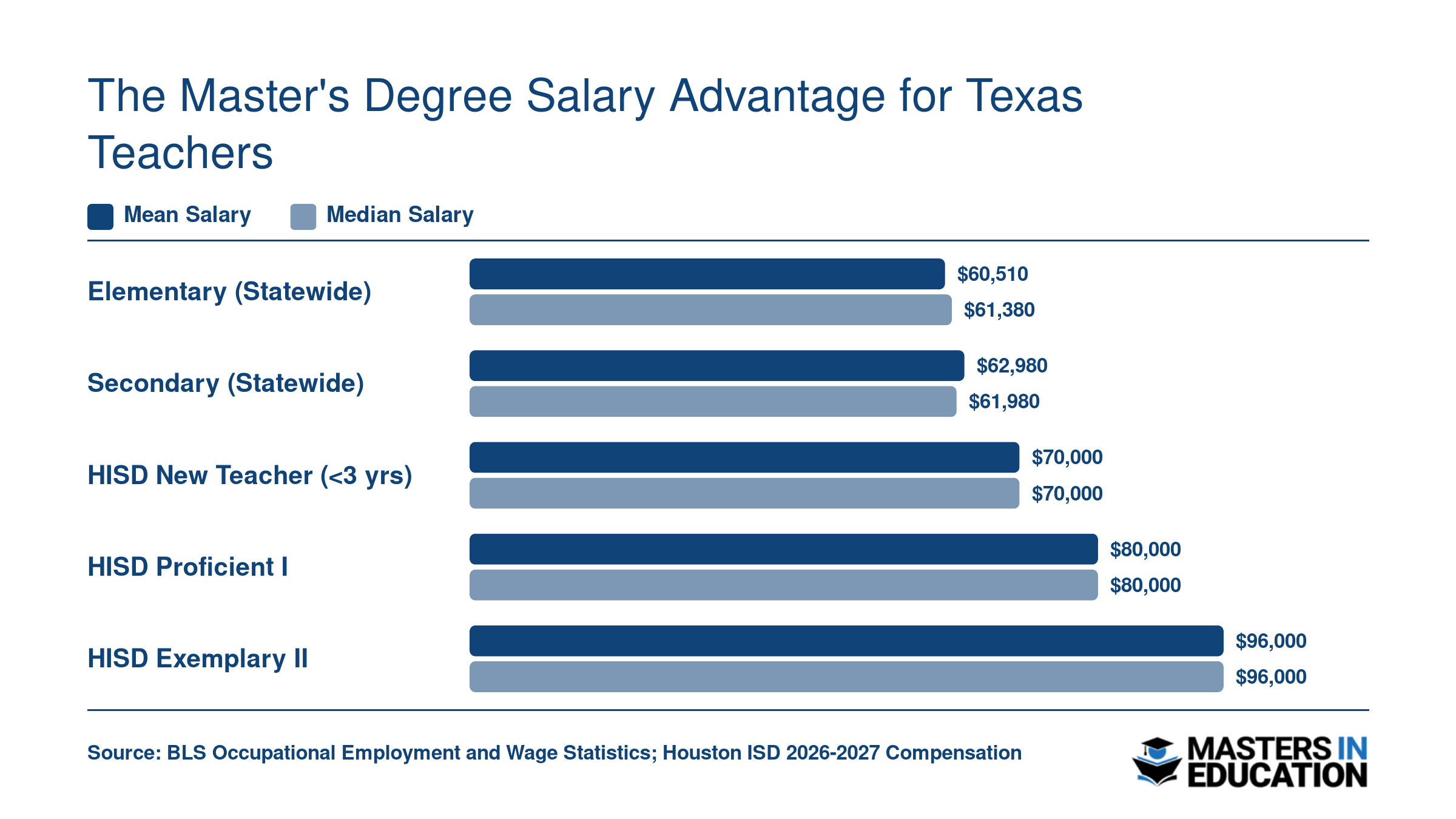
The Master's Degree Salary Advantage for Texas Teachers
Texas teacher pay varies by level and district, but BLS data shows median salaries in the low $60,000s statewide. While most districts offer a master's degree stipend on top of base pay, Houston ISD's 2026-2027 pay-for-performance model eliminates the traditional degree stipend entirely, tying compensation to effectiveness ratings instead. Understanding how your district structures pay is critical before investing in a graduate degree.
Texas Teacher Salaries by Metro Area
Teacher pay in Texas varies significantly depending on where you work and what grade level you teach. The table below shows the latest reported wages for elementary and secondary school teachers across major Texas metro areas. These figures represent all education levels combined; teachers holding a master's degree typically land on higher salary schedule steps, meaning your actual earnings with an advanced degree will often exceed the medians shown here.
Metro Area
Level
Total Employed
Mean Annual Salary
25th Percentile
Median Salary
75th Percentile
Dallas-Fort Worth-Arlington
Secondary
28,280
$66,030
$61,090
$64,180
$74,360
Dallas-Fort Worth-Arlington
Elementary
31,470
$63,860
$61,670
$63,700
$66,930
Houston-Pasadena-The Woodlands
Secondary
26,840
$64,790
$60,060
$64,230
$72,170
Houston-Pasadena-The Woodlands
Elementary
31,710
$62,490
$59,700
$61,950
$66,680
Austin-Round Rock-San Marcos
Secondary
8,020
$62,270
$59,820
$61,820
$63,990
Austin-Round Rock-San Marcos
Elementary
8,390
$59,000
$58,120
$59,590
$62,000
San Antonio-New Braunfels
Secondary
9,850
$61,330
$59,020
$60,430
$62,280
San Antonio-New Braunfels
Elementary
12,170
$58,340
$53,700
$60,220
$61,550
McAllen-Edinburg-Mission
Secondary
4,080
$63,500
$58,090
$60,500
$63,530
McAllen-Edinburg-Mission
Elementary
4,490
$61,940
$56,150
$60,740
$63,760
El Paso
Secondary
3,950
$60,950
$59,910
$60,000
$62,690
El Paso
Elementary
2,960
$59,770
$58,090
$62,810
$62,810
Corpus Christi
Secondary
1,460
$62,800
$58,980
$60,930
$63,320
Corpus Christi
Elementary
1,830
$57,390
$56,110
$58,210
$58,600
Killeen-Temple
Secondary
1,630
$62,100
$59,950
$61,680
$63,060
Killeen-Temple
Elementary
2,290
$58,370
$58,700
$59,650
$61,730
Brownsville-Harlingen
Secondary
2,060
$61,200
$57,530
$60,510
$63,630
Brownsville-Harlingen
Elementary
1,620
$59,900
$59,130
$62,900
$63,240
Laredo
Secondary
1,020
$61,060
$61,360
$61,360
$62,470
Laredo
Elementary
1,640
$58,880
$49,130
$60,980
$63,900
Beaumont-Port Arthur
Secondary
1,290
$60,230
$53,130
$61,170
$64,410
Beaumont-Port Arthur
Elementary
1,680
$56,180
$51,070
$58,040
$60,730
Waco
Secondary
1,160
$59,050
$50,910
$60,130
$63,900
Waco
Elementary
1,400
$53,930
$49,160
$54,590
$61,150
Lubbock
Secondary
2,130
$53,980
$48,710
$49,620
$60,280
Lubbock
Elementary
1,960
$54,670
$48,890
$55,350
$61,610
Longview
Secondary
1,130
$58,430
$50,600
$59,460
$61,480
Longview
Elementary
1,290
$54,970
$47,750
$58,290
$59,940
College Station-Bryan
Elementary
1,130
$58,700
$51,690
$57,480
$63,840
Amarillo
Secondary
990
$60,800
$57,340
$58,120
$61,690
Funding and Affordability: Scholarships, Stipends, and Residency Models
Cost is one of the biggest barriers to earning a master's degree with teacher certification, but Texas offers several paths that make the investment manageable. Between low-tuition programs, district-funded residencies, and federal grants, many candidates can complete their credential for far less than the sticker price suggests.
Low-Tuition Master's + Certification Programs
Several TEA-approved programs in Texas come in under $15,000 total at in-state rates. Institutions like Lamar University, Sul Ross State University, and the University of Houston-Downtown consistently rank among the most affordable options for an M.Ed. with certification. These programs are predominantly online, which eliminates relocation costs and allows candidates to keep working while they study. If you are comparing programs from the cost table earlier in this guide, filter first for total tuition, then weigh format and clinical placement logistics.
Teacher Residency Models: Earn While You Learn
Residency programs represent the lowest out-of-pocket route to certification. In these models, candidates spend a full year co-teaching in a partner district classroom while completing graduate coursework, and the district pays a stipend to offset living expenses.5
Dallas Teacher Residency: A 14-month program partnered with Texas A&M University-Commerce that leads to a Master's in Teaching and Texas teacher certification. Residents commit to teaching in Dallas ISD for three years after completion.1
Cypress-Fairbanks ISD Teacher Residency: Offers a $25,000 stipend for a 12-month residency as of spring 2026.3
Texas A&M Teacher Education Residency Model (TERM): Partners with districts including Aldine ISD, Austin ISD, Bryan ISD, and Spring ISD. Stipends range from $10,000 to $25,000 depending on the district.4
Fort Worth ISD Teacher Residency: A 12-month, grant-funded program with university partners including Texas Wesleyan, TCU, and Tarleton State.6
Longhorns in Residence (UT Austin): A 12-month program offering $15,000 to $20,000 in stipend support. It leads to a graduate certificate in EC-6 education, with six credits that can apply toward a master's or doctoral degree at UT Austin.2
Note that the Texas Education Agency introduced a formal Teacher Residency Route leading to an Enhanced Standard Certificate, though new applications for this specific route were paused as of 2026.5 Existing residency programs listed above continue to operate through their own EPP structures.
Federal and State Funding Sources
Beyond residency stipends, several funding streams are available to candidates pursuing certification in high-need fields or underserved areas. This is especially relevant for those entering shortage subjects like special education, bilingual education, and STEM.
TEACH Grant: Up to $4,000 per year for candidates who commit to teaching in a high-need subject area at a low-income school for at least four years. This grant converts to a loan if the service obligation is not met, so read the terms carefully.
Texas Grant: Need-based state aid available to graduate students at Texas public universities, though funding is limited and awarded on a first-come basis.
District signing bonuses: Some Texas districts offer bonuses ranging from a few hundred to several thousand dollars for new teachers in shortage subjects like bilingual education, special education, STEM, and career and technical education.
Federal loan forgiveness: Teachers who work five consecutive years in a qualifying low-income school may be eligible for up to $17,500 in federal loan forgiveness. Public Service Loan Forgiveness (PSLF) offers full remaining balance forgiveness after 120 qualifying payments for those in public school employment.
A Note on Assistantships and Tuition Waivers
Some Texas universities do offer graduate assistantships or partial tuition waivers, but these are far more common in traditional research-oriented master's programs than in certification-track programs designed for working professionals. If you are enrolled full-time and on campus, it is worth asking your department about available positions. For online or cohort-based certification programs, assistantships are rarely an option, making the funding sources above all the more important to pursue early in the application process.
A Texas teacher with a master's degree earning a $3,000 to $6,000 annual stipend can fully recoup tuition costs within three to five years. Over a 30 year career, that adds up to $90,000 to $180,000 in additional earnings. Every year you delay starting your program is a year of lost salary differential you can never recover.
Frequently Asked Questions About Master's Teacher Certification in Texas
Below are answers to the questions prospective Texas teachers ask most often about pursuing a master's degree with built-in certification. Because program details, costs, and policies change regularly, we also point you toward the authoritative sources where you can verify the latest information for yourself.
Can I get a master's degree and teacher certification at the same time in Texas?
Yes. Several Texas universities offer master's programs that embed an Educator Preparation Program (EPP) approved by the Texas Education Agency (TEA). These programs combine graduate coursework, clinical teaching, and TExES exam preparation so you finish with both a degree and a Standard Certificate. To confirm that a specific program holds current TEA approval, search the TEA's online list of approved EPPs at tea.texas.gov rather than relying solely on a university's marketing materials.
How long does it take to earn a master's and teaching certificate in Texas?
Most integrated programs take between 15 and 24 months of full-time study, though timelines vary by format, credit-hour requirements, and whether you need to complete a full semester of clinical teaching. Part-time and online cohorts sometimes stretch to 30 months. For the most accurate estimate, contact each program's admissions office directly and ask about cohort start dates, required field hours, and whether summer terms are mandatory.
What is the cheapest way to get a master's and teacher certification in Texas?
Total costs vary widely, from roughly $10,000 at some public universities for in-state students to $40,000 or more at private institutions. To compare affordably, start by reviewing tuition schedules on each university's official website, then factor in fees, textbook costs, and any clinical-placement expenses. Look for programs that offer graduate assistantships, Title IV financial aid, or employer-sponsored tuition reimbursement. The U.S. Department of Education's College Scorecard (collegescorecard.ed.gov) lets you compare estimated costs and financial-aid packages across institutions.
Can I earn Texas teacher certification through a fully online master's program?
Some TEA-approved master's programs deliver all coursework online, but nearly every certification pathway still requires in-person clinical teaching hours in a Texas classroom. When evaluating online options, verify two things on the program's website: whether the EPP component is TEA-approved and how many face-to-face field-experience hours are required. If you live outside Texas, ask whether the program can arrange clinical placements in your area or whether you will need to relocate temporarily.
How does a master's route compare to alternative certification in Texas?
Alternative certification programs (ACPs) let you begin teaching under a probationary certificate while completing training, often at lower upfront cost. A master's route typically involves more coursework and a longer timeline before you enter the classroom, but it results in both a graduate degree and a Standard Certificate, which can unlock higher salary schedule placement in many districts. For a side-by-side look at program requirements, consult the TEA's EPP directory, which lists both university-based and ACP providers along with their approval status and reported outcomes.
Do Texas teachers with a master's degree earn higher salaries?
Many Texas school districts use salary schedules that pay a stipend or place teachers on a higher step for holding a master's degree. The size of that bump varies by district, so check the salary schedule posted on the human-resources page of any district you are considering. For broader wage data, the Bureau of Labor Statistics (bls.gov) publishes state and metro-level salary statistics for elementary and secondary school teachers, which you can use to benchmark earnings across regions.
Will my Texas teaching certificate transfer to another state?
Texas participates in the NASDTEC Interstate Agreement, which facilitates, but does not guarantee, license reciprocity across most U.S. states. Receiving states may still require you to pass their own content exams, complete additional coursework, or fulfill specific background-check procedures. Before making a move, check the education department website of the state you plan to teach in and review NASDTEC's reciprocity resources at nasdtec.net for the most current requirements.
Where can I find reliable, up-to-date information on program quality and outcomes?
Start with three primary sources. First, the TEA website (tea.texas.gov) publishes EPP performance data, including completer rates and certification-exam pass rates. Second, individual university program pages list curriculum details, accreditation status, and admission requirements. Third, professional organizations such as the Association of Texas Professional Educators (ATPE) and the Texas State Teachers Association (TSTA) offer guidance on certification pathways, salary negotiations, and legislative changes that affect the profession. Cross-referencing these sources gives you the most complete and current picture before you commit to a program.