AI handles routine tasks like assessment scoring and progress monitoring, but school psychologists must interpret every output through learning science.
BLS data shows a median school psychologist salary of $84,940, with the District of Columbia topping state pay rankings.
NASP and APA ethics guidelines set firm red lines on student data privacy, algorithmic bias review, and informed consent for AI use.
A full M.Ed. in educational psychology builds layered AI competencies that short certificate courses cannot replicate for clinical practice.
More than 70 percent of K-12 districts now report using at least one AI-powered tool for student assessment, intervention planning, or behavioral monitoring. Yet fewer than one in five teachers say they have formal training in learning science or psychometrics, the foundations required to interpret what these tools actually produce. The gap is consequential: without grounding in educational psychology, educators risk acting on algorithmic outputs they cannot evaluate.
This tension sits at the center of a growing career question for teachers, school psychologists, and adjacent professionals. AI fluency alone is not enough. The practitioners who will use these tools responsibly, and benefit from them professionally, are those who pair technical literacy with deep expertise in how students learn, develop, and differ.
How AI Is Reshaping Educational Psychology Practice
School psychologists have long faced a tension between the high-touch clinical work they trained for and the paperwork that crowds it out. Artificial intelligence is starting to tip that balance. Below are four areas where AI is already changing daily practice, along with the evidence behind those changes.
Psychoeducational Assessment Scoring
Traditionally, scoring a battery of cognitive and achievement tests means toggling between manuals, norms tables, and spreadsheets. AI-assisted scoring platforms now flag potential errors in real time and cross-reference subtest patterns automatically. A 2026 study published through Frontiers Media found that AI-supported collaborative marking reduced scoring error by 63 percent compared to unaided scoring alone, dropping the mean absolute error from 3.26 to 1.22.1 That kind of accuracy gain matters when a single miscalculation can change an eligibility determination.
Report Writing and Drafting
Writing a comprehensive psychoeducational report can consume five to eight hours per evaluation. Generative AI tools trained on report templates and assessment language are cutting that time significantly. Research published through SAGE Publications in 2025 found that integrating generative AI into the report-drafting workflow reduced writing time by 30 to 40 percent.2 Practitioners describe a before-and-after shift: instead of starting from a blank page after a long testing day, they review and refine a structured draft, redirecting hours toward parent conferences and classroom observations.
Intervention Planning Through Recommendation Engines
AI-driven recommendation engines can match a student's profile of strengths and needs to evidence-based interventions cataloged across research databases. A 2026 review from Stanford University reported that AI-based tutoring systems improved student mastery by roughly 4 percent overall, and by 7 to 9 percent when supporting less experienced practitioners.3 For school psychologists consulting with teachers on tier-two interventions, that translates into more precise starting points and fewer trial-and-error cycles.
Progress-Monitoring Dashboards
Rather than waiting weeks to aggregate curriculum-based measurement data by hand, AI-powered dashboards visualize student trajectories in near real time. The same Stanford review noted that certain AI learning supports improved student performance by 5.5 percent, partly because educators could adjust instruction faster when dashboards surfaced trend lines and risk indicators automatically.3
Addressing Workload and Burnout
The common thread across all four use cases is time recaptured. When scoring, drafting, matching interventions, and tracking progress require fewer manual hours, school psychologists can reallocate that capacity to direct student contact, consultation with families, and crisis response. Professionals who hold a master's in educational psychology already understand the theoretical frameworks behind these tools, which positions them to adopt AI responsibly. Given that the national ratio of school psychologists to students still far exceeds recommended levels, even modest efficiency gains per practitioner can expand access to services.
A Necessary Caveat
None of these tools operate as a replacement for clinical judgment. An AI draft of a report still needs a practitioner who understands the child behind the numbers. A recommendation engine cannot weigh family context, cultural factors, or a student's own voice the way a trained educational psychologist can. The efficiency gains are real, but they work only when a knowledgeable professional remains in the loop. The next section explores why that expertise is becoming more important, not less, as these tools grow more powerful.
Why AI Demands Deeper Learning-Science Expertise, Not Less
A common assumption is that AI tools will simplify educational psychology enough to make specialized training optional. The reality runs in the opposite direction. The easier it becomes to generate a behavior plan, draft an IEP, or flag a struggling student with a few clicks, the more critical it is that a trained professional can evaluate whether the output is safe, equitable, and grounded in evidence.
What Goes Wrong Without Domain Knowledge
Consider three scenarios that illustrate the risk of using AI without a solid learning-science foundation:
IEP drafting without cognitive load theory: A teacher pastes a student's evaluation summary into a chatbot and asks it to generate IEP goals. The tool produces goals that sound polished but stack multiple complex demands into single objectives, violating basic cognitive load principles. Without understanding how working memory constraints shape goal design, the teacher may adopt language that looks professional yet sets the student up for failure.
Behavior plans that ignore trauma: An AI system suggests a token economy with response-cost consequences for a student displaying disruptive behavior. On paper the plan follows a standard operant framework, but the student's behavior stems from adverse childhood experiences. A practitioner trained in trauma-informed care would recognize that punitive contingencies can re-traumatize the child, while someone relying solely on the AI's recommendation would not catch the mismatch.
Biased risk screening: A predictive model flags certain student groups as "at risk" at disproportionate rates because its training data reflect historical patterns of over-referral. Without grounding in cultural responsiveness and assessment theory, an educator has no framework for questioning the algorithm's output or advocating for fairer screening practices.
Each example shares a common thread: the AI produces something that looks authoritative, but a professional without the right expertise has no reliable way to spot the error.
Is AI Replacing School Psychologists?
No. AI is an amplifier, not a substitute. It can accelerate data collection, surface patterns across large caseloads, and automate routine documentation. What it cannot do is exercise clinical reasoning, interpret assessment results within a child's cultural and developmental context, or navigate the ethical judgment calls that arise in every evaluation. Those considering this career path can explore how to become an educational psychologist to understand the training involved. School psychologists bring exactly the kind of integrative thinking that current AI architectures lack.
Why a Graduate Degree Matters More Now
The foundational competencies taught in a graduate-level educational psychology program, including assessment theory, developmental science, response-to-intervention frameworks, and cultural responsiveness, are precisely the skills AI cannot supply on its own. These disciplines give practitioners the lens to audit AI outputs, adapt recommendations to individual learners, and recognize when a tool's suggestion crosses an ethical line.
Rather than making that expertise obsolete, AI raises the stakes. A school psychologist who understands both the science of learning and the capabilities and limits of AI becomes exponentially more effective. Conversely, a professional who leans on AI without that grounding becomes a liability. The technology rewards depth of knowledge, not the absence of it.
Questions to Ask Yourself
When an AI tool drafts a student report or intervention plan, can you spot the moment its recommendation contradicts established learning science?
AI models can generate confident, well-formatted suggestions that rest on flawed assumptions about how students learn. Without grounding in developmental and cognitive research, educators risk implementing plans that sound credible but undermine student progress.
If an AI system flags a student for Tier 3 support, do you understand the underlying assessment model well enough to question whether that flag is valid or biased?
Algorithmic classifications reflect the data they were trained on, which may overrepresent or underrepresent certain student populations. Knowing how to interrogate a model's logic protects students from being mislabeled or overlooked.
Could you clearly explain to a parent why you trusted, or overrode, an AI-generated recommendation about their child?
Parents deserve a human rationale, not a reference to an algorithm. Being able to articulate your professional reasoning builds trust and demonstrates that technology supports, rather than replaces, your clinical judgment.
Ethical AI Use in School Psychology: Guidelines and Red Lines
AI tools can accelerate assessment scoring, streamline progress monitoring, and surface patterns in student data that would take hours to find manually. But every one of those capabilities sits on top of sensitive information about minors, and the ethical stakes are as high as the practical benefits. School psychologists who adopt AI without a clear ethical framework risk violating federal privacy law, breaching professional standards, and, most importantly, harming the students they serve.
Professional Standards You Should Know
The American Psychological Association (APA) and the National Association of School Psychologists (NASP) both address the responsible integration of technology into practice. Their guidance touches on informed consent, data security, algorithmic bias, and the irreplaceable role of clinical judgment. Because position statements and practice guidelines are revised on a rolling basis, the only reliable way to stay current is to visit the APA and NASP websites directly and review their latest publications on AI in psychological practice. Relying on secondhand summaries, even recent ones, can leave you working from outdated language that no longer reflects the associations' positions.
Key principles that run through both organizations' frameworks include:
Human oversight: AI outputs are decision supports, not decisions. A practitioner must interpret results within the context of the individual student.
Transparency: Parents, guardians, and eligible students should understand when and how AI is being used in evaluations or interventions.
Bias auditing: Tools trained on narrow or unrepresentative datasets can produce results that disadvantage students from historically marginalized groups. Practitioners are expected to evaluate tools for evidence of fairness before adoption.
Competence boundaries: Using an AI tool does not exempt a school psychologist from understanding what the tool does. If you cannot explain the logic behind an output, you are not in a position to defend it clinically or legally.
FERPA and Third-Party AI Processors
The Family Educational Rights and Privacy Act (FERPA) governs how schools share student education records with outside parties, and most cloud-based AI platforms qualify as third-party processors. The U.S. Department of Education's Privacy Technical Assistance Center (PTAC) publishes guidance on what agreements districts need before feeding student records into external tools. At a minimum, districts typically must have a written agreement that limits the vendor's use of student data to the purpose for which it was shared, prohibits re-disclosure, and requires appropriate security safeguards.
Because federal interpretations of how FERPA applies to emerging AI architectures are evolving quickly, practitioners should check the PTAC website for the most recent technical guidance rather than assuming that older memos cover current tool designs. Large language models and generative AI platforms, for instance, raise questions about whether student data could be retained for model training, a scenario that earlier FERPA guidance did not anticipate. Practitioners exploring how technology reshapes education roles may also benefit from learning about educational technology degrees.
Localized Policies and Pending Legislation
Federal and professional guidelines set a floor, not a ceiling. Many states have introduced or are actively considering legislation that adds requirements around AI use in educational settings, from mandatory algorithmic impact assessments to outright bans on certain automated decision-making in special education eligibility. Your state school psychology association is typically the fastest source for tracking these developments. District legal counsel can clarify how your specific district interprets overlapping federal, state, and local rules.
Staying Current Without Drowning in Information
The pace of change can feel overwhelming, but a few habits keep practitioners grounded:
Subscribe to the APA and NASP member newsletters, which flag new or revised guidance as it is published.
Monitor the Federal Register for proposed rulemaking related to FERPA and student privacy, especially notices involving AI or automated systems.
Set a quarterly calendar reminder to review your district's approved vendor list and any new data-sharing agreements.
Join or follow your state association's legislative committee for real-time updates on pending bills.
None of these steps require deep technical expertise. They require consistency. The ethical red lines in school psychology have always centered on protecting students and maintaining professional competence. AI does not change those principles; it simply introduces new ways to cross them if practitioners are not paying attention.
AI Tool Evaluation Framework for School Psychologists
Before you invest time, money, or student data in any AI platform, you need a structured way to judge whether it belongs in your practice. The checklist below is not a product review. It is a decision aid you can bring to your next team meeting, share with your district's IT department, or use quietly at your own desk when a vendor's demo looks tempting. Every criterion applies whether you are considering a purpose-built school psychology platform or a general-purpose large language model.1
Intended Use and Compliance
Start with the basics. What specific problem does this tool solve, and does it align with a practice domain you actually need support in?2 A platform designed for MTSS intervention matching serves a very different function than one that drafts psychoeducational reports.
Once you have confirmed relevance, move to data sensitivity. Ask the vendor directly:
FERPA and HIPAA posture: Does the company offer a Business Associate Agreement? Where is student data stored, and can you opt out of your data being used to train future models?
District approval: Has your district's legal or IT team formally vetted this product? If not, do not pilot it with real student information.
Authentication and governance: Look for single sign-on, role-based access controls, audit trails for edits, and clear data retention and deletion policies.2
Clinical Quality and Transparency
An AI tool that touches assessment data needs to produce clinically coherent output. If the platform claims to interpret instruments like the WISC, WJ, or BASC, verify that its outputs make sense to a trained eye.2 Equally important: can you easily edit, override, and document your own professional judgment? If the tool operates as a black box with no way to trace its reasoning, it will be difficult to explain results to parents, teachers, or due-process panels.
Bias, Equity, and Ethical Safeguards
Ask whether the vendor discloses the demographics of its training data. A tool trained predominantly on one population may produce skewed recommendations for another.3 Beyond vendor disclosures, build your own safeguards:
Review every output: Never copy-paste AI-generated language into a report without critical reading.
Culturally responsive language: Does the tool default to strengths-based, culturally responsive phrasing, or does it lean on deficit-oriented terminology you will need to rewrite?
Family transparency: Families should know that AI tools may assist with drafting, while a licensed professional remains responsible for every conclusion.3
Cost, Workflow Fit, and Scalability
Pricing models vary widely. Some platforms charge per user, others per report, per student, or per assessment administration. Watch for hidden costs like extra credits, additional storage fees, or IT overhead for integration.2 Then ask yourself whether the tool actually saves time. If it integrates with your existing systems (your SIS, IEP platform, or Microsoft 365 environment) and reduces report-writing time meaningfully, the return is real. If it requires a parallel workflow, those time savings may evaporate. Professionals weighing whether to deepen their expertise in this area may find that exploring careers for masters in education helps clarify how AI fluency fits into broader career planning.
Illustrative Examples, Not Endorsements
To make the framework concrete, consider how it might apply to a few tools school psychologists are currently discussing. Branching Minds is a platform focused on MTSS that helps match students to evidence-based interventions; evaluating it means asking about its intervention database sources and integration with your SIS. Q-Interactive and Q-global from Pearson handle digital test administration and scoring for well-known assessment batteries; the key questions center on data storage, scoring transparency, and per-administration costs.2 General-purpose large language models can draft report narratives or summarize research, but they raise the sharpest compliance concerns because student data entered into a public model may not stay private, and outputs require careful clinical review.1
None of these tools replaces your expertise. The checklist above ensures that whichever platform you consider earns its place in your practice on evidence, ethics, and practical value, not on marketing alone.
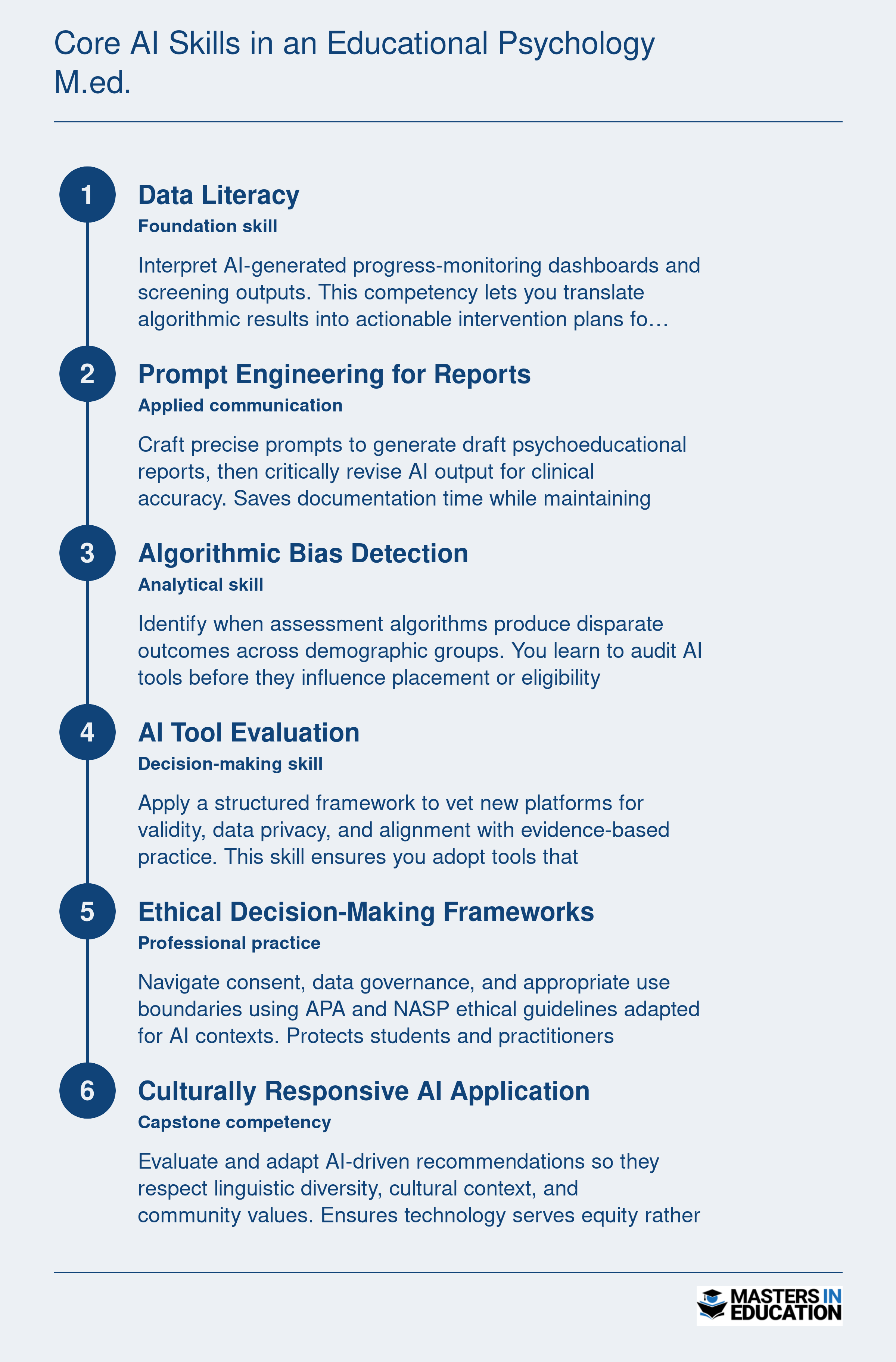
Core AI Skills in an Educational Psychology M.Ed.
What AI skills do school psychologists need? A strong M.Ed. in educational psychology builds competencies in a deliberate sequence, moving from foundational literacy to advanced, culturally responsive practice. Teachers who want to use AI effectively in student support benefit from this structured training far more than from standalone workshops alone.
Yes, teachers need educational psychology foundations to use AI effectively. The tools themselves are not hard to operate. The real challenge is knowing when to trust an AI recommendation, when to override it, and how to contextualize its output for a specific learner. That judgment comes from understanding how students actually learn, and no shortcut replaces it.
School Psychologist Salary and Job-Market Outlook
School psychologists earn competitive salaries and remain in steady demand, even as overall growth is projected to be slower than average through 2034. The table below summarizes key compensation benchmarks and labor-market indicators drawn from the Bureau of Labor Statistics and O*NET. For educators weighing a graduate degree in educational psychology, these figures offer a realistic snapshot of what the profession pays and where the field is headed.
Metric
Value
Source Year
Median Annual Wage
$86,930
2024
Mean Annual Wage
$93,610
2024
25th Percentile Wage
$73,240
2024
75th Percentile Wage
$108,210
2024
Total National Employment
Approximately 63,830
2024
Projected Job Growth Rate
1% to 2% (slower than average)
2024 to 2034
Projected Annual Openings
Approximately 3,800
2024 to 2034
Highest-Paying States for School Psychologists
Geography plays a major role in school psychologist compensation. The table below ranks the ten highest-paying states (and the District of Columbia) by median annual salary, based on the latest Bureau of Labor Statistics data. Professionals weighing relocation or remote consulting work should note that several of these states also have large workforces, meaning both pay and opportunity are strong. Keep in mind that cost of living varies significantly across these locations.
State
Total Employment
Median Annual Salary
25th Percentile
75th Percentile
Mean Annual Salary
California
9,350
$118,310
$101,930
$133,280
$117,630
Oregon
680
$113,180
$90,680
$123,210
$106,920
Colorado
1,370
$111,060
$100,400
$133,430
$117,190
Maryland
2,010
$108,710
$86,810
$132,310
$107,870
Washington
1,290
$106,440
$95,120
$124,350
$108,740
District of Columbia
280
$100,720
$81,750
$131,060
$105,360
New York
7,250
$99,310
$78,080
$129,370
$103,580
Massachusetts
2,730
$98,150
$78,200
$111,440
$100,140
Connecticut
1,100
$98,080
$78,630
$110,110
$98,190
Georgia
1,670
$96,810
$80,890
$109,140
$94,240
Graduate Degree vs. Short-Course AI Training: Which Path Fits You?
The right training path depends on where you are in your career, what credentials you need, and how deeply you want to integrate AI into your practice. Below is a side-by-side look across six dimensions that matter most.
Depth of Learning Science
A full M.Ed. in educational psychology grounds you in developmental theory, research methods, psychometrics, and intervention design over two or more years of coursework. Short courses and micro-credentials, by contrast, teach you how to use specific AI tools but rarely cover the theoretical scaffolding that helps you evaluate whether a tool's recommendations are developmentally appropriate. If you already hold a graduate degree in a related field, that foundation is in place, and a focused certificate can fill the AI gap efficiently.
AI Skill Acquisition
Standalone AI training gets you hands-on faster. Free courses (typically costing $0 to $100)1 and paid micro-credentials (roughly $100 to $500)2 can be completed in a few weeks, while graduate certificate programs ($1,200 to $4,000) may run one to two semesters.3 An M.Ed. program that has updated its curriculum to include AI modules will weave those skills into authentic case studies, but the AI content is one thread in a broader tapestry rather than the sole focus.
Career Credential Value
This is where the paths diverge sharply. An M.Ed. is typically required for state licensure as a school psychologist or for advancement on a district salary schedule. Graduate certificate programs often carry credit that counts toward salary-schedule movement, whereas free or low-cost micro-credentials are unlikely to do so.1 If licensure or a pay-lane bump is part of your plan, verify with your state board and district HR before enrolling. You can review educational psychologist licensing requirements for a fuller breakdown of what each state expects.
Time and Cost
Short courses and micro-credentials: A few weeks to a few months; $0 to $500 for most options, up to roughly $4,000 for a graduate-level certificate.
M.Ed. programs: Typically two to three years; tuition varies widely by institution, often ranging from the low five figures to considerably more depending on the school.
Long-Term Salary Impact
School psychologists with a master's or specialist-level degree generally earn salaries well above the median for classroom teachers, and the credential itself opens roles that are otherwise inaccessible. Adding AI proficiency on top of that degree positions you for emerging specialist roles in data-driven student support. A certificate alone, while valuable for immediate skill-building, is unlikely to unlock the same earning trajectory.
How to Self-Select
Choose a short course or micro-credential if you already hold a relevant graduate degree and simply need to add AI fluency to your existing toolkit. Choose a full M.Ed. if you are changing careers, early in your education journey, or pursuing licensure as a school psychologist. The degree delivers both the theoretical depth and the professional credential; AI coursework layered into that program means you will not have to bolt on separate training later.
Neither path is inherently better. The deciding factor is whether you need the credential, or only the competency.
Frequently Asked Questions About AI and Educational Psychology
Below are the questions educators and aspiring school psychologists ask most often about the intersection of AI and educational psychology. Each answer draws on the guidelines, workforce data, and ethical frameworks discussed throughout this guide.
Is AI replacing school psychologists?
No. AI can automate routine scoring, flag at-risk students earlier, and speed up data analysis, but it cannot replicate the clinical judgment, rapport building, or culturally responsive decision-making that school psychologists provide. The Bureau of Labor Statistics projects strong growth for school psychology roles through the end of this decade, reinforcing that demand for qualified professionals is rising, not shrinking.
Do teachers need educational psychology training to use AI effectively in the classroom?
Yes, at least a foundational understanding. Without knowledge of how students learn, develop, and differ cognitively, teachers risk misinterpreting AI-generated recommendations or applying interventions that do not fit the learner. Educational psychology training helps educators evaluate whether an AI tool's suggestions align with evidence-based learning science, making the technology far more useful and far less likely to cause harm.
What are the biggest ethical concerns with AI in school psychology?
The top concerns include algorithmic bias that may disproportionately affect students from underrepresented groups, lack of transparency in how AI models reach conclusions, over-reliance on automated outputs for high-stakes decisions such as special education placement, and the risk of student data being used beyond its intended purpose. Practitioners need clear ethical guidelines and regular audits to mitigate these risks.
What is the job outlook for school psychologists who know how to use AI?
The outlook is strong. The Bureau of Labor Statistics projects above-average growth for school psychologists, and professionals who can evaluate, implement, and monitor AI-driven assessment and intervention tools bring added value to districts investing in education technology. AI fluency is increasingly listed in job postings and can differentiate candidates in a competitive hiring market.
Can I learn AI skills without going back for a full degree?
You can build introductory AI literacy through certificate programs, workshops, and professional development courses. However, a graduate degree in educational psychology offers deeper grounding in research methods, psychometrics, and ethical practice that short courses rarely cover. Your best path depends on your current credentials and career goals; the earlier sections of this guide compare both options in detail.
How does FERPA apply to AI tools used with student data?
The Family Educational Rights and Privacy Act (FERPA) requires that any AI tool processing personally identifiable student information meet strict data protection standards. Schools must ensure vendors act as authorized agents, limit data use to the educational purpose for which consent was given, and provide parents the right to inspect records. Before adopting any AI platform, practitioners should verify that contracts include FERPA-compliant data governance provisions.
AI is a multiplier for school psychologists, not a replacement. But that multiplier only works when the practitioner understands the learning science underneath it. Without that foundation, even the best AI tool becomes a black box generating recommendations no one can properly evaluate or ethically defend.
If you do not yet hold a graduate degree, explore M.Ed. programs in educational psychology that weave AI competencies into their curricula, from data literacy through culturally responsive implementation. If you already have a master's or specialist credential, a structured professional development course focused on AI tool evaluation and ethical use can close the gap efficiently. Either way, the career incentive is clear: school psychologists who pair clinical expertise with AI fluency are entering a market defined by strong demand and competitive salaries.