

What you’ll learn in this article…
- Federal loan restrictions block many Black and Latino candidates from earning M.Ed.s.
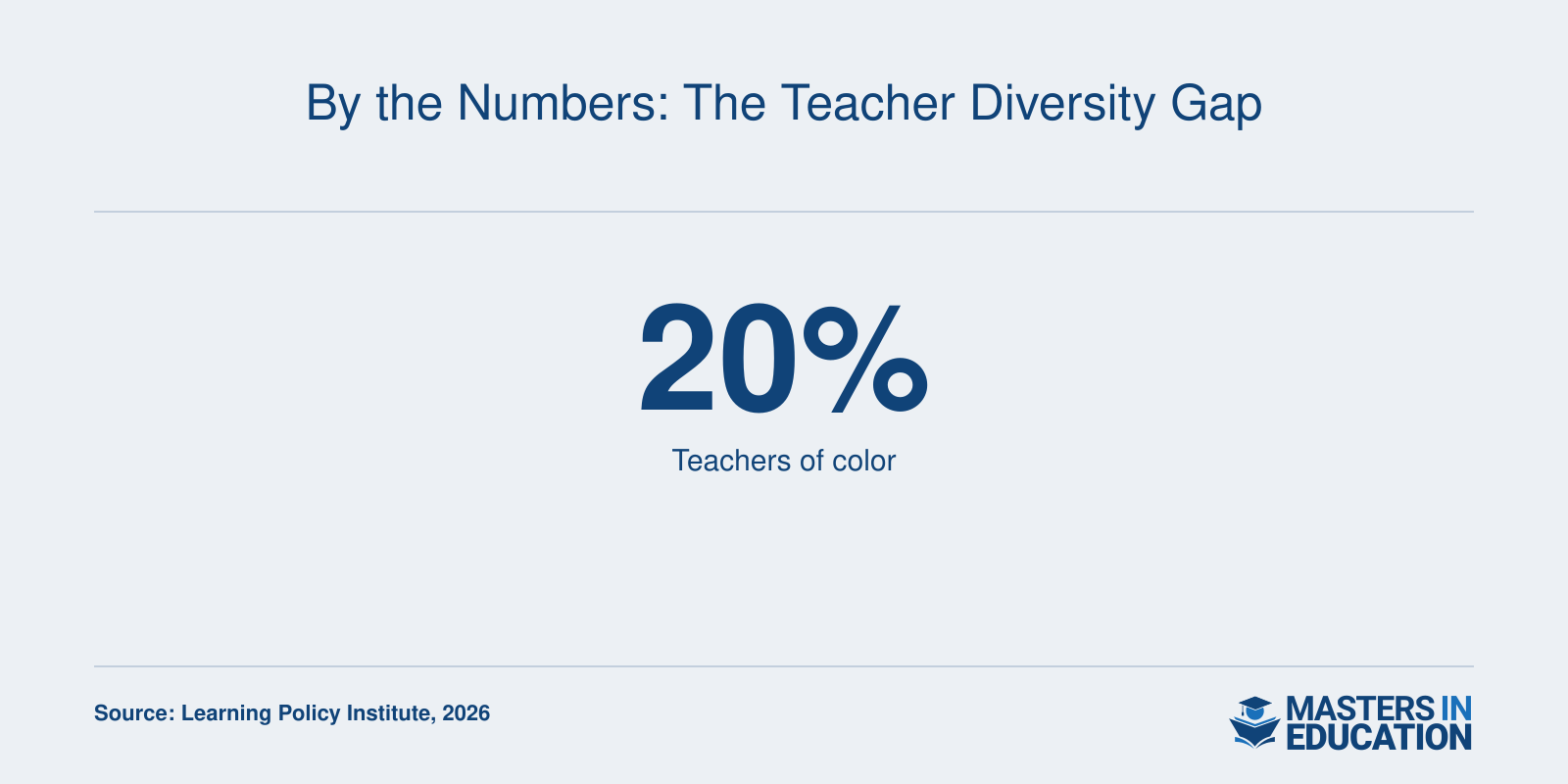
- Only 20% of teachers are people of color; students of color are 50%.
- State-funded residencies help fill gaps left by federal teacher diversity grant cuts.
Just 20 percent of U.S. teachers are people of color, while half of K-12 students are. The gap persists, but new federal policies are narrowing the pathways that once promised to close it. Borrowing limits under H.R. 1, cuts to teacher preparation grants, and restraints on race-conscious programming are reshaping who can afford to enter the classroom. Black and Latino candidates, who borrow at higher rates and carry debt longer, are hit first.
State-led recruitment initiatives are creating an uneven patchwork of opportunity. Meanwhile, M.Ed. programs are redesigning support systems, from financial aid advising to partnerships with minority-serving institutions, to operate without the federal grants and scholarships that previously underpinned diversity efforts. The pipeline for teachers of color is contracting at a moment when diverse schools show stronger outcomes for all students.
The Evolving Federal Policy Landscape: What Changed Between 2025 and 2026
The federal education funding environment shifted dramatically between 2025 and 2026, reshaping the financial calculus for aspiring teachers of color. The One Big Beautiful Bill Act (H.R. 1), enacted as Public Law 119-21 in July 20251, introduced the most sweeping changes to higher education financing in decades, and as of mid-2026, the statute remains fully in effect with no broad court stay. Its provisions touch nearly every loan and grant program that aspiring educators rely on, while a parallel set of executive actions and legal challenges has created additional uncertainty around diversity-focused initiatives.
H.R. 1 Rewrites Student Loan Rules
The law set new borrowing limits that directly affect graduate students in M.Ed. programs. For the 2026-2027 academic year, annual unsubsidized loan caps are $20,500 for non-professional graduate students, with a lifetime limit of $257,5002. Professional students in fields like law or medicine have higher annual caps of $50,000. More critically, Graduate PLUS loans were terminated entirely on July 1, 20263, removing a key financing tool for students who had exhausted other aid. For parents, Parent PLUS loans are now capped at $20,000 annually and $65,000 over a lifetime, with a FAFSA asset exclusion for small family-owned businesses and farms4. Pell Grant eligibility was also narrowed: students whose scholarships cover full costs or whose Student Aid Index exceeds a threshold now lose access4. While a Workforce Pell Grant for short-term programs (150, 600 hours) began on July 1, 20265, it does not replace the broad funding cuts.
Executive Actions and Legal Hurdles
Alongside H.R. 1, executive orders targeting diversity, equity, and inclusion (DEI) programs at federally funded institutions have drawn attention. However, as of July 2026, no executive order has superseded or overridden the specific education provisions of H.R. 11. The Department of Education’s May 1, 2026 final rule on program classification was preliminarily enjoined by a federal court on June 24, 20262, temporarily blocking its enforcement. This means that while DEI-related policy debates continue, the concrete financial restrictions enacted through H.R. 1 are what schools and students must navigate immediately.
A Compounding Effect on Teacher Diversity Pipelines
The convergence of these changes creates a compounding financial barrier for would-be teachers of color. Black and Latino/a candidates, who are more likely to borrow and carry loan balances longer, now face reduced borrowing options just as grant eligibility tightens. H.R. 1’s new Repayment Assistance Plan, effective July 20266, may offer some relief, but the loss of Grad PLUS loans and stricter Pell rules disproportionately affect students from low-wealth backgrounds. Meanwhile, the legal skirmishes over DEI directives leave institutions cautious about race-conscious scholarships, even as the statutory funding cuts take hold. The result is a pipeline where fewer candidates of color can access or complete M.Ed. programs, undercutting state and local efforts to diversify the teaching workforce, a dynamic the Learning Policy Institute's analysis on federal actions and teacher diversity explores in detail.
How Funding Cuts Hit Teacher Diversity Pipelines
Federal grants and state-led initiatives have long functioned as complementary legs supporting the teacher diversity pipeline, but recent funding shifts are forcing many programs to lean harder on state resources.
The Federal Grant Ecosystem That Underpins Diversity
Historically, several key grant programs have channeled resources toward diversifying the educator workforce. The Teacher Quality Partnership (TQP) grants, Teacher Incentive Fund (TIF), Supporting Effective Educator Development (SEED) grants, and Augustus F. Hawkins Centers of Excellence programs all helped recruit, prepare, and retain teachers of color, often through partnerships with minority-serving institutions and high-need school districts. These competitive grants funded residency models, induction supports, and innovative pathways that disproportionately benefited candidates from underrepresented backgrounds. While the precise scale of recent reductions varies by program, the broader pattern of federal budget scrutiny has injected noticeable uncertainty into the pipeline.
How to Monitor Shifts in Federal Funding
Given the fast-changing policy environment, education leaders and advocates need concrete methods for tracking what is happening to these grant streams. A practical monitoring approach includes:
- Budget justification documents: Review the Department of Education's annual budget justifications and accompanying Federal Register notices, specifically looking for terminations, reprogramming actions, or significant reductions that took effect after 2025.
- Historical obligations data: Use USAspending.gov to search past obligations for Teacher Quality Partnership, Teacher Incentive Fund, SEED, and Augustus F. Hawkins programs, filtering by fiscal year and awarding agency to spot downward trends.
- Institutional reports and websites: Check HBCU teacher preparation program websites and their publicly available Title II reports for language about grant losses or funding gaps, and monitor the White House Initiative on HBCUs for administration-level updates.
- Professional association surveys: Organizations like the American Association of Colleges for Teacher Education (AACTE) and the National Education Association (NEA) regularly survey members about federal funding impacts; their findings can reveal emerging patterns before formal data are published.
Implications for Maintaining Teacher Diversity
When major federal grants become less predictable, M.Ed. programs and the candidates they serve must adjust. Programs may need to pursue alternative funding sources, such as state-level diversity initiatives, tuition-free teacher education programs, philanthropic contributions, or district-sponsored residencies, to sustain recruitment and support for teachers of color. For aspiring educators, tighter federal lending rules and grant reductions can make the profession harder to afford, so it is essential to work with financial aid offices to identify M.Ed. scholarships, loan forgiveness options, and employer tuition benefits. Sustaining a diverse teacher workforce in this climate demands proactive state policy, resourceful institutional planning, and informed advocacy.
By the Numbers: The Teacher Diversity Gap
State-Led Initiatives: Where Progress Continues Despite Federal Headwinds
As federal support for teacher diversity wanes, state governments are taking uneven steps to fill the void, creating a patchwork landscape where aspiring educators' opportunities depend heavily on where they live and train. While some states have aggressively expanded their own funding and policy levers, others have done little to counteract the federal pullback.
Specific State Initiatives That Are Moving Forward
Several states stand out for their sustained or newly bolstered efforts to diversify the teacher workforce. Each employs a distinct strategy, from grow-your-own pipelines to loan forgiveness.
- Arkansas Teacher Cadets Program: A grow-your-own model that introduces high school students to teaching careers. Even with modest scale (38 districts, 450 students in 2018, 19), it demonstrates a long-term pipeline approach that other states have since scaled up2.
- Louisiana Believe and Prepare: This residency model focuses on underserved and rural schools, pairing novice teachers with expert mentors and preparing them for rural teacher careers; its design explicitly targets areas where diverse educators are often needed most, combining hands-on training with community recruitment3.
- Pennsylvania Clinical Experience Grants: These grants fund student teaching experiences in high-need schools, prioritizing low-income and minority students who face financial barriers to unpaid clinical placements, a key obstacle for many diverse candidates2.
- California's Educator Diversity Advisory Network: In 2024, 2025, California launched a comprehensive agenda outlining debt-free pathways, teacher residencies, grow-your-own programs, and bilingual pipelines. The plan explicitly aims to use state dollars to replace diminished federal support, signaling one of the strongest commitments in the nation4.
- Illinois Minority Teachers of Illinois (MTI) Scholarship: Illinois has maintained this state-funded scholarship program, which awards up to $5,000 per year to minority candidates pursuing teaching degrees. While the dollar amount is modest, it remains a reliable, on-the-books resource for M.Ed. scholarships in an era of tightening federal aid.
A Patchwork of Progress
Despite these bright spots, the national picture is far from uniform. In 2023, the National Council on Teacher Quality reported that while 36 states had some form of teacher retention initiative, only 14 explicitly targeted teacher diversity1. That gap means many states are not addressing the racial disparities in the workforce directly, even as they work to keep teachers in classrooms. In states without a diversity focus, progress is effectively stalled, or even reversing, as federal grants like TEACH and Title II dwindle or impose new restrictions.
For M.Ed. programs, this landscape carries clear implications. Programs located in or partnered with states that have robust diversity policies are better positioned to recruit and support cohorts of color. Graduates seeking to teach in diverse, supportive environments will find stronger career launchpads in states that back their commitments with actual funding, not just rhetoric.
Are Race-Conscious Scholarships Still Legal? What M.ed. Programs Need to Know
Is it still legal for M.Ed. programs to offer scholarships specifically for Black or Latino teacher candidates? The short answer is that race-exclusive scholarship criteria are now widely considered unlawful under Title VI, and institutions that persist face serious enforcement risk. While the 2023 Supreme Court decision in Students for Fair Admissions v. Harvard/UNC directly addressed admissions, the federal government has since applied that reasoning aggressively to financial aid, recruitment, and support programs.4 An executive order titled "Restoring Equality of Opportunity and Meritocracy" (2025) directed agencies to reinterpret civil rights laws1, and the Department of Education has threatened funding freezes or revocations for DEI practices it deems discriminatory.2 A February 2025 Dear Colleague Letter that sought to ban a broad swath of race-conscious campus activities was later rendered unenforceable3, but the underlying enforcement posture has not softened: programs that restrict eligibility by race remain high-risk.
What's Clearly Prohibited: Race-Exclusive Criteria
Scholarships that limit applicants to a particular racial group (e.g., "Black educators only") are almost certainly impermissible. A 2025 DOJ memo specifically targeted race-exclusive education grant programs as unlawful.4 The risk extends beyond explicit racial restrictions: use of facially neutral "proxies" that function as racial sorting, such as ZIP code mapping that correlates tightly with race, is also under scrutiny.5 Even affinity spaces or mentorship programs reserved exclusively for teachers of color now pose substantial Title VI risk, according to cross-agency anti-discrimination guidance issued over the past year.5 M.Ed. programs that receive federal funds must also monitor third-party partners, such as school district residency programs, to ensure they are not using prohibited criteria.5
Permissible Paths: Race-Neutral Framing That Works
Programs can still advance teacher diversity through carefully crafted, race-neutral initiatives. The key is to define eligibility around factors other than race: financial need, first-generation college status, or commitment to teaching in underserved communities.5 Pipeline programs that target "high-need rural schools" or "low-income urban districts" remain generally permissible, as long as selection is not used as a proxy for race.5 Merit-based scholarships tied to subject area (e.g., STEM or special education) are also safe.1 Legal counsel at peer institutions currently recommends auditing all existing scholarships and recruitment language to remove any explicit racial preference, and instead framing goals in terms of educational equity, community representation, or socioeconomic diversity.
What This Means for M.Ed. Programs Right Now
The single most important step is a programmatic review: examine every scholarship, fellowship, and recruitment message for language that conditions access on race.4 Swap out "underrepresented minority" with "underrepresented background" and define that background by income, geography, or educational experience rather than ethnicity. Need-based aid, such as M.Ed. scholarships based on financial need, incidentally supports a diverse pool and is legally defensible; race-exclusive aid is not. As one risk management guide puts it, the safest path is to design programs that are open to all but designed to attract and support candidates from the communities you aim to serve, without ever using race as a criterion.
What M.ed. Programs Can Do Right Now to Sustain Teacher Diversity
M.Ed. programs that sustain teacher diversity in 2026 do not treat it as a checkbox. They build structured, legally sound systems that support candidates of color from recruitment through licensure and into the classroom. These strategies are both an ethical commitment and a practical enrollment imperative: diverse educator pipelines serve increasingly diverse K-12 students and strengthen a program's institutional mission.
Build Enduring Pipelines With HBCUs and Grow-Your-Own Models
Programs with the most stable diversity outcomes forge deep partnerships with community colleges and Historically Black Colleges and Universities. A common approach is the 2+2 articulation model, where students complete an associate degree at a partner institution and seamlessly transfer into the M.Ed. program, a process detailed in our community college to master's in education pathway guide. At the district level, HBCU residency agreements pair candidates with paid classroom experiences while they earn their advanced degree, a balancing act explored in our balancing teaching and grad school guide. Grow Your Own pipelines, which recruit from local communities and paraprofessional pools, continue to gain traction as race-neutral recruitment strategies that are legally resilient.1 These programs often partner with school districts to create clear pathways from high school career academies through bachelor's and master's programs.
Rethink Financial Support to Reduce Reliance on Uncertain Federal Loans
With Parent PLUS loan caps and broader uncertainty around federal funding, M.Ed. programs are turning to institutional service scholarships, grant-based aid, and loan forgiveness programs instead of advising students to borrow more.1 Teacher residency programs, in particular, blend multiple funding streams, a practice known as braided funding, to offer stipends and tuition remission. While income-share agreements remain experimental and legally complex, many schools now pair reduced tuition with a multiyear service obligation of three to four years in a partner district.1 This not only lowers financial barriers but provides the job security that helps diverse candidates commit to the classroom.
Strengthen Retention With Responsive Curriculum and Mentorship
Retention of educators of color hinges as much on campus experience as on the classroom. Programs that embed culturally responsive teaching across their curriculum help candidates see their identities reflected in professional practice.3 Equally important is a structured mentoring and advising system that pairs students with experienced educators who share similar backgrounds or have explicit training in equity-focused support.2 Early evidence suggests these wraparound services, tutoring, licensure exam prep, and cohort-based learning, improve persistence, though comprehensive post-2025 data is still being collected. M.Ed. programs that invest in these supports report stronger application numbers from candidates who value environments where they are likely to finish, not just enroll.
Protect Teacher Residencies Through Data and Transparency
Teacher residency programs have survived recent funding cuts by demonstrating measurable impact. The most resilient models rely on data-driven justifications: they track candidate progress, licensure pass rates disaggregated by race and ethnicity, and long-term placement and retention outcomes. State data systems now routinely monitor licensure pass-rate gaps, and programs that openly share these metrics are better positioned for advocacy and grant applications.1 Publishing diversity data also signals to prospective students that the program takes accountability seriously. This public-facing transparency transforms recruitment by showing candidates of color that the institution walks the walk.
Related Articles
Financial Planning for Diverse M.ed. Candidates in a Tighter Lending Environment
How can I afford a master’s in education now that federal loan access is shrinking?
What Changed for Graduate Borrowing
Effective July 1, 2026, Grad PLUS Loans are eliminated for new borrowers.1 Graduate students now rely primarily on Direct Unsubsidized Loans, capped at $20,500 per academic year with a $100,000 lifetime limit for non-professional programs. For a typical two-year M.Ed., that means at most $41,000 in federal loans, often far below total cost of attendance, which can exceed $50,000 at many institutions. Parent PLUS loans, with their own tightened caps ($20,000 per year, $65,000 lifetime), are less relevant for independent graduate students but signal a broader credit squeeze.
The TEACH Grant: Is It Still a Reliable Option?
The TEACH Grant remains in effect, offering up to $4,000 per year2 to candidates who commit to teaching in a high-need field at a low-income school for four years. The risk, however, is still real: if service requirements aren’t met, the grant converts to an unsubsidized loan with retroactive interest. For diverse candidates willing to serve in underserved communities, it’s a focused tool, but treat it as a conditional award, not guaranteed aid.
Non-Federal Funding Sources That Remain Steady
Several funding streams are untouched by H.R. 11: - State grant programs: Many states continue offering state teacher scholarships for master's in education and loan repayment assistance for teachers, particularly in shortage areas. - Institutional aid: M.Ed. programs themselves often provide tuition discounts, fellowships, or emergency funds; ask admissions offices for a list of diversity-specific aid. - AmeriCorps: The Segal Education Award (over $7,000 for a full year of service) can be used for graduate education costs. - Union and foundation scholarships: The NEA Foundation, American Federation of Teachers, and private foundations like the McKnight Doctoral Fellowship (for select programs) maintain awards for aspiring teachers of color. Check eligibility and deadlines early.
Debt Repayment in a New Landscape
For new loans after July 2026, the old income-driven repayment plans are replaced by the Repayment Assistance Plan (RAP).3 While details are still settling, the shift is significant for Black educators, who data show carry student loan balances longer. The new plan’s terms will shape whether monthly payments remain manageable on a teacher’s salary. Candidates should project long-term costs using the Federal Student Aid simulator once updated for RAP, and compare public service loan forgiveness options still available.
Your Action Step
Before committing to any M.Ed. program, calculate your total cost of attendance assuming only $20,500 per year in federal loans (plus any TEACH Grant if you qualify). Then contact the program directly and ask: “What institutional backup funding exists if federal aid doesn’t cover my gap?” This conversation can uncover hidden grants, assistantships, or payment plans that make a degree financially feasible.
Frequently Asked Questions About Federal Policy and Teacher Diversity
As federal policies evolve in 2026, teacher diversity faces obstacles from funding cuts to accreditation overhauls. Below, we address the most urgent questions for educators and M.Ed. programs navigating these changes.
Federal policy changes between 2025 and 2026 have narrowed financial pathways for aspiring teachers of color, but the educator pipeline is stressed, not severed. State-led grant initiatives and residency funding continue to fill gaps, while M.Ed. programs refine their institutional aid strategies. Candidates of color, who face disproportionate borrowing burdens, should target programs with robust financial support and explore state-based loan forgiveness options. The path forward requires vigilance: use the Learning Policy Institute resource linked in this article as a live policy tracker, and engage with advocacy organizations that defend teacher diversity funding. Your informed action helps keep the pipeline open.