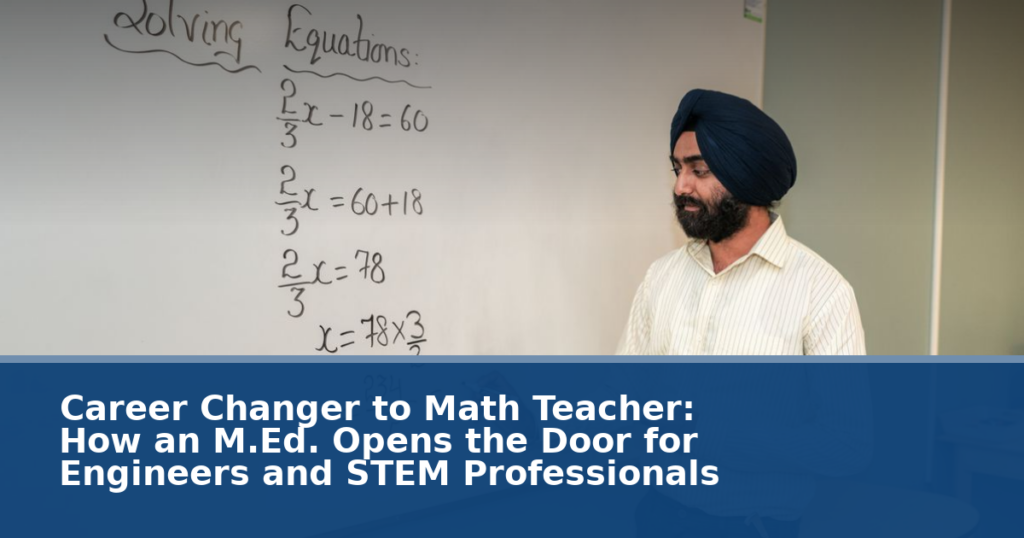
What you’ll learn in this article…
- Concordia Nebraska's CAEP-accredited M.Ed. has curriculum and reading specializations.
- All graduate education programs are 100% online and asynchronous.
- Omaha Public Schools master's teachers earn $7,000 more per year.
Concordia University Nebraska has been preparing educators since 1894, grounding its graduate program in a Lutheran tradition focused on reflective practice. Its CAEP-accredited M.Ed. now moves that century-old commitment online, with specializations in Curriculum & Instruction, Literacy, and more.
Designed for working teachers, the fully online, cohort-based format delivers an endorsement-ready curriculum without career interruption. In Nebraska, a master’s degree can add nearly $7,000 to a teacher’s annual salary, a return that compounds over a career.
Master's in Education Programs at Concordia University-Nebraska
Curriculum & Instruction
- Council for the Accreditation of Educator Preparation (CAEP) accredited
- 4 concentration options
- No entrance exam required
- Test optional
- $475 per credit
- 24-Month program
- 30 total credit hours
- Capstone required
- $0 application fee
- Financial aid available
- 100% online
- 8-week courses
- No textbook costs with OER
- Prior learning assessment credit
- One class at a time
- Personal support team
- Aligns with InTASC standards
- Council for the Accreditation of Educator Preparation (CAEP) accredited
- 4 concentration options
- No entrance exam required
- Test optional
- $475 per credit
- 24-Month program
- 30 total credit hours
- Capstone required
- Financial aid available
- 8-week course terms
- 100% online
- Free digital textbooks (OER)
- Prior learning credit up to 6 credits
- Faith-based education practices
- Small class sizes
- Prepares for instructional coordinator role
- Individual faculty support
- CAEP accredited
- 4 concentration options
- No entrance exam required
- $475 per credit
- 24-Month program
- 30 total credit hours
- Capstone required
- Financial aid available
- 100% online, 8-week course terms
- Lowest tuition among CUS schools in Nebraska
- STEAM courses: Arts integration, engineering design, teacher leadership
- Save ~$2,000 with open educational resources
- Earn up to 6 credits via prior learning assessment
- Aligns with InTASC Model Core Teaching Standards
- Careers: grade-level leader or instructional coordinator
- Special $375/credit rate for Nebraska residents, alumni
- 30 total credit hours
- Trauma-informed classroom strategies
- Practicum in curriculum and instruction
- Capstone research project
- Experienced faculty mentors
- CAEP accredited
- 6 concentration options
- $475 per credit
- 24-Month program
- 30 total credit hours
- 45 clinical hours
- Financial aid available
- 8-week course terms
- Faith-based curriculum focus
- Lowest tuition among CUS schools
- Special rate for Lutheran affiliates
- Initial teaching certificate option
- Practicum in your own classroom
- No mentor required for practicum
- Council for the Accreditation of Educator Preparation (CAEP) accredited
- 6 concentration options
- $475 per credit
- 24-Month program
- 30 total credit hours
- 45 clinical hours
- Financial aid available
- 100% online delivery
- 8-week courses
- Lowest price among CUS schools
- Faith-based education practices
- Initial teaching certificate available
- Preferred partner tuition discounts
- CAEP accredited
- 6 concentration options
- $475 per credit
- 24-Month program
- 30 total credit hours
- 45 clinical hours
- Capstone required
- Financial aid available
- 100% online format
- 8-week course terms
- Lowest price among CUS schools
- Faith-based curriculum approach
- Initial teaching certificate available
- Partner tuition discounts available
- No mentor required for practicum
- Apply latest educational research
Reading & Literacy
- CAEP accredited
- 2 concentration options
- $475 per credit
- 33 total credit hours
- Capstone required
- 100% online format
- 8-week course terms
- Lowest price among CUS schools
- Faith-based training approach
- Reading specialist or ESL endorsement
- Field-based case study required
- Top 25 online reading program (2019)
- CAEP accredited
- 2 concentration options
- $475 per credit
- 33 total credit hours
- Capstone required
- 100% online program
- 8-week course terms
- Lowest price among CUS schools
- Faith-based learning environment
- Ranked top 25 online program
- Choose reading specialist or ESL endorsement
- Field-based case study required
- Council for the Accreditation of Educator Preparation (CAEP) accredited
- 2 concentration options
- $475 per credit
- 48 total credit hours
- 45 clinical hours
- Capstone required
- 100% online
- 8-week courses
- Lowest price among CUS schools
- Faith-based training
- Top 25 online reading program
- Reading specialist careers
- ESL endorsement available
Exploring Concordia’s M.ed. Specializations: Curriculum & Instruction, Reading & Literacy, and More
Concordia University-Nebraska's Education Department holds CAEP accreditation, a mark of quality that signals a rigorous commitment to preparing reflective practitioners who can lead in diverse learning environments. The Master of Education (M.Ed.) programs are designed for working educators seeking to deepen their expertise and earn endorsements through Nebraska's master's in education programs that directly advance their careers.
M.Ed. in Curriculum & Instruction: Modernizing Classroom Practice
The 30-credit master's in curriculum and instruction is a fully online program that can be completed in as few as 20 months.2 It does not require GRE scores,2 and students complete 45 to 90 clinical hours embedded in coursework.3 The curriculum focuses on evidence-based instructional design, assessment, and leadership. A distinctive feature is the availability of emphasis areas that align with current classroom demands, including Trauma & Resilience, ESL, Instructional Technology Leadership, STEAM, and Artificial Intelligence in Teaching and Learning.1 These specializations allow teachers to tailor their studies to immediate district needs.
Starting in Fall 2026, Concordia Nebraska will offer a new Computer Science endorsement as a concentration within this degree. This pathway, approved by the Nebraska Department of Education, prepares teachers to integrate computational thinking and coding into K-12 settings.4 While the full course sequence is still being finalized, the endorsement underscores the program's responsiveness to emerging workforce priorities and state licensure trends.
M.Ed. in Reading & Literacy: Building Expert Coaches
The M.Ed. in Reading & Literacy requires 33 to 48 credits, depending on whether a student pursues the embedded ESL endorsement.2 Like the Curriculum & Instruction program, it is delivered entirely online. Coursework emphasizes literacy assessment, intervention strategies, and coaching techniques, equipping graduates to serve as reading specialists or district-level literacy coaches. The optional ESL endorsement expands teachers' capacity to support multilingual learners, a growing need across Nebraska schools.
Program Structure and Nebraska Endorsements
Both degrees follow a 30- to 36-credit framework and culminate in a capstone or action research project that demonstrates applied learning. Courses are offered in accelerated 8-week blocks,2 allowing educators to focus on one subject at a time while balancing full-time teaching responsibilities. The programs are designed to align with Nebraska Department of Education endorsement requirements, though specific licensure steps are addressed through the university's certification office.
Concordia Nebraska also embeds practical support into the learning experience: open educational resources eliminate textbook costs in many courses, and a prior learning assessment option may reduce credit requirements for experienced educators. This efficient, focused structure makes the M.Ed. a direct investment in professional growth.
Questions to Ask Yourself
Tuition and Financial Aid: What a Concordia Nebraska M.ed. Costs
How much does a master's in education at Concordia University Nebraska cost, and what financial aid options can make it more affordable?
Tuition for Concordia Nebraska's M.Ed. programs varies by delivery format: online and hybrid options may have different per-credit rates. For the most current pricing, visit Concordia Nebraska's official tuition page or contact the admissions office directly. They can confirm the total estimated program cost, including any additional fees such as technology, library, or graduation charges.
Tuition Structure and Estimated Costs
Because rates can change annually, the university's website is the best starting point to review the per-credit cost for the 2026 academic year. When calculating the full program expense, factor in the total number of credit hours required for your chosen specialization, commonly between 30 and 36 credits. Some programs might also charge a flat-rate tuition for full-time enrollment or offer a discount for active-duty military personnel. The admissions team can provide a detailed cost breakdown tailored to your program and learning format.
Financial Aid: Scholarships and Federal Loans
Concordia Nebraska offers institutional scholarships for graduate students, and the financial aid office can guide you through eligibility requirements. You should also complete the Free Application for Federal Student Aid (FAFSA) to access federal loans, which may include unsubsidized Direct Loans or Grad PLUS Loans. These government-backed options often feature flexible repayment plans and fixed interest rates. To maximize your aid package, submit your FAFSA as early as possible after it opens.
Employer Tuition Reimbursement and Military Benefits
Many school districts, corporations, and nonprofits provide tuition reimbursement programs that cover a portion of graduate tuition. Check with your HR department about your company's education benefit policies and any service commitments required. For military members and veterans, Concordia Nebraska has a dedicated military liaison who can help you navigate GI Bill benefits, tuition assistance (TA), and Military Tuition Assistance programs. Contact the Veterans Affairs office at the university for personalized support.
Professional Association Scholarships and Grants
Organizations like the Association for Supervision and Curriculum Development (ASCD) and state education associations frequently award state teacher scholarships for master's in education to educators pursuing advanced degrees. Visit the websites of professional groups in your field, such as subject-specific councils or administrator networks, to find current grant opportunities. Deadlines and application requirements vary, so verify details directly with the sponsoring organization and prepare materials like letters of recommendation and a statement of purpose well in advance.
By combining these resources, you can significantly reduce out-of-pocket expenses and make your M.Ed. investment more manageable.
Admissions Requirements: Are You Eligible?
Two paths define eligibility for Concordia Nebraska's M.Ed.: the straightforward route for applicants who meet the standard academic threshold, and a provisional entry for those who show promise but fall just below the typical cutoff. The program's rolling admissions and absence of testing requirements keep both paths accessible.
GPA and Academic Background
A minimum undergraduate GPA of 2.8 is required for full admission.1 Many graduate education programs set the bar at 3.0, so this slightly lower floor opens the door wider. If your GPA falls short, provisional admission may be an option: contact an enrollment counselor to discuss your transcript and any relevant professional experience.1
Teaching experience is not required for admission.1 While many M.Ed. specializations are designed for practicing educators, Concordia Nebraska does not mandate a current teaching license or classroom history. This makes the program equally viable for career-changers and those seeking initial endorsements. International applicants must demonstrate English proficiency via TOEFL (80) or IELTS (6.5).
Application Materials
A complete file includes four key items: - Official transcripts: From every institution where you earned undergraduate or graduate credit. - Resume or CV: Highlighting academic and professional achievements, especially any education-related roles. - Statement of purpose: A focused essay explaining your goals and how the M.Ed. aligns with them. This replaces a separate letter of intent. - Two letters of recommendation: Choose references who can speak to your academic potential or professional character: supervisors, professors, or colleagues.
A background check is also required, standard for programs involving field placements or school-based projects.1
Test Scores and Deadlines
Concordia Nebraska does not require GRE scores , per its M.Ed. program page nor Praxis scores , per the education program handbook. Concordia Nebraska takes a holistic view, prioritizing your transcripts, essay, and recommendations over standardized exams. Applications are reviewed on a rolling basis , according to the graduate admissions page, with multiple start dates throughout the year. The next available term begins August 31, 2026, but you can submit materials anytime to secure a seat. Early submission is encouraged, as cohorts can fill.
Career and Salary Outcomes: ROI of a Concordia Nebraska M.ed.
Return on investment is not just a financial term; it is a measure of how your degree transforms your professional life. For educators, a master’s from Concordia University Nebraska can unlock higher earnings, leadership roles, and specialized positions that a bachelor’s alone often cannot reach.
Earnings Outcomes for Concordia Nebraska Graduates
While program-level earnings data shortly after graduation are not yet published, long-term federal data paints a clear picture of value. According to the most recent College Scorecard figures, median earnings for Concordia Nebraska students ten years after entry stand at $52,415 per year. This figure reflects graduates across all education programs, and it sits well above typical bachelor’s-only earnings in Nebraska, highlighting how a master’s degree creates a meaningful financial step up.
Real-world salary data for teaching professionals in the region underscores this advantage. Job postings for master’s-level education roles in the Lincoln, NE, area show salary ranges from about $53,428 to $64,343 annually. These numbers align closely with Concordia Nebraska’s long-term graduate earnings, suggesting that the degree positions you solidly in the upper tier of mid-career education salaries.
Common Career Paths and Salary Ranges
A Concordia Nebraska M.Ed. opens doors to several well-defined career tracks. Graduates commonly move into roles such as:
- Curriculum Coordinator: Designs and evaluates instructional materials, aligning them with state standards. Salaries typically fall in the $55,000–$65,000 range in Nebraska.
- Instructional Coordinator: Works with teachers to improve classroom practice, often overseeing professional development. Nebraska-based roles commonly pay between $55,000 and $64,000.
- Reading Specialist: Focuses on literacy intervention and assessment, a high-demand specialty. Salaries in Nebraska frequently match the upper end of the Lincoln metro range, around $58,000–$65,000.
- Lead Teacher or Department Chair: Takes on team leadership while staying in the classroom, often with a stipend that boosts base pay by several thousand dollars.
These positions reward both experience and advanced credentials, and the M.Ed. from Concordia Nebraska gives you the expertise to step into them confidently.
The Master’s Pay Bump in Nebraska
Most Nebraska public school districts use a salary schedule that automatically increases pay when a teacher earns a graduate degree. While the exact amount varies by district, the typical master’s bump adds between $2,000 and $4,000 per year to a teacher’s base salary. Over a 20-year career, that differential can compound to over $80,000 in additional earnings, not counting the higher lifetime earnings from promotions into specialist roles.
This automatic increase means your M.Ed. starts paying you back from the first contract year after completion. Combine that with the potential to move into higher-paying specialist jobs, and the return on investment becomes concrete and rapid. Concordia Nebraska’s program is designed to be affordable and accelerated, which further shortens the timeline to a positive financial outcome.
Salary Snapshot: Concordia Nebraska M.ed. Graduate Earnings
Program-specific earnings for Concordia University-Nebraska’s Master of Education in Curriculum and Instruction are not yet reported. However, institutional data from the U.S. Department of Education offers a general picture of graduate outcomes. Use these figures as a baseline for your return on investment analysis.

Questions to Ask Yourself
Online Vs. Hybrid: Choosing Your Learning Format
Does Concordia Nebraska offer a hybrid M.Ed. option, or is the program fully online? For most individual learners, the answer is straightforward: all graduate education programs are delivered 100% online through an asynchronous, cohort-based model.1 This means you complete coursework on your own schedule within structured 8-week terms, with no required on-campus sessions. However, the university does retain the flexibility to design hybrid experiences for partner school districts that request customized, in-person cohort delivery.3 Understanding the differences between these two paths (and how the fully online model actually operates) will help you pick the approach that best matches your learning style and professional situation.
Fully Online, Asynchronous Learning
Concordia Nebraska’s online M.Ed. is built for working educators. You take one course at a time every eight weeks,1 allowing deep focus without the juggling of multiple concurrent classes. Because the format is asynchronous, there are no set login times; you can read, participate in discussions, and submit assignments at any hour that fits your schedule. This self-pacing is contained within each 8-week block, so while you have control over your weekly rhythm, you still progress steadily alongside your cohort. Multiple entry points: late June, late August, and late October mean you can start when it’s most convenient and complete the degree in as few as 18 to 30 months, depending on your chosen specialization and any transfer credits. This accelerated master's in education pace is notably faster than traditional 15-week semester models, where earning a degree often stretches to two or three years.
Hybrid and Cohort Customization Options
It’s important to know that Concordia Nebraska does not offer a standard hybrid track for individual applicants. The primary delivery is the online model described above. However, the university does work directly with schools and districts to create customized cohorts that blend online coursework with limited in-person meetings.3 These arrangements are negotiated on a case-by-case basis and typically involve a set of educators from the same employer who want to study together, with additional face-to-face workshops or mentorship sessions built into the program. If you are interested in a hybrid experience, the best step is to have your school or district administrator contact the university’s partnership office. For those without a ready-made cohort, the fully online path remains the default, and it is intentionally designed to be as accessible and relationship-rich as possible through small class sizes and regular faculty check-ins.1
Accelerated Pacing vs. Traditional Semesters
The 8-week term is the engine behind Concordia Nebraska’s accelerated format.1 Unlike a conventional 15-week semester, each course covers the same depth of content in roughly half the time. This requires discipline, but it also creates powerful momentum: you can complete up to six courses per year while working full time. By comparison, a student in a traditional semester system might need to pause during summer or stretch their studies over additional terms. The continuous, rolling admissions cycle at Concordia means you never wait long to begin your next class; brief breaks between 8-week sessions keep the pace brisk without being overwhelming. This model is especially appealing for educators who want to qualify for a salary bump or endorsement quickly, as it can shorten the timeline to degree completion by several months.
Student Support Across Formats
Support is not diminished for distance learners. Every online student is assigned an enrollment coach who helps with onboarding and registration, followed by ongoing access to academic tutors and personalized coaching.1 The university’s small class sizes (typically under 20 students) ensure that faculty know you by name, and individualized meetings are a standard part of the experience. Library resources, including research databases and interlibrary loan services, are fully accessible online. Technical support is available by phone and email, and the institution has been delivering graduate programs online since 2012, so the infrastructure is mature.2 For hybrid cohorts that incorporate in-person meetings, the same support team coordinates both virtual and on-site assistance, ensuring a seamless experience regardless of location.
Retention and Success Rates
While Concordia Nebraska does not publicly break out graduation rates by delivery format, the university’s overall retention rate of 80% suggests a strong capacity to keep students engaged and on track. Without program-specific completion data for online versus hybrid cohorts, it is reasonable to expect that the structured 8-week pacing, combined with the built-in support system, helps many working teachers persist through challenging moments. The key takeaway: both the fully online model and any customized hybrid arrangement are designed around the realities of a teaching career, so the likelihood of finishing what you start is closely tied to the support you receive, and Concordia Nebraska prioritizes that support regardless of where you log in.
Accreditation and Nebraska Licensure: Your Path to Endorsement
The decision between a master's that enriches your teaching and one that unlocks new endorsements often comes down to how well the program bridges classroom learning and state requirements. Concordia University Nebraska's M.Ed. pathways are designed to do exactly that, with CAEP-accredited preparation that aligns with Nebraska Department of Education standards for administrative and specialist endorsements.
Dual Accreditation: CAEP and HLC
Concordia University Nebraska holds institutional accreditation from the Higher Learning Commission (HLC). Its educator preparation programs, including the M.Ed. in Curriculum & Instruction, are also accredited by the Council for the Accreditation of Educator Preparation (CAEP). This dual recognition means the university meets rigorous quality standards at both the institutional and programmatic levels, and it signals to district hiring committees that your degree carries credible, nationally validated weight. CAEP accreditation specifically confirms that the education curriculum, faculty, and clinical experiences align with professional best practices and state licensure demands.
Nebraska Endorsement Pathways
Completing the M.Ed. in Curriculum & Instruction at Concordia Nebraska typically leads to a Curriculum Supervisor Endorsement through the Nebraska Department of Education. This endorsement authorizes you to serve in roles such as curriculum coordinator, instructional coach, or department leader, overseeing curriculum design and teacher support. The program's coursework and practicum are mapped to Nebraska Rule 24 (specifically 005.01 A-F), which outlines the knowledge, skills, and dispositions required for curriculum leadership.
Concordia also offers an M.Ed. with a Reading & Literacy specialization, though detailed endorsement information for that track is not as publicly documented. Based on standard state frameworks, the Reading & Literacy M.Ed. is designed to prepare candidates for a Reading Specialist endorsement. Prospective students should confirm directly with the program how coursework aligns with the specific competencies and any additional testing or experience required for that endorsement.
Practicum and Experience Requirements
A key component of the Curriculum & Instruction M.Ed. is a 90-hour practicum that integrates supervised field experiences. Importantly, no more than half of those clinical hours may be completed in your own classroom; the remainder must take place at the school or district level. This ensures exposure to broader organizational dynamics beyond your daily teaching environment. The practicum requires demonstration of the leadership competencies referenced in Rule 24, with oversight from university faculty and site mentors. While the program does not list a specific teaching experience prerequisite, Nebraska administrative endorsements often expect candidates to hold a valid teaching certificate with at least two years of successful classroom experience. You should verify this with the Nebraska Department of Education, as requirements can change.
Additional State Exams
No additional exams were identified for the Curriculum Supervisor Endorsement through Concordia's program. However, Nebraska may require passing the Praxis II exam for certain endorsements, particularly for initial licensure areas. Since exam policies vary by endorsement type and are subject to revision, you should consult the Nebraska Department of Education's website for the most current testing requirements. If you are pursuing the Reading Specialist endorsement, the state may also require a content-specific exam.
In Nebraska's largest school district, Omaha Public Schools, teachers with a master's degree earn nearly $7,000 more per year than those with only a bachelor's. That premium adds up fast over a teaching career.
Student Experience: Mentorship, Cohort Models, and Support
Concordia University-Nebraska prioritizes a student-centered learning environment, blending academic rigor with personalized support to help graduate students thrive. The M.Ed. program is intentionally designed to foster collaboration, mentorship, and professional growth, all while accommodating the busy schedules of working educators.
Cohort Model: Learning Together
Students move through their M.Ed. program as part of a cohort, taking one 8-week course at a time. This structure builds a strong sense of community, encouraging regular peer interaction, shared problem-solving, and networking that extends beyond graduation.
- Collaboration: Cohort members often form study groups, exchange classroom strategies, and provide mutual accountability.
- Networking: The relationships built often become lasting professional connections, opening doors to job opportunities and collaborative projects across Nebraska and beyond.
Faculty Mentorship and Small Class Sizes
With a student-to-faculty ratio of just 14:1, Concordia Nebraska ensures that graduate students receive direct, meaningful attention from instructors. Professors act as mentors, not just lecturers, drawing on their own K-12 and higher education experience to guide students' professional development.
- Personal Support Team: Each M.Ed. student is assigned a dedicated support team, providing one-on-one assistance from enrollment through graduation.
- One Course at a Time: This focused approach allows students to dive deeply into each subject while maintaining regular contact with faculty and classmates, reinforcing a mentorship dynamic.
A Track Record of Student Success
Concordia Nebraska's overall graduation rate of about 65% reflects a campus culture committed to seeing students through to completion. While graduate-specific data is not available, this institutional rate points to strong academic support systems and a nurturing environment that extends to the graduate level.
Professional Development Beyond the Classroom
Concordia Nebraska connects students with ongoing professional growth opportunities, including:
- Access to education webinars and virtual conferences featuring leading practitioners.
- Workshops on topics like literacy intervention, ESL strategies, and curriculum design.
- An active alumni network that provides mentorship, job leads, and collaborative projects.
These resources help graduates stay current in the field and continue advancing long after they earn their degree.
Does Concordia Nebraska Offer a PHD or EDD in Education?
Concordia University Nebraska does not offer a doctoral program in education.1 Its graduate education offerings are focused on master's-level preparation, with the Master of Education in Curriculum & Instruction serving as the primary graduate degree. For educators seeking a terminal degree, several sister institutions within the Concordia University System provide doctoral pathways that align with curriculum, instruction, and leadership specializations.
Doctoral Pathways at Other Concordia Universities
Concordia University Chicago offers both an EdD and a PhD in Leadership, each with a specialization in Curriculum & Instruction. The EdD requires 61 credits and can be completed in-person or online, while the PhD requires 67 credits and emphasizes research.2 Concordia University St. Paul provides a 61-credit Doctorate in Education (EdD) designed for working professionals.3 Concordia University Texas offers an EdD with a concentration in Curriculum & Instruction, preparing educators for advanced roles in program development and teacher leadership.4 These programs build on the foundational skills developed in a master's program and allow for deeper specialization.
Choosing the Right Doctoral Program
When evaluating doctoral programs, consider your career objectives. An EdD tends to focus on applied practice and leadership in educational settings, while a PhD typically emphasizes research and theory. Delivery format is also key: many educators prefer the flexibility of online or hybrid options. The Concordia network provides multiple entry points, making it possible to continue your education within a familiar institutional framework. The M.Ed. from Concordia University Nebraska can serve as a strong stepping stone toward these advanced degrees, with its 30-credit, fully online structure offering a solid base in curriculum and instruction theory.1
Ready to Start? How to Apply to Concordia Nebraska’s M.ed.
The move toward outcome-based licensing and advanced endorsements in Nebraska has made a master's degree a practical step for career-minded educators.
Application Checklist
- Online Application: Complete the graduate application available through Concordia Nebraska’s admissions portal. There is no application fee.
- Official Transcripts: Request sealed transcripts from every institution previously attended. A minimum cumulative GPA of 3.0 for full admission is typical, though provisional admission may be considered for those who fall slightly below this threshold.
- Statement of Intent: Submit a brief essay describing your professional goals, reasons for pursuing the M.Ed., and how the program aligns with your career path.
- Current Résumé: Provide a professional résumé detailing teaching experience, certifications, and relevant educational background.
- Letters of Recommendation: Two professional or academic references are required. Typically one should be from a current administrator or supervisor.
Priority Deadlines and Next Steps
Concordia Nebraska uses a rolling admission review, but applicants are encouraged to submit all materials by the priority deadlines to ensure cohort placement. For fall enrollment, the priority deadline is July 15; for spring, it is November 15; and for summer, April 1. To begin, visit the graduate admissions page at cune.edu/apply and create an account. International students have additional requirements, including English proficiency scores and transcript evaluations.
Contact the Graduate Education Admissions Office
Reach out directly for guidance on application status or program questions. Phone: (800) 535-5494 or (402) 643-3651. Email: [email protected]. Office hours are Monday through Friday, 8 a.m. to 5 p.m. Central Time.