
What you’ll learn in this article…
- On June 3, 2026, the SPLC and NEA sued over 28 cancelled English learner teacher professional development grants.
- The cancellations, part of $600 million in education grant terminations, disrupted teacher pipelines in 12+ states.
- A 9th Circuit ruling found similar grant cancellations arbitrary and capricious, offering a legal precedent.
M.Ed. students who had counted on federal grants to fund their bilingual teacher preparation are now facing cancelled awards and an uncertain path to certification. In September 2025, the U.S. Department of Education rescinded 28 professional development grants focused on teachers of English learners. These awards supported university-based programs, nonprofits, and school district partnerships in at least 12 states.1
The abrupt cancellations, part of over $600 million in terminated education grants, triggered a lawsuit on June 3, 2026, by the Southern Poverty Law Center and the National Education Association. Plaintiffs argue the Department used mechanical keyword searches to target programs involving equity and diversity, violating the First Amendment.1 The resulting disruption has left teacher certification pipelines scrambling for alternatives while the case moves through the courts.
What Happened: 28 Professional Development Grants Cancelled
Why did the U.S. Department of Education abruptly withdraw funding from 28 professional development grants focused on teachers of English learners? In September 2025, the Department rescinded these grants, which had been supporting universities, nonprofits, and school district partnerships across the country. The cancellations upended teacher training pipelines in at least 12 states, catching many M.Ed. students and program leaders off guard.1
Grant Origins: Biden-Era Investments in Teacher Training
The terminated grants were awarded between 2021 and 2024 under the Biden administration's push to expand bilingual and EL-certified teacher workforces. These federal funds supported master's-level coursework, alternative certification pathways, and embedded professional learning designed to fill critical gaps in underserved schools. Programs that prepare graduates to serve as ESL coordinators were among those affected. When the Department halted the awards, it effectively froze multiyear projects midstream, leaving enrolled teachers without scholarship support and partner districts without a promised influx of qualified staff.
The "Divisive Ideology" Justification and Keyword Searches
The Department formally justified the rescissions on the grounds that the programs promoted "divisive ideology." However, the lawsuit filed on June 3, 2026 by the Southern Poverty Law Center and the National Education Association alleges that the Department did not engage in any substantive program review. Instead, the complaint says, officials used mechanical keyword searches to scan grant abstracts and materials for terms like "equity" and "diversity," then cancelled any grant that triggered a hit.1 This approach, the plaintiffs argue, violated both the First Amendment and administrative procedures by ignoring the actual mission of each grant.
Part of a $600 Million Cancellation Wave
The 28 EL-focused grants were not isolated. They formed just a fraction of an estimated $600 million in total education grant terminations enacted around the same time. The Supreme Court temporarily allowed the broader cancellations to proceed while lower courts weigh the legality of the cuts. That ongoing legal uncertainty continues to complicate planning for M.Ed. programs, including those offering a teacher leadership degree, as students and faculty depend on predictable federal investment to complete their degrees and enter high-need classrooms.
The Lawsuit: SPLC and NEA Take the Department of Education to Court
Legal Action Filed on First Amendment Grounds
On June 3, 2026, the Southern Poverty Law Center (SPLC) and the National Education Association (NEA) jointly filed a lawsuit against the U.S. Department of Education, challenging the cancellation of 28 federal grants that supported professional development for teachers of English learners.1 The legal action, filed in a federal district court, centers on the method the Department used to rescind the grants: mechanical keyword searches that flagged terms such as "equity," "diversity," and "inclusion." According to the complaint, the Department then cancelled any grant containing those terms, regardless of the program's actual content or compliance with grant requirements.
The plaintiffs argue that this approach is viewpoint-discriminatory and violates the First Amendment. By singling out grants that addressed concepts of equity and diversity, concepts embedded in legitimate teacher preparation frameworks, the Department effectively punished institutions and educators for engaging in protected speech. The lawsuit contends that the government cannot condition federal funding on the suppression of constitutionally protected expression, particularly when that expression is integral to the academic and professional development mission of the grantees.
A Bilingual Teacher Pipeline Disrupted
Among the named plaintiffs is Tina Cheuk, an associate professor at California Polytechnic State University. Cheuk's grant was specifically designed to expand the bilingual teacher workforce in her state, a critical need given California's large population of English learners. In the lawsuit, Cheuk described the immediate and damaging impact of the cancellation: "The grant was designed to expand the bilingual teacher workforce, and its loss has disrupted programs that took years to build."1 Her experience echoes that of many grantees across at least 12 states, where teacher certification pipelines that relied on this funding have been abruptly severed, leaving aspiring bilingual educators without critical support. For those affected educators exploring alternative pathways, understanding the full range of M.Ed. degree jobs available can help inform next steps.
What the Plaintiffs Are Seeking
The lawsuit asks the court to reinstate the 28 cancelled grants and to issue an injunction prohibiting the Department from using mechanical keyword searches as the basis for future grant cancellations. Such an injunction would block the practice of cancelling grants simply because they contain certain flagged terms, requiring instead a substantive review of grant activities. The legal challenge also aims to establish that federal grantmaking cannot be used as a tool to silence educational speech, thereby protecting the integrity of professional development programs nationwide. This case draws strength from a recent 9th Circuit decision in *Washington v. U.S. Department of Education*, which found similar grant cancellations "arbitrary and capricious."1
Which M.Ed. Programs and States Are Affected
The 28 cancelled grants reached teacher-preparation programs in at least 12 states, disrupting bilingual and English learner (EL) certification pipelines from California to New England.1 While the U.S. Department of Education has not published a full list of terminated grantees, initial lawsuit filings, faculty statements, and early reporting identify several impacted institutions and the types of programs most at risk.
Confirmed Institutions and Programs
One confirmed grantee is California Polytechnic State University, San Luis Obispo (Cal Poly). Tina Cheuk, associate professor of elementary education at Cal Poly, is a plaintiff in the SPLC/NEA lawsuit and spoke directly about how the cancelled project was "designed to expand the bilingual teacher workforce." The grant supported a university-school district partnership focused on developing and certifying bilingual educators through M.Ed. coursework and clinical placements.
Beyond Cal Poly, Education Week reported in September 2025 that at least ten projects received termination notices.3 While those institutions are not all named, typical NPD programs reside in schools of education that offer graduate-level EL and bilingual endorsements. These often include large public universities with a history of federal professional development awards, such as those in the California State University system, University of Texas campuses, and Florida International University. Until further disclosure through the lawsuit, however, only Cal Poly can be identified with certainty.
A Dozen States, Multiple Certification Tracks
The complaint states that cancellations "destabilized teacher certification pipelines" in twelve or more states. Because the National Professional Development Program prioritizes partnerships between universities and high-need local education agencies, the affected tracks likely span multiple certification areas:
- Bilingual authorization and dual-language immersion certificates
- Cross-cultural, language, and academic development (CLAD) credentials
- English learner endorsement added to elementary or secondary licenses
- Master's degree pathways with embedded bilingual education concentrations
States known to have substantial NPD grant portfolios and large English learner populations include California, Texas, Florida, New York, Illinois, and Arizona, among others. For aspiring educators pursuing paths such as becoming an ESL teacher, the loss of a federally funded cohort often means the loss of a tuition stipend, a guaranteed student-teaching placement, or a job-embedded residency tied to a partner district.
How Many Students Lost Funding?
No official count of affected graduate students has been released. Each NPD grant typically supports a cohort of 20 to 50 teachers per year, combining tuition reimbursement, summer institutes, and ongoing mentor support. Across 28 grants, that means anywhere from 560 to over 1,400 teachers-in-training may have had their funding abruptly pulled mid-cycle. For those already enrolled in M.Ed. courses relying on grant scholarships, the cancellation created immediate financial hardship and, in some cases, forced withdrawal from their programs.
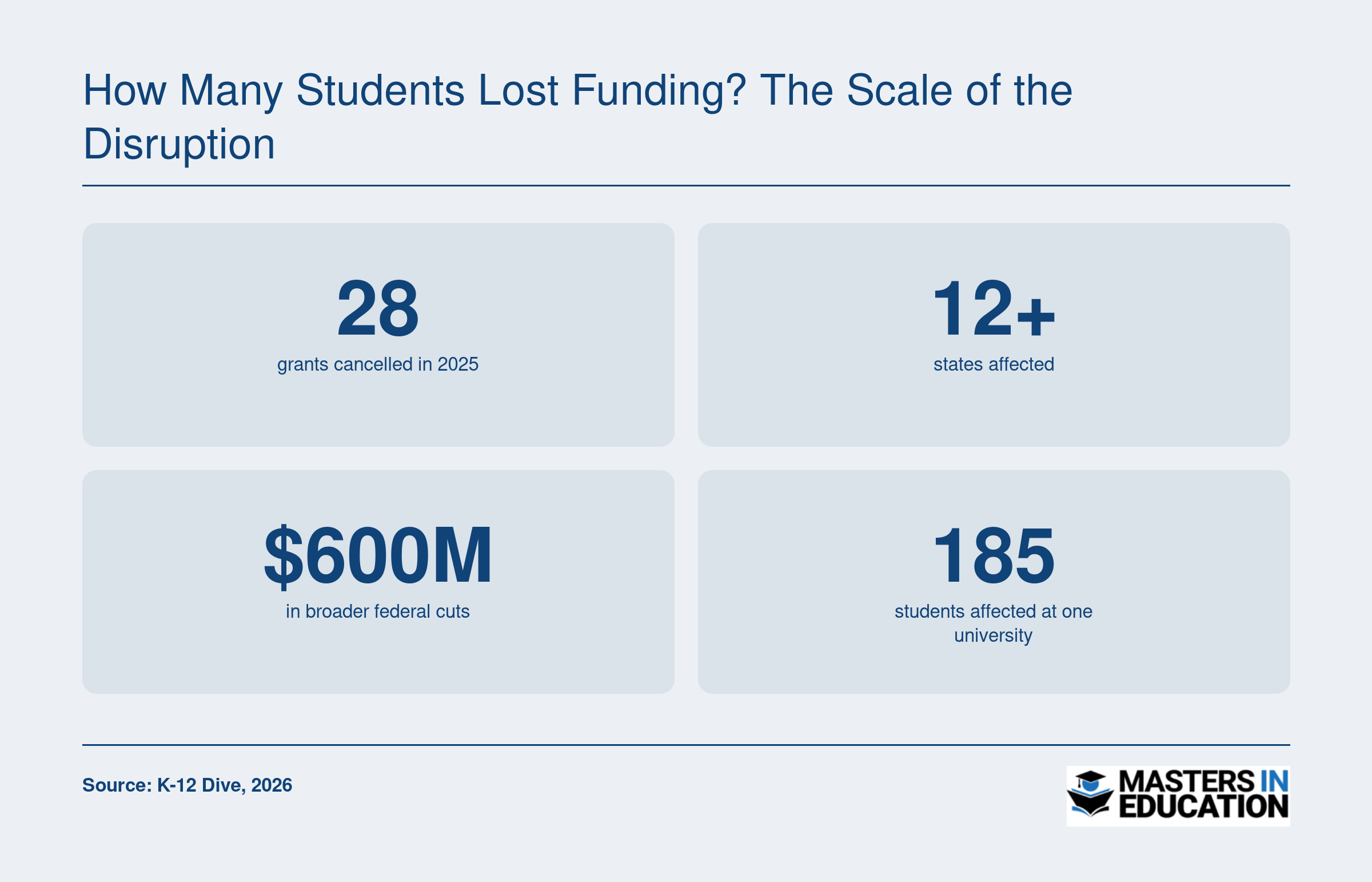
How Many Students Lost Funding? The Scale of the Disruption
The cancellation of 28 professional development grants for teachers of English learners has sent shockwaves through university-based preparation programs. While the full number of displaced students is still being tallied, early reports from affected institutions reveal a widespread impact on aspiring bilingual educators.
How Grant Cancellations Worsen the Teacher Shortage
Canceling 28 professional development grants that were specifically designed to expand the bilingual and English learner teacher workforce directly worsens an already critical shortage. These grants, awarded under the Biden administration between 2021 and 2024, were not general-purpose awards; they targeted precise pipeline gaps that school districts have struggled to fill for years. The abrupt cancellation, which the lawsuit alleges was based on mechanical keyword searches for terms like "equity" and "diversity," will make it harder for aspiring educators to earn the specialized credentials that high-need classrooms require.
Why bilingual and EL teacher pipelines are especially fragile
Becoming a bilingual or English learner teacher involves requirements above and beyond a standard teaching license. Candidates typically complete additional coursework in language acquisition, dual-language instruction methods, and culturally responsive pedagogy. They must also pass rigorous language proficiency assessments, and in many states, accumulate extra clinical hours in bilingual settings. Grant-funded programs help offset tuition, provide stipends for living expenses during unpaid residencies, and fund the cohort-based support that keeps candidates enrolled. When funding disappears mid-program, students may be forced to pause or abandon their training, and universities lose the capacity to recruit new cohorts.
On-the-ground disruption: evidence from the federal lawsuit
Tina Cheuk, associate professor at California Polytechnic State University and a plaintiff in the lawsuit, described exactly this kind of disruption. The grant was designed to expand the bilingual teacher workforce, Cheuk stated, and its loss disrupted programs that were already underway. Teacher candidates at Cal Poly and similar institutions in at least 12 states now face uncertainty about tuition support and program completion. For many, the choice is between taking on additional debt or leaving the profession before they have even entered the classroom.
A threat to high-need schools nationwide
The timing is especially damaging. Teacher shortages in English learner education, special education, and rural communities are well documented, and pandemic-era disruptions worsened the situation. Every cohort that fails to materialize means another year of unfilled positions, larger class sizes, and more students without qualified instructors. Removing targeted pipeline funding does not simply pause progress; it accelerates attrition and signals to potential candidates that teaching in high-need fields is an unsupported path. Educators exploring M.Ed. programs by state should be aware that without restored or replacement funding, the cancellations will deepen the shortage for years to come.
Questions to Ask Yourself
Legal Precedents: Could the Cancellations Be Overturned?
The Washington v. U.S. Department of Education Precedent
The strongest signal that the 28 English learner professional development grants could be restored comes from a separate lawsuit, *Washington v. U.S. Department of Education*. That case challenged the abrupt cancellation of School-Based Mental Health Services (SBMHS) grants. On December 19, 2025, U.S. District Judge Kymberly Evanson ruled that the Department of Education acted in an "arbitrary and capricious" manner under the Administrative Procedure Act, striking down the cancellations and issuing a permanent injunction.1
The court found the Department had abruptly applied new, unpublished political priorities to rescind funds, disregarded the reliance interests of grant recipients, and bypassed standard regulatory procedures. The Ninth Circuit subsequently denied two emergency stay requests, leaving the preliminary and permanent injunctions in place while the appeal proceeds.23
Applying the "Arbitrary and Capricious" Standard to EL Teacher Grants
Although the SBMHS ruling does not directly bind the 28 grants at issue in the June 3, 2026 lawsuit by the Southern Poverty Law Center and National Education Association, the legal reasoning is highly relevant. The SPLC/NEA complaint alleges that the Department used mechanical keyword searches for terms like "equity" and "diversity" to cancel the EL teacher preparation grants, a process that mirrors the abrupt, non-transparent decision-making condemned in the *Washington* case.
If a court applies the same "arbitrary and capricious" standard, the Department would need to show a rational connection between the facts found and the choice made. Canceling grants based on keyword scans without evaluating each program's actual content, or considering the harm to teacher pipelines in at least 12 states, is likely to fail that test. The *Washington* court's emphasis on reliance interests is especially salient here, because universities and school districts designed multi-year bilingual teacher certification pathways around these grants.
The Supreme Court Complication
Despite the successful challenge in the mental health case, the legal landscape remains uncertain. In a separate proceeding, the Supreme Court temporarily allowed other broader grant cancellations to proceed without specifying a legal standard. That procedural ruling did not address the merits but created a backdrop where lower-court victories do not guarantee immediate reinstatement. Even if a district court finds the EL grants were canceled unlawfully, the Department could seek an emergency stay from a higher court, prolonging the disruption.
What a Favorable Ruling Would Mean, and When
Litigation of this type typically takes 12 to 24 months to reach a final outcome, absent a settlement. As of mid-2026, the SPLC/NEA lawsuit is in its earliest stages, and no preliminary injunction has been requested or granted. Even if the plaintiffs eventually prevail, reinstated funding may arrive too late for students currently enrolled in affected M.Ed. programs. Universities may need to make program decisions, such as suspending bilingual cohorts or reducing faculty lines, long before a final court order. In the SBMHS case, the district court ordered the Department to resume grant administration by early March 2026, roughly three months after the December 2025 ruling.4 A similar timeline, if achieved, would push any restoration of EL grants into fall 2027 or later, leaving a critical gap in teacher training capacity. Educators exploring alternative funding paths in the interim may want to investigate tuition-free teacher education options that do not depend on federal grants.
Broader Federal Funding Landscape for Teacher Education
Federal investment in teacher education is undergoing a retreat that extends far beyond a single grant program. The 28 professional development grants cancelled in June 2026 are part of more than $600 million in total education grant terminations since 2025. For M.Ed. students and program administrators, understanding the breadth of these cuts is essential to assessing personal risk and identifying what support remains.
The $600 Million Context
The 28 grants targeting bilingual and English learner teacher preparation represent a narrow slice of a sweeping federal withdrawal. Cancellations have touched Title III national professional development projects, mental health service provider training, and other competitive grant streams awarded under the Biden administration between 2021 and 2024. The scope suggests a systematic reduction in funding for programs that address specific workforce gaps, such as shortages of bilingual educators and school counselors. M.Ed. students in any federally funded cohort should not assume their program is insulated from future policy shifts.
Where the TEACH Grant Stands
The TEACH Grant, a federal aid program that provides up to $4,000 per year to students who commit to teaching in high-need fields at low-income schools, was not among the 28 cancelled awards. As of June 2026, the program continues to accept applications and disburse funds. However, its future is tied to the same political environment that triggered the professional development grant cancellations. Proposals to alter service requirements or convert grants to loans could emerge. Prospective M.Ed. students relying on TEACH Grants should monitor policy announcements closely and have contingency plans for covering tuition, including exploring M.Ed. program service obligations.
The Supreme Court's Signal on Grant Challenges
Legal relief is not guaranteed even when lower courts rule against the administration. The Supreme Court temporarily allowed broader cancellations to proceed while lawsuits work through the system. This means that while some plaintiffs have succeeded at the district or circuit level, the high court has signaled that grant terminations may continue during appeals. For M.Ed. students, this introduces prolonged uncertainty: a program that appears saved by a lower court ruling could still be suspended months later.
Other Grant Categories at Risk
Beyond English learner teacher preparation, cancellations have hit mental health service grants, a move that prompted a similar lawsuit in Washington state. The 9th Circuit found those cancellations arbitrary and capricious, but that ruling does not automatically protect other grant types. The disruption also threatens the pipeline for roles like TESOL program coordinator, which depend on federally supported training cohorts. Title III formula grants to states, which support English language acquisition programs, remain mostly intact, but competitive professional development awards under that same title are vulnerable. M.Ed. students should identify the specific federal funding stream supporting their studies and check whether it has been challenged or terminated in recent months.
Related Articles
What M.Ed. Students Can Do Right Now
The loss of federal professional development grants for English learner and bilingual teacher programs has disrupted funding for many M.Ed. students. While the lawsuit proceeds, there are still actions you can take to secure financial support and stay on track. The most important step is to immediately explore the TEACH Grant, a federal program that remains fully operational in 2026.
The TEACH Grant: A Federal Lifeline Still Available
The Teacher Education Assistance for College and Higher Education (TEACH) Grant provides up to $3,772 per year for graduate students enrolled in an eligible M.Ed. program.1 Over the course of your degree, you can receive up to $8,000 in total TEACH Grant funds.1 The program is specifically designed for future educators committed to high-need fields, and bilingual education and English language acquisition are explicitly listed as qualifying areas.1 To apply, you must complete the Free Application for Federal Student Aid (FAFSA), sign an Agreement to Serve, and undergo entrance counseling.2 Eligibility requires a cumulative GPA of at least 3.25 or scoring above the 75th percentile on a college admissions test.1
- Service commitment: After graduation, you must teach full-time for four academic years in a low-income school within eight years of leaving the program.3
- Conversion risk: If you fail to meet the teaching obligation, the grant converts to a Direct Unsubsidized Loan with interest retroactive to the date of disbursement. Make sure you understand and are prepared to fulfill the service terms.3
Students pursuing M.Ed. in diverse learning pathways should note that the TEACH Grant also covers special education and reading, making it relevant across multiple high-need concentrations.
State-Level Scholarships and Emergency Funding
Many states that relied on the 28 cancelled grants have stepped in with backstop scholarship programs administered through state education agencies. While specific programs vary, several states have redirected existing teacher pipeline funds or created emergency scholarships for impacted M.Ed. students. Contact your state's department of education or the financial aid office at your institution to ask about temporary relief for bilingual and EL teacher candidates. Because this funding is often distributed quickly and without widespread publicity, you must actively inquire to learn about available options.
Institutional Aid and Financial Support
M.Ed. students should remember that university-based funding sources are entirely unaffected by the federal grant cancellations. Graduate assistantships, departmental fellowships, and institutional scholarships remain available. Title IV federal aid programs, including Direct Unsubsidized Loans and Grad PLUS Loans, also continue without interruption. If you are specifically enrolled in a bilingual or English learner program, schedule a meeting with your program coordinator and financial aid office to discuss any targeted support. Some universities have created dedicated emergency funds for teacher candidates caught in the cuts. For a broader look at programs that minimize out-of-pocket costs, see our guide to M.Ed. program service obligations explained.
Monitor the Lawsuit and Document Your Participation
The lawsuit filed by the Southern Poverty Law Center and the National Education Association seeks to reinstate the cancelled grants. A favorable ruling could mean retroactive funding for students who were enrolled during the gap period. To protect your eligibility, keep careful records: save your enrollment verification, course schedules, and any correspondence about your original grant funding. If restoration occurs, you will need to demonstrate that you were actively pursuing the bilingual or EL teacher pathway when the grants were revoked.
Tap into Advocacy Networks
The NEA and state teacher associations are closely tracking which students and programs were affected. Joining these networks gives you early notice of any reinstatement, new funding opportunities, or alternative grant rounds. Advocacy channels also amplify the collective voice needed to push for stable, long-term funding for EL and bilingual teacher preparation.
Frequently Asked Questions
Understand how grant cancellations affect your M.Ed. funding and career plans. Below are direct answers to the most common questions from educators navigating the 2025–2026 federal funding changes.