
What you’ll learn in this article…
- National Board Certification costs $1,900 total, while a typical M.Ed. runs between $10,000 and $60,000.
- State salary incentives for NBCTs range from zero to over $10,000 annually depending on where you teach.
- Texas is reviewing whether NBC qualifies for Teacher Incentive Allotment raises of up to $9,000 per year.
- Select universities award graduate credit for completed NBC components, potentially shortening your M.Ed. timeline.
Does National Board Certification count toward an M.Ed., and is it worth pursuing if you already hold one? Fewer than 1% of Texas teachers are nationally board certified, even though the state now offers salary boosts of up to $9,000 annually for those who earn the credential.1 That gap points to a broader reality: most educators, including M.Ed. graduates, are unclear on how the two credentials interact.
An M.Ed. and National Board Certification share overlapping intellectual demands but serve distinct professional purposes. The certification costs $1,900 upfront, takes one to three years to complete, and carries a salary impact that varies sharply by state. Some universities also award graduate credit for completed components, which changes the financial calculus considerably.
The stakes are rising. Texas' $8.5 billion school funding law, passed in 2026, has put National Board Certification under formal state review, with policymakers debating whether it qualifies for merit-based pay incentives at all.1 What happens in Texas will likely influence how other states value the credential going forward.
What Is National Board Certification?
National Board Certification sits at the intersection of professional prestige and practical classroom impact, offering a credential that complements your M.Ed. rather than competing with it.
What NBC Is and How It Works
National Board Certification is a voluntary, advanced teaching credential issued by the National Board for Professional Teaching Standards (NBPTS), an independent nonprofit organization. Unlike state teaching licenses, which grant you permission to teach, National Board Certification recognizes accomplished teaching practice. It is distinct from any state-issued licensure and is recognized in all 50 states, making it portable across district and state lines.
The NBPTS offers certificates in 25 areas, each combining a subject focus with a developmental level. Examples include Early Childhood Generalist (ages 3 to 8), Middle Childhood through Early Adolescence English Language Arts (ages 7 to 15), and Adolescence and Young Adulthood Science (ages 14 to 18+). Once earned, the certificate is valid for five years, after which teachers must complete a renewal process to maintain the credential.
Why NBC Is Considered the Most Rigorous Teaching Credential
National Board Certification is widely regarded as the most demanding voluntary teaching credential in the United States.1 The assessment process evaluates your ability to plan instruction, analyze student learning, and reflect on your practice using evidence from your own classroom. Roughly 1,200 of Texas' 382,000 teachers hold the credential, representing less than 1 percent of the state's teaching workforce.1 This selectivity underscores the rigor and commitment required to earn it.
How NBC Complements an M.Ed.
For M.Ed. graduates, National Board Certification offers a distinct value proposition. Your master's degree signals advanced academic knowledge in curriculum development, educational theory, or instructional leadership. National Board Certification, by contrast, documents classroom mastery. It demonstrates that you can apply research-based practices to real students, assess their progress, and adjust instruction accordingly. Together, the two credentials position you as both a scholar and a practitioner, a combination that resonates with hiring committees, salary schedules, and career advancement panels.
NBC Eligibility Requirements and the Four-Component Process
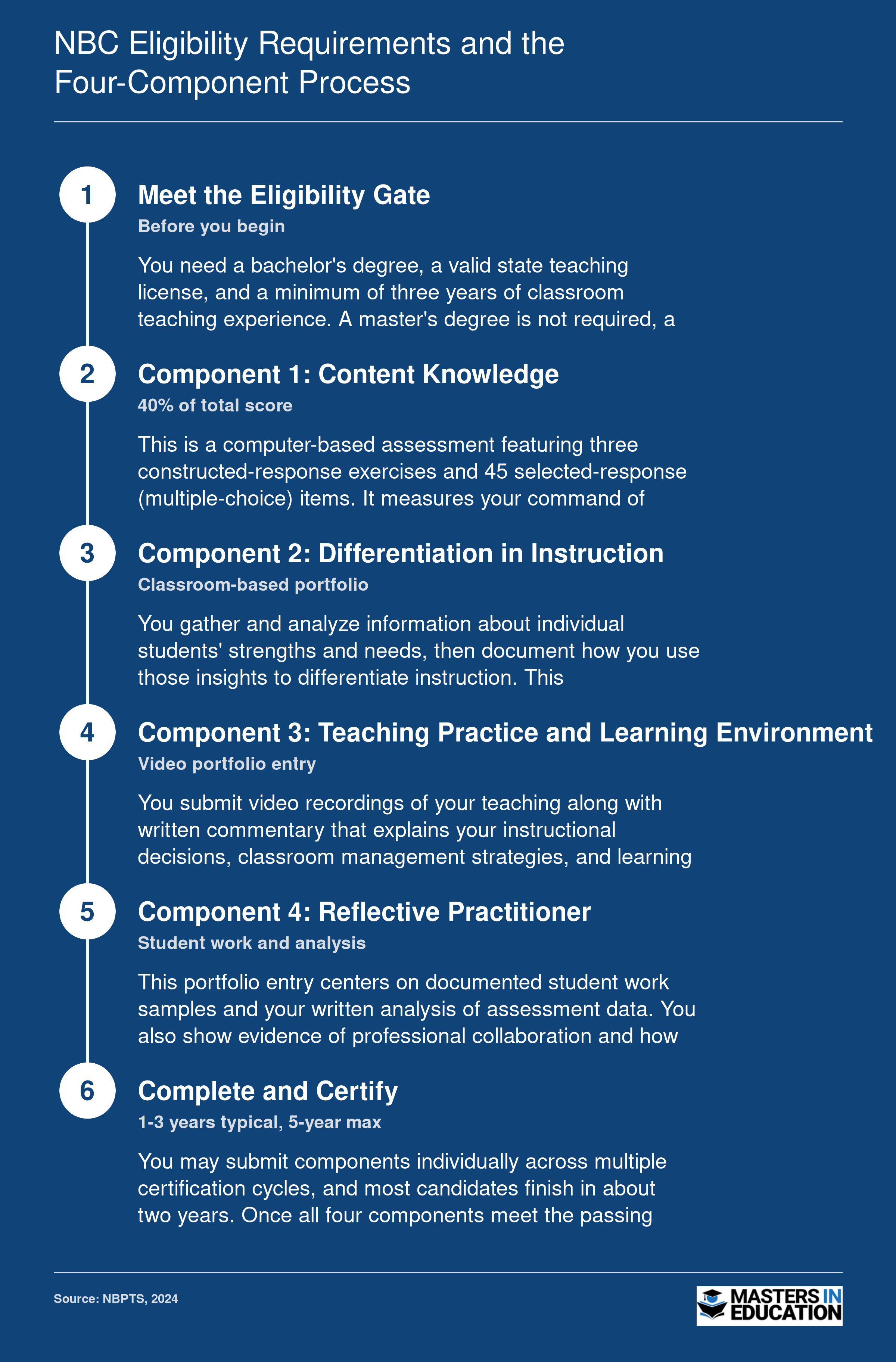
National Board Certification is widely regarded as the most rigorous teaching credential in the United States. Following the 2022 redesign, NBPTS removed the master's degree requirement, opening the process to any educator who holds a bachelor's degree, a valid state teaching license, and at least three years of classroom experience. Most candidates complete the four components over one to three years, though they have up to five years to finish. Component 1 (the assessment center exam) accounts for 40% of the total score, while Components 2 through 4 (the portfolio entries) collectively make up the remaining 60%.
How an M.Ed. Prepares You for National Board Certification
A Master of Education degree and National Board Certification share a surprising amount of intellectual DNA. Both demand deep reflection on teaching practice, systematic analysis of student learning, and the ability to connect classroom decisions to research and theory. When pursued strategically, an M.Ed. can significantly reduce the effort required to complete National Board Certification while strengthening your candidacy for both credentials.
Mapping M.Ed. Coursework to NBC Components
The overlap between graduate coursework and National Board requirements is substantial. Curriculum and instruction degree programs directly prepare you for Component 4, which requires you to reflect on your teaching context, professional growth, and contributions to student learning. When you write a curriculum theory paper in graduate school, you practice the same analytical lens that Component 4 demands: connecting instructional choices to learning outcomes and justifying decisions with evidence.
Assessment and differentiation courses, common in M.Ed. programs, map directly to Component 2. National Board evaluators look for your ability to analyze student work, adjust instruction based on assessment data, and meet diverse learner needs. Graduate coursework in assessment literacy gives you the vocabulary and frameworks to articulate these practices with precision.
Research methods courses strengthen the written commentary required across all four National Board components. The ability to make claims, support them with evidence, and cite research is central to both graduate writing and NBC portfolio entries. M.Ed. students who complete a thesis or capstone project arrive at National Board Certification with a major advantage: they already know how to construct an argument about teaching and back it up with data.
Integrated M.Ed. and NBC Programs
A small but growing number of universities have formalized the connection between M.Ed. degrees and National Board Certification. Texas A&M International University offers an M.S. in Curriculum and Instruction with a Master Teacher concentration explicitly aligned with NBPTS standards.1 The program is staffed by National Board Certified Teachers who guide students through portfolio analysis and help them use graduate coursework to generate NBC artifacts. The program treats the National Board application as a culminating experience rather than a separate credential to pursue after graduation.
While integrated programs remain rare, many M.Ed. programs allow you to count National Board portfolio work as graduate credit hours. This credit articulation reduces your total coursework load. For example, some programs accept completed NBC components as substitutes for elective courses or capstone projects, effectively awarding 3 to 6 graduate credits for work you complete during certification.
Concurrent Pursuit: Timeline and Artifacts
Pursuing an M.Ed. and National Board Certification concurrently typically adds six to twelve months to your timeline compared to completing them sequentially. However, the total effort decreases because your coursework produces artifacts you can adapt for your NBC portfolio. A video-recorded lesson for a pedagogy course can become part of your Component 3 submission with minor revisions. Student work samples analyzed in an assessment course can inform your Component 2 entry.
The key is intentional design. Before you begin either credential, map your M.Ed. program's major assignments against the four NBC components. Identify overlaps and plan assignments that serve both purposes. Educators pursuing a teacher leadership degree may find especially strong alignment, since those programs emphasize reflective practice and evidence-based decision-making.
The Graduate Advantage
If you already hold an M.Ed., your reflective writing and research skills give you a decisive advantage in Component 4. National Board evaluators consistently note that candidates with graduate training produce stronger written commentary because they know how to synthesize research, articulate their pedagogical reasoning, and connect classroom practice to broader educational theory. You have already built the thinking and writing habits that National Board Certification requires. What remains is translating those habits into the specific format and evidence standards of the NBC portfolio.
Can National Board Certification Count as Graduate Credit?
Completing National Board Certification components can earn you real graduate credit at select universities, reducing the time and money you need to finish an M.Ed.
How the Credit Mechanism Works
Some universities recognize the intellectual rigor of the National Board process as equivalent to graduate coursework. Rather than sitting through another seminar, candidates who complete portfolio components, assessment center exercises, or the full certification cycle can apply for credit that counts toward a master's degree. The catch: this arrangement is not universal, and the number of credits awarded varies significantly by institution. If you are already exploring accelerated master's in education options, pairing that timeline with NBC credit can compress your path even further.
Institutions That Award Credit
A handful of universities have published formal policies worth knowing about before you choose a graduate program.
- University of West Georgia: Awards 3 to 6 graduate credits to certified NBCTs who are enrolled in a UWG graduate program. The university may also apply a tuition waiver covering up to 6 credits. Credits may transfer to other institutions, though approval depends on the receiving school.1
- Illinois State University (via the National Board Resource Center): Offers 6 graduate credits through NBRC-affiliated courses. State subsidies frequently cover the NBPTS assessment fee for Illinois teachers who enroll. Credits are sometimes accepted as electives at other institutions when individually approved.2
- Loyola University Maryland: Awards 2 graduate credits, though the credit is tied to course enrollment rather than granted automatically for completing the NBPTS process.3
- Wilmington University: Offers a full M.Ed. in Instruction designed specifically for National Board Certified Teachers, with a 30-credit program structure built around the NBCT credential.4
- University of Colorado Colorado Springs (UCCS): Has a published credit-award policy for NBC components, recognizing the work as equivalent to graduate study.
Transferability Limits and District Policies
Graduate credit awarded for NBC work does not always follow you to a different institution's M.Ed. program. A credit earned at West Georgia may not count toward a degree at a state university across the country. Confirm transfer policies with the receiving program before you enroll anywhere.
Even when formal transfer is not possible, the credits still carry practical value. Many school districts accept NBC-equivalent graduate credits for salary lane advancement, meaning you could move to a higher pay step without completing a full master's degree at a specific school.
The Practical Takeaway
If you have not yet started an M.Ed., choosing a program that formally awards credit for NBC components can cut your tuition costs by roughly $3,000 to $6,000, depending on per-credit rates. That is a meaningful reduction for educators financing graduate school on a teacher's salary, and it makes the two credentials more complementary than competing.
National Board Certification Cost vs. M.Ed. Cost
Understanding the full financial picture of each credential helps you plan strategically. The table below compares the direct costs, additional fees, time investment, and renewal requirements for National Board Certification and a typical Master of Education program. Keep in mind that state subsidies, employer tuition reimbursement, and financial aid can significantly reduce out of pocket expenses for either path.
| Credential | Base Cost | Retake / Extension Fees | Time Commitment | Renewal Requirement |
|---|---|---|---|---|
| National Board Certification (initial) | Approximately $1,900 (total registration and assessment fees) | Component retake fees typically range from $125 to $475 per component | 1 to 3 years to complete all four components | Renewal required every 5 years (Profile of Professional Growth submission) |
| Master of Education (M.Ed.), typical program | Approximately $10,000 to $60,000+ depending on institution type (public vs. private, in state vs. out of state) | Varies by program; some charge per credit retake at full tuition rate | 1 to 3 years for full time enrollment; part time options may extend to 4 years | No renewal required; degree is permanent once conferred |
| National Board Certification renewal | Approximately $1,250 (renewal fee) | N/A | Completed during the final year of the 5 year certification cycle | Subsequent renewals every 5 years |
| M.Ed. with state teaching license renewal | Varies by state; continuing education and professional development costs typically range from $0 to $500 per renewal cycle | Some states charge additional fees for late renewal or endorsement additions | Ongoing; most states require renewal every 3 to 5 years | State license must be renewed on the state's cycle, independent of the M.Ed. degree |
Breaking Down the Numbers: What Each Credential Actually Costs
National Board Certification Fees
The National Board charges a flat $1,900 fee to complete all four components of the certification process. Candidates who need to retake an individual component pay $395 per retake. Fee assistance programs offered through the National Board for Professional Teaching Standards (NBPTS) and many state agencies can reduce or eliminate these costs. Some states, including Texas, fully reimburse the $1,900 upon achieving certification, making the upfront expense effectively zero for eligible teachers.
Master of Education Degree Costs
M.Ed. program costs vary widely by institution type. Online public university programs typically range from $10,000 to $20,000 total, while private university programs may run $25,000 to $45,000. You can research and compare M.Ed. programs by state to get a clearer picture of regional pricing. Programs that integrate National Board preparation into the curriculum sometimes offer bundled pricing or grant pathways that lower net cost, but these remain the exception rather than the norm.
Opportunity Costs Compared
Pursuing National Board Certification demands 1 to 3 years of evenings and weekends with no tuition bill, allowing teachers to continue earning a full salary throughout. An M.Ed., by contrast, requires structured enrollment over 1 to 3 years and often forces working teachers to balance coursework with job demands, potentially slowing income growth if the program does not align with salary lane advancement. Teachers looking to minimize time to completion may want to consider one-year M.Ed. programs that compress the timeline. The tradeoff: NBC carries a lower financial barrier but an intense self-directed workload, while the M.Ed. provides a degree that may unlock broader career moves beyond the classroom.
Combined Path Return on Investment
A teacher who earns both credentials in a state with strong NBC stipends can recover the total investment in 3 to 5 years through layered salary increases. For example, many districts add annual supplements of $2,000 to $10,000 for NBCTs, while the M.Ed. often triggers a permanent lane change that boosts base pay. Combined, these increases can compound significantly over a career. Before committing, verify whether your state or district reimburses NBC fees entirely after certification, as this can tip the cost-benefit analysis heavily in favor of pursuing both credentials.
How National Board Certification Affects Teacher Salaries
The salary impact of National Board Certification varies dramatically depending on where you teach. Some states offer robust, recurring stipends that can add tens of thousands of dollars over the life of your certificate, while others provide no state-level incentive at all. The table below pairs approximate 2024 median teacher salaries (based on Bureau of Labor Statistics data) with known state NBC incentives, giving M.Ed. graduates a clearer picture of the financial return on certification. Keep in mind that these figures represent the state floor: many individual districts layer their own bonuses on top, even in states without a formal state program.
| State | Approx. Median Elementary Teacher Salary (2024) | Approx. Median Secondary Teacher Salary (2024) | State NBC Incentive | Incentive Details |
|---|---|---|---|---|
| North Carolina | Not in top-reported states | Not in top-reported states | 12% salary increase | Annual raise for the life of the certificate; no high-need school requirement |
| California | $98,190 | $98,710 | $5,000 per year (up to $25,000 total) | Paid over 5 years; must teach in a high-priority school (55%+ ELL, foster, or free/reduced lunch students); $2,500 fee subsidy also available |
| Texas | Not in top-reported states | Not in top-reported states | $3,000 to $9,000 per year | Distributed through the Teacher Incentive Allotment to districts; $1,900 initial fee reimbursement and $495 renewal reimbursement available |
| Washington | $99,110 | $99,640 | Check state policy | N/A |
| New York | $82,480 | $98,370 | Check state policy | N/A |
| Pennsylvania | $74,160 | $77,990 | Check state policy | N/A |
| South Carolina | Not in top-reported states | Not in top-reported states | No state-level stipend currently | District-level incentives may still apply |
| Florida | Not in top-reported states | Not in top-reported states | No state-level stipend currently | District-level incentives may still apply |
| Georgia | Not in top-reported states | Not in top-reported states | No state-level stipend currently | District-level incentives may still apply |
NBC Pay Boost at a Glance
State incentives for NBCTs vary widely, but the credential consistently translates into higher annual pay.
Texas Spotlight: The NBC Policy Debate and What It Means for Your Career
As of the 2026-2027 school year, Texas is introducing a new "Nationally Board Certified" designation that can unlock between $3,000 and $9,000 annually through the Teacher Incentive Allotment (TIA).2 This change, driven by House Bill 2 and an $8.5 billion school funding law, places National Board Certification directly into the state's merit-based pay system, but also into a heated policy debate.
Why the Debate Matters
The Texas Tribune reported in May 2026 that a prominent Republican state senator argues National Board Certification does not align with Texas' goal of merit-based teacher pay.3 In response, the State Board for Educator Certification (SBEC) has been reviewing whether NBC meets the criteria for TIA raises. A subcommittee was formed, and SBEC must decide by December 31, 2026.1 If the board does not reauthorize NBC as a qualifying pathway, the designation will automatically sunset on that date, leaving teachers without the associated salary bump.4
Currently, about 620 NBCTs receive TIA funds under the previous "Recognized" designation.3 Under the new framework, they would transition to the "Nationally Board Certified" tier if reauthorization occurs. The uncertainty makes 2026 a critical year for any Texas educator considering the certification, and for M.Ed. graduates nationwide exploring careers for masters in education.
How to Stay Informed
Because the outcome will directly affect your compensation, staying current on the rulemaking process is essential. Here are four steps you can take:
- Monitor the Texas Education Agency website: The TEA's Teacher Incentive Allotment page is the central hub for designation updates.2 Review it monthly for any changes to eligible pathways or allotment amounts.
- Review SBEC meeting agendas and minutes: SBEC publishes full agendas and minutes on the TEA site. After May 2026, check for items labeled with "National Board Certification" to catch votes or staff recommendations. The subcommittee's work should appear in these records.1
- Contact a professional educator association: Organizations like the Association of Texas Professional Educators (ATPE) and the Texas Classroom Teachers Association (TCTA) closely track regulatory shifts. They often summarize SBEC actions in member alerts and can clarify how pending decisions affect your license.
- Set digital alerts: Use Google Alerts for "National Board Certification Texas" and "Teacher Incentive Allotment" to receive real-time news. Also subscribe to TEA email notifications to avoid missing formal announcements.
Planning Your Certification Timeline
If you are halfway through the NBC process, the December 2026 deadline creates pressure to complete and submit components so your certification is active before any potential revocation. Conversely, if you are just considering NBC, you might wait until SBEC's decision is public to avoid investing time and money in a credential that may lose salary incentive value. Keep in mind that Texas currently reimburses the $1,900 initial certification fee, $1,250 renewal, and $495 for Maintenance of Certification, which can significantly reduce your out-of-pocket costs.2 Even if the salary bump is later revised, completing certification now locks in those reimbursements and positions you for any future incentive adjustments.
Should You Pursue NBC, an M.Ed., or Both? A Decision Framework
The choice between National Board Certification, a Master of Education, or both is less about which credential is "better" and more about which one aligns with the career you are actually building. Each opens different doors, carries different costs, and signals different strengths to employers, so the right path depends on where you are now and where you want to go.
Start With Your Career Goal
National Board Certification is designed for accomplished classroom practitioners who want to deepen their teaching craft and be recognized for it. It does not qualify you for administrative licensure, and it is not a graduate degree. If your primary objective is to stay in the classroom while earning higher pay and building professional credibility, NBC is a strong fit.
An M.Ed., by contrast, serves a wider range of ambitions. Leadership-focused programs can lead to principal or district-level licensure. Specialist tracks open doors to curriculum and instruction degree options, instructional coaching, or school counseling. If you see yourself moving beyond a single classroom, the M.Ed. provides a broader credential.
Pursuing both credentials tends to benefit educators who want to maximize classroom earnings and instructional impact without ruling out future leadership opportunities. In New York City, for example, holding both an M.Ed. and NBC can place a teacher in the highest salary lane, sometimes designated C6+PD, which exceeds the differential available with either credential alone.1
Weigh the Practical Tradeoffs
Both credentials can take roughly 12 to 36 months to complete, but the day-to-day demands differ. Consider these factors:
- Teaching experience required: NBC requires at least three years of classroom experience. An M.Ed. can be started at any point, including before or during early-career teaching.
- Administrative pathway: Only the M.Ed. (in leadership concentrations) qualifies you for principal or assistant principal licensure in most states.
- Salary impact: State and district incentives vary widely. Some states offer NBC stipends of several thousand dollars per year, while an M.Ed. typically moves you to a higher column on your district's salary schedule. Nationally, the median annual wage for K-12 teachers sits around $74,500, and advanced credentials push earners above that benchmark.2
- Portability: NBC is recognized in all 50 states, though incentive amounts differ. An M.Ed. is universally recognized as a graduate degree, which can matter for non-teaching roles.
- Sequencing: Completing an M.Ed. first can build the content knowledge and research skills that make the NBC assessment components more manageable.
A Simple Decision Filter
Ask three questions in order. First, do you plan to remain primarily in the classroom for the next five or more years? If yes, NBC deserves serious consideration. Second, do you want the option to move into administration, counseling, or a specialist role? If yes, an M.Ed. is likely essential. Educators interested in roles like curriculum developer may find that the M.Ed. alone provides the necessary foundation. Third, do you want the highest possible salary lane and the deepest instructional expertise? If yes, pursuing both credentials (ideally the M.Ed. first and NBC second) positions you at the top of most district pay structures while reinforcing your classroom practice.
No single credential guarantees advancement, but understanding what each one is designed to do helps you invest your time and money where it will matter most for the career you actually want.
Questions to Ask Yourself
Frequently Asked Questions About National Board Certification for M.Ed. Graduates
National Board Certification and a Master of Education serve different but complementary purposes in a teaching career. Below are answers to the questions M.Ed. graduates and candidates ask most often when weighing this advanced credential.
Related Articles
The core tradeoff is not prestige versus practicality. It is timing and policy risk versus long-term career architecture. NBC and an M.Ed. are genuinely complementary credentials, but the right sequence depends on where you teach, what stipends your state currently offers, and whether an integrated program lets you pursue both at a lower combined cost.
Before committing to either path alone, check your state's current NBC incentive structure and compare it against integrated M.Ed.-NBC program costs. If you teach in Texas, pay particular attention: the state board's ongoing review of whether NBC aligns with the Teacher Incentive Allotment means the financial case for certification could shift within the next budget cycle. The credential itself remains rigorous and portable. The dollars attached to it are not guaranteed.