
What you’ll learn in this article…
- South Carolina's most affordable M.Ed. programs start below $8,000 per year in graduate tuition for in-state students.
- Every ranked program holds CAEP accreditation, the national standard for educator preparation quality.
- Completing a master's degree moves South Carolina teachers into a higher lane on the statewide salary schedule.
- Teacher vacancies in South Carolina's public schools dropped 35 percent from the prior year, per CERRA's latest report.
South Carolina's statewide teacher salary schedule pays measurably more at the master's level, with annual increases that compound across an entire career. For educators in a state still reporting critical-need shortages in areas like special ed, STEM, and multilingual learner instruction, an M.Ed. is one of the most direct routes to both higher pay and advanced licensure.
Across the state, 18 ranked programs span fully online, on-campus, and hybrid formats, with total tuition ranging from roughly $10,800 to over $20,000 depending on the institution and residency status. Programs run from as few as 12 months to three years, and specializations cover everything from curriculum and instruction to educational leadership and TESOL. The practical challenge for most candidates is matching program format, cost, and specialization to a specific licensure or career goal, especially when employer reimbursement timelines and family obligations are part of the equation.
Best Master's in Education Programs in South Carolina: Rankings Overview
South Carolina offers a strong lineup of graduate education programs spread across public flagships, private universities, and historically Black institutions. Every school on this list holds CAEP accreditation (the national standard that replaced NCATE), which means its educator preparation programs meet rigorous quality benchmarks for curriculum, clinical experiences, and candidate outcomes. Graduation rates shown below reflect the institution as a whole rather than any single M.Ed. program, but they remain a useful indicator of the campus culture, student support, and academic resources you can expect as a graduate student.
- Tuition and net price
- Institutional graduation rate
- Graduate earnings outcomes
- Program availability and format
- Accreditation status
- NCES-IPEDS federal institutional data — nces.ed.gov
- Internal program database
- College Scorecard graduate earnings — collegescorecard.ed.gov
- Independent program research
| Rank | School | Location | Net price | Best for | |
|---|---|---|---|---|---|
| #1 | Clemson University | Clemson, SC | $20,000 – $25,000/yr | Online learners seeking special education expertise | |
Clemson University's College of Education earned the top spot in the nation for online graduate education programs (U.S. News, 2026), making it a premier choice for South Carolina teachers who want to advance without leaving their classrooms. Its CAEP-accredited M.Ed. offerings in special education emphasize Multi-Tiered Systems of Support (MTSS), applied behavior analysis, and advanced classroom management, with an ABAI Verified Course Sequence that meets BCBA coursework requirements. A dedicated South Carolina Teacher Incentive helps keep costs manageable for in-state educators, and strong district partnerships across the state facilitate practicum placements.
| |||||
| #2 | Citadel Military College of South Carolina | Charleston, SC | $13,000 – $39,000/yr | Career changers entering SC classrooms | |
The Citadel's Zucker Family School of Education is widely recognized as one of the strongest teacher preparation programs in South Carolina, with deep pipelines into Charleston, Berkeley, and Dorchester County schools. As a TeachSC partner, it provides application fee reimbursement, one-on-one advising, and scholarship support for career changers pursuing initial licensure. Graduate tuition for in-state students starts at roughly $12,780, and the institution's 75% graduation rate reflects solid academic support within a disciplined campus culture.
| |||||
| #3 | University of South Carolina | Columbia, SC | $23,000/yr | Educators wanting diverse specialization choices | |
As South Carolina's flagship research university, the University of South Carolina delivers the broadest menu of CAEP-accredited M.Ed. and M.A.T. options in the state, spanning early childhood education, special education, higher education leadership, and the arts. USC leverages its statewide alumni network and district partnerships to place graduates across SC schools, and in-state tuition of approximately $14,134 keeps costs moderate for residents. The 78.8% institution-wide graduation rate and strong retention signal a well-resourced campus environment.
| |||||
| #4 | Furman University | Greenville, SC | $30,000/yr | ||
Furman University pairs a nationally recognized education department with more than a century of teacher preparation focused squarely on South Carolina's Upstate region. Its intimate 10:1 student-to-faculty ratio fosters close mentorship, and strong hiring pipelines into Greenville and Spartanburg area school districts give graduates a clear advantage. The M.A.Ed. in TESOL and M.A.T. programs are structured around South Carolina school calendars so working teachers can earn their degrees without stepping away from the classroom.
| |||||
| #5 | College of Charleston | Charleston, SC | $13,000 – $38,000/yr | ||
The College of Charleston is a primary teacher pipeline for the Lowcountry, training educators for Charleston, Berkeley, and Dorchester County schools. Its CAEP-accredited education programs carry Initial-level accreditation, and the M.Ed. in Languages targets the region's growing multilingual student population through 100% online delivery. In-state graduate tuition of roughly $16,300 and a cross-institutional partnership with The Citadel for middle grades coursework add flexibility and value for local educators.
| |||||
| #6 | Anderson University | Anderson, SC | $24,000/yr | ||
Anderson University offers a values-driven M.Ed. experience rooted in Christian principles and tailored to Upstate South Carolina educators. Its fully online M.Ed. in Administration and Supervision can be completed in as few as 18 months and prepares graduates for PK-12 principal certification in South Carolina, with internship placements arranged in local public schools across Anderson, Greenville, and Pickens counties. The MAT in Elementary Education serves career changers through a seated satellite format with I-20 approval for international students.
| |||||
| #7 | Winthrop University | Rock Hill, SC | $15,000/yr (net price) | ||
Winthrop University in Rock Hill is a long-standing educator preparation institution with strong ties to South Carolina school districts in the Charlotte metro area and beyond. Its CAEP-accredited programs span educational leadership, learning design and technology, special education intervention, and a 14-concentration M.A.T., giving teachers wide flexibility to specialize. A 30% tuition discount for educators and a 98% licensure pass rate in the online Educational Leadership program make Winthrop an especially practical choice for SC teachers eyeing principal roles.
| |||||
| #8 | Coastal Carolina University | Conway, SC | $10,000 – $15,000/yr | ||
Coastal Carolina University in Conway provides CAEP-accredited education programs that serve the Grand Strand and Pee Dee regions of South Carolina. Its M.Ed. in Educational Leadership uses a hybrid cohort model designed for completion in three years while candidates continue teaching, and internship placements are typically arranged in Horry County and neighboring districts. In-state graduate tuition of approximately $10,764 is among the lowest on this list, making Coastal Carolina an attractive option for budget-conscious SC educators.
| |||||
| #9 | Claflin University | Orangeburg, SC | ~$18,000/yr (est.) | ||
Claflin University is a private HBCU in Orangeburg that plays a vital role in preparing teachers and curriculum leaders of color for South Carolina's rural and high-need school districts. Its fully online M.Ed. in Curriculum and Instruction offers asynchronous coursework in 8-week terms, making it accessible to working educators statewide. The program waives the GRE or MAT for applicants with at least three years of full-time K-12 teaching experience, removing a common barrier for experienced SC professionals.
| |||||
| #10 | Converse University | Spartanburg, SC | $23,000/yr | ||
Converse University in Spartanburg is a well-established Upstate South Carolina educator preparation institution with CAEP accreditation at both Initial and Advanced levels. Its M.Ed. and M.A.T. programs serve working teachers through evening classes, hybrid formats, and rolling admissions aligned with SC school calendars. Specializations in gifted education, special education, elementary education, and art education give Converse one of the most varied graduate catalogs among smaller SC institutions.
| |||||


Most Affordable M.Ed. Programs in South Carolina
Cost is one of the biggest factors for educators weighing a graduate degree. The table below ranks South Carolina M.Ed. programs by in-state graduate tuition, from lowest to highest. Note that net price figures reflect institutional averages across all students (not graduate-specific costs), so your actual out-of-pocket expense may differ based on financial aid, assistantships, and employer tuition reimbursement.
| School | City | In-State Tuition | Out-of-State Tuition | Avg. Net Price | Student-to-Faculty Ratio | Median Earnings (10 Yr) |
|---|---|---|---|---|---|---|
| Lander University | Greenwood | $9,810 | $9,910 | $15,363 | 18:1 | $42,396 |
| Coastal Carolina University | Conway | $10,764 | $21,438 | $13,966 | 17:1 | $47,258 |
| Claflin University | Orangeburg | $10,912 | $10,912 | $17,800 | 13:1 | $40,304 |
| Francis Marion University | Florence | $11,388 | $21,997 | $11,386 | 13:1 | $43,888 |
| South Carolina State University | Orangeburg | $11,460 | $22,570 | $18,097 | 19:1 | $38,262 |
| University of South Carolina Aiken | Aiken | $14,096 | $30,122 | $11,641 | 16:1 | $45,603 |
| University of South Carolina, Upstate | Spartanburg | $14,114 | $30,140 | $13,557 | 15:1 | $48,587 |
| Columbia College | Columbia | $15,630 | $15,630 | $18,408 | 12:1 | $41,338 |
| College of Charleston | Charleston | $16,300 | $21,412 | $18,960 | 16:1 | $56,416 |
| Winthrop University | Rock Hill | $16,306 | $30,780 | $15,343 | 13:1 | $47,185 |
Questions to Ask Yourself
Online vs. On-Campus M.Ed. Programs in South Carolina
South Carolina educators weighing a master's in education have more delivery options than ever, and the choice between online and on-campus study can shape everything from your weekly schedule to your total out-of-pocket cost. Here is what to consider as you compare formats.
The Online Landscape in South Carolina
Many of the state's established universities now offer fully online M.Ed. programs. USC Upstate's M.Ed. in Learning and Instruction, for example, is a 36-credit online program that can be completed in about 24 months at roughly $362 per credit, bringing the total estimated cost to around $13,032.1 Clemson University delivers its M.Ed. in Teaching and Learning entirely online as well, requiring a minimum 3.0 GPA for admission.2 Anderson University offers an online, non-certification M.Ed. suited for educators who want advanced knowledge without pursuing a new credential.3 The University of South Carolina's main campus also hosts a suite of online graduate education programs.4 For working teachers who cannot leave the classroom during the day, these options make it possible to earn a degree on evenings and weekends without relocating.
When On-Campus Programs Make Sense
On-campus cohorts still offer advantages that matter for certain career goals. Face-to-face practica, lab-based research, and in-person mentoring relationships can be especially valuable if you are pursuing a specialization that requires clinical hours, such as school counseling or educational leadership. Some students also find that structured class schedules and peer accountability help them progress more consistently.
Salary and Employer Perceptions
From a hiring standpoint, most South Carolina school districts do not differentiate between an online and an on-campus M.Ed. when placing teachers on salary schedules. What matters is that the degree comes from a regionally accredited institution. Exploring careers for masters in education graduates can help you understand how different credentials map to salary tiers across the profession.
Doing Your Own Due Diligence
Before committing, take a few practical steps:
- Review program pages directly: University websites for Clemson, USC, USC Upstate, and Anderson publish completion rates, enrollment figures, and, in some cases, job placement data.
- Consult professional organizations: The South Carolina Education Association can point you toward employer-perception research and connect you with career counselors who understand the local hiring landscape.
- Compare total costs carefully: Online programs sometimes carry technology fees or differential tuition rates, while on-campus programs may involve commuting, parking, or childcare expenses that do not appear on a tuition chart.
Ultimately, the best format is the one that aligns with your schedule, learning style, and professional goals. Both pathways lead to the same credential on the salary schedule, so let your circumstances, not assumptions about prestige, guide the decision.
Related Articles
Popular M.Ed. Specializations in South Carolina
South Carolina's graduate education landscape offers a wide range of M.Ed. specializations, each tailored to different career goals and licensure outcomes. Understanding which concentrations are available, how they connect to state endorsements, and whether they can be completed online will help you match your program choice to your professional trajectory.
Curriculum and Instruction
Curriculum and Instruction remains one of the most versatile M.Ed. specializations in South Carolina. Programs at schools like Claflin University and Coker University are available fully online, making them accessible to working teachers statewide. Coker's program blends curriculum studies with instructional technology, a combination that reflects growing demand for educators who can integrate digital tools into lesson design. These programs generally do not lead to a new certification but can count toward South Carolina's MA+30 salary supplement when you complete at least 21 semester hours in a concentration area.1
Educational Leadership
Educational Leadership is the most widely offered specialization across the state, with programs at Anderson University, Coastal Carolina University, Winthrop University, Columbia College, Charleston Southern University, and the University of South Carolina Aiken, among others. Completing an approved M.Ed. in Educational Administration prepares you for the Praxis Educational Leadership exam and qualifies you for South Carolina's principal certification.2 Delivery formats range from fully online (Anderson University, Columbia College) to hybrid cohort models (Coastal Carolina) and traditional on-campus programs (Winthrop).
Special Education
Clemson University offers an online M.Ed. in Special Education that includes an ABAI Verified Course Sequence, while the University of South Carolina's Special Education M.Ed. can lead to add-on certifications in areas such as Early Childhood Special Education, Emotional Disabilities, Intellectual Disabilities, Learning Disabilities, and Severe Disabilities.2 USC also offers an M.Ed. in Applied Behavior Analysis that prepares graduates for the Board Certified Behavior Analyst credential.2
Literacy, Reading, and Language
Literacy-focused specializations align closely with South Carolina's Read to Succeed (R2S) requirements. USC's M.Ed. in Language and Literacy can lead to Literacy Teacher and Literacy Coach add-on certifications, while its M.Ed. in Teaching with a Literacy and Reading focus prepares graduates for the R2S Literacy Teacher endorsement.2 These credentials are increasingly valuable as districts prioritize evidence-based reading instruction. Educators in neighboring states face similar literacy mandates; those exploring best master's in education programs in georgia will find comparable endorsement structures tied to state reading initiatives.
TESOL, STEAM, and Educational Technology
Furman University and the College of Charleston both offer graduate programs in TESOL and Multilingual Learners, with Furman's on-campus M.A.Ed. partnering with the state for TESOL endorsement. Educational technology is woven into several Curriculum and Instruction programs rather than standing alone as a separate degree in most SC institutions. STEAM-focused coursework appears as an emphasis within broader programs at select universities.
Alternative Certification Pathways
If you hold a bachelor's degree outside of education, several South Carolina institutions offer Master of Arts in Teaching (MAT) programs designed specifically for career changers seeking initial licensure. Converse University provides an MAT with nine concentration options, South Carolina State University offers MAT tracks in areas like Early Childhood Education, and Francis Marion University runs a hybrid MAT in Early Childhood. The Citadel's MAT prepares candidates for middle grades certification. At the University of South Carolina, initial licensure is available through its MAT and MT pathways rather than its M.Ed. programs.2 Anderson University's M.Ed. is a non-certification option for professionals who want a graduate credential without pursuing a teaching license, completable in as few as 12 months online.3
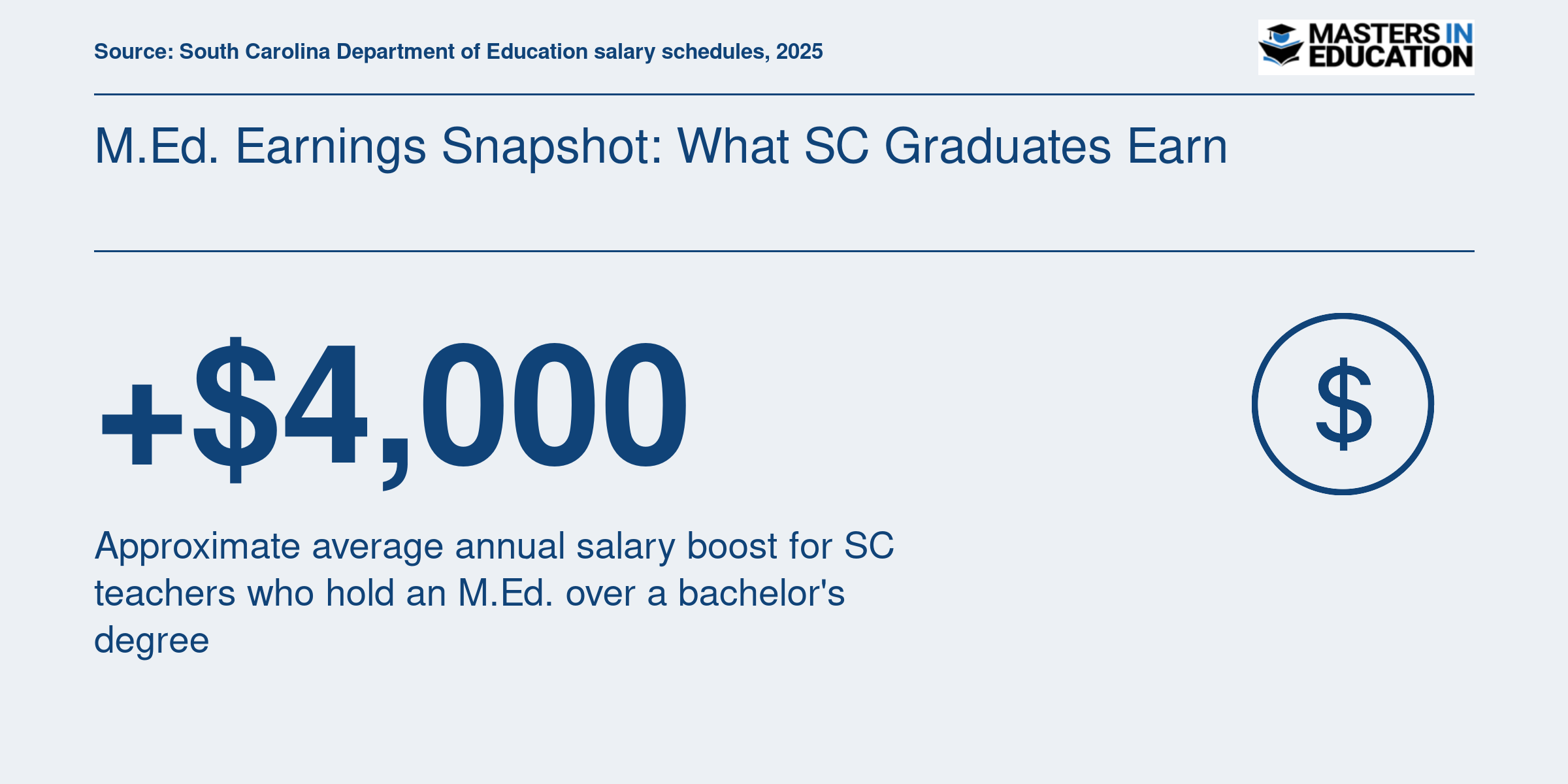
M.Ed. Earnings Snapshot: What SC Graduates Earn
Program-level earnings data for South Carolina M.Ed. programs are not yet available through federal reporting channels. However, earning a master's degree in education directly impacts salary in the state: South Carolina's statewide teacher salary schedule awards higher pay at every experience level for educators holding a master's degree, typically adding $3,000 to $6,000 annually over a bachelor's-level salary. Over a 20-plus year teaching career, that step increase can translate into six figures in additional lifetime earnings.
Admissions Requirements for South Carolina M.Ed. Programs
Getting into a master's in education program in South Carolina is more accessible than many applicants expect, but requirements vary depending on the program type and the institution. Here is what you should prepare for as you build your application.
GPA Expectations
Most South Carolina M.Ed. programs set their minimum undergraduate GPA between 2.75 and 3.0. Clemson University, the University of South Carolina, The Citadel, and the College of Charleston each require a 3.0 on a 4.0 scale. Winthrop University, Coastal Carolina University, Francis Marion University, and South Carolina State University accept applicants with GPAs as low as 2.75, though a stronger GPA improves your chances of admission and may be necessary for certain concentrations.1 If your GPA falls below the posted minimum, some programs allow you to petition for conditional admission or submit additional materials to demonstrate readiness.
GRE Waivers and Test-Optional Policies
One of the most significant shifts in recent years is the widespread adoption of GRE waivers across South Carolina institutions. As of 2026, every major M.Ed. program in the state, including Clemson, USC, Winthrop, Coastal Carolina, The Citadel, Francis Marion, SC State, and the College of Charleston, offers a GRE waiver or test-optional pathway.1 Many of these policies took root during the pandemic and have remained in place as programs found that standardized test scores added little predictive value for graduate success in education. In practice, this means you can focus your application energy on other components rather than months of test preparation.
Standard Application Components
Beyond GPA and test scores, expect to submit the following with most applications:
- Letters of recommendation: Typically two or three, ideally from supervisors, professors, or colleagues who can speak to your professional skills.
- Personal statement or statement of purpose: Programs want to see your motivation for pursuing graduate study and your goals within the field.
- Resume or CV: Highlighting teaching experience, leadership roles, and relevant professional development.
- Official transcripts: From all previously attended institutions.
Prerequisites by Track
Admissions requirements differ based on where you are in your career. Programs designed for already-certified teachers, such as advanced curriculum and instruction degree tracks or educational leadership tracks, typically expect an active teaching license and classroom experience. Initial certification tracks, which prepare candidates to earn their first South Carolina teaching credential, accept applicants without an education background. USC, Winthrop, Coastal Carolina, Francis Marion, and the College of Charleston all welcome applicants who hold non-education bachelor's degrees into at least some of their M.Ed. pathways. Clemson, The Citadel, and SC State accept non-education majors on a more selective or program-specific basis.
Field Experience, Practicum, and Capstone Requirements
Every M.Ed. program reviewed across South Carolina requires some form of practicum, field experience, or capstone project.1 For initial certification tracks, this typically means a supervised student-teaching placement in a South Carolina school. Advanced tracks for experienced educators may substitute an action research project, portfolio, or comprehensive exam for traditional student teaching. Some programs offer a thesis option for students interested in research, while others rely on applied capstone projects that connect directly to classroom practice. Confirm the specific requirements for your chosen concentration before enrolling, as these hands-on components significantly affect your time commitment and scheduling flexibility.
South Carolina Teacher Licensure and Salary Advancement Pathways
Earning a master's in education in South Carolina does more than deepen your expertise. It can directly advance your teaching certificate and unlock higher pay on the state salary schedule. Understanding how licensure tiers, salary lanes, and workforce demand intersect will help you get the most value from your M.Ed. investment.
How SC's Licensure System Works
South Carolina uses a tiered certification structure.1 Teachers typically begin with an Initial Certificate, which is valid for three years. During that window, you must complete an induction program, receive satisfactory ADEPT evaluations, and meet assessment and pedagogy requirements while employed in a South Carolina public school. Once those benchmarks are met, you advance to a Professional Certificate, which is valid for five years and renewable through ongoing professional development.
These certificate tiers determine whether you are authorized to teach, but a separate classification, known as the certificate class level, determines where you fall on the salary schedule. South Carolina recognizes several class levels:2
- Bachelor's: Entry-level placement on the salary schedule.
- Bachelor's plus 18: Requires 18 approved graduate semester hours beyond the bachelor's degree.
- Master's: Requires a master's degree approved by the South Carolina Department of Education.
- Master's plus 30: Requires an additional master's degree, a specialist's degree, or 60 graduate semester hours completed within seven years.
- Doctorate: The highest class level on the schedule.
Moving from the Bachelor's lane to the Master's lane typically results in a meaningful salary increase at every experience step on the state schedule. Over a full career, that difference compounds into a significant earnings advantage.
Choosing a Program That Counts
Not every M.Ed. program will move your certificate class level. To advance on the salary schedule, your degree must come from a program approved by the South Carolina Department of Education.2 Programs designed purely for professional enrichment or leadership development outside the SCDE approval framework may not qualify. Before enrolling, confirm with your prospective institution that the program is recognized for certificate class advancement in South Carolina. You can also compare options across the region by reviewing M.Ed. programs by state.
Where an M.Ed. Carries Extra Weight
South Carolina continues to face teacher shortages in several high-need fields. As of 2026, common shortage areas include special education, mathematics, science, English as a second language, and career and technical education.1 Educators who hold an M.Ed. with a specialization aligned to one of these shortage areas are especially competitive for hiring, retention incentives, and leadership roles. A masters in special education, for example, positions you for one of the state's most persistent shortage disciplines. If you are weighing specialization options, targeting a shortage area can increase both your job security and your bargaining position.
According to CERRA's 2024-2025 South Carolina Educator Supply and Demand Report, teacher vacancies in the state's public schools dropped by 35 percent compared to the prior year. While the improvement is encouraging, ongoing shortages in key subject areas mean that educators with advanced credentials remain in high demand across South Carolina districts.
How to Choose the Right M.Ed. Program in South Carolina
Selecting the right M.Ed. program is a decision that will shape your career trajectory, your finances, and your day-to-day life for the next one to three years. Rather than defaulting to name recognition or convenience alone, use a structured checklist to compare your options side by side.
Verify Accreditation and Licensure Approval
Start by confirming that any program you are considering holds accreditation from the Council for the Accreditation of Educator Preparation (CAEP). This is the gold standard for educator preparation programs and signals that the curriculum, faculty, and clinical experiences meet rigorous national benchmarks. Just as important, check whether the program is approved by the South Carolina Department of Education for licensure advancement. Not every M.Ed. leads to certification, so if moving up on the state salary schedule or adding an endorsement area is your goal, you need explicit confirmation from the program that it qualifies.
Match Format and Specialization to Your Goals
Consider how each program's delivery format fits your life. A fully online cohort model offers predictability and peer support, while a hybrid or on-campus option may provide richer clinical experiences. Then evaluate specialization alignment. A masters in curriculum and instruction track serves a different purpose than an educational leadership or special education concentration. Map each program's coursework to the role you want to hold in three to five years, not just the role you hold today.
Compare True Costs and Timelines
Look beyond sticker tuition. Net price, which accounts for scholarships, assistantships, and fee waivers, gives a far more accurate picture of what you will actually pay. Ask your current employer about tuition reimbursement or loan forgiveness partnerships, because many South Carolina school districts offer partial or full reimbursement for approved graduate coursework. Also compare completion timelines. Accelerated programs can be finished in as few as 12 months, while part-time tracks may stretch to three years. Weigh the trade-off between speed and workload against your salary return on investment once you complete the degree.
Ask the Right Questions Before You Commit
Before submitting an application, schedule a conversation with a program advisor. Come prepared with specific questions:
- Practicum placements: Does the program arrange clinical placements, or are you responsible for securing your own site?
- Cohort scheduling: Are courses offered in a fixed sequence with a set group, or can you enroll on a rolling basis?
- Licensure outcomes: What percentage of recent graduates successfully advanced their South Carolina teaching credential?
- Support services: Is there dedicated advising for working professionals who need flexible pacing?
The answers you receive will reveal how well a program supports students who are balancing full-time teaching with graduate study. Programs that provide strong practicum coordination and transparent completion data tend to produce graduates who finish on time and move into their next career chapter with confidence.
Frequently Asked Questions About M.Ed. Programs in South Carolina
Choosing a graduate education program raises practical questions about cost, format, and career outcomes. Below are answers to some of the most common questions prospective students ask about M.Ed. programs in South Carolina, drawn from program data and state requirements.
More M.Ed. Programs in South Carolina to Consider
The following schools offer additional master's in education programs beyond our top-ranked list. Explore these options to find a program that fits your career goals, location, and schedule.