
What you’ll learn in this article…
- Iowa M.Ed. tuition ranges from roughly $7,000 to over $18,000 per year depending on institution type.
- Most programs require 30 to 36 credit hours and offer online, hybrid, or on-campus formats.
- Only programs approved by the Iowa Board of Educational Examiners qualify graduates for licensure or endorsement changes.
- Specializations span curriculum and instruction, educational leadership, gifted education, early childhood, and more across Iowa schools.
Iowa's salary schedule for public school teachers ties pay directly to graduate credit hours and degree level, making an M.Ed. one of the most straightforward paths to a lasting raise. Across the state, total program tuition ranges from roughly $6,790 at Northwestern College to over $20,000 at Upper Iowa University, with eight ranked institutions offering best online master's in education formats alongside hybrid and on-campus options.
The real tension for Iowa educators is matching program format and specialization to licensure requirements set by the Board of Educational Examiners. Not every M.Ed. automatically qualifies graduates for a new endorsement or administrator credential, and missteps can cost both time and tuition. With several programs now completable in 14 months or less, the gap between affordable online options and research-focused campus programs is narrowing faster than most candidates realize.
Best Master's in Education Programs in Iowa: Rankings Overview
Iowa's M.Ed. landscape spans large research universities, faith-based colleges, and small private institutions, each offering distinct pathways for educators at every career stage. The programs below were evaluated on affordability, institutional outcomes, and alignment with Iowa Board of Educational Examiners (BOEE) standards, giving you a practical starting point for comparing options. Note that graduation rates listed are institution-wide figures, not specific to individual graduate programs.
- Graduate tuition and net price
- Institution-wide graduation rates
- Program-level earnings outcomes
- Program format and flexibility
- Iowa licensure alignment
- College Scorecard graduate earnings — collegescorecard.ed.gov
- NCES-IPEDS federal institutional data — nces.ed.gov
- Internal program database
- Independent program research
| Rank | School | Location | Net price | Best for | |
|---|---|---|---|---|---|
| #1 | Iowa State University | Ames, IA | $19,000/yr (net price) | STEM career changers seeking Iowa licensure | |
Iowa State University is the state's flagship research institution and offers one of the widest M.Ed. portfolios in Iowa, including accelerated M.A.T. tracks in math, science, and secondary education alongside an online Educational Technology M.Ed. and on-campus Special Education programs. With in-state graduate tuition near $12,967 and an institution-wide graduation rate of 75.3%, ISU combines strong STEM-to-teaching pipelines with deep connections to Iowa public school districts and Area Education Agencies. Its 12-month M.A.T. programs are specifically designed for career changers with backgrounds in math, engineering, or the sciences who want to earn a grades 5 through 12 Iowa teaching license quickly.
| |||||
| #2 | Drake University | Des Moines, IA | $25,000 – $30,000/yr | Aspiring principals in Iowa districts | |
Drake University in Des Moines is a private institution with an outsized footprint in Iowa school leadership: roughly 70% of the state's school districts employ at least one Drake-trained administrator. Its hybrid M.S. in Educational Leadership, M.A.T., and M.S. in Special Education programs blend online sessions with on-campus components, and the university's Des Moines location provides direct access to urban and suburban student-teaching placements. Graduate tuition is $12,825 regardless of residency, and the institution-wide graduation rate is 74%.
| |||||
| #3 | Dordt University | Sioux Center, IA | $25,000 – $30,000/yr | Budget-minded educators wanting online flexibility | |
Dordt University in Sioux Center delivers fully online M.Ed. programs in School Leadership, Educational Technology, and Special Education, all designed for working educators who need flexible scheduling. The Special Education track stands out for its affordability, with a total program cost as low as $11,950 and the option to add BCBA certification preparation. The School Leadership concentration leads directly to an Iowa Initial Administrator license and is approved by the Iowa Department of Education, with field experiences built into the curriculum. The institution-wide graduation rate is 70.1%.
| |||||
| #4 | Simpson College | Indianola, IA | ~$22,000/yr (est.) | ||
Simpson College in Indianola offers a hybrid Master of Arts in Teaching that leads to Iowa secondary teaching licensure with endorsement options in over a dozen subjects, from biology and mathematics to English and social studies. Evening courses accommodate working professionals, and the program culminates in a full-time student teaching semester, master's project, and comprehensive exam. The institution-wide graduation rate is 63.3%, and graduate tuition is $9,204, making it one of the more affordable private-college M.Ed. paths in the state.
| |||||
| #5 | Buena Vista University | Storm Lake, IA | $15,000 – $20,000/yr | ||
Buena Vista University in Storm Lake offers a fully online M.Ed. in Teacher Leadership, Curriculum, and Instruction with a Talented and Gifted concentration that is approved by the Iowa BOEE. The 30-credit program can be completed in under two years and is tailored for practicing teachers, many of whom serve as the sole TAG specialist in rural Iowa districts. No GRE is required, and graduate tuition is $9,061 per year. The institution-wide graduation rate is 61.7%.
| |||||
| #6 | Mount Mercy University | Cedar Rapids, IA | $20,000 – $25,000/yr | ||
Mount Mercy University in Cedar Rapids provides a broad M.A. in Education with concentrations in Early Childhood Inclusive Classroom, Special Education, and Instructional Strategist tracks, plus an online M.S. in Education for aspiring principals. A 25% tuition discount is available for Iowa teachers enrolling in the leadership program, and clinical placements leverage the university's eastern Iowa district network. Graduate tuition is $12,148, and the institution-wide graduation rate is 57.7%.
| |||||
| #7 | Northwestern College | Orange City, IA | ~$26,000/yr (est.) | ||
Northwestern College in Orange City offers 100% online, asynchronous M.Ed. programs in Educational Administration and Special Education, with all coursework delivered in 8-week terms so students take one class at a time. The principal endorsement track is aligned with Iowa Standards for School Leaders and NELP standards, while the Special Education tracks can include Instructional Strategist I or II endorsements. At $360 per credit, Northwestern is one of the most affordable options, and alumni may receive their first class tuition-free. The institution-wide graduation rate is 66.1%.
| |||||
| #8 | Upper Iowa University | Fayette, IA | $21,000/yr (net price) | ||
Upper Iowa University in Fayette offers a fully online M.Ed. with 11 concentration options, including a Talented and Gifted track that satisfies Iowa K-12 TAG endorsement requirements. At $355 per credit across 36 credit hours, UIU keeps costs competitive, and a partnership with Happy Teacher PD lets students transfer up to 12 credits, potentially reducing total program cost to roughly $10,000. The institution-wide graduation rate is 33.9%, the lowest among ranked schools, which prospective students should weigh alongside the program's flexible 8-week course terms and six annual start dates.
| |||||


Iowa M.Ed. Tuition Comparison: What Does a Master's in Education Cost?
Graduate tuition for M.Ed. programs in Iowa varies widely depending on whether you attend a public or private institution, and whether you study on campus or online. The table below compares annual graduate tuition rates, median graduate debt, and median earnings ten years after enrollment for eight Iowa schools offering master's in education programs. Many Iowa districts also help offset costs: Des Moines Public Schools reimburses teachers for roughly 6 to 9 credits per year, Cedar Rapids Community School District offers cohort program partnerships with local universities, and Iowa City Community School District provides an annual tuition reimbursement cap for eligible staff. At the state level, the Iowa Teacher Shortage Loan Forgiveness program has offered $3,000 to $4,000 per year toward loan repayment for educators in shortage areas, and teachers working in public schools may also qualify for federal Public Service Loan Forgiveness after 120 qualifying payments.
| School | In-State Graduate Tuition | Out-of-State Graduate Tuition | Median Graduate Debt | Median Earnings (10 Years) | Format |
|---|---|---|---|---|---|
| Northwestern College | $6,790 | $6,790 | $23,249 | $49,802 | Online |
| Buena Vista University | $9,061 | $9,061 | $25,000 | $49,156 | Online |
| Simpson College | $9,204 | $9,204 | $26,000 | $59,274 | Hybrid |
| Dordt University | $10,990 | $10,990 | $21,500 | $52,559 | Online |
| Mount Mercy University | $12,148 | $12,148 | $23,699 | $60,787 | Hybrid |
| Drake University | $12,825 | $12,825 | $23,000 | $71,901 | Hybrid |
| Iowa State University | $12,967 | $30,577 | $22,869 | $63,386 | Campus |
| Upper Iowa University | $20,185 | $20,185 | $25,000 | $52,766 | Online |
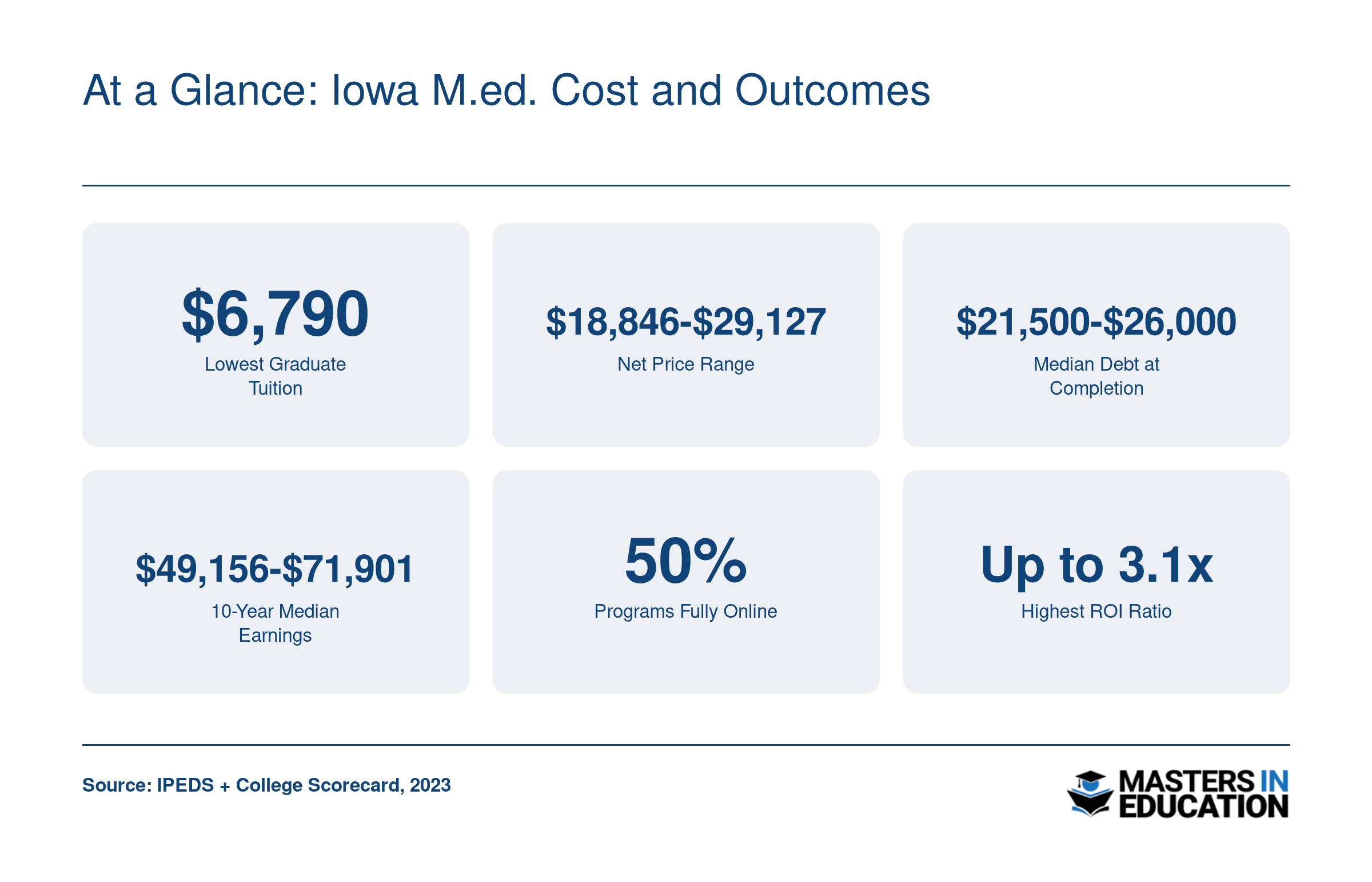
At a Glance: Iowa M.Ed. Cost and Outcomes
These figures offer a snapshot of what Iowa educators can expect when investing in a master's in education. From tuition to debt to long-term earnings, the numbers below are drawn from the ranked programs featured in this guide.
Online vs. On-Campus M.Ed. Programs in Iowa
Iowa educators can choose from fully online, hybrid, and on-campus M.Ed. formats, each with distinct trade-offs in flexibility, pacing, and networking. Most programs require 30 to 36 credit hours, but completion timelines vary significantly depending on whether an accelerated option is available. Here is how the major delivery formats compare across Iowa institutions.
| Feature | Fully Online | Hybrid | On-Campus |
|---|---|---|---|
| Representative Iowa Programs | Upper Iowa University, Northwestern College, Iowa State University, Buena Vista University, Dordt University | Drake University, Simpson College, Mount Mercy University, University of Northern Iowa | Iowa State University (M.A.T. in Mathematics Education) |
| Typical Credit Hours | 30 to 36 | 30 to 36 | 35 |
| Fastest Completion Timeline | 12 months (Upper Iowa, accelerated 8-week sessions) | 24 months (Drake, cohort-based) | 12 months (Iowa State M.A.T., summer start) |
| Standard Completion Timeline | 24 months at most programs | 24 to 36 months | 12 to 24 months |
| Session Format | 8-week terms common; 6-week accelerated summer sessions at Upper Iowa | Mix of Zoom or evening classes with periodic on-site meetings | Traditional 15-week semesters with clinical hours |
| Accelerated or Fast-Track Option | Yes: Upper Iowa (8-week sessions, summer acceleration); Dordt (14-month leadership track) | Not formally offered; UNI students can add summer courses to shorten timeline | Iowa State M.A.T. completes in 12 months with summer start |
| Best Fit For | Working teachers seeking maximum scheduling flexibility and self-paced study | Educators who want some face-to-face collaboration without a full commute | Career changers or full-time students who benefit from in-person clinical experiences |
| Networking and Mentorship | Virtual cohort interaction; Northwestern pairs students with practicing administrators | Cohort-based learning at Drake; evening and weekend peer sessions at Mount Mercy | Direct faculty mentorship and on-site school partnerships |
Questions to Ask Yourself
Iowa Licensure and Endorsement Paths for M.Ed. Graduates
Understanding how your M.Ed. connects to Iowa's licensure system is essential before you commit to a program. The Iowa Board of Educational Examiners (BOEE) is the state agency that governs teacher licensure, endorsement additions, and administrator credentials.1 Every program you consider should be approved by the BOEE, and every endorsement or license upgrade you pursue will ultimately flow through that office.
Initial Licensure vs. Endorsement Addition
Iowa M.Ed. programs generally serve two distinct audiences, and knowing which path applies to you will shape your entire search.
- Initial licensure programs are designed for career changers or individuals who hold a bachelor's degree but lack a teaching credential. These programs bundle a state-approved teacher preparation sequence, including student teaching, into a master's degree.2 Graduates earn both a degree and eligibility for Iowa's Initial Teaching License, which is valid for three years.1 Because the BOEE requires completion of a state-approved preparation program, enrolling in a non-approved program could leave you ineligible for licensure.
- Endorsement-addition programs are built for educators who already hold a valid Iowa license and want to add a content area or specialist role. Popular endorsement additions available through M.Ed. coursework include ESL/TESOL (K-12), Instructional Strategist I (mild/moderate), and Reading Specialist. The Reading Specialist endorsement specifically requires a master's degree.1 Endorsements can be added through completion of a BOEE-approved program or, in some cases, through transcript review.
Iowa's license structure progresses from Initial to Standard to Master Educator.1 The Master Educator Teaching License requires a master's degree related to education or your endorsement area plus at least five years of teaching experience, with six renewal credits required per cycle.3 Educators interested in the Instructional Strategist I endorsement may also want to explore masters in special education pathways, which often align with that credential.
How an M.Ed. Connects to Iowa's Salary Schedule
Most Iowa public school districts use a salary schedule with lanes based on degree level. Moving from the bachelor's column to the master's column typically triggers an annual pay increase. While the exact differential varies by district, educators in Iowa commonly see a bump in the range of $2,000 to $5,000 per year when they move to the master's lane, with the figure climbing in districts that offer additional steps for experience. Over a 20-plus-year career, that differential adds up significantly, making the degree a genuine financial investment rather than just a credential. For a broader look at how advanced degrees affect educator pay nationwide, see our guide to master's in education salary.
Before You Enroll: BOEE Approval Matters
Regardless of whether you are pursuing initial licensure or adding an endorsement, confirm that your chosen program holds BOEE-approved status.2 Programs offered by out-of-state or online institutions may or may not carry Iowa approval, and completing a non-approved program can create costly delays. Additionally, all Iowa licensure candidates must complete mandatory reporter training for child abuse identification and pass a background check.1 These are baseline requirements that apply across every pathway.
Popular M.Ed. Specializations Available in Iowa
Iowa institutions offer a wide range of M.Ed. specializations, from teaching licensure and educational leadership to gifted education and early childhood. The table below maps each specialization to a specific Iowa school, its delivery format, approximate graduate tuition, and key program details so you can quickly compare your options.
| Specialization | School | Delivery Format | Graduate Tuition | Credit Hours | Notable Details |
|---|---|---|---|---|---|
| Mathematics Education (M.A.T.) | Iowa State University | On Campus | $12,967 (in state) / $30,577 (out of state) | 35 | 12 month program; earns grades 5 to 12 teaching license; ideal for math, engineering, and CS graduates |
| Educational Leadership | Drake University | Hybrid (Zoom and on campus) | $12,825 | N/A | Cohort based; prepares for principal licensure; 70% of Iowa districts employ Drake trained administrators |
| School Leadership (M.Ed.) | Dordt University | Online | $10,990 | 30 | 14 month program; leads to Iowa Initial Administrator license; three start dates per year |
| Teaching (M.A.T.) | Simpson College | Hybrid | $9,204 | N/A | 17 concentration options; evening course format; leads to secondary teaching license; capstone and comprehensive exam required |
| Talented and Gifted / Teacher Leadership, Curriculum, and Instruction | Buena Vista University | Online | $9,061 | 30 | Five concentration options; no entrance exam; Iowa BOEE approved; designed for working teachers |
| Early Childhood Inclusive Classroom (M.A. in Education) | Mount Mercy University | Hybrid | $12,148 | N/A | Prepares for birth through grade 3; 12 credit hour core; evening, weekend, and summer class options |
| Educational Administration with Principal Endorsement | Northwestern College | Online | $6,790 ($360 per credit) | 34 | No entrance exam; rolling admissions; mentorship with practicing administrators; alumni grant covers first course tuition |
| Talented and Gifted (M.Ed.) | Upper Iowa University | Online | $20,185 ($355 per credit) | 36 | 11 concentration options; six start dates per year; TEACH grants up to $4,000; transfer up to 12 graduate credits |
Career Outcomes and Earnings for Iowa M.Ed. Graduates
Earning a master's in education in Iowa is not just a professional milestone. It is a financial decision with measurable returns over the course of a career. Understanding what you can expect to earn, and how a graduate degree shifts your salary trajectory, will help you weigh the investment with confidence.
What Iowa Teachers Earn Today
For the 2024, 2025 school year, Iowa teachers earned a mean annual wage of roughly $65,312, with a median starting salary around $48,139.1 That places Iowa slightly below the national median of approximately $67,000 for teachers, though the state's lower cost of living narrows the gap in practical terms.1 These figures represent all degree levels combined, so the picture changes once you isolate educators holding a master's degree.
The Master's Degree Salary Bump
Nationally, teachers with a master's degree earn about $14,500 more per year than their peers holding only a bachelor's degree.1 In the first year after completing an M.Ed., the typical salary increase is around $2,760.2 That figure grows over time as educators move through salary schedule steps, with annual raises averaging approximately $5,285 more than bachelor's-level peers would receive at comparable experience levels.2 At the top of the salary scale, the difference between a BA column and an MA column commonly ranges from $10,000 to $20,000 per year, depending on the district.2 Over a full career, these incremental differences can add up to an estimated $160,000 or more in additional earnings.2 For a broader look at how these gains compare across careers for masters in education, the salary advantage holds consistently in classroom, administrative, and specialist roles alike.
To see how this plays out in Iowa specifically, take these steps:
- Review district salary schedules: Large districts such as Des Moines, Cedar Rapids, and Iowa City publish their full salary schedules on district HR pages. Look for the BA and MA columns side by side at each experience step to calculate your projected increase.
- Consult the Iowa Teacher Salary Report: The Iowa Department of Education publishes an annual report breaking down average salaries by degree level. Search for "Iowa Teacher Salary Report" on the department's website for the most current data.
- Check BLS data for context: The Bureau of Labor Statistics publishes Occupational Employment Statistics for Iowa covering kindergarten through secondary teachers. You can filter by wage percentile to understand where you might fall, though BLS does not separate results by degree level.
- Reach out to the ISEA: The Iowa State Education Association and local teachers' unions often compile salary comparisons and advocacy materials that quantify the return on investment of advanced degrees in concrete, Iowa-specific terms.
Putting It All Together
The long-term financial case for a master's in education in Iowa is strongest for educators who plan to remain in the classroom or in district-level roles for a decade or more. The cumulative salary advantage grows each year, and many Iowa districts offer additional stipends for educators who hold advanced endorsements or take on leadership responsibilities that require a graduate degree. Before you enroll, pull up your target district's salary schedule, map your current step, and project your earnings over 10, 20, and 30 years with and without the MA column. That simple exercise will give you a personalized picture of what your M.Ed. is truly worth.
Iowa M.Ed. Earnings: 1-Year vs. 4-Year Post-Graduation
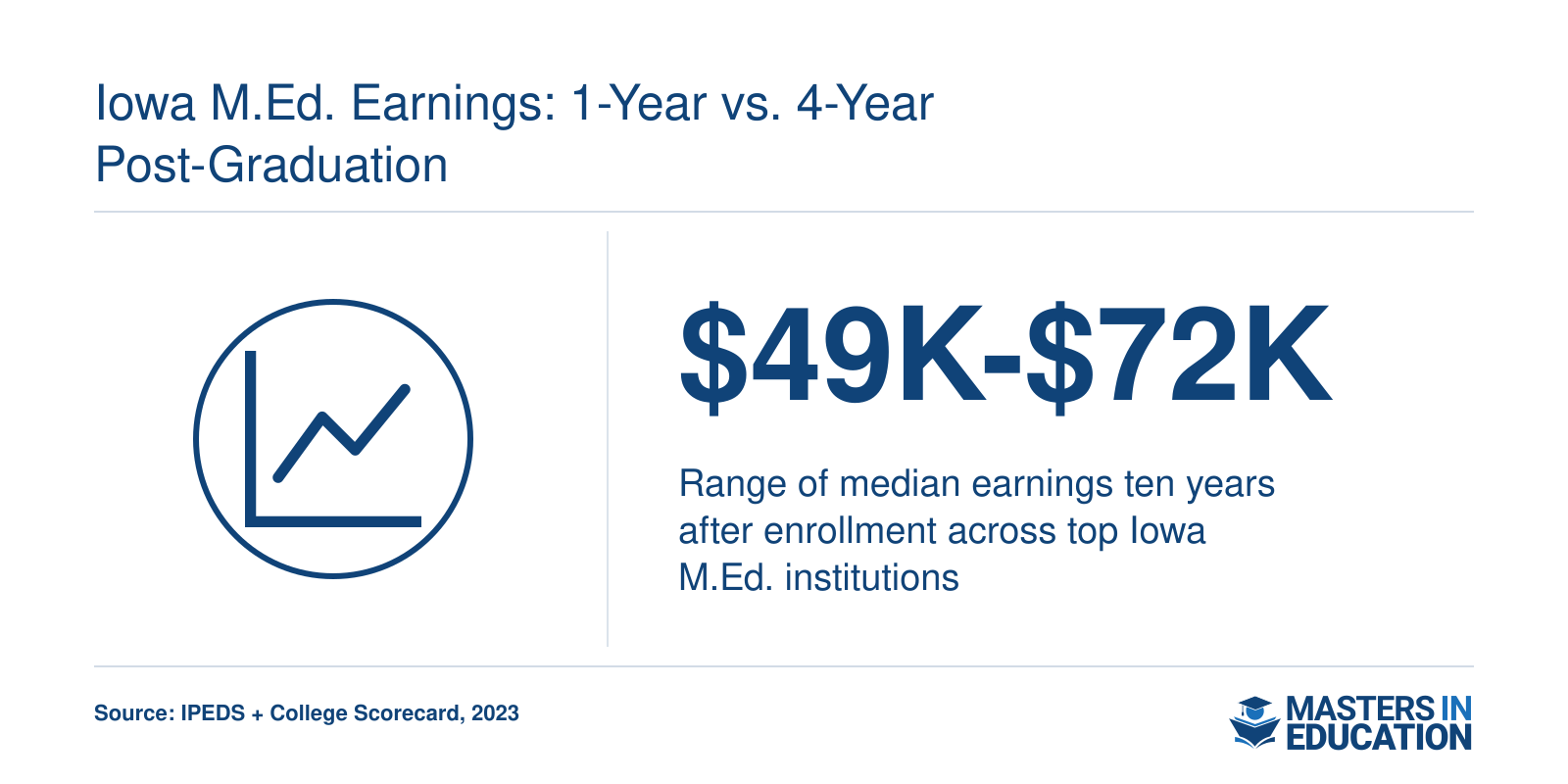
Program-level earnings data at the one-year and four-year marks after completion are not yet available for the top-ranked Iowa M.Ed. programs. Without verified salary figures at both time points, a side-by-side comparison would be misleading. However, institution-level data shows that median earnings ten years after enrollment range from roughly $49,000 to $72,000 across these schools, suggesting meaningful long-term salary growth for education graduates in Iowa.
Admission Requirements for Iowa M.Ed. Programs
Getting into an M.Ed. program in Iowa is generally straightforward for working educators, but requirements do vary from one institution to the next. Understanding what each program expects will help you prepare a strong application and avoid surprises.
GPA Thresholds
Most Iowa M.Ed. programs set a minimum undergraduate GPA somewhere between 2.75 and 3.0 on a 4.0 scale. The University of Iowa and Iowa State University, for example, both list a 3.0 minimum for their graduate education programs.12 Other institutions may accept applicants with a GPA as low as 2.75, sometimes with the condition that candidates demonstrate relevant professional experience or complete a provisional semester. If your GPA falls below the stated minimum, check whether the program offers conditional admission, as several Iowa schools do.
Standardized Test Policies
The trend across Iowa is clearly moving away from required entrance exams. The University of Iowa lists the GRE as optional for its M.Ed. programs, and Iowa State University's Higher Education M.Ed. does not require a standardized test at all.2 While policies can shift from year to year, the majority of Iowa programs have either dropped the GRE requirement or made it optional. Always confirm the current policy directly with the admissions office before assuming a test is not needed.
Teaching License and Experience
This is where programs diverge most significantly. Some M.Ed. tracks, particularly those tied to teaching licensure or curriculum and instruction concentrations, expect applicants to hold a valid teaching license and bring classroom experience. Others are designed to welcome career changers or professionals working in higher education, training, or related fields. Iowa State's M.Ed. in higher education, for instance, does not require a teaching license or prior teaching experience.2 Programs at Drake University and the University of Northern Iowa set their own thresholds for experience and credentials, so prospective students should review each program's requirements carefully.
Common Application Materials
Regardless of the institution, you can expect to submit a fairly standard set of documents:
- Official transcripts: From all undergraduate and any prior graduate coursework.
- Statement of purpose: A brief essay explaining your professional goals and reasons for pursuing the degree.
- Letters of recommendation: Typically two or three, with at least one from a professional supervisor or academic reference.
- Resume or CV: Highlighting your teaching, leadership, or other relevant experience.
Some programs may also request a writing sample or a brief interview, though this is less common at the master's level.
Application Deadlines
Deadlines vary by program and entry term. Iowa State's Higher Education M.Ed. accepts applications for fall (July 1), spring (November 1), and summer (March 1) starts.2 Other programs may have earlier priority deadlines, especially if financial aid or assistantship funding is involved. Plan to have your materials ready well in advance, as processing times for transcripts and recommendation letters can add weeks to the timeline.
How to Choose the Right M.Ed. Program in Iowa
Choosing the right M.Ed. program is less about finding the "best" school on paper and more about finding the best fit for your career goals, budget, and life. The most effective approach is goal-backward planning: start with where you want to end up, then work backward through the factors that matter most.
Start With Your Endorsement or Career Goal
Before comparing tuition rates or class schedules, identify the specific Iowa Board of Educational Examiners (BOEE) endorsement or career outcome you are pursuing. Whether you want to move into educational leadership, add a reading specialist endorsement, or deepen your expertise in curriculum and instruction, that target should drive every other decision. Once you know the endorsement or credential you need, filter your program list to only those that are BOEE-approved to deliver it. This single step eliminates guesswork and prevents you from investing in a program that does not lead to the license you want.
Evaluate Cost and Financial Support
Tuition varies considerably across Iowa institutions, so cross-reference the cost data from the tuition comparison earlier in this article with your own financial picture. Contact your district's human resources office to ask about tuition reimbursement policies, stipends for advanced degrees, or salary lane changes tied to a master's completion. Many Iowa districts offer partial or full reimbursement, and knowing your out-of-pocket cost upfront changes the calculus significantly.
Weigh Format and Flexibility
Consider whether an online, on-campus, or hybrid format fits your daily routine. If you are teaching full time, evening cohort models or fully online programs may be the most realistic options. If you value face-to-face mentorship and networking, a campus-based program could be worth the commute. Some programs also offer accelerated timelines that let you finish in as few as 18 months, while others spread coursework over two to three years for a lighter per-semester load.
Use a Decision Checklist
As you narrow your options, run each remaining program through these five filters:
- BOEE alignment: Does this program lead directly to the endorsement or licensure I need?
- Total cost: What is the full tuition after district reimbursement and financial aid?
- Format: Does the delivery method (online, campus, hybrid) work with my schedule?
- Specialization depth: Does the curriculum match my professional development goals?
- Time to completion: Can I finish within a timeline that fits my career plan?
A program that checks all five boxes is almost certainly a stronger choice than one that ranks higher on a list but fails on two or three.
Explore Specializations That Match Your Path
Iowa institutions offer M.Ed. concentrations ranging from curriculum and instruction to educational leadership, special education, and literacy coaching. If you are drawn to teacher leadership, dedicated guides break down what to expect from coursework, fieldwork requirements, and career trajectories. Exploring those resources is a practical next step once you have your short list ready.
Common Questions About Iowa M.Ed. Programs
Choosing a master's in education program raises practical questions about cost, format, and career impact. Below are answers to some of the most common questions prospective Iowa M.Ed. students ask, drawn from program details and data covered throughout this article.