
What you’ll learn in this article…
- A bachelor's degree is the standard entry requirement, though master's degrees accelerate advancement to manager roles.
- BLS projects about 11 percent job growth for training and development specialists from 2024 to 2034.
- Earning the CPTD or APTD certification from ATD signals credibility and can lead to higher salaries.
- Top paying metro areas cluster around tech hubs, federal agencies, and major corporate headquarters.
U.S. employers spent over $100 billion on workplace training in 2024, and the Bureau of Labor Statistics projects 11 percent job growth for training and development specialists through 2034. That combination of investment and demand has turned corporate learning into one of the more accessible career pivots for teachers, HR generalists, and instructional technologists looking to move into the private sector.
The role blends curriculum design, facilitation, and data analysis with tools like LMS platforms and e-learning authoring software. Yet breaking in requires navigating real trade-offs: which degree matters most, whether certifications like the CPTD justify their cost, and how dramatically salaries shift by geography. Median pay ranges from roughly $52,000 in lower-cost states to over $90,000 in top metro areas, a spread that shapes relocation and remote-work decisions alike.
What Does a Training and Development Specialist Do?
Training and development specialists design, deliver, and evaluate programs that help employees build the skills organizations need. The role sits at the intersection of education, human resources, and business strategy, making it an ideal career path for educators who want to apply instructional expertise in corporate, government, or nonprofit settings. It is one of several promising careers for masters in education graduates.
Core Responsibilities
Day to day, training and development specialists perform a range of tasks:
- Needs assessment: Analyzing workforce skill gaps through surveys, interviews, and performance data.
- Program design: Creating curricula, e-learning modules, workshops, and on-the-job training plans aligned with organizational goals.
- Facilitation: Leading in-person sessions, virtual webinars, and blended learning experiences.
- Evaluation: Measuring training effectiveness through assessments, feedback, and business outcome metrics.
- Stakeholder collaboration: Working with department managers, subject-matter experts, and HR leadership to align learning initiatives with strategic priorities.
How the Workplace Is Changing
Virtual delivery has reshaped this profession. While many training specialists still facilitate sessions on-site, a growing share of the work now happens through video conferencing platforms, learning management systems, and asynchronous digital content. Professionals who enjoy building those digital experiences may also want to explore what an e-learning designer does. According to recent workforce data, about 21 percent of human resources roles (the broader category that includes training specialists) are hybrid, roughly 3 percent are fully remote, and around 76 percent remain primarily on-site.1 Those figures mirror broader professional trends, where roughly 19 percent of all U.S. professional roles are hybrid and 4 percent are fully remote as of 2026.1
Travel expectations vary by employer. Specialists at companies with multiple locations may travel regularly to conduct workshops, while those at organizations with mature virtual training infrastructure may rarely leave their home office. Entry-level positions tend to have fewer remote or hybrid options (about 13 percent hybrid and 6 percent remote) compared to senior-level roles (20 percent hybrid and 8 percent remote).1
Where to Find Reliable, Up-to-Date Information
Because work arrangements and job duties continue to evolve, it pays to consult current sources before making career decisions:
- The Bureau of Labor Statistics Occupational Outlook Handbook for training and development specialists provides employment projections and, in some editions, telework percentages.
- The Association for Talent Development publishes annual State of the Industry reports that track virtual delivery trends and how organizations allocate training budgets.
- SHRM's annual Employee Benefits surveys often detail remote work policies and travel expectations for HR and training roles.
- LinkedIn's workforce insights and the career pages of large employers let you filter current job postings by remote, hybrid, or on-site status, giving you a real-time snapshot of what companies actually offer.
Reviewing these resources regularly will help you understand not just what training and development specialists do today, but how the role is likely to shift in the years ahead.
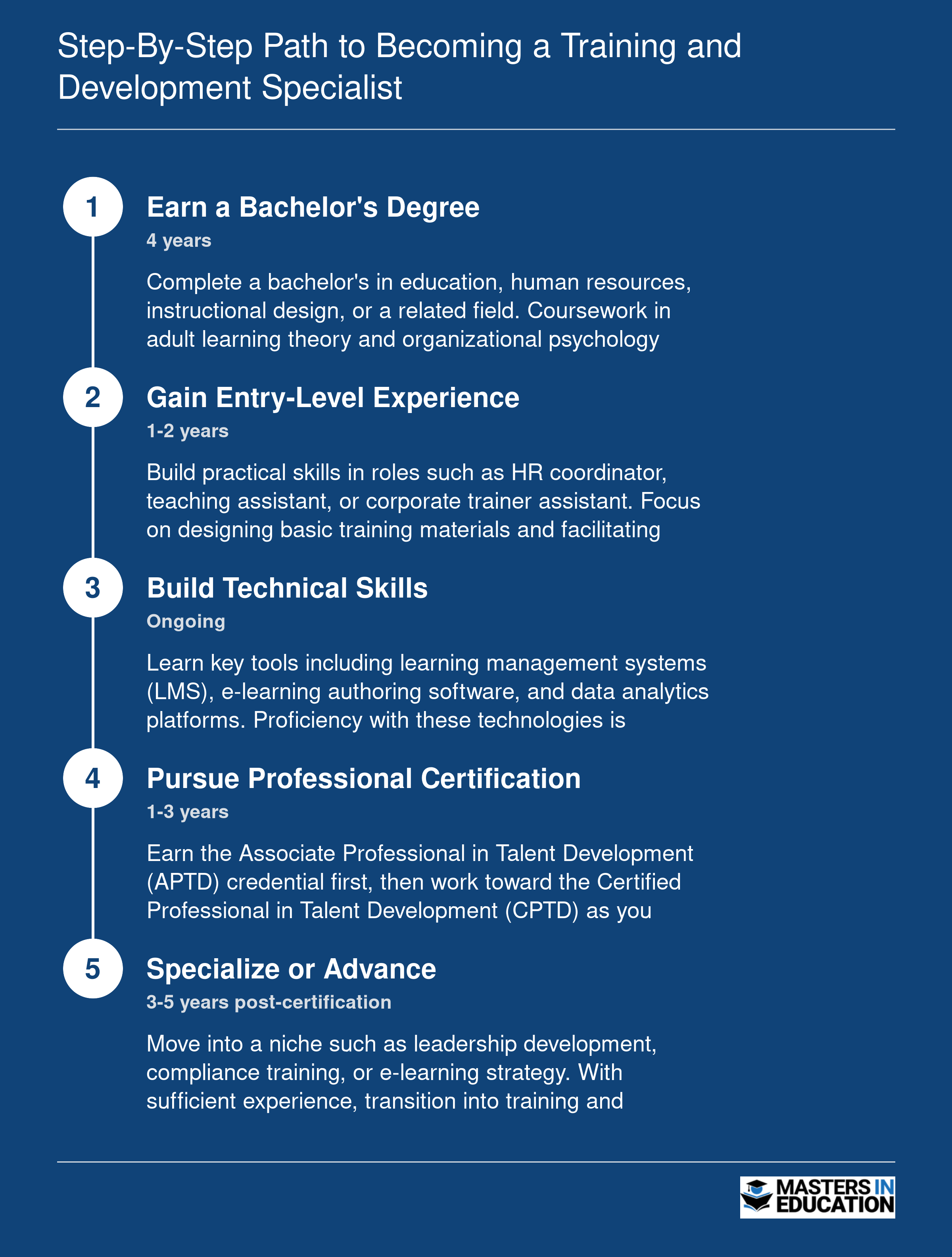
Step-by-Step Path to Becoming a Training and Development Specialist
Most training and development specialists follow a progressive career ladder that blends formal education, hands-on experience, and professional certification. The timeline below outlines the typical milestones and how long each stage takes.
Education Requirements and Best Degree Options
Most employers require a bachelor's degree to hire a training and development specialist, though the specific major can vary widely. The field draws professionals from several academic backgrounds, and understanding which degrees align best with employer expectations will help you plan a direct route into the career.
Common Bachelor's Degree Paths
Human resources, organizational development, education, communications, psychology, and business are the majors employers look for most often. Each of these disciplines builds a different piece of the training specialist skill set:
- Human resources or organizational development: Grounds you in workforce planning, needs assessment, and employee lifecycle management.
- Education: Builds strong curriculum design, lesson planning, and facilitation skills that translate directly to corporate training.
- Communications: Sharpens presentation, writing, and messaging abilities critical for developing learner-facing materials.
- Psychology: Provides insight into motivation, adult learning theory, and behavioral change.
- Business administration: Offers a broad understanding of operations, strategy, and the metrics organizations use to measure training ROI.
Any of these degrees can serve as a solid launchpad, so choose the one that aligns with your interests and the industry sector you want to work in.
When a Master's Degree Matters
A master's degree is not always required at the entry level, but it becomes increasingly valuable as you move toward senior or leadership positions. Programs in instructional design, adult education, organizational development, or human resource development deepen your expertise in learning theory, program evaluation, and strategic talent development. Many director and training manager job postings list a graduate degree as preferred or required. If you plan to lead a learning and development department or consult at the organizational level, earning a master's degree can meaningfully accelerate that trajectory. For a broader look at what advanced education unlocks, explore masters in education jobs.
Advice for Career Changers
Former K-12 teachers bring curriculum design, classroom facilitation, and assessment skills that map closely to corporate training work. The main gaps to fill are typically familiarity with business metrics, e-learning authoring tools, and adult learning frameworks that differ from K-12 pedagogy. Teachers who enjoy the design side of instruction may also want to consider how to become a curriculum developer as a related path. An HR generalist already has needs-assessment experience and organizational context but may need to build presentation and instructional design skills. In both cases, targeted coursework, a certificate program, or a focused master's degree can bridge those gaps efficiently.
Experience in Lieu of a Degree
Some employers, particularly in tech and at startups, accept equivalent professional experience instead of a specific degree. Three to five years in a dedicated training role, combined with a portfolio of programs you have designed and delivered, can satisfy hiring requirements at these organizations. That said, having a degree still broadens your options and may be non-negotiable at larger corporations, government agencies, and regulated industries. If you are building your career through experience alone, pairing that track record with a recognized certification can strengthen your candidacy considerably.
Questions to Ask Yourself
Certifications: CPTD, APTD, and More
Certification is not legally required to work as a training and development specialist, but it signals credibility to employers and can translate into a meaningful salary bump. If you already have several years of hands-on experience and a strong portfolio, you may land roles without a credential. However, if you are competing for senior positions, pivoting from a teaching career, or trying to stand out in a crowded applicant pool, a recognized certification is worth the investment.
ATD's Two-Tier System
The Association for Talent Development (ATD) offers the most widely recognized credentials in the field, structured as a clear progression.
APTD (Associate Professional in Talent Development)
Designed for early-career professionals, the APTD requires at least three years of work experience plus 28 hours of professional development in talent development.1 Candidates who hold an ATD Master designation can satisfy the professional development requirement through that pathway instead. The exam itself runs 120 minutes and contains 115 questions.2 Once earned, the APTD must be renewed every three years by accumulating 40 recertification points through continued learning and professional activity.3
CPTD (Certified Professional in Talent Development)
The CPTD targets experienced practitioners with a minimum of five years of relevant work experience and 60 hours of professional development.4 Multiple eligibility pathways exist, including a standard route, an ATD Master Series route, and a pathway for current APTD holders. The exam is more rigorous: 180 minutes long with 150 scored measurement opportunities that blend knowledge-based and scenario-based items.5 Renewal follows the same three-year cycle but requires 60 recertification points.3
A practical approach is to pursue the APTD once you hit the three-year mark, then upgrade to the CPTD after accumulating five or more years of experience. This builds your credentials incrementally without front-loading costs.
SHRM Credentials for HR-Adjacent Roles
If your position straddles human resources and learning and development, the SHRM Certified Professional (SHRM-CP) or SHRM Senior Certified Professional (SHRM-SCP) can carry equal or greater weight with hiring managers. These credentials emphasize workforce planning, employee relations, and compliance, areas that matter when your training work is embedded within an HR department. Only pursue a SHRM credential if a significant portion of your responsibilities falls on the HR side; otherwise, the ATD certifications align more directly with talent development competencies.
Niche and Vendor-Specific Certifications
Beyond ATD and SHRM, a few specialized credentials can strengthen a focused skill set.
- Certified Performance Technologist (CPT): Offered by the International Society for Performance Improvement (ISPI), the CPT recognizes professionals who apply a systematic, results-based approach to improving workplace performance. It suits specialists who lean heavily into performance consulting and gap analysis.
- Vendor-specific certifications: Platforms like Articulate (for e-learning authoring) and Cornerstone OnDemand (for learning management) offer their own certification programs. These are especially useful if your organization relies on a particular tool and you want to be the in-house expert. Professionals who build courses and digital learning experiences may also find value in exploring the educational technology specialist career path.
The bottom line: start with the APTD to establish professional credibility, aim for the CPTD as your career matures, and layer in SHRM or niche certifications only when they directly serve the work you do every day.
Essential Skills, Tools, and Software
Standing out as a training and development specialist in 2026 means building competence across three distinct categories: soft skills, e-learning authoring tools, and learning management system (LMS) platforms. Employers increasingly expect candidates to demonstrate capability in all three buckets, not just one.
Soft Skills That Drive Impact
Technology alone does not make a training program effective. The human-centered skills below remain central to the role:
- Needs assessment: Diagnosing performance gaps before designing any content.
- Facilitation: Leading live or virtual sessions that keep adult learners engaged.
- Instructional design thinking: Structuring learning objectives, assessments, and activities around proven frameworks.
- Data analysis: Reading completion rates, assessment scores, and dashboard reports in tools like Excel or Power BI to measure program effectiveness.
- Stakeholder communication: Translating learning outcomes into business language that managers and executives understand.
These competencies form the foundation. Without them, even the slickest digital course will miss the mark.
Authoring Tools Employers Request Most
When you scan job postings in corporate training, a handful of authoring platforms appear again and again:
- Articulate 360 (Storyline and Rise): The most frequently requested suite in employer listings. Storyline handles complex branching scenarios, while Rise enables rapid, responsive course creation.
- Adobe Captivate: Popular in organizations that already use the Adobe ecosystem, especially for software simulations and responsive content.
- TechSmith Camtasia: The go-to for screen recording and video-based tutorials, common in technical onboarding roles.
- iSpring Suite and Lectora: Both appear in postings, though less frequently. iSpring integrates tightly with PowerPoint, making it appealing for teams transitioning from slide-based training.
Familiarity with SCORM and xAPI standards is also expected, since these protocols govern how courses communicate with an LMS. Professionals who want to specialize further in course creation may find the elearning designer career path a natural complement to these authoring skills.
LMS Platforms: Enterprise vs. Mid-Market
Knowing your way around an LMS, from uploading content to pulling learner reports, is a practical requirement in most training roles.1 The platforms you encounter will depend on the size of the organization:
- Enterprise-scale: Cornerstone OnDemand and SAP SuccessFactors (including SAP Litmos) dominate large organizations with thousands of learners and complex compliance needs.
- Mid-market and growth-stage: Docebo, Absorb LMS, and 360Learning are widely adopted by mid-size companies that want a modern, AI-assisted learning experience.
- Budget-friendly and flexible: TalentLMS and Moodle serve smaller teams or organizations that need quick deployment without heavy IT overhead.
You do not need to master every platform, but understanding general LMS administration, including user management, reporting dashboards, and content uploads, makes you adaptable across employers.2 Those drawn to the broader intersection of technology and learning may also explore the educational technology specialist role.
Putting It All Together
Think of these three categories as overlapping circles. The soft skills help you figure out what to build. The authoring tools let you build it. The LMS ensures learners can access, complete, and be tracked through it. Candidates who can speak confidently about all three areas position themselves well above applicants who only check one box.
Related Articles
Training and Development Specialist Salary by State
Salaries for training and development specialists vary considerably depending on where you work. The table below ranks states by median annual wage, drawing from the latest Bureau of Labor Statistics data. High cost of living areas such as the District of Columbia, Washington state, and Connecticut tend to top the list, while states with lower living costs still offer competitive pay relative to regional norms.
| State | Total Employment | Median Annual Salary | 25th Percentile | 75th Percentile | Mean Annual Salary |
|---|---|---|---|---|---|
| District of Columbia | 1,930 | $84,460 | $70,800 | $102,510 | $89,560 |
| Wyoming | 820 | $83,450 | $54,650 | $94,260 | $76,990 |
| Washington | 9,270 | $82,910 | $61,550 | $108,780 | $92,210 |
| Connecticut | 3,310 | $79,660 | $53,040 | $104,650 | $85,040 |
| Delaware | 1,240 | $79,320 | $60,050 | $101,780 | $87,940 |
| New Jersey | 8,790 | $76,660 | $52,180 | $100,900 | $81,030 |
| Virginia | 15,290 | $76,250 | $56,050 | $100,500 | $81,200 |
| Minnesota | 8,760 | $75,980 | $60,920 | $97,040 | $80,390 |
| Alaska | 460 | $75,010 | $60,640 | $100,090 | $80,580 |
| New York | 25,510 | $73,550 | $53,300 | $99,430 | $79,360 |
| Massachusetts | 11,880 | $73,480 | $50,310 | $104,740 | $80,520 |
| Maryland | 8,680 | $73,220 | $46,350 | $98,380 | $75,700 |
| California | 44,750 | $72,930 | $49,460 | $101,760 | $82,040 |
| Colorado | 11,040 | $72,790 | $50,160 | $98,270 | $76,600 |
| Rhode Island | 1,250 | $72,600 | $51,490 | $105,820 | $84,380 |
| New Hampshire | 1,890 | $71,740 | $53,940 | $88,840 | $75,410 |
| Oregon | 4,850 | $70,320 | $55,070 | $92,300 | $78,090 |
| Maine | 1,630 | $67,420 | $57,120 | $85,550 | $75,830 |
| Vermont | 520 | $67,180 | $56,140 | $88,860 | $76,530 |
| Wisconsin | 10,600 | $66,990 | $54,560 | $83,230 | $71,870 |
| Arizona | 10,980 | $66,000 | $52,000 | $93,350 | $75,090 |
| Alabama | 2,750 | $65,520 | $49,720 | $84,250 | $71,650 |
| Florida | 30,380 | $65,010 | $46,080 | $93,860 | $72,640 |
| Kansas | 4,700 | $64,670 | $49,030 | $87,450 | $70,090 |
| Pennsylvania | 13,570 | $64,640 | $50,300 | $87,890 | $73,230 |
Highest-Paying Metro Areas for Training and Development Specialists
Geography plays a major role in earning potential for training and development specialists. Metro areas with large concentrations of tech companies, federal agencies, or corporate headquarters tend to offer the highest salaries. The table below ranks the top 15 metro areas by mean annual wage, based on the latest available data from the Bureau of Labor Statistics.
| Metro Area | Total Employment | Mean Annual Wage | Median Annual Wage | 25th Percentile | 75th Percentile |
|---|---|---|---|---|---|
| Seattle, Tacoma, Bellevue, WA | 6,060 | $100,250 | $92,710 | $68,660 | $124,540 |
| San Francisco, Oakland, Fremont, CA | 7,080 | $97,920 | $92,390 | $59,430 | $126,460 |
| Washington, Arlington, Alexandria, DC/VA/MD/WV | 11,120 | $86,310 | $82,330 | $57,190 | $106,460 |
| Boston, Cambridge, Newton, MA/NH | 9,040 | $83,990 | $77,750 | $55,960 | $109,070 |
| New York, Newark, Jersey City, NY/NJ | 21,340 | $83,720 | $78,720 | $53,990 | $102,910 |
| Minneapolis, St. Paul, Bloomington, MN/WI | 5,960 | $83,160 | $78,760 | $62,150 | $99,500 |
| Philadelphia, Camden, Wilmington, PA/NJ/DE/MD | 6,900 | $81,010 | $72,710 | $55,360 | $100,010 |
| Los Angeles, Long Beach, Anaheim, CA | 13,470 | $80,850 | $73,350 | $49,020 | $100,710 |
| Denver, Aurora, Centennial, CO | 7,000 | $78,140 | $75,290 | $51,180 | $98,610 |
| Miami, Fort Lauderdale, West Palm Beach, FL | 7,010 | $76,620 | $68,900 | $49,290 | $98,880 |
| Phoenix, Mesa, Chandler, AZ | 8,600 | $75,620 | $66,360 | $52,030 | $94,940 |
| Dallas, Fort Worth, Arlington, TX | 13,030 | $75,410 | $67,130 | $54,630 | $93,500 |
| Chicago, Naperville, Elgin, IL/IN | 10,930 | $73,070 | $65,030 | $47,560 | $93,470 |
| Atlanta, Sandy Springs, Roswell, GA | 13,120 | $72,750 | $65,100 | $57,570 | $83,490 |
| Houston, Pasadena, The Woodlands, TX | 8,950 | $72,430 | $64,600 | $47,850 | $89,180 |
The Bureau of Labor Statistics projects that employment for training and development specialists will grow by about 11 percent from 2024 to 2034, notably faster than the average for all occupations. That pace reflects rising employer demand for professionals who can design and deliver effective workplace learning programs across industries.
Job Outlook and Career Advancement Paths
The training and development field offers a clearly defined career ladder, and understanding each rung helps you plan your trajectory with realistic expectations for both timeline and compensation.
The Career Ladder at a Glance
Most professionals move through five recognizable stages, though individual timelines vary based on industry, geography, and educational credentials.
- Training Coordinator (0 to 2 years): This entry-level role focuses on logistics, scheduling sessions, tracking completions, and supporting senior specialists. Expect starting salaries in the range of $45,000 to $55,000.
- Training and Development Specialist (2 to 5 years): At this stage you design, deliver, and evaluate programs independently. The Bureau of Labor Statistics reports a median annual wage of roughly $65,850, while broader compensation data suggests total pay can reach the mid-$70,000s when bonuses and other compensation are included.12
- Senior Specialist or Training Manager (5 to 8 years): Senior specialists typically earn between roughly $90,000 and $105,000 in total pay. Those who move into management can see a significant jump; the BLS places the median for training and development managers at approximately $105,830, and total compensation packages at this level can reach $130,000 or more according to aggregated salary surveys.4
- Director of Learning and Development (8 to 12 years): Directors oversee enterprise-wide strategy, manage sizable budgets, and lead cross-functional teams. Total pay at this level generally falls between $160,000 and $210,000.
- VP of Talent Development (12-plus years): At the executive tier, compensation varies widely by company size but frequently exceeds $200,000, with total packages climbing well above that figure at large organizations.
Advancement beyond the specialist level often requires a master's degree in instructional design, human resource development, organizational leadership, or a related field. Reviewing masters in education salary data can help you weigh the return on that investment. Earning the Certified Professional in Talent Development (CPTD) credential is another common prerequisite for manager and director roles.
Lateral Moves Worth Considering
The skill set you build as a training and development specialist opens doors beyond a single career track. Common lateral pivots include instructional design, organizational development, HR business partner positions, and independent consulting. If content creation appeals to you, the curriculum developer path leverages many of the same competencies. Each of these directions draws on your expertise in adult learning, needs analysis, and program evaluation in a slightly different context.
What Is Driving Demand?
The BLS projects solid growth for training and development specialists over the coming decade, outpacing the average for all occupations. Three forces are accelerating that demand in 2026 and beyond. First, the rapid adoption of artificial intelligence across industries is creating urgent upskilling needs that organizations cannot ignore. Second, evolving regulatory environments continue to expand compliance training requirements. Third, the persistence of hybrid and remote work models means companies need specialists who can design effective virtual onboarding and continuous learning programs.
Taken together, these trends suggest that professionals who invest in the right credentials and stay current with emerging learning technologies will find no shortage of opportunities to advance.
Training and Development Specialist vs. Instructional Designer
These two roles operate in the same ecosystem, and their titles sometimes appear interchangeably on job boards. In practice, however, each role sits on a different side of the learning process.1 Understanding the distinction will help you target the right positions and build the right skill set.
Primary Focus
A training and development specialist centers on delivery and operations: facilitating sessions, running onboarding programs, conducting needs analyses, and evaluating whether training actually changed behavior on the job. An instructional designer, by contrast, focuses on creating the learning experience itself, producing storyboards, writing course content, building assessments, and structuring eLearning modules. Think of it this way: the instructional designer builds the materials; the training specialist brings them to life in front of learners and measures the results.
Daily Tasks and Core Tools
Training specialists spend much of their time coordinating schedules, leading workshops, managing a learning management system (LMS), generating completion reports, and presenting with tools like PowerPoint or Google Slides. Instructional designers work more independently, using authoring software, storyboarding tools, and design frameworks such as ADDIE or SAM to develop content from scratch. If you scan job postings, you will notice a pattern: training specialist listings lean on verbs like "facilitate," "coordinate," and "deliver," while instructional designer postings emphasize "design," "develop," "storyboard," and "author."1
Salary Ranges and Career Trajectory
Salaries overlap, though instructional designers tend to command a slightly higher range. Training and development specialists typically earn between $55,000 and $85,000, while instructional designers fall in the $62,000 to $92,000 band. On the advancement side, a training specialist often moves into an L&D Manager role overseeing an entire department's learning strategy, whereas an instructional designer may progress toward a Learning Architect position responsible for enterprise-wide curriculum frameworks.
Where the Lines Blur
At smaller organizations or startups, one person often handles both design and delivery. If you enjoy creating content and facilitating it, look for hybrid titles such as "Learning and Development Specialist" or "Training Designer." These combined roles are increasingly common and can be a strong entry point for career changers.
Guidance for Career Changers
Teachers transitioning out of the classroom frequently gravitate toward instructional design because the work mirrors curriculum developer responsibilities: mapping objectives, sequencing content, and writing assessments. Former facilitators, corporate coaches, and HR generalists tend to find a more natural fit in training specialist roles, where interpersonal delivery and real-time learner engagement are the core of the job. Those drawn to the technology side of learning design may also want to explore what an instructional coordinator does, since that role blends oversight of training materials with program-level strategy. If you are unsure which path suits you, consider volunteering for both types of projects in your current role to test your preference before committing to a credential or job search strategy.
Frequently Asked Questions
Below are answers to some of the most common questions prospective training and development specialists ask. Each response draws on current labor market data and industry standards to help you plan your next career move.
Explore Careers
- Child Development Specialist
- College Admissions Counselor
- Curriculum Developer
- District Administrator
- Diversity & Inclusion Coordinator
- Academic Advisor
- Adult Education Instructor
- Arts Educator
- Arts Integration Specialist
- E-Learning Designer
- Early Childhood Education Coordinator
- EdTech Specialist
- Educational Administrator
- Educational Psychologist
- Elementary School Teacher
- ESL Coordinator
- ESL Teacher